Attorney-Verified  Divorce Settlement Agreement Document for Michigan

Attorney-Verified Divorce Settlement Agreement Document for Michigan

The Michigan Divorce Settlement Agreement form is a legal document that outlines the terms and conditions agreed upon by both spouses during a divorce. This form addresses important issues such as property division, child custody, and support payments. To ensure a smooth process, it’s essential to fill out this form accurately and completely; click the button below to get started.

Article Guide

When navigating the complexities of divorce, having a clear and comprehensive Divorce Settlement Agreement form is essential for both parties involved. This document serves as a crucial roadmap for resolving various aspects of the divorce process, ensuring that each individual’s rights and responsibilities are clearly outlined. Key elements typically addressed in the form include the division of marital property and debts, child custody arrangements, visitation rights, and child support obligations. Additionally, spousal support, often referred to as alimony, may also be part of the agreement. By detailing these important factors, the Divorce Settlement Agreement not only helps to prevent future disputes but also provides a sense of closure for both parties. Understanding the components of this form can significantly ease the transition into post-divorce life, allowing individuals to move forward with clarity and confidence.

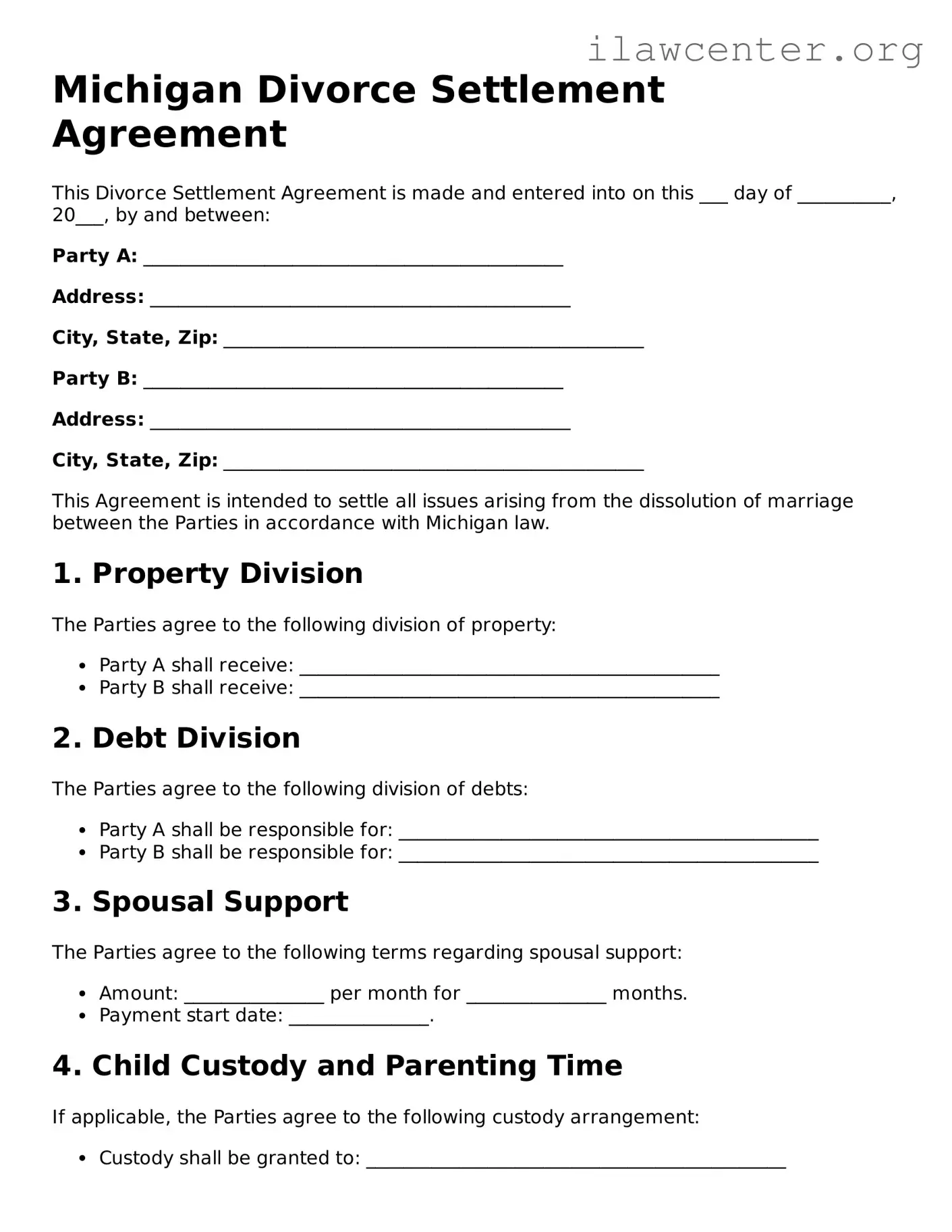
Michigan Divorce Settlement Agreement Preview

Michigan Divorce Settlement Agreement

This Divorce Settlement Agreement is made and entered into on this ___ day of __________, 20___, by and between:

Party A: _____________________________________________

Address: _____________________________________________

City, State, Zip: _____________________________________________

Party B: _____________________________________________

Address: _____________________________________________

City, State, Zip: _____________________________________________

This Agreement is intended to settle all issues arising from the dissolution of marriage between the Parties in accordance with Michigan law.

1. Property Division

The Parties agree to the following division of property:

  • Party A shall receive: _____________________________________________
  • Party B shall receive: _____________________________________________

2. Debt Division

The Parties agree to the following division of debts:

  • Party A shall be responsible for: _____________________________________________
  • Party B shall be responsible for: _____________________________________________

3. Spousal Support

The Parties agree to the following terms regarding spousal support:

  • Amount: _______________ per month for _______________ months.
  • Payment start date: _______________.

4. Child Custody and Parenting Time

If applicable, the Parties agree to the following custody arrangement:

  • Custody shall be granted to: _____________________________________________
  • Parenting time shall be as follows: _____________________________________________

5. Child Support

The Parties agree to the following child support terms:

  • Amount: _______________ per month.
  • Payment start date: _______________.

6. Miscellaneous

The Parties agree to the following additional terms:

  • _____________________________________________________________________
  • _____________________________________________________________________

This Agreement represents the entire understanding between the Parties regarding the matters addressed herein. It supersedes all prior discussions or agreements.

IN WITNESS WHEREOF, the Parties have executed this Agreement as of the date first above written.

Party A Signature: ___________________________ Date: _______________

Party B Signature: ___________________________ Date: _______________

PDF Form Characteristics

Fact Name Description
Governing Law The Michigan Divorce Settlement Agreement is governed by Michigan state law, specifically the Michigan Compiled Laws (MCL) 552.6.
Purpose This form outlines the terms agreed upon by both parties regarding the division of assets, debts, and other relevant matters during a divorce.
Mutual Agreement Both spouses must voluntarily agree to the terms laid out in the settlement agreement for it to be valid.
Filing Requirement The completed agreement must be filed with the court as part of the divorce proceedings.
Child Custody and Support If children are involved, the agreement must address child custody arrangements and child support obligations.
Spousal Support The agreement can include provisions for spousal support, also known as alimony, if applicable.
Modification Once finalized, the terms of the agreement can be modified, but both parties must consent to any changes.
Legal Advice It is highly recommended that both parties seek independent legal advice before signing the agreement to ensure their rights are protected.

Instructions on Utilizing Michigan Divorce Settlement Agreement

After completing the Michigan Divorce Settlement Agreement form, the next step involves submitting it to the appropriate court. This document is crucial for finalizing the terms of the divorce, including asset division, child custody, and support arrangements. Make sure to review all information for accuracy before submission.

  1. Begin by downloading the Michigan Divorce Settlement Agreement form from the official state website or obtaining a physical copy from the local courthouse.
  2. Fill in the names of both parties at the top of the form. Ensure that the names match those on the divorce petition.
  3. Provide the date of marriage and the date of separation. This information is essential for establishing the timeline of the marriage.
  4. List all assets and debts acquired during the marriage. Be thorough in detailing property, bank accounts, vehicles, and any liabilities.
  5. Detail the proposed division of assets and debts. Clearly state which party will receive each item and how debts will be handled.
  6. Address any child custody arrangements if children are involved. Specify the living arrangements, visitation schedules, and decision-making responsibilities.
  7. Include child support and spousal support provisions, if applicable. State the amount and frequency of payments clearly.
  8. Sign and date the form at the bottom. Both parties must sign to indicate their agreement to the terms outlined in the document.
  9. Make copies of the completed form for both parties and retain a copy for personal records.
  10. File the original form with the court clerk in the county where the divorce was filed. Pay any required filing fees.

Important Facts about Michigan Divorce Settlement Agreement

What is a Michigan Divorce Settlement Agreement?

A Michigan Divorce Settlement Agreement is a legal document that outlines the terms of a divorce between two parties. It typically includes provisions related to the division of assets and debts, child custody and support, and alimony. This agreement serves to clarify the rights and responsibilities of each party post-divorce and is often submitted to the court for approval as part of the divorce proceedings.

How do I create a Divorce Settlement Agreement in Michigan?

Creating a Divorce Settlement Agreement involves several steps. First, both parties should gather all relevant financial information, including income, expenses, assets, and debts. Next, discussions should take place to negotiate terms that are acceptable to both parties. It may be beneficial to consult with a legal professional to ensure that the agreement complies with Michigan law and adequately protects both parties' interests. Once an agreement is reached, it should be documented in writing and signed by both parties.

Is a Divorce Settlement Agreement legally binding in Michigan?

Yes, a Divorce Settlement Agreement is legally binding in Michigan once it has been signed by both parties and approved by the court. This means that both parties are obligated to adhere to the terms outlined in the agreement. If one party fails to comply, the other party may seek enforcement through the court system. It is essential to ensure that the agreement is comprehensive and fair to minimize disputes in the future.

What happens if we cannot agree on the terms of the Divorce Settlement Agreement?

If the parties cannot reach an agreement on the terms of the Divorce Settlement Agreement, they may need to consider alternative dispute resolution methods, such as mediation or arbitration. These processes involve a neutral third party who can facilitate discussions and help the parties find common ground. If these efforts fail, the case may proceed to court, where a judge will make decisions regarding the divorce terms based on the evidence presented.

Common mistakes

Filling out the Michigan Divorce Settlement Agreement form can be a daunting task. Many individuals make common mistakes that can lead to complications down the line. Understanding these pitfalls can help ensure a smoother process.

One frequent mistake is failing to provide complete information. It’s essential to fill out every section of the form thoroughly. Incomplete forms can delay the divorce process and may require additional court appearances to rectify issues.

Another common error is not being specific about asset division. Vague descriptions of property and debts can lead to misunderstandings later. Clearly identifying each asset and its value helps avoid disputes and ensures both parties are on the same page.

Many people also overlook the importance of including all relevant debts. It’s not just about dividing assets; debts must be addressed as well. Failing to account for debts can result in one party being unfairly burdened with financial obligations.

Additionally, some individuals forget to consider tax implications when dividing assets. Certain assets, like retirement accounts, can have tax consequences that affect their value. Consulting with a financial advisor can provide clarity on these issues.

Another mistake is neglecting to outline child custody and support arrangements clearly. These provisions are critical for the well-being of children involved. Ambiguities in custody agreements can lead to conflicts and additional court interventions.

Inaccurate calculations of child support payments are also a common issue. Many people miscalculate income or fail to account for necessary expenses. Using the Michigan Child Support Formula can help ensure that calculations are fair and accurate.

Finally, some individuals fail to seek legal advice before finalizing the agreement. Even if both parties seem amicable, having a legal professional review the settlement can help identify potential issues and protect one’s rights.

Documents used along the form

When navigating a divorce in Michigan, several important documents often accompany the Divorce Settlement Agreement. Each of these forms plays a crucial role in ensuring that the process runs smoothly and that all parties understand their rights and responsibilities.

  • Complaint for Divorce: This document initiates the divorce process. It outlines the reasons for the divorce and provides basic information about the parties involved, including any children.
  • Parenting Plan: If children are involved, a parenting plan is essential. It details custody arrangements, visitation schedules, and how decisions regarding the children will be made.
  • Financial Affidavit: This form provides a comprehensive overview of each party's financial situation. It includes income, expenses, assets, and debts, helping the court make informed decisions regarding support and division of property.
  • Judgment of Divorce: This is the final document issued by the court that officially ends the marriage. It outlines the terms agreed upon in the settlement, including asset division, support, and custody arrangements.

Understanding these documents can help individuals feel more prepared as they go through the divorce process. Each form serves a specific purpose and contributes to a fair resolution for all parties involved.

Similar forms

  • Separation Agreement: This document outlines the terms of separation between spouses, similar to a Divorce Settlement Agreement. It covers issues like property division, child custody, and support, but is used when couples are not yet divorced.
  • Child Custody Agreement: This agreement specifically addresses the custody arrangements for children. Like a Divorce Settlement Agreement, it aims to ensure the best interests of the child while detailing parental responsibilities and visitation rights.
  • Property Settlement Agreement: This document focuses on the division of marital property and debts. It shares similarities with a Divorce Settlement Agreement in that it provides a clear outline of how assets will be divided upon divorce.
  • Alimony Agreement: This agreement specifies the terms of spousal support. Like a Divorce Settlement Agreement, it details the amount and duration of support payments, ensuring both parties understand their financial obligations.
  • Marital Settlement Agreement: This document serves as a comprehensive resolution of all issues related to the marriage dissolution. It encompasses elements found in a Divorce Settlement Agreement, such as custody, support, and property division.
  • Final Judgment of Divorce: This court document finalizes the divorce process. While it is a legal decree, it often incorporates the terms agreed upon in the Divorce Settlement Agreement, making them enforceable by law.

Dos and Don'ts

When filling out the Michigan Divorce Settlement Agreement form, it’s essential to approach the process with care. Here are some important dos and don’ts to keep in mind:

  • Do read the entire form carefully before starting. Understanding each section will help you provide accurate information.
  • Don’t rush through the process. Taking your time can prevent mistakes that may delay your divorce.
  • Do be honest about your assets and liabilities. Full disclosure is crucial in ensuring a fair settlement.
  • Don’t leave any sections blank unless instructed. Incomplete forms can lead to complications or rejections.
  • Do seek legal advice if you have questions. A knowledgeable attorney can guide you through the complexities of the agreement.
  • Don’t ignore deadlines. Submitting your form on time is vital to keep the divorce process moving smoothly.

Misconceptions

When navigating the Michigan Divorce Settlement Agreement form, individuals may encounter several misconceptions. Understanding these can help ensure a smoother process during an already challenging time.

  • The form is only for couples with children. Many believe that the Divorce Settlement Agreement is necessary only if children are involved. However, this form is essential for any couple seeking to finalize their divorce, regardless of whether children are part of the equation.
  • Once signed, the agreement cannot be changed. Some individuals think that after signing the agreement, it is set in stone. In reality, modifications can be made if both parties agree to the changes. It is important to communicate openly about any concerns or new circumstances that may arise.
  • The agreement covers everything related to the divorce. While the Divorce Settlement Agreement addresses key issues like property division and spousal support, it does not encompass every aspect of the divorce. Additional documents may be necessary to address specific legal matters, such as child custody arrangements.
  • Legal representation is not necessary. A common misconception is that individuals can navigate the form without legal assistance. While it is possible to complete the form independently, having legal guidance can provide clarity and ensure that all necessary details are accurately captured.
  • Filling out the form guarantees a quick divorce. Many believe that simply completing the Divorce Settlement Agreement will expedite the divorce process. However, the timeline for finalizing a divorce can vary based on court schedules and other factors. Patience and understanding are crucial during this time.

By addressing these misconceptions, individuals can approach the Michigan Divorce Settlement Agreement with a clearer understanding, ultimately leading to a more informed and less stressful experience.

Key takeaways

When filling out and using the Michigan Divorce Settlement Agreement form, keep the following key takeaways in mind:

  • Ensure all information is accurate and complete. Mistakes or omissions can delay the process.
  • Both parties must agree on the terms outlined in the agreement. This includes division of assets, debts, and custody arrangements.
  • Review the form carefully before submission. It’s important to understand all terms and conditions agreed upon.
  • Consider seeking legal advice. A lawyer can help clarify complex issues and ensure that your rights are protected.
  • Once signed, the agreement becomes a binding contract. Both parties are expected to adhere to its terms.