Attorney-Verified  Employee Handbook Document for Michigan

Attorney-Verified Employee Handbook Document for Michigan

The Michigan Employee Handbook form serves as a vital document that outlines the policies, procedures, and expectations within a workplace. This handbook helps ensure that both employers and employees are on the same page regarding workplace rules and employee rights. To get started on creating your own Employee Handbook, fill out the form by clicking the button below.

Article Guide

When it comes to setting clear expectations and fostering a positive workplace culture, the Michigan Employee Handbook form plays a crucial role. This document serves as a comprehensive guide for employees, outlining important policies, procedures, and benefits that govern their employment. It typically includes sections on company values, code of conduct, attendance policies, and employee rights. Additionally, it addresses issues such as workplace safety, anti-discrimination policies, and procedures for reporting grievances. By providing this information, the handbook not only helps employees understand their responsibilities but also ensures they are aware of the resources available to them. A well-structured employee handbook is not just a legal requirement; it is a valuable tool for communication and engagement within the organization. Overall, the Michigan Employee Handbook form is essential for creating a transparent and supportive work environment.

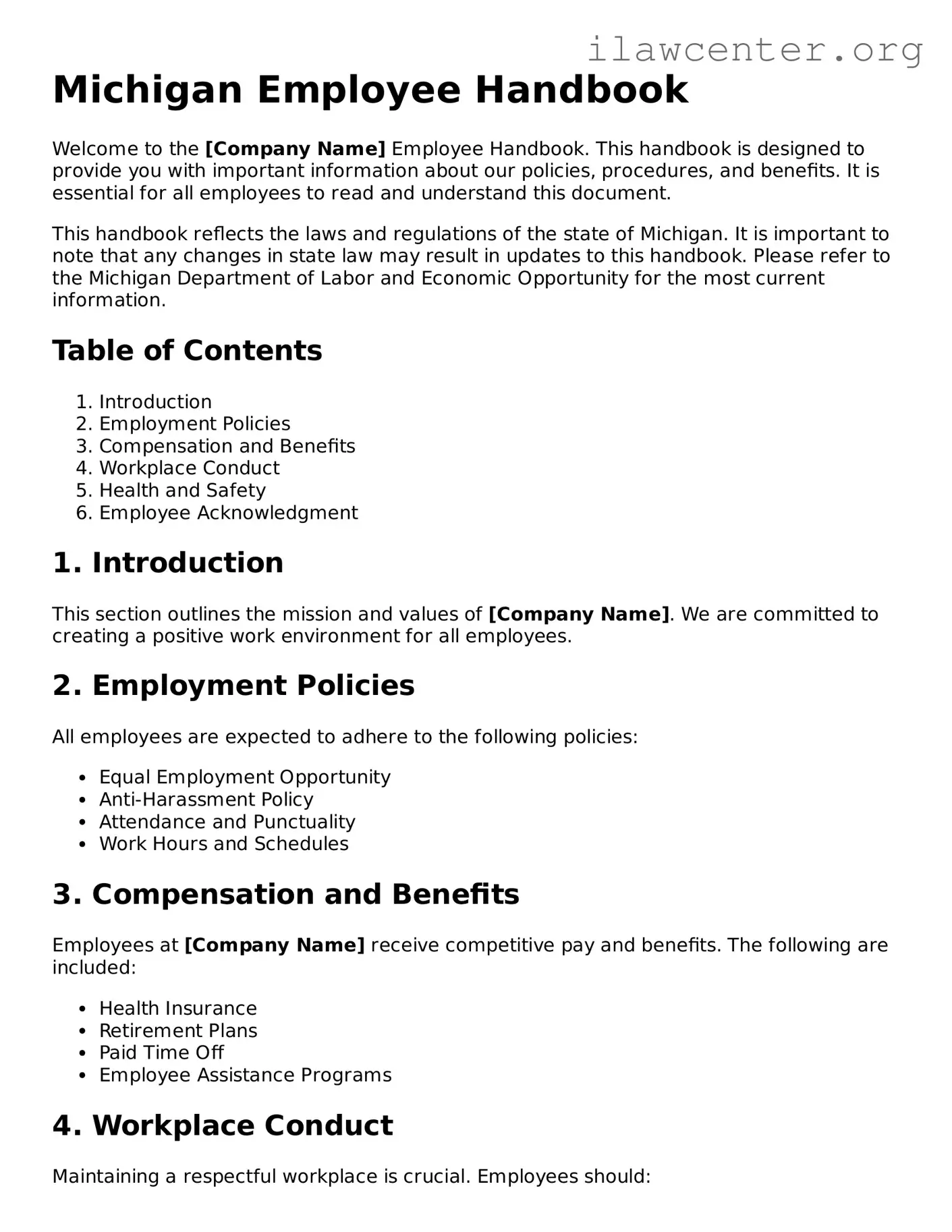
Michigan Employee Handbook Preview

Michigan Employee Handbook

Welcome to the [Company Name] Employee Handbook. This handbook is designed to provide you with important information about our policies, procedures, and benefits. It is essential for all employees to read and understand this document.

This handbook reflects the laws and regulations of the state of Michigan. It is important to note that any changes in state law may result in updates to this handbook. Please refer to the Michigan Department of Labor and Economic Opportunity for the most current information.

Table of Contents

  1. Introduction
  2. Employment Policies
  3. Compensation and Benefits
  4. Workplace Conduct
  5. Health and Safety
  6. Employee Acknowledgment

1. Introduction

This section outlines the mission and values of [Company Name]. We are committed to creating a positive work environment for all employees.

2. Employment Policies

All employees are expected to adhere to the following policies:

  • Equal Employment Opportunity
  • Anti-Harassment Policy
  • Attendance and Punctuality
  • Work Hours and Schedules

3. Compensation and Benefits

Employees at [Company Name] receive competitive pay and benefits. The following are included:

  • Health Insurance
  • Retirement Plans
  • Paid Time Off
  • Employee Assistance Programs

4. Workplace Conduct

Maintaining a respectful workplace is crucial. Employees should:

  • Communicate respectfully with colleagues.
  • Follow the dress code.
  • Report any misconduct to management.

5. Health and Safety

We prioritize the health and safety of our employees. Please be aware of the following:

  • Emergency procedures.
  • Reporting workplace injuries.
  • Maintaining a clean work environment.

6. Employee Acknowledgment

All employees must sign an acknowledgment form indicating they have read and understood this handbook. Please complete the following:

Name: [Employee Name]

Date: [Date]

Thank you for being a part of [Company Name]. We look forward to working together to achieve our goals!

PDF Form Characteristics

Fact Name Description
Purpose The Michigan Employee Handbook serves as a guide for employees, outlining company policies, procedures, and expectations.
Legal Requirement While not mandated by law, having an employee handbook is highly recommended to clarify workplace rules and protect against legal issues.
Governing Laws The handbook should comply with Michigan labor laws, including the Michigan Employment Security Act and the Elliott-Larsen Civil Rights Act.
Updates Regular updates are essential to ensure compliance with changing laws and to reflect any modifications in company policies.

Instructions on Utilizing Michigan Employee Handbook

Filling out the Michigan Employee Handbook form is an important step in ensuring that you understand your rights and responsibilities as an employee. Follow these steps carefully to complete the form accurately.

  1. Start by downloading the Michigan Employee Handbook form from the official website or request a copy from your HR department.
  2. Open the form and read through the instructions provided to familiarize yourself with the required information.
  3. Begin filling in your personal information at the top of the form, including your full name, job title, and department.
  4. Provide your employee identification number, if applicable, in the designated section.
  5. Review the sections regarding company policies, procedures, and benefits. Take notes if necessary.
  6. Sign and date the form in the appropriate area to confirm your understanding and agreement.
  7. Submit the completed form to your HR representative or the designated department as instructed.

After submitting the form, you will receive confirmation from your HR department. They may provide you with additional information regarding your employee rights and responsibilities.

Important Facts about Michigan Employee Handbook

What is the Michigan Employee Handbook form?

The Michigan Employee Handbook form is a document that outlines the policies, procedures, and expectations of an employer regarding employee conduct and rights. It serves as a guide for employees to understand their roles, responsibilities, and the company's standards. This handbook is essential for fostering a positive work environment and ensuring compliance with state and federal laws.

Why is it important for employees to read the Employee Handbook?

Reading the Employee Handbook is crucial for employees as it provides essential information about workplace policies, benefits, and procedures. Understanding these guidelines helps employees navigate their work environment effectively. It also clarifies what is expected of them and what they can expect from their employer, promoting transparency and accountability.

How often should the Employee Handbook be updated?

The Employee Handbook should be reviewed and updated regularly, typically at least once a year. Changes in laws, company policies, or organizational structure may necessitate updates. Keeping the handbook current ensures that employees have the most accurate information and that the company remains compliant with legal requirements.

What should employees do if they have questions about the handbook?

If employees have questions about the Employee Handbook, they should feel encouraged to reach out to their supervisor or the Human Resources department. Open communication is vital. HR is there to clarify any uncertainties and provide additional context regarding policies and procedures outlined in the handbook.

Are there any legal requirements for the Employee Handbook in Michigan?

Yes, there are legal requirements that must be considered when creating an Employee Handbook in Michigan. The handbook should include information about workplace rights, anti-discrimination policies, and workplace safety. Employers should ensure that their handbook complies with both state and federal laws to protect their employees and themselves.

Can the Employee Handbook be used in legal disputes?

The Employee Handbook can serve as an important reference in legal disputes. If a disagreement arises regarding workplace policies or employee rights, the handbook can provide clarity on what was expected of both parties. However, it is essential that the handbook is well-written and accurately reflects the company's policies to be effective in such situations.

What happens if an employee does not sign the acknowledgment of the Employee Handbook?

If an employee does not sign the acknowledgment form indicating that they have received and understood the Employee Handbook, it may lead to complications. Employers often require this acknowledgment to ensure that employees are aware of the policies. However, it is still the responsibility of the employer to ensure that the employee has access to the handbook and understands its contents, regardless of the signed acknowledgment.

Is the Employee Handbook the same for all employees?

Generally, the Employee Handbook is the same for all employees, but there may be variations based on specific roles or departments. Certain positions may have additional policies or guidelines that pertain to their unique responsibilities. Employers should communicate any differences clearly to ensure that all employees understand the expectations relevant to their roles.
Common mistakes

Filling out the Michigan Employee Handbook form can seem straightforward, but many people make common mistakes that can lead to confusion or even issues later on. One frequent error is not reading the instructions carefully. Each section of the form has specific requirements. Skipping this step can result in incomplete or incorrect submissions.

Another mistake is failing to provide accurate personal information. This includes your name, address, and contact details. If any of this information is incorrect, it can create problems when the employer tries to reach you or when you need to access your records.

Some individuals overlook the importance of signing and dating the form. Without a signature, the form may be considered invalid. Dates are equally important, as they establish when you acknowledged the handbook and its policies.

People often neglect to check for updates or changes in the handbook before filling out the form. Employers may revise policies, and being unaware of these changes can lead to misunderstandings about your rights and responsibilities.

Additionally, many fail to ask questions when they don’t understand a section. It’s important to seek clarification on any point that seems unclear. Ignoring these questions can lead to misinterpretations that affect your employment.

Another common issue is not keeping a copy of the completed form. Retaining a copy can be crucial if any disputes arise in the future. It serves as proof that you have acknowledged the policies set forth by your employer.

Finally, some people rush through the process without taking the time to review their answers. A quick review can catch typos or mistakes that might otherwise go unnoticed. Taking a moment to double-check can save a lot of hassle down the road.

Documents used along the form

When creating an employee handbook in Michigan, there are several other important documents that can support the handbook and help clarify workplace policies. These documents ensure that both employers and employees understand their rights and responsibilities. Below are five forms and documents often used alongside the Michigan Employee Handbook.

  • Employment Application: This form collects essential information from job applicants. It typically includes personal details, work history, and references. This document helps employers assess candidates for job openings.
  • Job Description: A job description outlines the duties, responsibilities, and qualifications for a specific position. It helps employees understand what is expected of them and provides a basis for performance evaluations.
  • Employee Agreement: This document is a contract between the employer and employee. It often includes terms of employment, confidentiality clauses, and non-compete agreements. It protects both parties by clearly defining the relationship.
  • Performance Review Form: This form is used to evaluate an employee's job performance. It typically includes criteria for assessment and allows for feedback. Regular performance reviews can help employees improve and grow in their roles.
  • Termination Notice: This document is issued when an employee's employment is ended. It outlines the reasons for termination and any final pay or benefits. Providing a termination notice ensures clarity and helps maintain professionalism.

These documents work together with the employee handbook to create a comprehensive understanding of workplace policies and expectations. By utilizing these forms, employers can foster a transparent and organized work environment.

Similar forms

When considering the Employee Handbook, it’s helpful to recognize its similarities with other important documents that guide workplace policies and procedures. Here are four documents that share common ground with the Employee Handbook:

  • Company Policies and Procedures Manual: This document outlines specific policies that govern employee behavior and operational procedures. Like the Employee Handbook, it serves as a reference for employees to understand what is expected of them and what they can expect from the company.
  • Onboarding Guide: An onboarding guide helps new hires acclimate to the company culture and processes. Similar to the Employee Handbook, it provides essential information about the organization, including its values, mission, and key policies, ensuring that employees start off on the right foot.
  • Code of Conduct: The Code of Conduct establishes the ethical standards and expectations for employee behavior. Much like the Employee Handbook, it serves to create a safe and respectful workplace by clearly defining acceptable and unacceptable behaviors.
  • Employee Agreement or Contract: This document outlines the terms of employment, including job responsibilities, compensation, and benefits. Similar to the Employee Handbook, it sets clear expectations for both the employee and the employer, fostering a mutual understanding of the working relationship.

Dos and Don'ts

When filling out the Michigan Employee Handbook form, it is important to approach the task with care and attention to detail. Here are some guidelines to help ensure the process goes smoothly.

  • Do read the entire handbook before starting the form. Understanding the policies will help you fill it out accurately.
  • Do provide accurate personal information. Double-check names, addresses, and contact details.
  • Do ask questions if something is unclear. Reaching out to HR can clarify any doubts.
  • Do keep a copy of the completed form for your records. This can be useful for future reference.
  • Don't rush through the form. Taking your time can prevent mistakes that may need correction later.
  • Don't leave any required fields blank. Incomplete forms may delay processing.
  • Don't use jargon or abbreviations that may not be understood. Clear communication is key.
  • Don't ignore the deadlines for submission. Timeliness is crucial in the onboarding process.

Misconceptions

Misconceptions about the Michigan Employee Handbook form can lead to confusion among employers and employees alike. Here are eight common misconceptions explained:

  1. Employee Handbooks are optional.

    Many believe that having an employee handbook is not necessary. However, a well-crafted handbook can serve as a vital communication tool, outlining company policies and expectations.

  2. All handbooks must be the same.

    Some think that there is a one-size-fits-all handbook template. In reality, each handbook should be tailored to reflect the specific culture, policies, and legal requirements of the organization.

  3. Handbooks can include any policy.

    While it is tempting to include all policies, not every policy is appropriate for an employee handbook. Policies must comply with state and federal laws to avoid potential legal issues.

  4. Handbooks are legally binding contracts.

    Many assume that an employee handbook creates a contract between the employer and employee. Generally, handbooks are considered guidelines rather than enforceable agreements unless explicitly stated otherwise.

  5. Once created, handbooks do not need updates.

    Some believe that a handbook is a one-time effort. In fact, handbooks should be reviewed and updated regularly to reflect changes in laws, regulations, and company policies.

  6. Employees will read the handbook thoroughly.

    It is a common misconception that employees will read and understand the handbook. Employers should encourage discussions and training sessions to ensure comprehension of key policies.

  7. Handbooks can eliminate all legal risks.

    While a handbook can mitigate risks, it cannot eliminate them entirely. Employers must still adhere to laws and regulations and handle employee relations carefully.

  8. Only HR can create the handbook.

    Some think that only human resources can draft the handbook. However, input from various departments can provide valuable insights and create a more comprehensive document.

Key takeaways

Filling out and using the Michigan Employee Handbook form is an important step for both employers and employees. Here are some key takeaways to consider:

  • The form serves as a guide for employees regarding company policies and expectations.
  • It is essential to ensure that all sections of the form are completed accurately to avoid misunderstandings.
  • Employees should review the handbook thoroughly to understand their rights and responsibilities.
  • Employers must keep the handbook updated to reflect any changes in laws or company policies.
  • Both parties should sign the form to acknowledge receipt and understanding of the handbook.