Attorney-Verified  Firearm Bill of Sale Document for Michigan

Attorney-Verified Firearm Bill of Sale Document for Michigan

The Michigan Firearm Bill of Sale form is a legal document that facilitates the transfer of ownership of a firearm between parties in Michigan. This form serves as proof of the transaction, providing essential details about the buyer, seller, and the firearm being sold. To ensure a smooth and compliant transfer, it is crucial to fill out this form accurately.

Ready to complete your transaction? Fill out the form by clicking the button below.

Article Guide

The Michigan Firearm Bill of Sale form serves as a crucial document for individuals engaging in the private sale or transfer of firearms within the state. This form provides essential details about the transaction, including the names and addresses of both the buyer and seller, as well as a description of the firearm being sold, which typically includes the make, model, and serial number. By requiring both parties to sign the document, the form ensures that the transaction is acknowledged and legally recognized. Additionally, it may include information regarding the date of the sale, the purchase price, and any relevant terms or conditions. This form not only helps protect the interests of both the buyer and seller but also aids in maintaining a record of firearm ownership, which can be important for legal and safety reasons. Understanding the significance of this document is vital for anyone involved in firearm transactions in Michigan, as it promotes responsible ownership and compliance with state regulations.

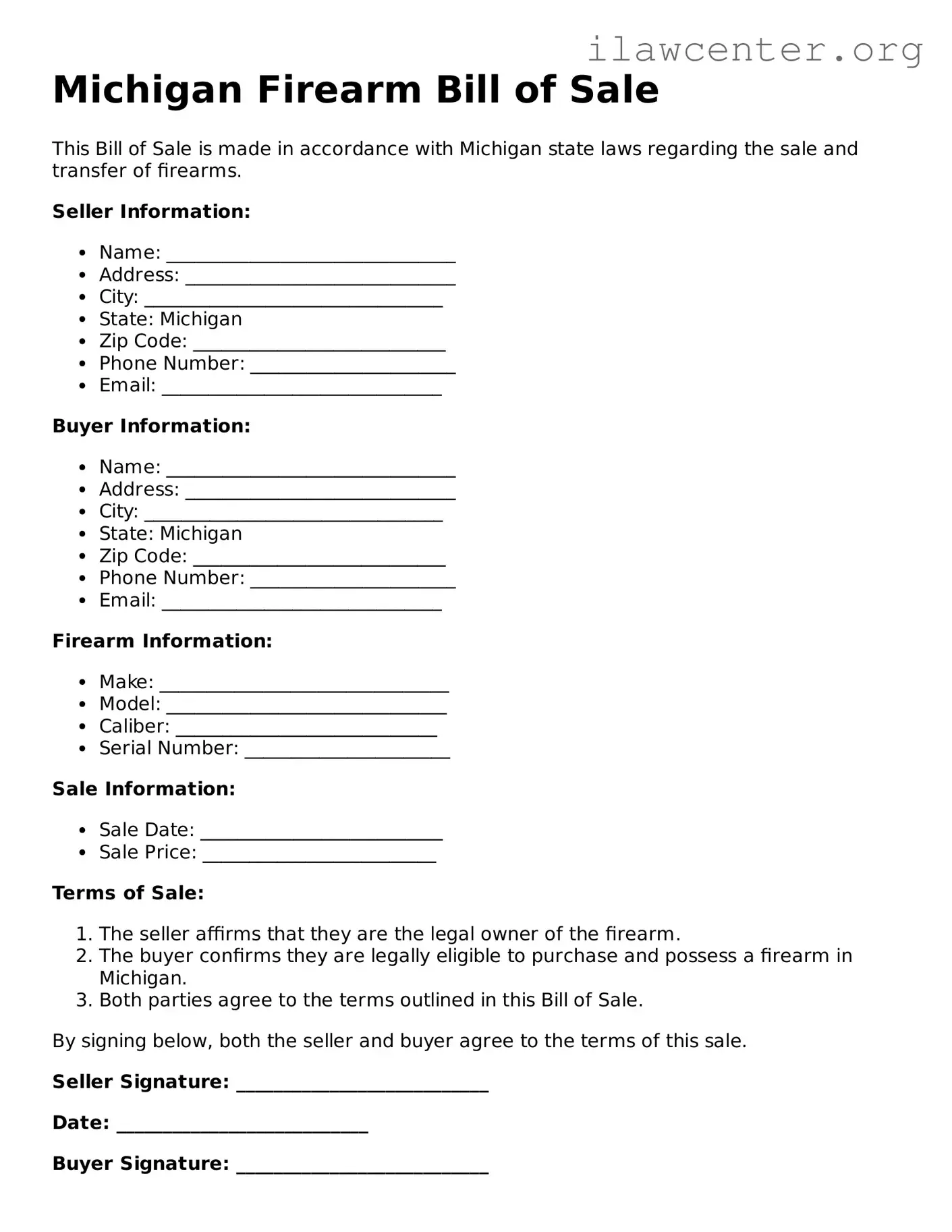
Michigan Firearm Bill of Sale Preview

Michigan Firearm Bill of Sale

This Bill of Sale is made in accordance with Michigan state laws regarding the sale and transfer of firearms.

Seller Information:

  • Name: _______________________________
  • Address: _____________________________
  • City: ________________________________
  • State: Michigan
  • Zip Code: ___________________________
  • Phone Number: ______________________
  • Email: ______________________________

Buyer Information:

  • Name: _______________________________
  • Address: _____________________________
  • City: ________________________________
  • State: Michigan
  • Zip Code: ___________________________
  • Phone Number: ______________________
  • Email: ______________________________

Firearm Information:

  • Make: _______________________________
  • Model: ______________________________
  • Caliber: ____________________________
  • Serial Number: ______________________

Sale Information:

  • Sale Date: __________________________
  • Sale Price: _________________________

Terms of Sale:

  1. The seller affirms that they are the legal owner of the firearm.
  2. The buyer confirms they are legally eligible to purchase and possess a firearm in Michigan.
  3. Both parties agree to the terms outlined in this Bill of Sale.

By signing below, both the seller and buyer agree to the terms of this sale.

Seller Signature: ___________________________

Date: ___________________________

Buyer Signature: ___________________________

Date: ___________________________

PDF Form Characteristics

Fact Name Details
Purpose The Michigan Firearm Bill of Sale form serves as a legal document to record the sale and transfer of firearms between parties.
Governing Law This form is governed by Michigan Compiled Laws, specifically MCL 28.422 regarding the sale and transfer of firearms.
Parties Involved The form requires information from both the seller and the buyer, ensuring clarity in the transaction.
Identification Requirement Both parties must provide valid identification to verify their identities during the sale.
Record Keeping It is advisable for both parties to keep a copy of the completed Bill of Sale for their records.
Legal Protection The form provides legal protection for both the buyer and seller in case of future disputes regarding ownership.
Notarization While notarization is not required, it can add an extra layer of authenticity to the document.

Instructions on Utilizing Michigan Firearm Bill of Sale

After obtaining the Michigan Firearm Bill of Sale form, it is important to ensure that all necessary information is accurately filled out. This document serves as a record of the transaction between the buyer and seller of a firearm.

  1. Begin by entering the date of the transaction at the top of the form.
  2. Provide the full name and address of the seller in the designated fields.
  3. Next, enter the buyer's full name and address in the appropriate sections.
  4. Include a description of the firearm being sold. This should encompass details such as the make, model, caliber, and serial number.
  5. Specify the purchase price of the firearm clearly in the designated area.
  6. Both the seller and buyer must sign the form at the bottom. Ensure that the signatures are dated as well.
  7. Make a copy of the completed form for both the seller and the buyer for their records.

Important Facts about Michigan Firearm Bill of Sale

What is a Michigan Firearm Bill of Sale form?

The Michigan Firearm Bill of Sale form is a document that records the sale or transfer of a firearm between two parties. This form serves as proof of the transaction and includes important details such as the names of the buyer and seller, the date of the sale, and a description of the firearm being sold. It helps protect both parties by providing a legal record of the transfer.

Is a Bill of Sale required in Michigan for firearm transfers?

No, a Bill of Sale is not legally required in Michigan for the transfer of firearms. However, having one is highly recommended. It can provide clarity and protection in case of disputes or legal issues that may arise in the future. It is a good practice to document the sale, especially for private transactions.

What information should be included in the Bill of Sale?

A comprehensive Bill of Sale should include several key details. This includes the names and addresses of both the buyer and seller, the date of the transaction, a detailed description of the firearm (including make, model, caliber, and serial number), and the sale price. Both parties should sign and date the document to make it official.

Can I create my own Bill of Sale?

Yes, you can create your own Bill of Sale for a firearm in Michigan. There are many templates available online that can guide you. Just ensure that all necessary information is included and that both parties sign the document. Alternatively, you can also use a pre-made form available at various legal websites.

Do I need to have the Bill of Sale notarized?

In Michigan, notarization of the Bill of Sale is not required. However, getting it notarized can add an extra layer of security and legitimacy to the document. It may also be helpful if you ever need to prove the transaction in a legal setting.

What if the firearm is a gift rather than a sale?

If the firearm is being given as a gift, a Bill of Sale can still be useful. You can modify the form to indicate that the transfer is a gift rather than a sale. This documentation can help clarify the intent and ownership of the firearm, protecting both parties in case of future questions.

Are there any restrictions on who can buy a firearm in Michigan?

Yes, there are restrictions. In Michigan, individuals must be at least 18 years old to purchase a firearm. Additionally, certain individuals, such as those with felony convictions or those deemed mentally incompetent by a court, are prohibited from buying firearms. It is essential to ensure that the buyer is legally eligible to own a firearm before completing the sale.

What should I do if I lose my Bill of Sale?

If you lose your Bill of Sale, it can be challenging, but not impossible to address. If you still have the details of the transaction, you might consider creating a new Bill of Sale and having both parties sign it again. If the firearm is ever questioned, having some form of documentation can help clarify ownership, even if it’s not the original document.
Common mistakes

Filling out the Michigan Firearm Bill of Sale form can seem straightforward, but many people make common mistakes that can lead to complications. One frequent error is failing to include all necessary information about the firearm. Details such as the make, model, caliber, and serial number are crucial. Without this information, the transaction may not be legally binding.

Another mistake is not providing accurate personal information. Buyers and sellers must ensure that their names, addresses, and contact details are correct. Inaccurate information can create confusion and may even lead to legal issues later on.

Many individuals overlook the importance of signatures. Both the buyer and seller must sign the document. If one party neglects to sign, the bill of sale may not be valid. This simple oversight can cause significant problems down the line.

Some people fail to date the form. Including the date of the transaction is essential for record-keeping and can help clarify any disputes that may arise. Without a date, it may be challenging to establish when the transfer took place.

It’s also common to see incomplete or vague descriptions of the firearm. A detailed description helps prevent misunderstandings. Instead of just stating “handgun,” specify the type, such as “9mm Glock 19.” This level of detail is necessary for clarity.

People sometimes forget to check local laws regarding the sale of firearms. Michigan has specific regulations that must be followed. Ignoring these laws can lead to serious legal repercussions for both parties involved.

Another error is not keeping a copy of the bill of sale. Both the buyer and seller should retain a copy for their records. This documentation can be vital if questions about ownership arise in the future.

Some individuals rush through the process, thinking it’s a simple transaction. Taking the time to carefully review the form and ensure all details are correct can save a lot of trouble later. Rushing can lead to mistakes that could have been easily avoided.

Finally, not understanding the implications of the sale can be a significant oversight. Both parties should be aware of their rights and responsibilities. Educating oneself about the process can prevent misunderstandings and ensure a smooth transaction.

Documents used along the form

When completing a transaction involving the purchase or sale of a firearm in Michigan, several additional documents may be necessary to ensure compliance with state laws and to protect the interests of both parties involved. Below is a list of commonly used forms that complement the Michigan Firearm Bill of Sale form.

  • Michigan Pistol Sales Record: This form is required for the sale of handguns in Michigan. It records details about the firearm, the seller, and the buyer. This document helps maintain an accurate record of firearm transactions within the state.
  • ATF Form 4473: This is the federal Firearms Transaction Record. It must be completed by the buyer when purchasing a firearm from a licensed dealer. This form helps to ensure that the sale complies with federal regulations and background checks.
  • Application to Purchase a Pistol: In Michigan, prospective buyers may need to complete this application before acquiring a handgun. It requires personal information and is submitted to local law enforcement for approval.
  • Affidavit of Ownership: This document serves as a declaration by the seller that they legally own the firearm being sold. It may include details about the firearm and the seller's acknowledgment of their legal right to sell it.
  • Firearm Registration Form: While not required for all firearms, this form is essential for certain types of firearms in Michigan. It registers the firearm with the state and provides a record of ownership.

Using these documents alongside the Michigan Firearm Bill of Sale form helps ensure a smooth and legally compliant transaction. Always consider consulting with a legal professional if you have questions about the process or specific requirements.

Similar forms

The Firearm Bill of Sale form serves a specific purpose in documenting the sale of firearms. However, it shares similarities with several other documents. Here are nine such documents, each with a brief explanation of how they relate to the Firearm Bill of Sale:

  • Vehicle Bill of Sale: Like the Firearm Bill of Sale, this document records the transfer of ownership of a vehicle. It includes details about the buyer, seller, and the vehicle itself.
  • Boat Bill of Sale: This document is used for the sale of boats. Similar to the Firearm Bill of Sale, it includes essential information about the parties involved and the item being sold.
  • Real Estate Purchase Agreement: This agreement outlines the sale of property. It shares the same purpose of documenting a transaction and protecting both parties' interests.
  • Personal Property Bill of Sale: This form is used for the sale of various personal items. It serves to confirm the transfer of ownership, much like the Firearm Bill of Sale.
  • Business Bill of Sale: When a business is sold, this document details the transaction. It ensures that both the buyer and seller have a clear understanding of the sale terms, similar to a firearm transaction.
  • Lease Agreement: While primarily used for rental situations, this document also serves to outline terms between two parties. It protects the rights of both the lessor and lessee, akin to the protection offered in a firearm sale.
  • Loan Agreement: This document records the terms of a loan between parties. It establishes the responsibilities of each party, similar to how a Firearm Bill of Sale clarifies the obligations of the buyer and seller.
  • Employment Contract: This contract outlines the terms of employment between an employer and employee. Like the Firearm Bill of Sale, it formalizes an agreement and provides legal protection for both parties.
  • Service Agreement: This document specifies the terms under which services will be provided. It shares the same goal of ensuring clarity and accountability between the parties involved.

Dos and Don'ts

When filling out the Michigan Firearm Bill of Sale form, it's important to keep a few things in mind. Here’s a list of what you should and shouldn’t do:

  • Do double-check all the information you provide for accuracy.
  • Do include both the buyer's and seller's full names and addresses.
  • Do specify the make, model, and serial number of the firearm clearly.
  • Do ensure that both parties sign and date the form.
  • Don't leave any required fields blank; fill in all necessary information.
  • Don't use nicknames or abbreviations for names; use legal names only.
  • Don't forget to keep a copy of the completed form for your records.
  • Don't rush through the process; take your time to avoid mistakes.

Misconceptions

The Michigan Firearm Bill of Sale form is a crucial document for anyone involved in the sale or transfer of firearms. However, several misconceptions surround its use and requirements. Here are four common misunderstandings:

  • The Bill of Sale is not necessary for private sales. Many people believe that private sales do not require documentation. In Michigan, while a bill of sale is not legally mandated, it is highly recommended to protect both the buyer and seller in case of future disputes.
  • Only licensed dealers can use the Bill of Sale. This is not true. Any individual can create and use a Bill of Sale for the transfer of firearms, regardless of whether they are a licensed dealer or a private seller.
  • Filling out the Bill of Sale guarantees a legal transfer. While the Bill of Sale serves as a record of the transaction, it does not guarantee that the transfer is legal. Both parties must ensure they comply with all applicable laws regarding firearm ownership and transfer.
  • The Bill of Sale is only for handguns. This misconception overlooks the fact that the Bill of Sale can be used for all types of firearms, including rifles and shotguns. It is a versatile document applicable to various firearm transactions.

Understanding these misconceptions can help ensure that firearm transactions in Michigan are handled correctly and legally. Always consider consulting with a legal expert for specific advice related to firearm sales and transfers.

Key takeaways

When filling out and using the Michigan Firearm Bill of Sale form, consider the following key takeaways:

  1. Accurate Information: Ensure that all information entered on the form is correct, including the names, addresses, and firearm details.
  2. Identification: Both the buyer and seller should provide valid identification to verify their identities.
  3. Condition of the Firearm: Clearly describe the condition of the firearm being sold. This includes noting any defects or modifications.
  4. Transfer Date: Include the date of the transaction. This helps establish a clear record of when the sale occurred.
  5. Witness Signatures: Although not required, having a witness sign the form can provide additional proof of the transaction.
  6. Record Keeping: Both parties should keep a copy of the completed bill of sale for their records. This can be important for future reference.
  7. Legal Compliance: Ensure that the sale complies with all local, state, and federal laws regarding firearm transactions.
  8. Minors: Be aware that selling a firearm to a minor is illegal. Verify the buyer's age before completing the sale.
  9. Notarization: While notarization is not mandatory, having the document notarized can add an extra layer of legitimacy.

By following these guidelines, you can ensure a smooth and lawful transaction when using the Michigan Firearm Bill of Sale form.