Attorney-Verified  Homeschool Letter of Intent Document for Michigan

Attorney-Verified Homeschool Letter of Intent Document for Michigan

The Michigan Homeschool Letter of Intent is a crucial document that parents must submit to officially notify the state of their decision to homeschool their children. This form serves as a formal declaration, ensuring compliance with state regulations and helping to establish a clear educational path. If you are ready to take this important step, fill out the form by clicking the button below.

Article Guide

In Michigan, families choosing to homeschool their children must navigate a few essential requirements to ensure compliance with state regulations. One crucial step in this process is the completion of the Homeschool Letter of Intent form. This document serves as a formal notification to the local school district, indicating the family's decision to educate their child at home. It includes key information such as the names and ages of the children being homeschooled, as well as the address of the residence where the education will take place. While the form does not require extensive details about the curriculum or educational philosophy, it is important for parents to submit it in a timely manner to avoid any potential issues with truancy laws. The submission of this letter not only fulfills legal obligations but also marks the beginning of a personalized educational journey tailored to the unique needs and interests of each child.

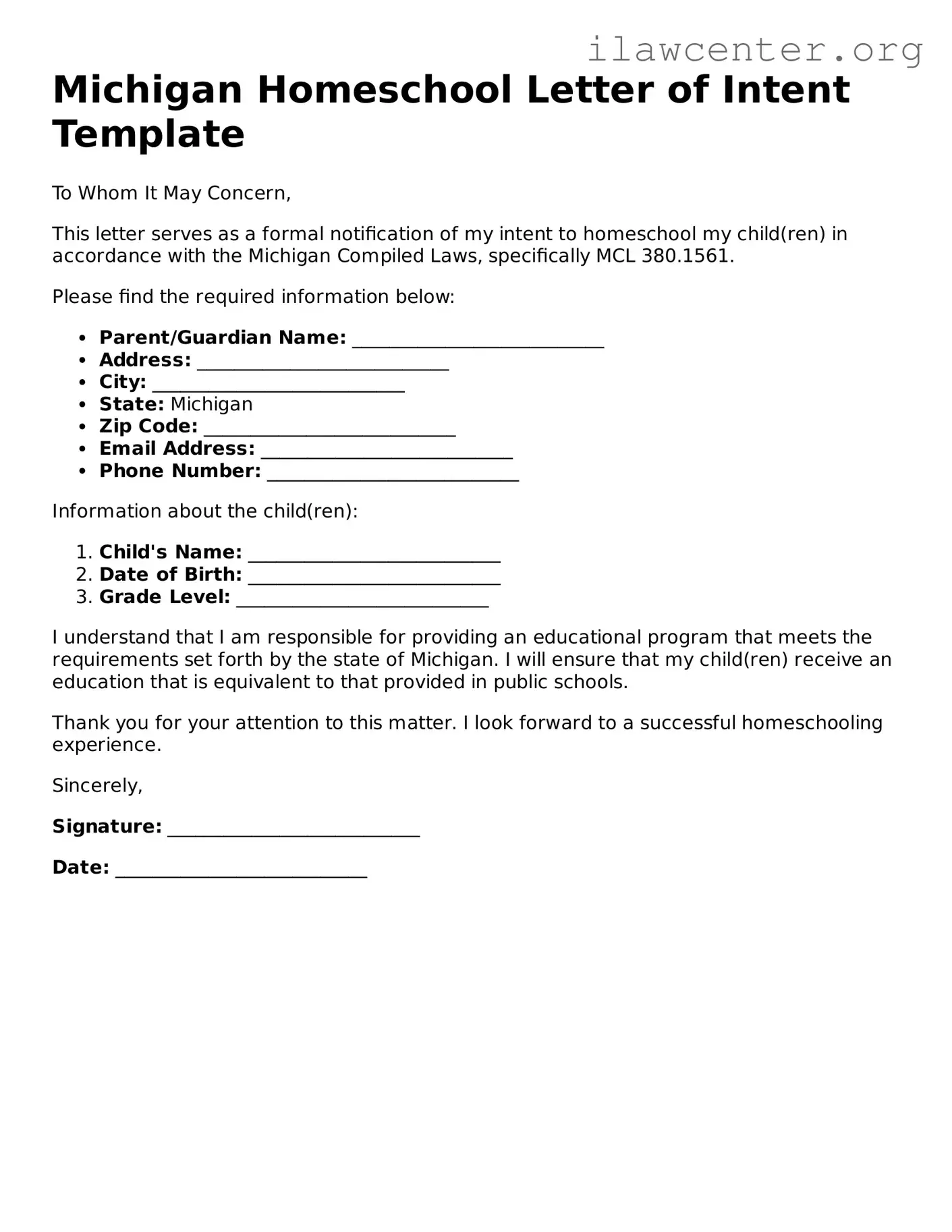
Michigan Homeschool Letter of Intent Preview

Michigan Homeschool Letter of Intent Template

To Whom It May Concern,

This letter serves as a formal notification of my intent to homeschool my child(ren) in accordance with the Michigan Compiled Laws, specifically MCL 380.1561.

Please find the required information below:

  • Parent/Guardian Name: ___________________________
  • Address: ___________________________
  • City: ___________________________
  • State: Michigan
  • Zip Code: ___________________________
  • Email Address: ___________________________
  • Phone Number: ___________________________

Information about the child(ren):

  1. Child's Name: ___________________________
  2. Date of Birth: ___________________________
  3. Grade Level: ___________________________

I understand that I am responsible for providing an educational program that meets the requirements set forth by the state of Michigan. I will ensure that my child(ren) receive an education that is equivalent to that provided in public schools.

Thank you for your attention to this matter. I look forward to a successful homeschooling experience.

Sincerely,

Signature: ___________________________

Date: ___________________________

PDF Form Characteristics

Fact Name Description
Governing Law The Michigan Homeschool Letter of Intent is governed by the Michigan Compiled Laws, specifically MCL 380.1561.
Purpose of the Form This form serves to notify the local school district of a parent's intent to homeschool their child.
Submission Timeline Parents must submit the Letter of Intent within 10 days of beginning their homeschool program.
Required Information The form requires basic information such as the child's name, age, and the address of the homeschooling family.
Frequency of Submission The Letter of Intent only needs to be submitted once, unless there is a change in educational status.
Additional Documentation No additional documentation is required when submitting the Letter of Intent.
Local School District The form must be submitted to the local school district where the family resides.
Record Keeping Parents are encouraged to keep a copy of the submitted Letter of Intent for their records.
Legal Protection Submitting this form provides legal recognition of the homeschooling status in Michigan.

Instructions on Utilizing Michigan Homeschool Letter of Intent

Filling out the Michigan Homeschool Letter of Intent form is an important step for families choosing to educate their children at home. Once completed, the form needs to be submitted to the appropriate school district. This ensures that your intent to homeschool is officially recognized.

  1. Start by downloading the Michigan Homeschool Letter of Intent form from the Michigan Department of Education website or obtain a physical copy from your local school district.
  2. Fill in the date at the top of the form. This helps to establish when you are submitting your intent.
  3. Provide your name and address. Make sure to include the complete address where you reside.
  4. List the names and ages of all children who will be homeschooled. Include their birth dates for clarity.
  5. Indicate the grade level for each child. This helps to ensure proper educational tracking.
  6. Sign the form at the bottom. Your signature confirms your intent to homeschool.
  7. Make a copy of the completed form for your records before submission.
  8. Submit the form to your local school district office. You may choose to do this by mail or in person, depending on your preference.

After submitting the form, keep an eye out for any communication from the school district. They may reach out for additional information or to confirm receipt of your intent to homeschool.

Important Facts about Michigan Homeschool Letter of Intent

What is the Michigan Homeschool Letter of Intent form?

The Michigan Homeschool Letter of Intent form is a document that parents or guardians must submit to notify their local school district of their intention to homeschool their children. This form serves as an official declaration that the parent will be providing education at home instead of enrolling the child in a public or private school. It is an important first step in the homeschooling process in Michigan.

Who needs to fill out the Letter of Intent?

Any parent or guardian who wishes to homeschool their child in Michigan must complete the Letter of Intent. This includes families with children of compulsory school age, which is typically between the ages of 6 and 18. Even if you have previously homeschooled or have children who are older, you still need to submit this form for each child you plan to educate at home.

When should the Letter of Intent be submitted?

The Letter of Intent should be submitted to your local school district before you begin homeschooling. Ideally, it should be filed at least 14 days before the start of your homeschooling program. This allows the district to process your intent and ensures that you are in compliance with state regulations. If you are withdrawing your child from a public or private school to homeschool, it's best to submit the form as soon as possible to avoid any gaps in education.

What happens after I submit the Letter of Intent?

Once you submit the Letter of Intent, the school district will acknowledge receipt of your form. You will not receive any formal approval or denial, as Michigan law does not require school districts to approve homeschooling. However, it's important to keep a copy of the submitted form for your records. After this, you are free to begin your homeschooling journey, but you must ensure that you comply with all educational requirements set forth by the state.

Common mistakes

Filling out the Michigan Homeschool Letter of Intent form can seem straightforward, but many families make common mistakes that could lead to delays or complications. One frequent error is failing to include all required information. The form asks for specific details about the student and the educational plan. Omitting any of this information can result in the form being returned or rejected.

Another mistake involves incorrect or unclear contact information. Parents must provide accurate phone numbers and addresses. If the school district cannot reach the family for any reason, it may create unnecessary confusion. Ensuring that this information is up-to-date is crucial for effective communication.

Some families overlook the importance of signing the form. A signature is not just a formality; it validates the intent to homeschool. Without a signature, the form is incomplete. This simple oversight can cause significant setbacks in the homeschooling process.

Additionally, many people fail to keep a copy of the submitted form. It's essential to maintain a record of all correspondence with the school district. Having a copy can help clarify any issues that arise later and serves as proof of intent should questions come up.

Another common pitfall is misunderstanding the submission timeline. Parents must submit the Letter of Intent within a specific timeframe. Failing to meet this deadline can lead to complications, including the possibility of being considered truant. Staying aware of these timelines is vital for a smooth homeschooling experience.

Some individuals also misinterpret the educational plan requirements. The form does not ask for a detailed curriculum but does require a general outline of the educational approach. Providing vague or insufficient information may raise red flags for the school district.

Lastly, neglecting to check for updates or changes to the form can lead to mistakes. Regulations and requirements can change, and it’s important to ensure that the most current version of the form is being used. Regularly reviewing the Michigan Department of Education’s website can help avoid outdated submissions.

Documents used along the form

When families decide to homeschool in Michigan, they often complete the Homeschool Letter of Intent form. However, this form is just one part of the documentation that may be necessary for a successful homeschooling experience. Below are some additional forms and documents that are commonly used alongside the Homeschool Letter of Intent.

  • Educational Goals Statement: This document outlines the educational objectives for the homeschooling year. It serves as a roadmap for what the family aims to achieve in terms of academic and personal development.
  • Curriculum Plan: A detailed plan that describes the subjects to be taught and the materials to be used. This document helps parents organize their teaching strategy and ensures that they cover the required educational content.
  • Attendance Records: Keeping track of the days and hours of instruction is essential. These records can be helpful for monitoring progress and may be required if the family decides to transition back to a traditional school setting.
  • Assessment Records: Many homeschooling families choose to conduct regular assessments to gauge their child's progress. These can include standardized tests, portfolios of work, or other evaluation methods.
  • Withdrawal Letter (if applicable): If a child is transferring from a public or private school to homeschooling, a withdrawal letter may be necessary. This letter formally notifies the previous school of the decision to homeschool.

Each of these documents plays a crucial role in the homeschooling process. They help parents stay organized, ensure compliance with state requirements, and ultimately support the educational journey of their children.

Similar forms

  • Notice of Intent to Homeschool: This document serves a similar purpose, informing the local school district of a parent's decision to homeschool their child. It typically includes the child's name, age, and the educational plan for the year.
  • Curriculum Plan: Like the Homeschool Letter of Intent, a curriculum plan outlines the educational materials and methods a parent intends to use. It provides a framework for the educational approach and learning goals.
  • Annual Assessment Report: This report is often required to demonstrate the child's educational progress. It parallels the Letter of Intent in that it communicates essential information to the school district about the child's learning outcomes.
  • Withdrawal Form from Public School: When a child is withdrawn from public school to be homeschooled, this form notifies the school of the change. Similar to the Letter of Intent, it marks a transition in the child's educational path.
  • Educational Portfolio: An educational portfolio collects evidence of a child's learning throughout the year. It complements the Letter of Intent by showcasing how the educational goals are being met.
  • Homeschool Affidavit: This document is a sworn statement affirming the parent’s intent to homeschool. It shares the same purpose as the Letter of Intent in establishing the legal basis for homeschooling in the state.

Dos and Don'ts

When filling out the Michigan Homeschool Letter of Intent form, it is important to follow specific guidelines to ensure the process goes smoothly. Here are six key things to keep in mind:

  • Do provide accurate information about your child, including their name, age, and address.
  • Do submit the form to your local school district within the required timeframe.
  • Do keep a copy of the completed form for your records.
  • Don't leave any sections blank; incomplete forms may lead to delays or issues.
  • Don't forget to include your contact information, as the school district may need to reach you.
  • Don't submit the form without reviewing it for errors or typos.

Following these guidelines will help ensure that your homeschooling journey starts off on the right foot.

Misconceptions

Many parents consider homeschooling as an educational option for their children in Michigan. However, several misconceptions surround the Michigan Homeschool Letter of Intent form. Understanding these misconceptions can help parents navigate the process more effectively.

  • Misconception 1: The form is mandatory for all homeschooling families.
  • While submitting a Letter of Intent is recommended, it is not legally required in Michigan. Families can choose to homeschool without filing this form, but doing so can provide clarity and establish a formal record.

  • Misconception 2: The Letter of Intent must be submitted annually.
  • Once a family submits a Letter of Intent, they do not need to resubmit it each year. The initial submission is sufficient as long as the family continues to homeschool.

  • Misconception 3: The Letter of Intent needs to be submitted to the state government.
  • The form is submitted to the local school district where the family resides, not directly to the state government. This local submission helps keep the district informed about homeschooling families in the area.

  • Misconception 4: There is a specific format required for the Letter of Intent.
  • Michigan law does not prescribe a specific format for the Letter of Intent. Parents can create their own letter as long as it includes essential information such as the child's name and the intent to homeschool.

  • Misconception 5: The Letter of Intent is a legally binding contract.
  • The Letter of Intent is not a contract. It serves as a notification to the local school district about the family's decision to homeschool, but it does not impose legal obligations on the family.

  • Misconception 6: Submitting the form requires detailed educational plans.
  • Parents are not required to submit detailed educational plans or curricula when filing the Letter of Intent. The form is primarily a statement of intent, not an outline of educational strategies.

  • Misconception 7: Parents must be certified teachers to homeschool.
  • In Michigan, parents do not need to be certified teachers to homeschool their children. The law allows parents to take full responsibility for their child's education without formal teaching credentials.

  • Misconception 8: Homeschooling families are subject to the same regulations as public schools.
  • Homeschooling families in Michigan are not subject to the same regulations as public schools. They have more flexibility in choosing their educational methods and materials, allowing for a personalized approach to learning.

Key takeaways

Filling out and using the Michigan Homeschool Letter of Intent form is an important step for parents who wish to educate their children at home. Here are some key takeaways to consider:

  • Understand the Requirements: Familiarize yourself with Michigan's homeschooling laws. The Letter of Intent must be submitted to your local school district.
  • Complete the Form Accurately: Provide all necessary information, including your child's name, age, and the educational curriculum you plan to use.
  • Submit on Time: Ensure the form is submitted within the required timeframe. This helps you stay compliant with state regulations.
  • Keep Records: Maintain a copy of the submitted Letter of Intent for your records. This can be useful for future reference or in case of inquiries.