Attorney-Verified  Medical Power of Attorney Document for Michigan

Attorney-Verified Medical Power of Attorney Document for Michigan

The Michigan Medical Power of Attorney form is a legal document that allows individuals to appoint someone they trust to make healthcare decisions on their behalf if they become unable to do so. This form ensures that your medical preferences are honored, even when you cannot communicate them yourself. To ensure your wishes are respected, consider filling out the form by clicking the button below.

Article Guide

In the realm of healthcare decision-making, the Michigan Medical Power of Attorney form serves as a vital tool for individuals seeking to ensure their medical preferences are honored when they cannot communicate those wishes themselves. This legal document allows a person, often referred to as the "principal," to designate a trusted individual, known as the "agent," to make healthcare decisions on their behalf. The form encompasses various critical aspects, including the scope of authority granted to the agent, the specific medical treatments that may be accepted or declined, and the conditions under which the agent's authority takes effect. Additionally, the form emphasizes the importance of clear communication between the principal and the agent, encouraging discussions about values and preferences related to medical care. By completing this form, individuals can gain peace of mind, knowing that their healthcare choices will be respected, even in times of crisis or incapacity. Understanding the nuances of the Michigan Medical Power of Attorney form is essential for anyone looking to navigate the complexities of healthcare decision-making effectively.

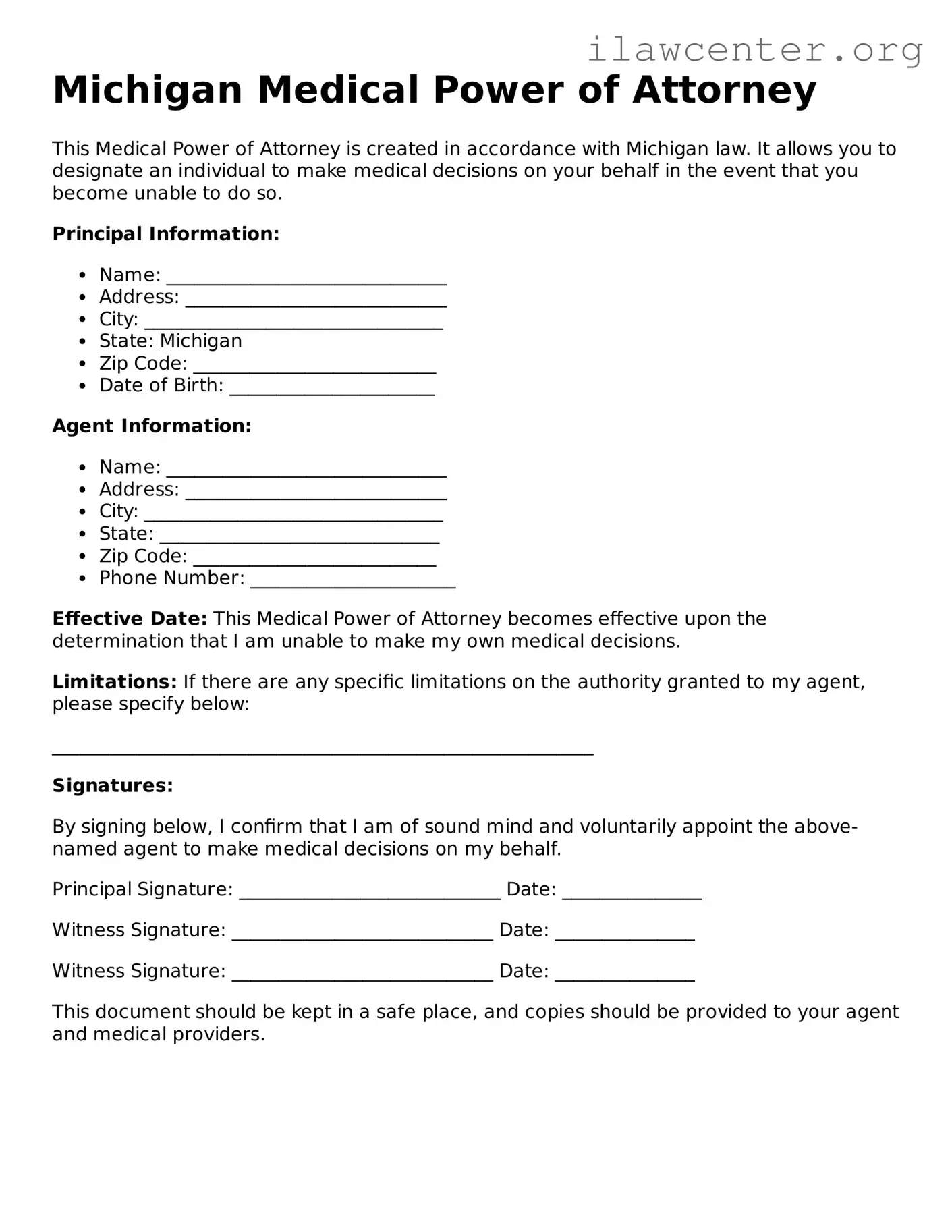
Michigan Medical Power of Attorney Preview

Michigan Medical Power of Attorney

This Medical Power of Attorney is created in accordance with Michigan law. It allows you to designate an individual to make medical decisions on your behalf in the event that you become unable to do so.

Principal Information:

  • Name: ______________________________
  • Address: ____________________________
  • City: ________________________________
  • State: Michigan
  • Zip Code: __________________________
  • Date of Birth: ______________________

Agent Information:

  • Name: ______________________________
  • Address: ____________________________
  • City: ________________________________
  • State: ______________________________
  • Zip Code: __________________________
  • Phone Number: ______________________

Effective Date: This Medical Power of Attorney becomes effective upon the determination that I am unable to make my own medical decisions.

Limitations: If there are any specific limitations on the authority granted to my agent, please specify below:

__________________________________________________________

Signatures:

By signing below, I confirm that I am of sound mind and voluntarily appoint the above-named agent to make medical decisions on my behalf.

Principal Signature: ____________________________ Date: _______________

Witness Signature: ____________________________ Date: _______________

Witness Signature: ____________________________ Date: _______________

This document should be kept in a safe place, and copies should be provided to your agent and medical providers.

PDF Form Characteristics

Fact Name Details
Purpose The Michigan Medical Power of Attorney form allows an individual to designate someone to make medical decisions on their behalf if they become unable to do so.
Governing Law This form is governed by the Michigan Compiled Laws, specifically MCL 700.5501 et seq.
Eligibility Any adult resident of Michigan can create a Medical Power of Attorney.
Revocation The principal can revoke the document at any time as long as they are mentally competent.
Signature Requirements The form must be signed by the principal and witnessed by at least two individuals or notarized.

Instructions on Utilizing Michigan Medical Power of Attorney

Filling out the Michigan Medical Power of Attorney form is an important step in ensuring your healthcare decisions are made according to your wishes. Once you have completed the form, it will need to be signed and witnessed to be valid. Here are the steps to guide you through the process.

  1. Obtain the Michigan Medical Power of Attorney form. You can find it online or request a copy from a legal professional.
  2. Read the instructions carefully to understand the requirements and sections of the form.
  3. In the designated area, fill in your name, address, and date of birth. This identifies you as the principal.
  4. Next, select a trusted individual to act as your agent. Provide their name, address, and phone number. This person will make medical decisions on your behalf if you are unable to do so.
  5. Consider whether you want to include any specific instructions regarding your medical treatment. If so, write them clearly in the provided section.
  6. Indicate any limitations on your agent's authority, if applicable. Be specific about what decisions they can or cannot make.
  7. Sign and date the form in the presence of a notary public or two witnesses. Ensure that the witnesses are not related to you and do not stand to benefit from your estate.
  8. Make copies of the completed form for your records and provide copies to your agent and any relevant healthcare providers.

Important Facts about Michigan Medical Power of Attorney

What is a Michigan Medical Power of Attorney?

A Michigan Medical Power of Attorney is a legal document that allows you to appoint someone to make healthcare decisions on your behalf if you become unable to do so. This person, known as your agent or proxy, will have the authority to make medical decisions based on your wishes and best interests.

Who can be my agent in a Medical Power of Attorney?

Your agent can be anyone you trust to make healthcare decisions for you. This can include family members, friends, or even a trusted advisor. However, it is important to choose someone who understands your values and preferences regarding medical care.

Do I need a lawyer to create a Medical Power of Attorney in Michigan?

No, you do not need a lawyer to create a Medical Power of Attorney in Michigan. You can fill out the form yourself. However, consulting with a legal professional can be beneficial to ensure that your document meets all legal requirements and accurately reflects your wishes.

Is there a specific form I need to use for the Medical Power of Attorney?

While Michigan does not require a specific form, it is recommended to use a standardized Medical Power of Attorney form. This ensures that all necessary information is included and recognized by healthcare providers. You can find these forms online or through healthcare facilities.

Can I change or revoke my Medical Power of Attorney?

Yes, you can change or revoke your Medical Power of Attorney at any time, as long as you are mentally competent. To revoke it, you should notify your agent and healthcare providers in writing. It’s also a good idea to create a new document if you wish to appoint a different agent.

What happens if I don’t have a Medical Power of Attorney?

If you do not have a Medical Power of Attorney and become unable to make healthcare decisions, your family members may have to go through a court process to appoint a guardian. This can be time-consuming and may not reflect your personal wishes.

When does the Medical Power of Attorney take effect?

The Medical Power of Attorney takes effect when you become unable to make your own healthcare decisions. You can specify in the document whether it should take effect immediately or only upon your incapacity.

Are there any limitations to the authority of my agent?

Yes, you can specify limitations in your Medical Power of Attorney. For instance, you may want to restrict your agent from making certain types of medical decisions. Clearly outlining these limitations in the document will help ensure that your wishes are followed.

Common mistakes

Filling out a Michigan Medical Power of Attorney form can be a straightforward process, but many individuals make common mistakes that can lead to complications. One frequent error is failing to specify the agent clearly. The agent is the person who will make medical decisions on behalf of the individual. If this person is not clearly identified, it can create confusion during critical moments.

Another mistake is neglecting to sign and date the form. Without a signature, the document is not valid. Additionally, the date is essential for determining the form's effectiveness. Some people forget to have the form witnessed or notarized, which is a requirement in Michigan. This oversight can invalidate the entire document.

Many individuals also overlook the importance of discussing their wishes with their chosen agent. Failing to communicate preferences regarding medical treatment can lead to decisions that do not align with the individual's values. It is crucial to have an open dialogue about healthcare wishes before filling out the form.

Some people mistakenly believe that a Medical Power of Attorney only takes effect when they become incapacitated. In reality, they can choose to make it effective immediately or at a later time. Misunderstanding this aspect can lead to unnecessary complications in decision-making.

Another common error is not updating the form when circumstances change. Life events, such as a divorce or the death of a chosen agent, necessitate a review and potential revision of the document. Failing to keep the form current can result in outdated information being used during critical healthcare decisions.

People often forget to include alternate agents. If the primary agent is unavailable or unwilling to act, having a backup can ensure that decisions are made without delay. This is an essential aspect that many overlook.

Additionally, some individuals make the mistake of using vague language when describing their healthcare preferences. Specific instructions help guide the agent in making decisions that reflect the individual’s wishes. Clear and direct language is vital.

Another issue arises when individuals do not understand the limitations of the authority granted. A Medical Power of Attorney does not cover financial decisions; it is strictly for medical matters. Confusing these two types of powers can lead to misunderstandings about the agent's role.

Lastly, people sometimes fail to provide copies of the completed form to relevant parties, such as healthcare providers or family members. Ensuring that everyone involved is aware of the document can prevent confusion and facilitate smoother decision-making when the time comes.

Documents used along the form

When considering a Michigan Medical Power of Attorney, it is essential to understand that this document often works in conjunction with several other forms and documents. Each of these plays a vital role in ensuring that an individual's healthcare preferences are respected and that their legal and medical needs are met. Below is a list of commonly used documents that complement the Medical Power of Attorney.

  • Advance Directive: This document outlines a person’s wishes regarding medical treatment in situations where they cannot communicate their preferences. It provides guidance to healthcare providers and loved ones about the types of care the individual desires or wishes to avoid.
  • Living Will: A living will specifies the types of medical treatment a person wishes to receive or refuse in the event of a terminal illness or incapacitation. This document helps ensure that a person's end-of-life preferences are honored.
  • Do Not Resuscitate (DNR) Order: A DNR order instructs medical personnel not to perform CPR if a person's heart stops beating or they stop breathing. This document is crucial for those who wish to avoid aggressive resuscitation efforts.
  • HIPAA Authorization: This authorization allows healthcare providers to share a person's medical information with designated individuals. It is essential for ensuring that family members or agents can access important health information when needed.
  • Patient Advocate Designation: This document appoints a specific individual to make healthcare decisions on behalf of a person if they become unable to do so. It is similar to a Medical Power of Attorney but focuses more on the individual’s healthcare choices.
  • Guardianship Papers: In cases where a person is unable to make decisions due to incapacity, guardianship papers may be necessary. These documents establish a legal guardian who can make decisions on behalf of the individual.
  • Financial Power of Attorney: While not directly related to medical decisions, this document allows someone to manage financial matters on behalf of another person. It is often used in conjunction with a Medical Power of Attorney to ensure comprehensive planning.

Understanding these documents can empower individuals to make informed decisions about their healthcare and legal preferences. By preparing these forms, one can help ensure that their wishes are respected and that their loved ones have the necessary guidance during challenging times.

Similar forms

The Medical Power of Attorney (MPOA) form is an essential document that allows individuals to designate someone else to make healthcare decisions on their behalf. Several other documents serve similar purposes in various contexts. Here’s a list of nine documents that share similarities with the MPOA:

  • Durable Power of Attorney: This document grants someone the authority to make financial and legal decisions for you, even if you become incapacitated.
  • Living Will: A living will outlines your preferences regarding medical treatment and end-of-life care, providing guidance to healthcare providers and family members.
  • Healthcare Proxy: Similar to the MPOA, a healthcare proxy allows you to appoint someone to make medical decisions on your behalf if you cannot do so.
  • Advance Healthcare Directive: This document combines elements of both a living will and a healthcare proxy, detailing your healthcare wishes and appointing a decision-maker.
  • Do Not Resuscitate (DNR) Order: A DNR order instructs medical personnel not to perform CPR if your heart stops, reflecting your wishes about resuscitation.
  • Organ Donation Consent: This document expresses your wishes regarding organ donation after death, ensuring your preferences are honored.
  • End-of-Life Care Plan: This plan outlines your preferences for care during the final stages of life, addressing comfort measures and treatment options.
  • Patient Advocate Designation: Similar to a healthcare proxy, this designation allows you to name someone to advocate for your medical needs and treatment preferences.
  • Guardian Designation: In case of incapacity, this document allows you to appoint someone to make decisions for you, covering both personal and healthcare matters.

Understanding these documents can help individuals prepare for future healthcare decisions, ensuring that their wishes are respected and upheld.

Dos and Don'ts

When filling out the Michigan Medical Power of Attorney form, it is important to follow specific guidelines to ensure the document is valid and effective. Below is a list of things you should and shouldn't do.

  • Do choose a trusted individual as your agent who understands your medical preferences.
  • Do clearly outline your wishes regarding medical treatment and end-of-life care.
  • Do sign the form in the presence of a notary public or witnesses, as required by Michigan law.
  • Do keep a copy of the completed form in a safe place and provide copies to your agent and healthcare providers.
  • Don't leave any sections of the form blank; complete all required information to avoid confusion.
  • Don't choose someone who may have conflicting interests, such as a healthcare provider involved in your treatment.

By following these guidelines, you can help ensure that your medical decisions are respected and carried out according to your wishes.

Misconceptions

Understanding the Michigan Medical Power of Attorney form is crucial for making informed healthcare decisions. However, several misconceptions may lead to confusion. Here are seven common misconceptions about this important document:

  1. It only applies to end-of-life decisions. Many people believe that a Medical Power of Attorney is only relevant when a patient is near death. In reality, this document can guide healthcare decisions at any time when the individual is unable to communicate their wishes.
  2. Any family member can serve as an agent. While family members can often be chosen as agents, not all family members are suitable. The individual creating the document must designate a trusted person who understands their healthcare preferences.
  3. It is the same as a living will. Although both documents deal with healthcare decisions, a Medical Power of Attorney specifically designates someone to make decisions on behalf of the individual, while a living will outlines specific medical treatments the individual does or does not want.
  4. It can be used in any state. The Michigan Medical Power of Attorney form is specific to Michigan law. If an individual moves to another state, they may need to create a new document that complies with that state’s requirements.
  5. Once signed, it cannot be changed. This is not true. Individuals can revoke or update their Medical Power of Attorney at any time, as long as they are competent to do so. It is essential to inform the agent and healthcare providers of any changes.
  6. Healthcare providers must follow the agent's decisions without question. While healthcare providers are generally obligated to follow the agent's decisions, they must also consider the patient’s best interests and any applicable laws. This can sometimes lead to discussions about the appropriateness of certain decisions.
  7. It is only necessary for older adults. Many assume that only seniors need a Medical Power of Attorney. However, anyone over the age of 18 can benefit from this document, especially those with health concerns or specific treatment preferences.

Addressing these misconceptions is vital for ensuring that individuals can effectively communicate their healthcare wishes and appoint trusted representatives to act on their behalf when necessary.

Key takeaways

Filling out and using the Michigan Medical Power of Attorney form is an important step in ensuring that your healthcare wishes are respected. Here are some key takeaways to consider:

  • Understand the purpose: This form allows you to appoint someone to make medical decisions on your behalf if you are unable to do so.
  • Choose your agent wisely: Select a trusted individual who understands your values and healthcare preferences.
  • Be clear about your wishes: Clearly outline your preferences for medical treatment and end-of-life care to guide your agent.
  • Complete the form accurately: Fill out all required sections of the form to ensure it is valid and legally binding.
  • Sign and date the document: Your signature, along with the date, is essential for the form to be effective.
  • Witness requirements: Michigan law requires that the form be signed in the presence of two witnesses or notarized to be valid.
  • Keep copies accessible: Provide copies of the signed form to your agent, healthcare providers, and family members to ensure everyone is informed.
  • Review regularly: Revisit your Medical Power of Attorney periodically to ensure it still reflects your current wishes and circumstances.

By taking these steps, you can help ensure that your healthcare decisions are made according to your wishes, providing peace of mind for you and your loved ones.