Attorney-Verified  Motor Vehicle Bill of Sale Document for Michigan

Attorney-Verified Motor Vehicle Bill of Sale Document for Michigan

The Michigan Motor Vehicle Bill of Sale form is a crucial document that serves as a legal record of the sale and transfer of ownership of a motor vehicle in Michigan. This form protects both the buyer and the seller by providing essential details about the transaction, including the vehicle's identification and sale price. To ensure a smooth transfer of ownership, it is important to fill out this form accurately; click the button below to get started.

Article Guide

The Michigan Motor Vehicle Bill of Sale form serves as a crucial document in the transfer of ownership for vehicles within the state. This form captures essential details such as the vehicle's make, model, year, and Vehicle Identification Number (VIN), ensuring that both the buyer and seller have a clear record of the transaction. Additionally, it includes information about the sale price, which is important for tax purposes and future registration. Signatures from both parties are required to validate the agreement, providing legal protection and clarity. The form also outlines any warranties or guarantees related to the vehicle, which can help prevent disputes after the sale. Overall, the Michigan Motor Vehicle Bill of Sale is a straightforward yet vital tool for anyone involved in buying or selling a vehicle in Michigan.

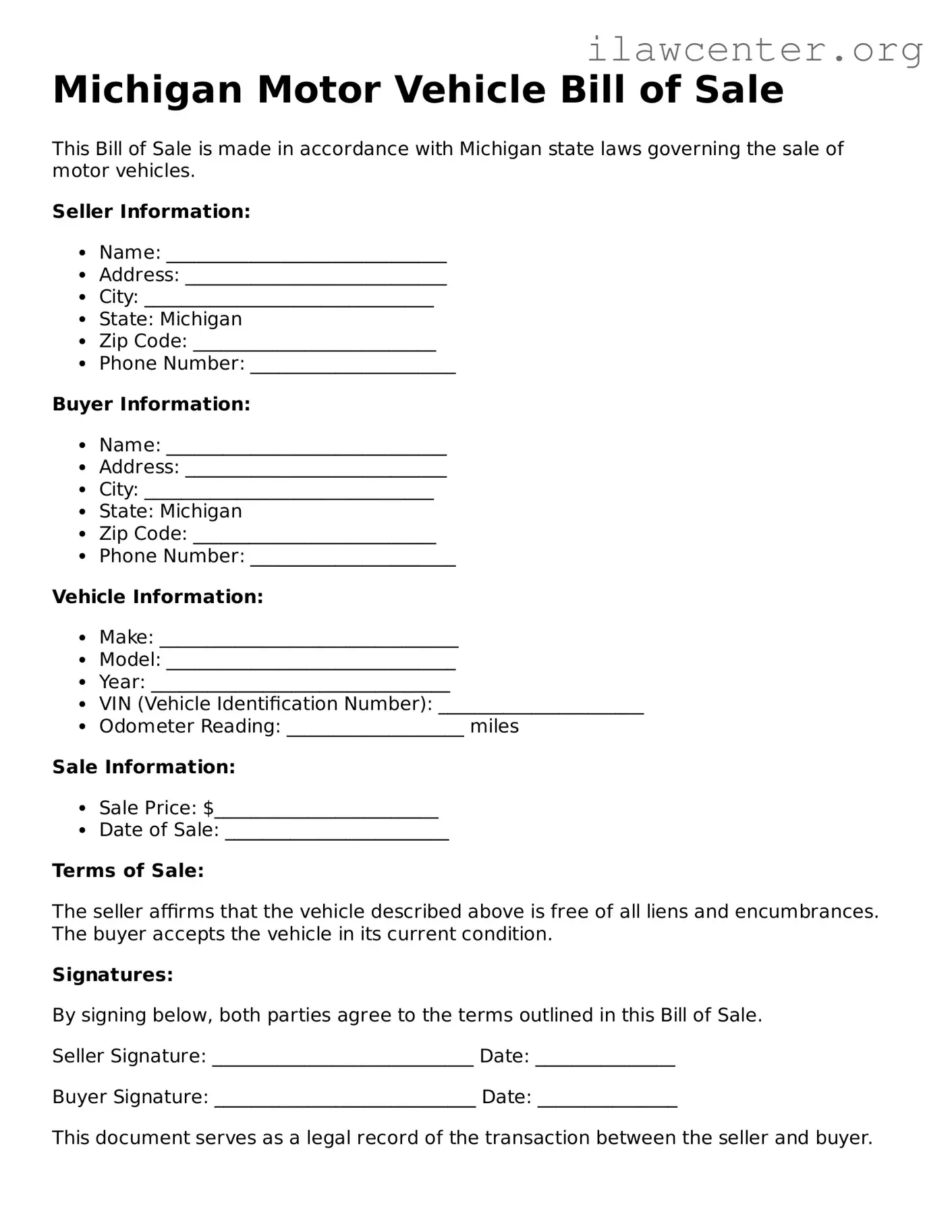
Michigan Motor Vehicle Bill of Sale Preview

Michigan Motor Vehicle Bill of Sale

This Bill of Sale is made in accordance with Michigan state laws governing the sale of motor vehicles.

Seller Information:

  • Name: ______________________________
  • Address: ____________________________
  • City: _______________________________
  • State: Michigan
  • Zip Code: __________________________
  • Phone Number: ______________________

Buyer Information:

  • Name: ______________________________
  • Address: ____________________________
  • City: _______________________________
  • State: Michigan
  • Zip Code: __________________________
  • Phone Number: ______________________

Vehicle Information:

  • Make: ________________________________
  • Model: _______________________________
  • Year: ________________________________
  • VIN (Vehicle Identification Number): ______________________
  • Odometer Reading: ___________________ miles

Sale Information:

  • Sale Price: $________________________
  • Date of Sale: ________________________

Terms of Sale:

The seller affirms that the vehicle described above is free of all liens and encumbrances. The buyer accepts the vehicle in its current condition.

Signatures:

By signing below, both parties agree to the terms outlined in this Bill of Sale.

Seller Signature: ____________________________ Date: _______________

Buyer Signature: ____________________________ Date: _______________

This document serves as a legal record of the transaction between the seller and buyer.

PDF Form Characteristics

Fact Name Description
Purpose The Michigan Motor Vehicle Bill of Sale form serves as a legal document to record the sale of a vehicle between a buyer and a seller.
Governing Law This form is governed by the Michigan Vehicle Code, specifically MCL 257.233.
Required Information The form must include details such as the vehicle's make, model, year, VIN, and the sale price.
Signatures Both the buyer and the seller must sign the document to validate the transaction.
Notarization While notarization is not required, having the form notarized can provide additional legal protection.
Record Keeping Both parties should keep a copy of the signed Bill of Sale for their records.
Transfer of Ownership The Bill of Sale is essential for transferring ownership and can be used when registering the vehicle with the state.

Instructions on Utilizing Michigan Motor Vehicle Bill of Sale

After obtaining the Michigan Motor Vehicle Bill of Sale form, you will need to complete it accurately to ensure a smooth transaction. Follow the steps below to fill out the form correctly.

  1. Begin by entering the date of the sale at the top of the form.
  2. Provide the full name and address of the seller. Make sure to include any necessary contact information.
  3. Next, enter the buyer's full name and address, ensuring all details are correct.
  4. Fill in the vehicle information. This includes the make, model, year, and Vehicle Identification Number (VIN).
  5. Indicate the sale price of the vehicle. Clearly state the amount in both numbers and words for clarity.
  6. Both the seller and buyer must sign the form. Ensure that signatures are dated appropriately.
  7. Keep a copy of the completed form for your records. This is important for both parties involved in the sale.

Important Facts about Michigan Motor Vehicle Bill of Sale

What is a Michigan Motor Vehicle Bill of Sale?

A Michigan Motor Vehicle Bill of Sale is a legal document that records the sale of a vehicle between a buyer and a seller. It provides important details about the transaction, such as the vehicle's identification number (VIN), make, model, year, and the sale price. This document serves as proof of ownership transfer and can be useful for both parties in case of disputes or for future reference.

Is a Bill of Sale required in Michigan?

While a Bill of Sale is not legally required in Michigan for vehicle sales, it is highly recommended. Having this document can protect both the buyer and the seller by providing clear evidence of the transaction. It can also help with the registration process when the new owner goes to the Secretary of State’s office to transfer the title.

What information should be included in the Bill of Sale?

A complete Bill of Sale should include several key pieces of information. This includes the names and addresses of both the buyer and seller, the vehicle's VIN, make, model, year, and odometer reading at the time of sale. Additionally, the sale price and the date of the transaction should be clearly stated. Both parties should sign the document to make it valid.

Can I create my own Bill of Sale?

Yes, you can create your own Bill of Sale in Michigan. There are templates available online that you can use to ensure you include all necessary information. However, make sure that the document is clear and contains all relevant details. Alternatively, you can also obtain a standard Bill of Sale form from the Michigan Secretary of State’s website or local offices.

What do I do with the Bill of Sale after the sale?

After the sale, both the buyer and the seller should keep a copy of the Bill of Sale for their records. The buyer will need it when registering the vehicle in their name. The seller may also want to keep a copy as proof that the vehicle was sold, which can be important for tax purposes or if any issues arise later.

Where can I find the Michigan Motor Vehicle Bill of Sale form?

The Michigan Motor Vehicle Bill of Sale form can be found on the Michigan Secretary of State’s website. You can also visit local Secretary of State offices to obtain a physical copy. If you prefer, many online resources offer printable templates that you can fill out. Just ensure that the version you use meets all the necessary requirements for Michigan.
Common mistakes

When filling out the Michigan Motor Vehicle Bill of Sale form, individuals often overlook critical details that can lead to complications later. One common mistake is failing to include all necessary information about the vehicle. This includes the vehicle identification number (VIN), make, model, year, and odometer reading. Omitting any of these details can create confusion and may even invalidate the sale.

Another frequent error is not providing accurate seller and buyer information. Both parties must include their full names and addresses. If this information is incorrect or incomplete, it can lead to issues with title transfer and registration. Always double-check that the names are spelled correctly and that addresses are current.

Many people also forget to sign the document. A signature is essential for the Bill of Sale to be legally binding. Without it, the form may not hold up in court if disputes arise. Both the seller and buyer should ensure they sign the document in the designated areas.

Some individuals make the mistake of not including the sale price. The Bill of Sale should clearly state the amount paid for the vehicle. This detail is important for tax purposes and can affect the buyer's ability to register the vehicle. Leaving this field blank can lead to complications during the registration process.

Another common oversight is not keeping a copy of the completed Bill of Sale. After the form is filled out and signed, both parties should retain a copy for their records. This serves as proof of the transaction and can be crucial if any disputes arise later on.

Lastly, individuals sometimes fail to check for any liens on the vehicle before completing the sale. If the vehicle has an outstanding loan or lien, the seller may not have the legal right to sell it. Buyers should always verify that the title is clear to avoid future complications.

Documents used along the form

The Michigan Motor Vehicle Bill of Sale form is an essential document for transferring ownership of a vehicle. However, several other forms and documents may also be required or beneficial during this process. Below is a list of these documents, each serving a specific purpose in the vehicle sale and registration process.

  • Title Transfer Document: This form is necessary to officially transfer the vehicle's title from the seller to the buyer. It includes details about the vehicle and the parties involved.
  • Odometer Disclosure Statement: This document records the vehicle's mileage at the time of sale. Federal law requires this statement for vehicles under 10 years old to prevent odometer fraud.
  • Vehicle Registration Application: After purchasing a vehicle, the buyer must complete this application to register the vehicle in their name with the state of Michigan.
  • Proof of Insurance: Buyers must provide proof of insurance coverage before they can register the vehicle. This ensures that the vehicle is legally insured on the road.
  • Sales Tax Form: This form is used to report and pay the sales tax associated with the vehicle purchase. It is typically submitted to the state when registering the vehicle.
  • Affidavit of Vehicle Ownership: In cases where the title is lost, this affidavit can help establish ownership. It provides a sworn statement regarding the vehicle's ownership history.
  • Application for a Duplicate Title: If the original title is lost or damaged, this application allows the owner to request a duplicate title from the state.
  • Vehicle History Report: While not mandatory, obtaining a vehicle history report can provide valuable information about the vehicle's past, including accidents and title issues.

These documents collectively facilitate a smooth transaction and ensure compliance with state regulations. Being prepared with the necessary paperwork can help avoid complications during the sale or registration process.

Similar forms

  • Boat Bill of Sale: This document serves a similar purpose for the sale of boats. It includes details about the vessel, such as the make, model, and identification number, along with the buyer's and seller's information.
  • Aircraft Bill of Sale: Like the Motor Vehicle Bill of Sale, this form is used to transfer ownership of an aircraft. It contains specific details about the aircraft, including its registration number and airworthiness status.
  • Real Estate Purchase Agreement: This document outlines the terms of a property sale. It includes information about the property, purchase price, and conditions of sale, similar to how a vehicle bill of sale details the transaction between buyer and seller.
  • Personal Property Bill of Sale: This form is used for the sale of personal items, such as furniture or electronics. It documents the transaction, including a description of the item and the sale price, akin to the vehicle bill of sale.
  • Mobile Home Bill of Sale: This document facilitates the sale of mobile homes. It includes essential information about the mobile home, such as its VIN and condition, paralleling the details found in a motor vehicle bill of sale.

Dos and Don'ts

When filling out the Michigan Motor Vehicle Bill of Sale form, it's important to ensure that you do it correctly to avoid any future complications. Here’s a list of things you should and shouldn’t do:

  • Do provide accurate information about the vehicle, including the VIN (Vehicle Identification Number).
  • Don't leave any sections blank. Every part of the form needs to be completed to be valid.
  • Do include the purchase price clearly to avoid any disputes later.
  • Don't use abbreviations or unclear terms. Write everything out to ensure clarity.
  • Do sign and date the form to make it official.
  • Don't forget to have the buyer sign as well. Both parties need to acknowledge the sale.
  • Do keep a copy of the completed form for your records.

By following these guidelines, you can help ensure that the sale process goes smoothly and that all necessary information is documented properly. Remember, a well-filled form can save you from headaches down the road!

Misconceptions

When it comes to the Michigan Motor Vehicle Bill of Sale form, several misconceptions often arise. Understanding these can help ensure a smoother transaction when buying or selling a vehicle. Here are four common misunderstandings:

  1. It is not necessary to have a Bill of Sale in Michigan.

    Many people believe that a Bill of Sale is optional when transferring vehicle ownership in Michigan. However, while it is not legally required, having a Bill of Sale is highly recommended. This document serves as proof of the transaction and can protect both the buyer and seller in case of disputes.

  2. The Bill of Sale must be notarized.

    Some individuals think that notarization is a requirement for the Bill of Sale to be valid. In Michigan, notarization is not necessary. The form simply needs to be filled out accurately and signed by both parties involved in the sale.

  3. All information must be completed for the Bill of Sale to be valid.

    It is a common belief that every single field on the Bill of Sale must be filled out for it to be legally binding. While it is best to provide as much information as possible, certain fields may be left blank if they do not apply to the transaction. However, essential details like the vehicle identification number (VIN) and the sale price should always be included.

  4. The Bill of Sale is the same as the title transfer.

    Many people confuse the Bill of Sale with the title transfer process. While both documents are important in the sale of a vehicle, they serve different purposes. The Bill of Sale records the transaction, while the title transfer is the official change of ownership that must be filed with the state.

Key takeaways

When dealing with the Michigan Motor Vehicle Bill of Sale form, there are several important aspects to consider. Understanding these can help ensure a smooth transaction when buying or selling a vehicle.

  • The form serves as a legal document to record the sale of a vehicle between a buyer and a seller.
  • Both parties should complete the form accurately to avoid any disputes in the future.
  • It is essential to include the vehicle identification number (VIN) on the form, as it uniquely identifies the vehicle.
  • Details such as the make, model, year, and odometer reading should also be included.
  • Both the buyer and the seller must sign the form to validate the transaction.
  • Consider having a witness sign the form, although it is not a requirement in Michigan.
  • Keep a copy of the completed Bill of Sale for personal records; this can be useful for future reference.
  • The form may be required when registering the vehicle in the buyer's name.
  • It is advisable to complete the transaction in a secure location to ensure safety for both parties.

By following these guidelines, individuals can facilitate a smoother vehicle transfer process in Michigan.