Attorney-Verified  Motor Vehicle Power of Attorney Document for Michigan

Attorney-Verified Motor Vehicle Power of Attorney Document for Michigan

The Michigan Motor Vehicle Power of Attorney form allows individuals to designate another person to handle specific tasks related to their motor vehicle. This legal document grants authority for actions such as title transfers and registration. To get started on filling out the form, click the button below.

Article Guide

In Michigan, the Motor Vehicle Power of Attorney form serves as a vital tool for individuals seeking to delegate authority related to their motor vehicles. This form allows one person, known as the principal, to appoint another individual, called the agent, to handle specific tasks on their behalf. These tasks may include signing documents for vehicle transfers, registration, or title changes. By utilizing this form, the principal can ensure that their vehicle-related matters are managed efficiently, even if they are unable to attend to them personally. The Motor Vehicle Power of Attorney form is particularly useful in situations such as selling a vehicle, transferring ownership, or dealing with legal issues surrounding a vehicle. Moreover, it provides a clear framework for the agent's authority, helping to prevent misunderstandings and ensuring that all actions taken align with the principal's wishes. Understanding the nuances of this form can empower individuals to navigate their vehicle ownership responsibilities with confidence and ease.

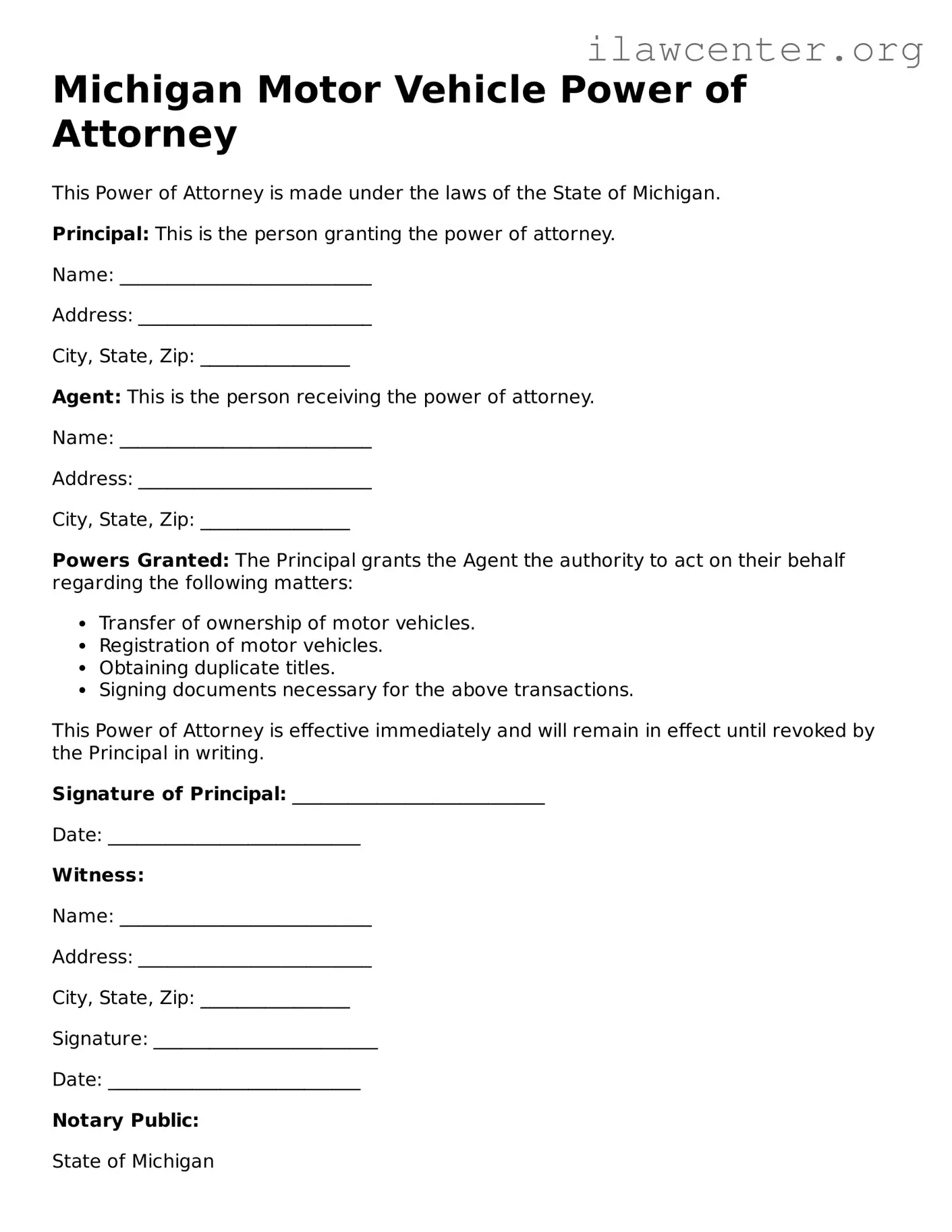
Michigan Motor Vehicle Power of Attorney Preview

Michigan Motor Vehicle Power of Attorney

This Power of Attorney is made under the laws of the State of Michigan.

Principal: This is the person granting the power of attorney.

Name: ___________________________

Address: _________________________

City, State, Zip: ________________

Agent: This is the person receiving the power of attorney.

Name: ___________________________

Address: _________________________

City, State, Zip: ________________

Powers Granted: The Principal grants the Agent the authority to act on their behalf regarding the following matters:

  • Transfer of ownership of motor vehicles.
  • Registration of motor vehicles.
  • Obtaining duplicate titles.
  • Signing documents necessary for the above transactions.

This Power of Attorney is effective immediately and will remain in effect until revoked by the Principal in writing.

Signature of Principal: ___________________________

Date: ___________________________

Witness:

Name: ___________________________

Address: _________________________

City, State, Zip: ________________

Signature: ________________________

Date: ___________________________

Notary Public:

State of Michigan

County of ______________________

Subscribed and sworn to before me this ____ day of __________, 20__.

Notary Signature: ________________________

My Commission Expires: ________________

PDF Form Characteristics

Fact Name Description
Purpose The Michigan Motor Vehicle Power of Attorney form allows an individual to authorize another person to handle motor vehicle-related transactions on their behalf.
Governing Law This form is governed by Michigan Compiled Laws, specifically MCL 600.5501 et seq.
Eligibility Any adult resident of Michigan can create a Motor Vehicle Power of Attorney.
Revocation The Power of Attorney can be revoked at any time by the principal, as long as the revocation is communicated in writing.
Notarization While notarization is not strictly required, it is recommended to ensure the document's validity and to avoid disputes.
Duration The authority granted through this form remains in effect until it is revoked or the principal becomes incapacitated.
Limitations The agent's powers can be limited to specific tasks, such as selling a vehicle or transferring title, as defined by the principal.
Agent's Responsibilities The agent must act in the best interest of the principal and follow any specific instructions provided in the Power of Attorney.

Instructions on Utilizing Michigan Motor Vehicle Power of Attorney

After obtaining the Michigan Motor Vehicle Power of Attorney form, you will need to complete it accurately to ensure it serves its intended purpose. Follow these steps to fill out the form correctly.

  1. Begin by entering the date at the top of the form.
  2. Provide the name of the person granting the power of attorney. This person is referred to as the "Principal."
  3. Enter the address of the Principal, including city, state, and ZIP code.
  4. Next, fill in the name of the individual who will be acting on behalf of the Principal. This person is known as the "Agent."
  5. Include the Agent's address, ensuring it has the correct city, state, and ZIP code.
  6. Specify the powers being granted to the Agent. This may include handling the sale, transfer, or registration of a motor vehicle.
  7. Sign and date the form at the designated space. The Principal must sign the document.
  8. Have the form notarized. This step is essential for the document to be valid.

Once the form is filled out and notarized, it can be submitted as needed to authorize the designated Agent to act on behalf of the Principal regarding motor vehicle matters.

Important Facts about Michigan Motor Vehicle Power of Attorney

What is a Michigan Motor Vehicle Power of Attorney form?

The Michigan Motor Vehicle Power of Attorney form is a legal document that allows one person to grant another person the authority to act on their behalf regarding motor vehicle transactions. This can include tasks like transferring ownership, registering a vehicle, or obtaining a title. It is particularly useful when the vehicle owner is unable to be present for these transactions due to reasons such as being out of state or having health issues.

Who can be designated as an agent in the Power of Attorney?

Any adult can be designated as an agent in the Michigan Motor Vehicle Power of Attorney form. This means you can choose a trusted family member, friend, or even a professional, such as an attorney. The key is to select someone you trust to handle your vehicle-related matters responsibly and in your best interest.

How do I complete and submit the Power of Attorney form?

To complete the form, you will need to provide information about both the principal (the person granting authority) and the agent (the person receiving authority). After filling out the necessary details, both parties must sign the document. It is advisable to have the signatures notarized to ensure the document's validity. Once completed, you can submit it to the appropriate agency, such as the Michigan Secretary of State, depending on the transaction you wish to conduct.

Is the Michigan Motor Vehicle Power of Attorney form revocable?

Yes, the Michigan Motor Vehicle Power of Attorney form is revocable. This means that you can cancel or change the authority granted to your agent at any time, as long as you are mentally competent to do so. To revoke the power of attorney, you should provide a written notice to your agent and any relevant parties, and it is wise to keep a copy of the revocation for your records.

Common mistakes

Filling out the Michigan Motor Vehicle Power of Attorney form can be a straightforward process, but many individuals make common mistakes that can lead to complications down the line. One frequent error is not providing complete information. This includes failing to fill in all required fields, such as the names and addresses of both the principal and the agent. Omitting even a small detail can render the document invalid, which may cause delays in transactions involving the vehicle.

Another mistake occurs when individuals do not properly sign the form. In Michigan, the principal must sign the document in front of a notary public. If the signature is missing or the notarization is not completed correctly, the power of attorney may not be recognized. Always ensure that the signature is clear and that the notary has completed their part before submitting the form.

People often overlook the importance of specifying the scope of authority granted to the agent. The form should clearly outline what the agent can do on behalf of the principal. For instance, if the intent is to allow the agent to sell the vehicle, that should be explicitly stated. Vague language can lead to misunderstandings and disputes later on, so clarity is essential.

Finally, individuals sometimes fail to keep a copy of the completed form. Once the Michigan Motor Vehicle Power of Attorney is signed and notarized, it’s crucial to retain a copy for personal records. This serves as proof of the authority granted and can be helpful in case any questions arise regarding the agent's powers. Not having a copy can lead to confusion and potential issues when the agent attempts to act on behalf of the principal.

Documents used along the form

When dealing with the Michigan Motor Vehicle Power of Attorney form, several other documents may be necessary to complete the process effectively. These forms help ensure that all aspects of vehicle ownership and transfer are handled appropriately.

  • Michigan Vehicle Title Application: This form is required when applying for a new title for a vehicle. It captures essential information about the vehicle and its owner, ensuring proper registration with the state.
  • Bill of Sale: A Bill of Sale serves as a legal document that records the transaction between the buyer and seller. It outlines the terms of the sale, including the purchase price and vehicle details, providing proof of ownership transfer.
  • Affidavit of Ownership: This document is used when there is no title available for a vehicle. It allows the owner to declare their ownership and provides a legal basis for obtaining a new title.
  • Application for a Duplicate Title: If the original title is lost or damaged, this form can be submitted to request a replacement. It ensures that the vehicle remains legally titled in the owner's name.

Utilizing these forms alongside the Michigan Motor Vehicle Power of Attorney can streamline the process of managing vehicle transactions. Being prepared with the right documents helps avoid complications and ensures compliance with state regulations.

Similar forms

  • General Power of Attorney: This document allows one person to grant another the authority to act on their behalf in a wide range of matters, not just related to motor vehicles. It covers financial and legal decisions, providing broad powers to the agent.
  • Durable Power of Attorney: Similar to a general power of attorney, this document remains effective even if the principal becomes incapacitated. It ensures that someone can manage financial affairs and make decisions when the principal cannot.
  • Health Care Power of Attorney: This document specifically focuses on medical decisions. It allows an agent to make health care choices for the principal if they are unable to do so themselves, ensuring that their medical preferences are respected.
  • Vehicle Title Transfer Form: While not a power of attorney, this document is used to transfer ownership of a vehicle. It requires signatures from both the seller and buyer, similar to how a power of attorney requires signatures for authority to act.
  • Bill of Sale: This document serves as proof of the sale of a vehicle. It outlines the transaction details and is often required when transferring ownership, much like how a power of attorney is needed to authorize actions on behalf of another.
  • Release of Liability Form: When selling a vehicle, this document protects the seller from future claims related to the vehicle after the sale. It is similar in purpose to a power of attorney, which can limit liability by delegating authority to another party.

Dos and Don'ts

When filling out the Michigan Motor Vehicle Power of Attorney form, it’s important to follow certain guidelines. Here are some things you should and shouldn’t do:

  • Do read the entire form carefully before starting.
  • Do ensure that all information is accurate and up-to-date.
  • Don’t leave any required fields blank.
  • Don’t sign the form until you are in the presence of a notary public.

Misconceptions

When it comes to the Michigan Motor Vehicle Power of Attorney form, there are several misconceptions that can lead to confusion. Here are four common misunderstandings:

  1. It can only be used for buying or selling vehicles.

    Many people think that this form is limited to transactions like buying or selling a vehicle. However, it can also be used for a variety of purposes, including registering a vehicle, transferring titles, and handling other motor vehicle-related tasks.

  2. Only a lawyer can fill out the form.

    Some believe that a lawyer is required to complete the Motor Vehicle Power of Attorney form. In reality, any individual can fill it out as long as they understand the responsibilities and powers being granted.

  3. It must be notarized to be valid.

    While notarization can add an extra layer of authenticity, it is not a strict requirement for the form to be valid in Michigan. As long as the form is signed by the principal and the agent, it can be effective.

  4. It expires after a short period.

    Another common misconception is that the Motor Vehicle Power of Attorney form has a limited lifespan. In fact, it remains in effect until the principal revokes it or until the specified tasks are completed, unless otherwise stated in the document.

Understanding these misconceptions can help individuals navigate the process more effectively and ensure that they use the form correctly.

Key takeaways

When considering the Michigan Motor Vehicle Power of Attorney form, it is essential to understand its purpose and how to use it effectively. Here are some key takeaways to keep in mind:

  1. Purpose of the Form: This form allows you to designate another person to handle specific motor vehicle-related transactions on your behalf.
  2. Eligibility: Any adult resident of Michigan can be appointed as your attorney-in-fact, but they should be trustworthy and reliable.
  3. Specific Authority: Clearly outline the powers you are granting. This may include signing documents, transferring titles, or registering vehicles.
  4. Durability: The power of attorney remains in effect until you revoke it or it is no longer needed, so choose your agent wisely.
  5. Signature Requirements: You must sign the form in the presence of a notary public for it to be valid. Ensure all signatures are properly executed.
  6. Revocation: You can revoke the power of attorney at any time. To do so, provide a written notice to your agent and any relevant parties.
  7. Usage: Present the completed form to the appropriate authorities or institutions when your agent is acting on your behalf.
  8. Record Keeping: Keep a copy of the signed form for your records and provide copies to your agent and any relevant entities.
  9. Consultation: If you have any doubts or questions, consider consulting a legal professional to ensure your intentions are clearly expressed.

By understanding these key points, you can navigate the process of using the Michigan Motor Vehicle Power of Attorney form with confidence.