Attorney-Verified  Notary Acknowledgement Document for Michigan

Attorney-Verified Notary Acknowledgement Document for Michigan

The Michigan Notary Acknowledgement form is a legal document used to confirm that a notary public has verified the identity of the signer and witnessed the signing of a document. This form plays a crucial role in ensuring that important documents are executed properly and can be used in various legal contexts. To get started on filling out the form, click the button below.

Article Guide

The Michigan Notary Acknowledgment form plays a crucial role in the notarization process, ensuring that signatures on important documents are verified and legally recognized. This form is often used when individuals need to affirm their identity before a notary public, confirming that they willingly signed a document. It includes essential details such as the name of the signer, the date of signing, and the notary's official stamp. The notary public's role is to witness the signing and provide an acknowledgment that the signer is who they claim to be. By using this form, parties can enhance the credibility of their documents, making it easier to enforce agreements and protect against fraud. Understanding how to properly complete and utilize the Michigan Notary Acknowledgment form is vital for anyone engaged in legal transactions or document execution in the state.

Michigan Notary Acknowledgement Preview

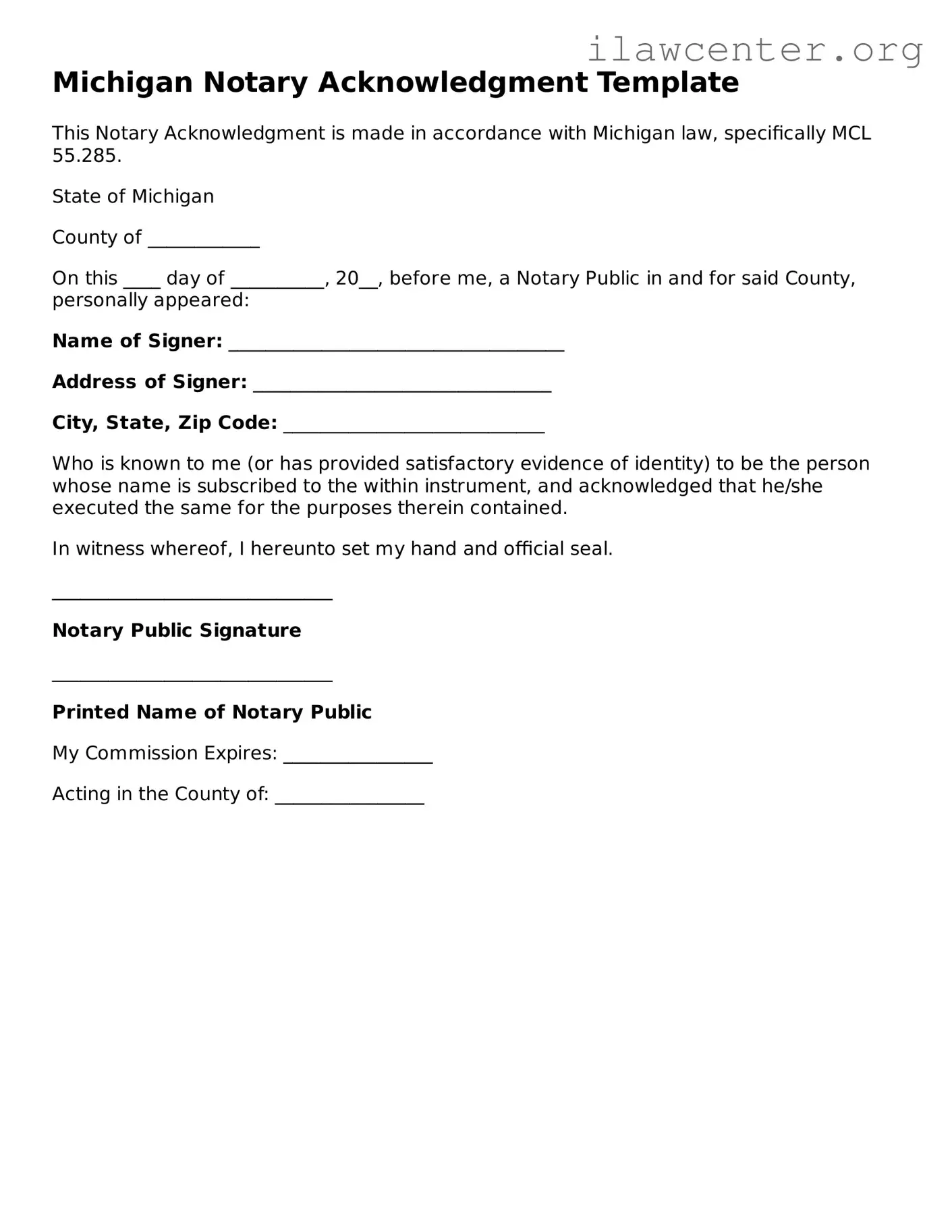
Michigan Notary Acknowledgment Template

This Notary Acknowledgment is made in accordance with Michigan law, specifically MCL 55.285.

State of Michigan

County of ____________

On this ____ day of __________, 20__, before me, a Notary Public in and for said County, personally appeared:

Name of Signer: ____________________________________

Address of Signer: ________________________________

City, State, Zip Code: ____________________________

Who is known to me (or has provided satisfactory evidence of identity) to be the person whose name is subscribed to the within instrument, and acknowledged that he/she executed the same for the purposes therein contained.

In witness whereof, I hereunto set my hand and official seal.

______________________________

Notary Public Signature

______________________________

Printed Name of Notary Public

My Commission Expires: ________________

Acting in the County of: ________________

PDF Form Characteristics

Fact Name Details
Purpose The Michigan Notary Acknowledgement form is used to verify the identity of a signer and confirm that they have willingly signed a document.
Governing Law This form is governed by the Michigan Notary Public Act, specifically MCL 55.261 through MCL 55.309.
Signature Requirement Signers must personally appear before the notary at the time of the acknowledgment.
Notary's Role The notary public must complete the form by providing their signature, seal, and the date of the acknowledgment.
Record Keeping Notaries are required to maintain a record of all acknowledgments performed, ensuring accountability and transparency.

Instructions on Utilizing Michigan Notary Acknowledgement

After gathering the necessary information, you will proceed to fill out the Michigan Notary Acknowledgement form. Ensure you have all required details at hand for a smooth process.

  1. Start by entering the date on which the acknowledgment is being made.
  2. In the first blank, write the name of the person who is signing the document.
  3. In the second blank, provide the address of the signer, including city and state.
  4. Next, indicate the type of identification the signer is providing. This may include a driver's license number or another form of ID.
  5. In the space provided, write the name of the notary public who will be witnessing the signature.
  6. Sign and date the form as the notary public.
  7. Finally, affix your notary seal in the designated area on the form.

Important Facts about Michigan Notary Acknowledgement

What is a Michigan Notary Acknowledgement form?

The Michigan Notary Acknowledgement form is a legal document used to verify that a person has willingly signed a document in the presence of a notary public. This form provides assurance that the signer is who they claim to be and that they understand the contents of the document they are signing.

Who can act as a notary public in Michigan?

In Michigan, a notary public can be any individual who is at least 18 years old, a resident of Michigan or employed in the state, and has completed the necessary training and application process. Notaries must also pass a background check and obtain a notary commission from the state.

What documents require a Notary Acknowledgement in Michigan?

Many legal documents may require a Notary Acknowledgement, including contracts, deeds, powers of attorney, and affidavits. It is important to check the specific requirements for each document, as not all documents need notarization.

How do I complete a Notary Acknowledgement form?

To complete a Notary Acknowledgement form, the signer must appear before the notary and provide valid identification. The notary will then fill out the form, indicating the date, the signer's name, and their acknowledgment of the signature. The notary will also sign and stamp the form to validate it.

Is there a fee for notarization in Michigan?

Yes, notaries in Michigan are allowed to charge a fee for their services. The maximum fee is set by state law, and it can vary based on the type of document being notarized. It's advisable to confirm the fee with the notary before the service is rendered.

How long is a Notary Acknowledgement valid in Michigan?

A Notary Acknowledgement does not have an expiration date on its own. However, the document being notarized may have its own validity period. It is essential to consider the context of the document to determine how long the acknowledgment remains effective.

What should I do if I believe a Notary Acknowledgement was improperly executed?

If you suspect that a Notary Acknowledgement was improperly executed, you should gather any relevant evidence and contact the notary directly to address your concerns. If the issue remains unresolved, you may report the notary to the Michigan Secretary of State or seek legal advice to explore your options.
Common mistakes

Filling out the Michigan Notary Acknowledgment form can seem straightforward, but many individuals make critical mistakes that can lead to delays or rejections. One common error is failing to include the correct name of the signer. The name on the form must match the identification presented to the notary. If there is any discrepancy, the acknowledgment may not be valid.

Another frequent mistake involves the date. It is essential to enter the correct date when the acknowledgment is being signed. A missing or incorrect date can render the document ineffective. Always double-check this detail before submitting the form.

People often overlook the importance of the notary's signature. The notary must sign the form in the designated area. Failure to do so can invalidate the acknowledgment. Additionally, the notary should ensure that their seal is clearly affixed to the document; an unclear or missing seal can cause problems.

Some individuals neglect to provide a complete address for the signer. This information is crucial for identification purposes and must be included in the acknowledgment. Omitting this detail can lead to questions about the legitimacy of the document.

Another mistake is not using the correct form for the specific purpose. Michigan has different acknowledgment forms for various types of documents. Using the wrong form can complicate matters and may not fulfill the legal requirements needed for certain transactions.

In some cases, people fail to ensure that the signer is present during the notarization. The signer must personally appear before the notary to acknowledge their signature. If the notary does not witness the signing, the acknowledgment is not valid.

Lastly, individuals may not review the entire form before submitting it. Skimming through the document can lead to overlooked errors. A thorough review can catch mistakes that could otherwise jeopardize the notarization process.

Documents used along the form

When preparing to use the Michigan Notary Acknowledgement form, there are several other documents that may be helpful. Each of these documents serves a specific purpose in the process of notarization and can ensure that all legal requirements are met. Below is a list of common forms and documents often used alongside the Michigan Notary Acknowledgement form.

  • Affidavit: A written statement confirmed by oath or affirmation, used as evidence in court. This document often requires notarization to ensure its authenticity.
  • Power of Attorney: A legal document that allows one person to act on behalf of another in legal or financial matters. Notarization is usually required to validate the authority granted.
  • Deed: A document that conveys ownership of real property. A notary public often witnesses the signing of a deed to confirm the identities of the parties involved.
  • Contract: An agreement between two or more parties that is enforceable by law. Notarizing a contract can add an extra layer of security and trust to the agreement.
  • Living Will: A document that outlines a person’s wishes regarding medical treatment in case they are unable to communicate. Notarization can help ensure that the document is recognized legally.
  • Certification of Trust: A document that provides information about a trust and its terms. This document may require notarization to confirm its legitimacy.
  • Loan Documents: Various forms related to borrowing money, including promissory notes and mortgage agreements. Notarization is often necessary to finalize these documents.

Using these documents in conjunction with the Michigan Notary Acknowledgement form can help streamline the notarization process. It is important to ensure that all forms are completed accurately and are notarized properly to avoid any potential legal issues.

Similar forms

The Notary Acknowledgment form serves a specific purpose in the realm of legal documentation. However, several other documents share similar functions or characteristics. Here’s a look at five such documents:

  • Affidavit: Like a Notary Acknowledgment, an affidavit is a written statement confirmed by oath or affirmation. Both documents require a notary public to verify the identity of the signer, ensuring the authenticity of the declaration made.
  • Power of Attorney: This document grants one person the authority to act on behalf of another. Similar to a Notary Acknowledgment, it must be notarized to confirm the identity of the principal and ensure that the grant of authority is legitimate.
  • Deed: A deed transfers ownership of property from one party to another. Much like a Notary Acknowledgment, it requires notarization to validate the signatures and affirm that the parties involved are acting willingly and knowingly.
  • Certificate of Acknowledgment: This document specifically confirms that a signer appeared before a notary and acknowledged that they signed the document voluntarily. It directly parallels the Notary Acknowledgment in its purpose and function.
  • Loan Agreement: Often requiring notarization, a loan agreement outlines the terms between a borrower and a lender. Like the Notary Acknowledgment, it provides a level of security and legitimacy by confirming the identities of the parties involved.

Understanding these documents can help individuals navigate legal processes more effectively. Each serves to establish trust and authenticity in various transactions, much like the Notary Acknowledgment itself.

Dos and Don'ts

When filling out the Michigan Notary Acknowledgment form, it is important to approach the task with care. Here are some guidelines to help ensure that the form is completed correctly.

Things You Should Do:

  • Read the instructions carefully before starting. Understanding the requirements will help you avoid mistakes.
  • Ensure that all required fields are filled out completely. Missing information can lead to delays or rejections.
  • Sign the document in the presence of the notary public. This step is crucial for the acknowledgment to be valid.
  • Use clear and legible handwriting if filling out the form by hand. This will help prevent misunderstandings.
  • Keep a copy of the completed form for your records. This can be useful for future reference.

Things You Shouldn't Do:

  • Do not leave any required fields blank. Omitting information can invalidate the acknowledgment.
  • Avoid using white-out or erasing mistakes. Instead, cross out the error and initial it, or start over with a new form.
  • Do not sign the form before meeting with the notary. The notary must witness your signature for it to be valid.
  • Refrain from using abbreviations or unclear terms. Clarity is essential for legal documents.
  • Do not forget to check the expiration date of your notary commission. An expired commission will invalidate the acknowledgment.

Misconceptions

Understanding the Michigan Notary Acknowledgment form is crucial for anyone involved in notarization. Unfortunately, there are several misconceptions that can lead to confusion. Here are five common myths about this important document:

  1. Notaries can notarize any document.

    This is not true. Notaries in Michigan are only authorized to notarize documents that are presented to them by individuals. The content of the document must be lawful, and the notary must ensure that the signer is present and can provide proper identification.

  2. The notary must know the signer personally.

    While personal acquaintance can help, it is not a requirement. A notary can verify the identity of a signer through valid identification, such as a driver's license or passport, even if they do not know them personally.

  3. All signatures must be witnessed by the notary.

    This is a common misunderstanding. In Michigan, the notary's role is to acknowledge the signature, not necessarily to witness it. The signer must sign the document in the notary's presence, but the notary does not have to witness the signing itself.

  4. Notary acknowledgments are the same as notarized signatures.

    This is misleading. A notarized signature simply means that the notary has verified the identity of the signer. An acknowledgment, however, is a specific statement that the signer has willingly signed the document, which is formally recorded on the acknowledgment form.

  5. The notary can provide legal advice.

    Notaries are not authorized to give legal advice. Their role is strictly to verify identities and witness signatures. If you have legal questions or need assistance, it is best to consult a qualified attorney.

Clearing up these misconceptions can help ensure that the notarization process goes smoothly and that all parties understand their rights and responsibilities. Always consult with a professional if you have questions about the notarization process.

Key takeaways

When filling out and using the Michigan Notary Acknowledgement form, it is important to keep several key points in mind. Understanding these can help ensure that the process goes smoothly and that the document is legally valid.

  • The form is used to verify the identity of the signer and confirm that they willingly signed the document.
  • It must be completed in the presence of a notary public, who will witness the signing.
  • All parties involved should provide valid identification to the notary at the time of signing.
  • The notary will complete the acknowledgment section, which includes their signature and seal.
  • Ensure that the document being acknowledged is complete and accurate before the notary's signature is added.
  • Keep a record of the notarial act in the notary's journal, which is required by Michigan law.
  • After the acknowledgment is complete, the document can be used as needed, often for legal or official purposes.

By following these guidelines, individuals can navigate the process of using the Michigan Notary Acknowledgement form more effectively.