Attorney-Verified  Notice to Quit Document for Michigan

Attorney-Verified Notice to Quit Document for Michigan

The Michigan Notice to Quit form is a legal document used by landlords to inform tenants that they must vacate the rental property. This form serves as an official notice and outlines the reasons for termination of the lease agreement. If you're in need of this form, click the button below to fill it out.

Article Guide

The Michigan Notice to Quit form is an important document for landlords and tenants navigating the rental landscape. This form serves as a formal notification that a tenant must vacate the rental property, typically due to lease violations or non-payment of rent. It outlines specific details, such as the reason for the notice, the timeframe in which the tenant must respond or leave, and any necessary actions that may follow. Understanding this form is crucial for both parties, as it helps ensure that the eviction process, if needed, is handled legally and appropriately. By adhering to the guidelines set forth in the Notice to Quit, landlords can protect their rights while providing tenants with a clear understanding of their obligations. This form plays a vital role in maintaining a fair rental relationship, allowing both landlords and tenants to address issues before they escalate into more significant disputes.

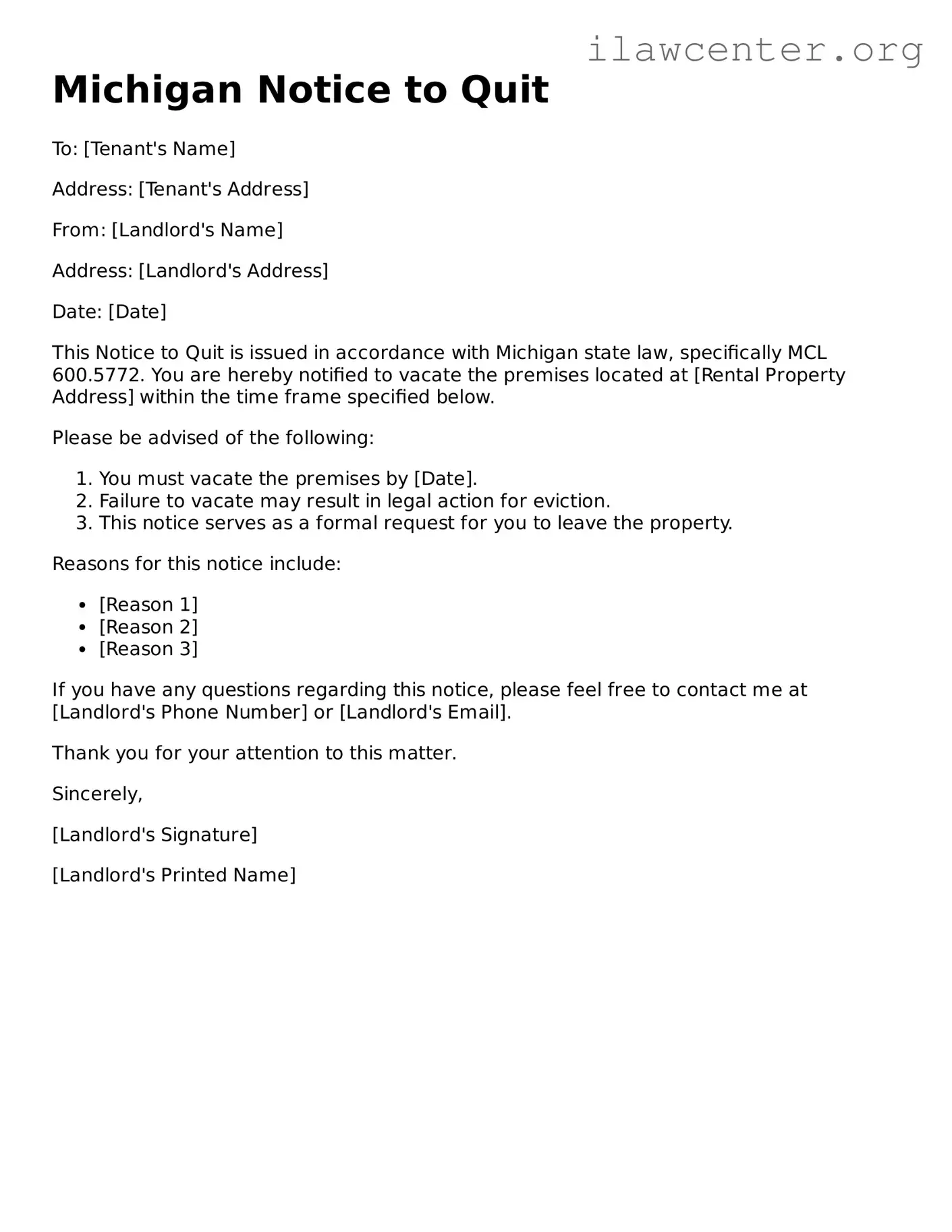
Michigan Notice to Quit Preview

Michigan Notice to Quit

To: [Tenant's Name]

Address: [Tenant's Address]

From: [Landlord's Name]

Address: [Landlord's Address]

Date: [Date]

This Notice to Quit is issued in accordance with Michigan state law, specifically MCL 600.5772. You are hereby notified to vacate the premises located at [Rental Property Address] within the time frame specified below.

Please be advised of the following:

  1. You must vacate the premises by [Date].
  2. Failure to vacate may result in legal action for eviction.
  3. This notice serves as a formal request for you to leave the property.

Reasons for this notice include:

  • [Reason 1]
  • [Reason 2]
  • [Reason 3]

If you have any questions regarding this notice, please feel free to contact me at [Landlord's Phone Number] or [Landlord's Email].

Thank you for your attention to this matter.

Sincerely,

[Landlord's Signature]

[Landlord's Printed Name]

PDF Form Characteristics

Fact Name Description
Purpose The Michigan Notice to Quit form is used by landlords to inform tenants of their intention to terminate a lease agreement.
Governing Law This form is governed by the Michigan Landlord-Tenant Act, specifically MCL 554.134.
Notice Period Typically, a landlord must provide a notice period of at least 7 days for non-payment of rent or 30 days for lease violations.
Delivery Methods The notice can be delivered in person, by mail, or by posting it on the tenant's door.

Instructions on Utilizing Michigan Notice to Quit

Once you have the Michigan Notice to Quit form ready, it's time to fill it out accurately. This form is essential for notifying a tenant about the need to vacate the premises. Following the steps below will help ensure that you complete it correctly.

  1. Begin by entering your name and address at the top of the form. This identifies you as the landlord.
  2. Next, provide the tenant's name and address. Make sure to write it clearly to avoid any confusion.
  3. Specify the date you are issuing the notice. This is important for tracking purposes.
  4. Indicate the reason for the notice. Be concise and factual.
  5. State the number of days the tenant has to vacate the property. This should align with Michigan's legal requirements.
  6. Sign and date the form at the bottom. Your signature confirms the notice has been issued.
  7. Make copies of the completed form for your records and for the tenant.

After filling out the form, you will need to deliver it to the tenant. This can be done in person, by mail, or by posting it on the property, depending on the circumstances. Ensure you keep a record of how and when the notice was delivered.

Important Facts about Michigan Notice to Quit

What is the Michigan Notice to Quit form?

The Michigan Notice to Quit form is a legal document used by landlords to inform tenants that they must vacate the rental property. This notice is typically issued when a tenant has violated the lease agreement or failed to pay rent. The form serves as a formal request for the tenant to leave the premises within a specified time frame.

When should a landlord use a Notice to Quit?

A landlord should use a Notice to Quit when a tenant has not complied with the terms of the lease. Common reasons include non-payment of rent, lease violations, or engaging in illegal activities on the property. The notice provides the tenant with an opportunity to remedy the situation or vacate the property.

How much notice must a landlord give before filing for eviction?

The amount of notice required depends on the reason for the eviction. For non-payment of rent, a 7-day notice is typical. If the eviction is due to lease violations, a 30-day notice may be required. It is important to check local laws for specific requirements.

Can a tenant contest a Notice to Quit?

Yes, a tenant can contest a Notice to Quit. If a tenant believes the notice is unjust or that they have remedied the issue, they can respond to the landlord or seek legal assistance. A court hearing may be necessary to resolve the dispute.

What happens if a tenant does not comply with the Notice to Quit?

If a tenant does not comply with the Notice to Quit, the landlord may proceed with filing for eviction in court. The court will review the case and determine whether to grant the eviction. It is important for landlords to follow the legal process to avoid potential complications.

Is the Notice to Quit form available online?

Yes, the Notice to Quit form is often available online through various legal resources or state government websites. It is important to ensure that the form used is the most current version and complies with Michigan laws.

Do I need to provide a reason for the Notice to Quit?

Yes, the Notice to Quit should include a reason for the eviction. Providing a clear reason helps ensure that the notice is valid and gives the tenant an understanding of why they are being asked to leave.

Can a Notice to Quit be delivered by email?

In Michigan, a Notice to Quit must be delivered in writing. While email may be an acceptable method of communication, it is generally recommended to deliver the notice in person or via certified mail to ensure it is received and documented properly.

What should a tenant do upon receiving a Notice to Quit?

Upon receiving a Notice to Quit, a tenant should review the document carefully. They should assess the reason for the notice and determine if they can resolve the issue. Seeking legal advice or assistance may also be beneficial to understand their rights and options.

Are there any legal protections for tenants against a Notice to Quit?

Yes, tenants have legal protections. If a tenant believes that the Notice to Quit is retaliatory or discriminatory, they may have grounds to contest it. Additionally, tenants may have rights under local and state housing laws that protect them from unjust eviction.
Common mistakes

Filling out the Michigan Notice to Quit form can be a straightforward process, but many people make common mistakes that can complicate matters. Understanding these pitfalls can help ensure that the form is completed correctly and effectively. Here are ten mistakes to watch out for.

One frequent error is not providing the correct address of the rental property. This address must be precise, including the street number, street name, city, and zip code. Omitting any part of this information can lead to confusion and potentially delay the eviction process.

Another common mistake is failing to include the tenant's full name. The form should clearly state the name of the tenant as it appears on the lease agreement. If a nickname or abbreviated name is used, it may not be legally binding.

Many people also overlook the importance of specifying the reason for the notice. Whether it’s for non-payment of rent or a lease violation, stating the reason clearly is crucial. Without this information, the notice may be deemed incomplete.

Additionally, some individuals forget to sign and date the form. This step is essential, as an unsigned notice is not valid. It’s important to remember that the signature should be that of the landlord or the authorized representative.

Another mistake involves not giving the correct amount of notice. In Michigan, the required notice period varies based on the reason for eviction. For instance, a non-payment of rent notice typically requires a seven-day notice, while lease violations may require a longer period. Failing to adhere to these timelines can invalidate the notice.

People sometimes also fail to deliver the notice properly. Simply placing the notice on the tenant's door is not sufficient. The notice must be delivered in a manner that complies with Michigan law, such as through personal delivery or certified mail.

Moreover, neglecting to keep a copy of the completed form for personal records is a mistake that can lead to complications later. Having a copy can serve as proof of the notice and the date it was delivered.

Some individuals mistakenly assume that the Notice to Quit is the final step in the eviction process. In reality, this form is just the beginning. After serving the notice, landlords must follow through with the appropriate legal procedures to initiate an eviction if necessary.

Another oversight is not checking for any local ordinances that may affect the eviction process. Different cities or counties in Michigan may have specific regulations that need to be followed, so it’s wise to do some research before proceeding.

Finally, failing to consult with a legal professional can be a significant mistake. While it may seem unnecessary, getting advice from someone knowledgeable in landlord-tenant law can help avoid errors that could jeopardize the eviction process.

Documents used along the form

The Michigan Notice to Quit form is an essential document for landlords seeking to terminate a tenancy. However, several other forms and documents may accompany this notice to ensure compliance with legal requirements and to facilitate the eviction process. Below is a list of commonly used documents that landlords and tenants should be aware of.

  • Lease Agreement: This is the original contract between the landlord and tenant, outlining the terms and conditions of the rental arrangement. It serves as the foundation for any legal actions regarding the tenancy.
  • Notice of Nonpayment: This document is issued when a tenant fails to pay rent. It formally notifies the tenant of their overdue payment and may be a prerequisite for further eviction proceedings.
  • Eviction Complaint: If the tenant does not comply with the Notice to Quit, the landlord may file an eviction complaint with the court. This document initiates the legal process to remove the tenant from the property.
  • Summons: After filing an eviction complaint, a summons is issued to the tenant. It informs them of the court date and the nature of the complaint against them, requiring their presence in court.
  • Judgment Order: If the court rules in favor of the landlord, a judgment order is issued. This document officially allows the landlord to proceed with eviction and may include details about any owed rent or damages.
  • Writ of Eviction: Following a judgment order, a writ of eviction is obtained. This legal document authorizes law enforcement to remove the tenant from the property if they do not vacate voluntarily.
  • Tenant's Answer: The tenant may respond to the eviction complaint with an answer, outlining their defense or reasons for contesting the eviction. This document is crucial for the court's consideration of the case.

Understanding these documents is vital for both landlords and tenants navigating the eviction process in Michigan. Each form plays a specific role and contributes to ensuring that the rights of all parties are respected throughout the legal proceedings.

Similar forms

The Notice to Quit form is an important document in landlord-tenant relationships. It serves as a formal communication that a tenant must vacate the property. Several other documents share similarities with the Notice to Quit form, as they also serve to communicate important information regarding tenancy and property rights. Below is a list of nine documents that are similar to the Notice to Quit form:

  • Eviction Notice: This document informs a tenant that they are being evicted due to specific reasons, such as non-payment of rent or lease violations. Like the Notice to Quit, it provides a timeframe for the tenant to vacate the premises.
  • Notice of Lease Termination: This notice indicates that a lease will not be renewed at the end of its term. It communicates the landlord's intention to terminate the lease agreement, similar to how a Notice to Quit requests a tenant to leave.
  • Demand for Rent: This document is issued when rent has not been paid. It serves as a formal request for overdue rent and may precede eviction actions, paralleling the Notice to Quit's role in addressing tenancy issues.
  • Notice of Rent Increase: This notice informs tenants of an upcoming rent increase. It is similar in that it communicates important changes regarding the tenancy, similar to how a Notice to Quit addresses the need to vacate.
  • Notice of Intent to Enter: This document informs tenants that the landlord intends to enter the rental property for specific reasons. Like the Notice to Quit, it serves to maintain clear communication between landlords and tenants.
  • Notice of Abandonment: This notice is used when a landlord believes that a tenant has abandoned the property. It outlines the landlord's intention to reclaim the property, akin to the purpose of a Notice to Quit.
  • Lease Violation Notice: This document notifies a tenant of a violation of lease terms. It typically gives the tenant a chance to correct the issue before further action is taken, similar to how a Notice to Quit requests compliance.
  • Notice to Cure: This notice is issued when a tenant has violated a term of the lease, providing them with an opportunity to remedy the situation. It parallels the Notice to Quit in its goal of resolving tenancy issues.
  • Termination of Tenancy Notice: This document formally terminates a tenancy agreement, similar to the Notice to Quit. It outlines the reasons for termination and the required actions from the tenant.

Dos and Don'ts

When filling out the Michigan Notice to Quit form, it is essential to follow certain guidelines to ensure accuracy and legality. Here are some things you should and shouldn't do:

  • Do ensure that you have the correct address of the rental property.
  • Do clearly state the reason for the notice.
  • Do provide the date by which the tenant must vacate the premises.
  • Do sign and date the form to validate it.
  • Do keep a copy of the Notice to Quit for your records.
  • Don't use vague language; be specific about the reasons for the notice.
  • Don't forget to check local laws for any additional requirements.
  • Don't send the notice without confirming that it is filled out correctly.
  • Don't ignore the timelines; ensure you comply with Michigan's legal requirements.

Following these guidelines can help prevent misunderstandings and ensure that the process is handled properly. Proper documentation is crucial in legal matters, especially in landlord-tenant relationships.

Misconceptions

Understanding the Michigan Notice to Quit form is crucial for both landlords and tenants. However, several misconceptions can lead to confusion. Here are five common misunderstandings:

  • It is the same as an eviction notice. Many people believe that a Notice to Quit is an eviction notice. In reality, it is a formal request for a tenant to vacate the property. An eviction notice follows a Notice to Quit if the tenant does not comply.
  • It can be issued for any reason. Some assume that landlords can issue a Notice to Quit for any reason. However, valid reasons must exist, such as non-payment of rent or lease violations.
  • It does not require a specific format. There is a common belief that the Notice to Quit can be written in any format. In fact, the form must adhere to specific legal requirements to be enforceable.
  • Tenants have unlimited time to respond. Many tenants think they can take their time in responding to a Notice to Quit. However, they typically have a limited timeframe to either comply or contest the notice.
  • It guarantees eviction. Some landlords may believe that issuing a Notice to Quit guarantees that a tenant will be evicted. This is not the case, as the eviction process requires further legal steps and court involvement.

Clarifying these misconceptions can help ensure that both landlords and tenants understand their rights and responsibilities regarding the Notice to Quit in Michigan.

Key takeaways

Filling out and using the Michigan Notice to Quit form can be a straightforward process if you keep a few important points in mind. Here are some key takeaways to consider:

  1. Understand the Purpose: The Notice to Quit is a formal way to inform a tenant that they must vacate the rental property. It is often used when rent is overdue or when there is a lease violation.
  2. Know the Required Notice Period: Depending on the reason for the eviction, the notice period can vary. Typically, a 7-day notice is required for non-payment of rent, while a 30-day notice may be necessary for other lease violations.
  3. Provide Clear Information: Fill out the form with accurate details, including the tenant's name, address of the rental property, and the specific reason for the eviction. Clarity helps avoid confusion.
  4. Deliver the Notice Properly: Ensure that the Notice to Quit is delivered in a manner that complies with Michigan law. This can include personal delivery, certified mail, or posting it on the property.
  5. Keep a Copy: Always retain a copy of the completed Notice to Quit for your records. This documentation can be essential if further legal action becomes necessary.
  6. Consult Legal Advice if Needed: If you are unsure about any part of the process, consider seeking legal advice. This can help ensure that you are following the law correctly and protecting your rights.

By following these guidelines, you can navigate the process of using the Michigan Notice to Quit form more effectively.