Attorney-Verified  Operating Agreement Document for Michigan

Attorney-Verified Operating Agreement Document for Michigan

The Michigan Operating Agreement form is a legal document that outlines the management structure and operational guidelines for a limited liability company (LLC) in Michigan. This form helps establish the roles and responsibilities of members, ensuring clarity and compliance with state laws. Ready to set up your LLC? Fill out the form by clicking the button below.

Article Guide

When starting a limited liability company (LLC) in Michigan, one of the most crucial documents you will encounter is the Operating Agreement. This form serves as the backbone of your business structure, outlining the roles and responsibilities of members, management procedures, and the distribution of profits and losses. It is essential for clarifying how decisions will be made and how disputes will be resolved, ensuring that all members are on the same page from the outset. Additionally, the Operating Agreement helps to protect your personal assets by reinforcing the separation between your business and personal finances. While Michigan does not legally require an Operating Agreement, having one in place can provide significant advantages, including enhanced credibility with banks and investors. Understanding the key components of this document can empower you to craft an agreement that reflects your business goals and meets the needs of all members involved.

Michigan Operating Agreement Preview

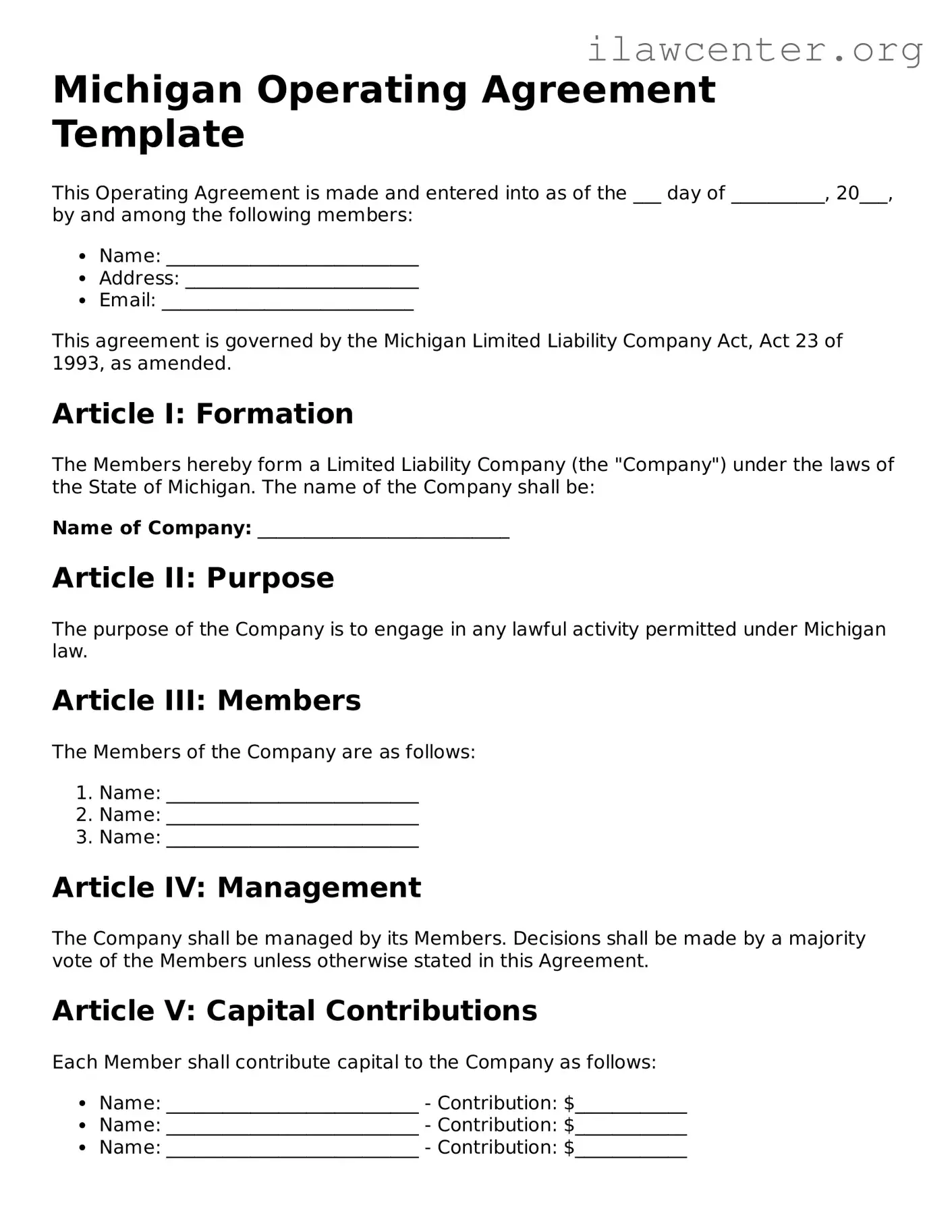
Michigan Operating Agreement Template

This Operating Agreement is made and entered into as of the ___ day of __________, 20___, by and among the following members:

  • Name: ___________________________
  • Address: _________________________
  • Email: ___________________________

This agreement is governed by the Michigan Limited Liability Company Act, Act 23 of 1993, as amended.

Article I: Formation

The Members hereby form a Limited Liability Company (the "Company") under the laws of the State of Michigan. The name of the Company shall be:

Name of Company: ___________________________

Article II: Purpose

The purpose of the Company is to engage in any lawful activity permitted under Michigan law.

Article III: Members

The Members of the Company are as follows:

  1. Name: ___________________________
  2. Name: ___________________________
  3. Name: ___________________________

Article IV: Management

The Company shall be managed by its Members. Decisions shall be made by a majority vote of the Members unless otherwise stated in this Agreement.

Article V: Capital Contributions

Each Member shall contribute capital to the Company as follows:

  • Name: ___________________________ - Contribution: $____________
  • Name: ___________________________ - Contribution: $____________
  • Name: ___________________________ - Contribution: $____________

Article VI: Distributions

Distributions of profits and losses shall be allocated to the Members in proportion to their respective capital contributions.

Article VII: Indemnification

The Company shall indemnify any Member against any loss or liability incurred in connection with the Company, except in cases of gross negligence or willful misconduct.

Article VIII: Amendments

This Operating Agreement may be amended only by a written agreement signed by all Members.

Article IX: Governing Law

This Agreement shall be governed by and construed in accordance with the laws of the State of Michigan.

IN WITNESS WHEREOF, the Members have executed this Operating Agreement as of the date first above written.

______________________________
Signature of Member

______________________________
Signature of Member

______________________________
Signature of Member

PDF Form Characteristics

Fact Name Description
Purpose The Michigan Operating Agreement outlines the management structure and operating procedures of a limited liability company (LLC).
Governing Law This agreement is governed by the Michigan Limited Liability Company Act, specifically Act 23 of 1993.
Members' Rights The agreement specifies the rights and responsibilities of each member, including profit sharing and decision-making processes.
Amendments Members can amend the Operating Agreement as needed, but such changes must be documented and agreed upon by all members.
Duration The agreement can specify the duration of the LLC, whether it is perpetual or for a fixed term.
Legal Requirement While not legally required, having an Operating Agreement is highly recommended for LLCs in Michigan to clarify operations and reduce disputes.

Instructions on Utilizing Michigan Operating Agreement

Filling out the Michigan Operating Agreement form is an important step for business owners. Once completed, this form will help outline the management structure and operational procedures for your business. After you have filled it out, you will need to keep it on file for your records and share it with relevant parties as necessary.

  1. Begin by entering the name of your business at the top of the form.
  2. Next, provide the principal address of your business. This should be where your business is primarily located.
  3. List the names and addresses of all members involved in the business. Include their roles if applicable.
  4. Specify the percentage of ownership for each member. This will clarify how profits and losses will be distributed.
  5. Outline the management structure. Indicate whether the business will be member-managed or manager-managed.
  6. Include the duration of the business. State whether it is intended to be perpetual or for a specific period.
  7. Detail any additional provisions or rules that members agree upon. This can include voting rights, meetings, and other operational guidelines.
  8. Sign and date the form at the bottom. Each member should also sign to acknowledge their agreement to the terms outlined.

Important Facts about Michigan Operating Agreement

What is a Michigan Operating Agreement?

A Michigan Operating Agreement is a legal document that outlines the management structure and operational procedures of a limited liability company (LLC) in Michigan. It serves as an internal guideline for the members of the LLC, detailing their rights, responsibilities, and the distribution of profits and losses. This agreement is crucial for establishing clear expectations among members and protecting their interests.

Is an Operating Agreement required in Michigan?

No, Michigan does not legally require LLCs to have an Operating Agreement. However, it is highly recommended to create one. Having an Operating Agreement can help prevent disputes among members and provide a clear framework for decision-making. Additionally, it can strengthen the LLC's credibility in the eyes of banks and potential investors.

Who should draft the Operating Agreement?

What should be included in a Michigan Operating Agreement?

A comprehensive Michigan Operating Agreement should include several key elements: the name and purpose of the LLC, the names of the members, the management structure, the voting rights of members, how profits and losses will be distributed, and procedures for adding or removing members. Additionally, it should outline how disputes will be resolved and what happens if a member wants to exit the LLC.

Can the Operating Agreement be changed?

Yes, the Operating Agreement can be amended. It is important to include a process for making changes within the agreement itself. Typically, any modifications require the consent of a certain percentage of the members. Documenting changes in writing is essential to maintain clarity and legal standing.

How does an Operating Agreement affect liability protection?

An Operating Agreement reinforces the limited liability status of the LLC. By clearly defining the roles and responsibilities of members, it helps to separate personal assets from business liabilities. This separation is crucial in protecting members from being personally liable for the debts and obligations of the LLC, provided they adhere to the terms of the agreement.

What happens if there is no Operating Agreement?

If an LLC does not have an Operating Agreement, Michigan's default laws will govern the business. This could lead to unintended consequences, such as unequal profit distribution or conflicts among members. Without a clear agreement, resolving disputes may become more complicated, and members may have less control over the management of the LLC.

How can I obtain a Michigan Operating Agreement template?

Templates for Michigan Operating Agreements can be found online through legal websites, business formation services, or by consulting with an attorney. While templates can provide a good starting point, it is crucial to customize the agreement to fit the specific needs of your LLC. This ensures that it accurately reflects the intentions of all members involved.

Is it necessary to file the Operating Agreement with the state?

No, the Operating Agreement does not need to be filed with the state of Michigan. It is an internal document meant for the members of the LLC. However, it is advisable to keep it in a safe place and ensure that all members have access to it, as it may be needed for various business dealings or legal matters.

Common mistakes

When completing the Michigan Operating Agreement form, individuals often overlook critical details that can lead to complications down the line. One common mistake is failing to specify the management structure of the business. Whether it’s a member-managed or manager-managed entity, clearly outlining who is responsible for day-to-day operations is essential. Without this clarity, disputes may arise among members regarding decision-making authority.

Another frequent error involves neglecting to include the names and addresses of all members. This information is vital for legal documentation and communication purposes. Omitting a member's details can create confusion and may even lead to legal challenges. It is crucial to ensure that all members are accurately listed to avoid potential issues in the future.

Additionally, many individuals do not take the time to outline the financial contributions of each member. This section is important as it establishes the ownership percentages and profit-sharing arrangements. If these contributions are not documented, misunderstandings may occur regarding each member's stake in the business, which can lead to conflicts.

Lastly, individuals sometimes forget to include provisions for handling disputes. An Operating Agreement should contain clear procedures for resolving disagreements among members. Without these provisions, conflicts may escalate, resulting in costly and time-consuming litigation. Including a dispute resolution process can help maintain harmony within the business and protect the interests of all parties involved.

Documents used along the form

An Operating Agreement is a crucial document for businesses operating as Limited Liability Companies (LLCs) in Michigan. It outlines the management structure, responsibilities, and operational guidelines for the company. Alongside the Operating Agreement, several other forms and documents are often necessary to ensure proper compliance and functioning of the business. Here’s a list of some commonly used documents:

  • Articles of Organization: This is the foundational document that officially establishes your LLC with the state. It includes essential details like the business name, address, and the registered agent.
  • Employer Identification Number (EIN): Obtained from the IRS, this number is required for tax purposes and is essential for opening a business bank account.
  • Bylaws: While not mandatory for LLCs, bylaws can help outline the internal rules and procedures for the company, including decision-making processes and member responsibilities.
  • Member Consent Forms: These documents are used to record decisions made by members, especially for significant actions like admitting new members or approving major business transactions.
  • Operating Procedures: This document details the day-to-day operations of the LLC, including workflows, employee responsibilities, and other operational guidelines.
  • Meeting Minutes: Keeping a record of meetings and decisions made by members is essential for transparency and can help in legal matters if disputes arise.
  • Membership Certificates: These certificates serve as proof of ownership for members and can help establish rights and responsibilities within the LLC.
  • Tax Documents: Depending on the business structure, various tax forms may be required, such as state and federal tax returns, to ensure compliance with tax regulations.
  • Business Licenses and Permits: Depending on the nature of your business, local, state, or federal licenses may be required to operate legally.

Utilizing these documents in conjunction with the Michigan Operating Agreement can help ensure that your LLC operates smoothly and remains compliant with legal requirements. It's always wise to consult with a professional when preparing these documents to ensure that they meet all necessary regulations and requirements.

Similar forms

The Operating Agreement serves as a foundational document for a limited liability company (LLC), outlining the management structure and operational procedures. Several other documents share similarities with the Operating Agreement in terms of purpose and function. Here are six such documents:

  • Bylaws: Like an Operating Agreement, bylaws govern the internal management of a corporation. They outline the roles of directors and officers, meeting protocols, and voting procedures.
  • Partnership Agreement: This document details the terms of a partnership, including the responsibilities of each partner, profit-sharing arrangements, and procedures for resolving disputes, similar to how an Operating Agreement addresses member roles and responsibilities.
  • Shareholder Agreement: Aimed at corporations, this agreement outlines the rights and obligations of shareholders. It often includes buy-sell provisions and voting rights, paralleling the governance aspects found in an Operating Agreement.
  • LLC Formation Documents: These documents, filed with the state, establish the LLC's existence. While they do not govern internal operations, they are crucial for formation, similar to how the Operating Agreement sets the framework for operations.
  • Joint Venture Agreement: This document outlines the terms of collaboration between two or more parties for a specific project. It includes roles, contributions, and profit-sharing, akin to how an Operating Agreement defines member contributions and roles within the LLC.
  • Employment Agreement: This contract specifies the terms of employment for individuals within a company. It covers duties, compensation, and termination conditions, reflecting the clarity and structure found in an Operating Agreement regarding member roles.

Each of these documents plays a crucial role in defining relationships, responsibilities, and operational guidelines within various business structures. Understanding their similarities helps clarify the importance of the Operating Agreement in the context of an LLC.

Dos and Don'ts

When filling out the Michigan Operating Agreement form, it is essential to approach the task with care and attention to detail. Below is a list of things you should and shouldn't do to ensure that your agreement is completed accurately.

  • Do read the entire form thoroughly before beginning to fill it out.
  • Do provide clear and accurate information about all members involved.
  • Do include specific details regarding the management structure of the LLC.
  • Do ensure that all members sign and date the agreement.
  • Don't leave any sections blank; if a section does not apply, indicate that clearly.
  • Don't use vague language; be precise in your descriptions and terms.
  • Don't rush through the process; take your time to avoid mistakes.

By following these guidelines, you can create a comprehensive and effective Operating Agreement that meets your needs and complies with Michigan laws.

Misconceptions

The Michigan Operating Agreement form is an important document for limited liability companies (LLCs). However, several misconceptions about this form can lead to confusion. Here are five common misconceptions:

  • All LLCs are required to have an Operating Agreement. While it is highly recommended, Michigan does not legally require LLCs to have an Operating Agreement. However, having one can help clarify the roles and responsibilities of members.
  • Operating Agreements are only necessary for large businesses. This is not true. Even small LLCs benefit from having an Operating Agreement. It provides a framework for decision-making and can help prevent disputes among members.
  • The Operating Agreement must be filed with the state. This is a misconception. The Operating Agreement is an internal document and does not need to be filed with the Michigan Department of Licensing and Regulatory Affairs. It should be kept on record for reference.
  • All members must sign the Operating Agreement for it to be valid. While it is advisable for all members to sign, the agreement can still be valid even if not all members have signed it, as long as there is a mutual understanding of its terms.
  • Once created, the Operating Agreement cannot be changed. This is incorrect. The Operating Agreement can be amended as needed. Members can agree to changes, and it is important to document any amendments to ensure clarity.

Understanding these misconceptions can help LLC members make informed decisions regarding their Operating Agreement in Michigan.

Key takeaways

When filling out and using the Michigan Operating Agreement form, it is important to keep several key points in mind. These takeaways can help ensure that the agreement meets legal requirements and serves the intended purpose.

  • The Operating Agreement outlines the management structure and operating procedures of the business.
  • All members of the LLC should participate in the drafting process to ensure everyone's interests are represented.
  • Clearly define roles and responsibilities for each member to avoid confusion in decision-making.
  • Include provisions for profit distribution, as this can prevent disputes among members.
  • Consider adding clauses that address what happens if a member wants to leave the LLC or if a new member wants to join.
  • Regularly review and update the Operating Agreement to reflect any changes in the business or its members.
  • Ensure that the agreement complies with Michigan state laws to avoid legal issues in the future.
  • Keep a signed copy of the Operating Agreement in a safe place, as it is a vital document for the LLC.
  • Consult with a legal professional if there are any uncertainties about the terms or implications of the agreement.