Attorney-Verified  Power of Attorney Document for Michigan

Attorney-Verified Power of Attorney Document for Michigan

The Michigan Power of Attorney form is a legal document that allows an individual, known as the principal, to designate another person, called the agent, to make decisions on their behalf. This form is essential for managing financial and healthcare matters when the principal is unable to do so. To get started on filling out the form, click the button below.

Article Guide

The Michigan Power of Attorney form serves as a crucial legal document that allows individuals to designate another person to act on their behalf in various matters, including financial and medical decisions. This form is particularly important for those who wish to ensure their preferences are honored in situations where they may be unable to communicate their wishes due to illness or incapacity. It typically includes specific powers granted to the agent, the duration of authority, and any limitations the principal may wish to impose. Moreover, the form must be signed and dated in accordance with state laws to ensure its validity. Understanding the nuances of this document can empower individuals to make informed decisions about their future, safeguarding their interests and ensuring that their chosen representatives can act effectively when needed. By carefully considering the implications of granting authority, individuals can maintain control over their personal and financial affairs, even in challenging circumstances.

Michigan Power of Attorney Preview

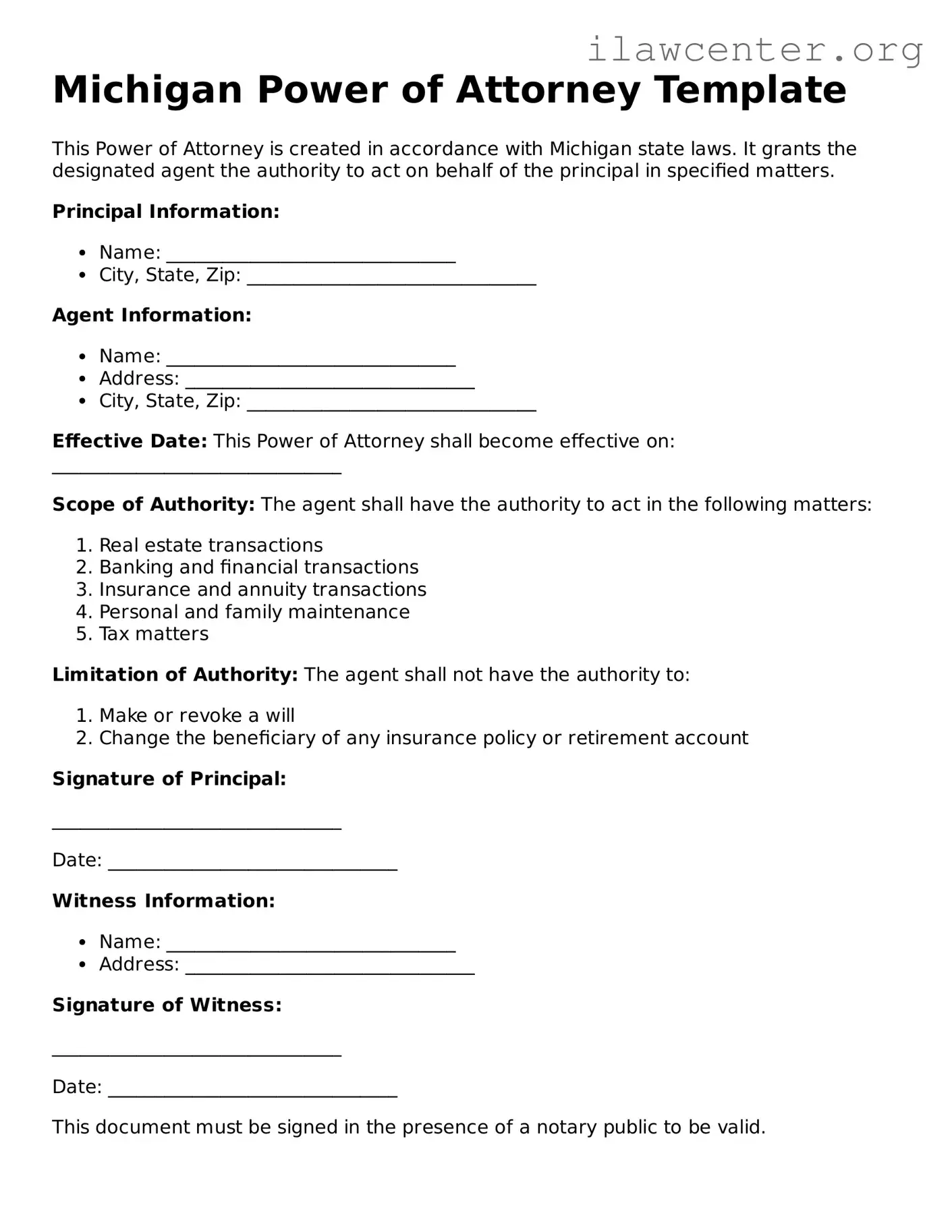
Michigan Power of Attorney Template

This Power of Attorney is created in accordance with Michigan state laws. It grants the designated agent the authority to act on behalf of the principal in specified matters.

Principal Information:

  • Name: _______________________________
  • City, State, Zip: _______________________________

Agent Information:

  • Name: _______________________________
  • Address: _______________________________
  • City, State, Zip: _______________________________

Effective Date: This Power of Attorney shall become effective on: _______________________________

Scope of Authority: The agent shall have the authority to act in the following matters:

  1. Real estate transactions
  2. Banking and financial transactions
  3. Insurance and annuity transactions
  4. Personal and family maintenance
  5. Tax matters

Limitation of Authority: The agent shall not have the authority to:

  1. Make or revoke a will
  2. Change the beneficiary of any insurance policy or retirement account

Signature of Principal:

_______________________________

Date: _______________________________

Witness Information:

  • Name: _______________________________
  • Address: _______________________________

Signature of Witness:

_______________________________

Date: _______________________________

This document must be signed in the presence of a notary public to be valid.

PDF Form Characteristics

Fact Name Description
Definition The Michigan Power of Attorney form allows one person to appoint another to make decisions on their behalf.
Governing Law This form is governed by the Michigan Compiled Laws, specifically Act 386 of 1978.
Types of Powers The form can grant general or specific powers, depending on the needs of the principal.
Durability A Power of Attorney can be durable, meaning it remains effective even if the principal becomes incapacitated.
Signature Requirement The principal must sign the form for it to be valid, and their signature must be witnessed or notarized.
Agent Responsibilities The agent is expected to act in the best interest of the principal and must follow their wishes.
Revocation The principal can revoke the Power of Attorney at any time, as long as they are competent.
Filing There is no requirement to file the Power of Attorney with the state, but it should be kept in a safe place.
Healthcare Decisions A separate form is needed for healthcare decisions, called a Patient Advocate Designation.
Limitations Some actions, such as making a will or changing beneficiaries, cannot be granted through this form.

Instructions on Utilizing Michigan Power of Attorney

Filling out the Michigan Power of Attorney form is a straightforward process. It is essential to ensure that all information is accurate and complete. Once you have completed the form, it will need to be signed and witnessed according to state requirements.

  1. Obtain the Michigan Power of Attorney form. This can be found online or through legal resources.
  2. Read the form carefully to understand the sections that need to be filled out.
  3. Begin with your personal information. Enter your full name, address, and contact information in the designated areas.
  4. Identify the person you are appointing as your agent. Provide their full name, address, and contact information.
  5. Clearly outline the powers you wish to grant to your agent. Specify any limitations or specific powers you want to include.
  6. Include the date the Power of Attorney becomes effective. You can choose for it to be effective immediately or upon a specific event.
  7. Sign and date the form in the presence of a notary public or witnesses, as required by Michigan law.
  8. Provide copies of the signed form to your agent and any relevant institutions, such as banks or healthcare providers.

Important Facts about Michigan Power of Attorney

What is a Power of Attorney in Michigan?

A Power of Attorney (POA) in Michigan is a legal document that allows one person to give another person the authority to act on their behalf. This can include making financial decisions, managing property, or handling medical care. The person granting the authority is known as the principal, while the person receiving the authority is called the agent or attorney-in-fact.

Why should I create a Power of Attorney?

Creating a Power of Attorney is important for ensuring that your wishes are carried out if you become unable to make decisions for yourself. It provides peace of mind, knowing that someone you trust can manage your affairs. This can be particularly beneficial in cases of illness, injury, or advanced age.

What types of Power of Attorney are available in Michigan?

Michigan recognizes several types of Power of Attorney. The most common include the Durable Power of Attorney, which remains effective even if you become incapacitated, and the Medical Power of Attorney, which specifically allows your agent to make healthcare decisions on your behalf. There are also limited or specific POAs that grant authority for particular tasks or timeframes.

How do I create a Power of Attorney in Michigan?

To create a Power of Attorney in Michigan, you must complete a form that outlines your wishes. You can find templates online or consult with a legal professional. The document must be signed by you and, in most cases, witnessed by two individuals or notarized to be valid.

Can I revoke a Power of Attorney once it is created?

Yes, you can revoke a Power of Attorney at any time as long as you are mentally competent. To do this, you should create a written revocation document and notify your agent and any relevant third parties, such as banks or healthcare providers, that the POA is no longer valid.

What happens if I do not have a Power of Attorney?

If you do not have a Power of Attorney and become incapacitated, a court may need to appoint a guardian or conservator to manage your affairs. This process can be lengthy, costly, and may not reflect your personal wishes. Having a POA in place can prevent this situation.

Can my agent make any decisions I would make?

Your agent can make decisions on your behalf, but the extent of their authority depends on the terms outlined in the Power of Attorney document. You can specify what powers they have, such as handling financial transactions, making healthcare decisions, or managing property. It’s important to clearly define these powers to avoid any confusion.

Is a Power of Attorney valid in other states?

A Power of Attorney created in Michigan is generally valid in other states, but it’s wise to check the laws of the state where it will be used. Some states may have specific requirements or may require a new POA to be drafted. Always consult with a legal professional if you plan to use your POA outside Michigan.
Common mistakes

Filling out a Michigan Power of Attorney form can be a straightforward process, but many individuals make common mistakes that can lead to complications. Understanding these pitfalls can help ensure that your document serves its intended purpose effectively.

One frequent error is failing to specify the powers granted. It's crucial to clearly outline what authority you are giving to your agent. Vague language can lead to misunderstandings or limit your agent's ability to act on your behalf. Be as specific as possible about the powers you wish to grant.

Another mistake is not signing the document properly. In Michigan, your signature must be witnessed by at least one individual, and it may also need to be notarized depending on the circumstances. Omitting these steps can render the document invalid. Always double-check the signing requirements before finalizing your form.

People often overlook the importance of choosing the right agent. Selecting someone who is trustworthy and capable of handling your affairs is essential. Friends or family members may not always be the best choice, especially if they lack the necessary skills or are unable to act in your best interest.

Additionally, failing to update the document can create problems down the line. Life changes, such as a divorce or the death of an agent, may necessitate a revision of your Power of Attorney. Regularly reviewing and updating the document ensures it reflects your current wishes and circumstances.

Some individuals make the mistake of not discussing their intentions with their agent. It is vital to communicate your wishes clearly to the person you are appointing. This conversation can help prevent confusion and ensure that your agent understands your preferences and values.

Another common oversight is neglecting to include alternate agents. In the event that your primary agent is unable to serve, having a backup can save time and stress. Consider naming one or two alternate agents to ensure that your affairs can be managed without interruption.

People sometimes forget to review state-specific laws. While the Michigan Power of Attorney form is standardized, state laws can change. Being aware of any recent updates or changes to the law can help you avoid issues that may arise from outdated information.

Moreover, not considering the scope of authority can lead to complications. Decide whether you want to grant general powers, which allow your agent to act broadly, or specific powers that limit their authority. This decision will impact how your agent can manage your affairs.

Finally, overlooking the importance of storage is a mistake that many make. Once completed, the Power of Attorney should be stored in a safe place, and copies should be provided to your agent and any relevant institutions, such as banks or healthcare providers. This ensures that the document is accessible when needed.

By being aware of these common mistakes, you can take steps to avoid them. Properly completing your Michigan Power of Attorney form is essential for ensuring that your wishes are honored and your affairs are managed according to your preferences.

Documents used along the form

When creating a Michigan Power of Attorney, several other forms and documents may be beneficial to ensure comprehensive legal coverage. Each of these documents serves a unique purpose and can complement the Power of Attorney effectively.

  • Advance Directive: This document outlines your preferences for medical treatment in case you become unable to communicate your wishes. It provides guidance to healthcare providers and loved ones regarding your care.
  • Living Will: A specific type of advance directive, a living will details your wishes regarding life-sustaining treatments. It clarifies what measures should or should not be taken if you are terminally ill or in a persistent vegetative state.
  • HIPAA Release Form: This form allows designated individuals access to your medical records. It ensures that your healthcare agents can make informed decisions based on your health information.
  • Will: A will outlines how your assets should be distributed after your death. It can also designate guardians for minor children and name an executor to manage your estate.
  • Trust: A trust can hold and manage your assets for your benefit or the benefit of others. It can help avoid probate and provide more control over how your assets are distributed.
  • Durable Power of Attorney for Healthcare: This document specifically grants someone the authority to make healthcare decisions on your behalf if you are unable to do so. It is separate from a general Power of Attorney.

Using these documents alongside the Michigan Power of Attorney can provide clarity and security for your personal and financial decisions. It is advisable to consult with a legal professional to ensure all documents are properly prepared and executed.

Similar forms

The Power of Attorney form is a vital document that allows one person to act on behalf of another. Several other documents serve similar purposes or provide related functions. Here is a list of nine documents that share similarities with the Power of Attorney:

  • Living Will: This document outlines a person's wishes regarding medical treatment in case they become unable to communicate. Like a Power of Attorney, it provides direction to others, especially healthcare providers.
  • Healthcare Proxy: This document appoints someone to make medical decisions on behalf of another individual. It is similar to a Power of Attorney but specifically focuses on healthcare choices.
  • Durable Power of Attorney: This variation remains effective even if the principal becomes incapacitated. It ensures that decisions can continue to be made on their behalf, similar to the standard Power of Attorney.
  • Financial Power of Attorney: This document grants authority to manage financial matters. It is closely related to the general Power of Attorney but is specifically focused on financial decisions.
  • Trust Agreement: A trust allows one person to manage assets for another's benefit. Like a Power of Attorney, it involves the management of another's affairs, though it typically pertains to property and finances.
  • Will: A will outlines how a person's assets should be distributed after their death. While it does not grant authority during life, it serves to express intentions, similar to how a Power of Attorney expresses authority during life.
  • Joint Account Agreement: This agreement allows two or more people to share ownership of a bank account. It enables access to funds and decision-making, akin to the authority granted in a Power of Attorney.
  • Business Partnership Agreement: This document outlines the roles and responsibilities of partners in a business. It provides authority and decision-making power, similar to a Power of Attorney in a business context.
  • Guardianship Documents: These documents appoint a guardian for a minor or incapacitated adult. They share the purpose of providing care and making decisions, much like a Power of Attorney does for adults who are unable to manage their affairs.

Dos and Don'ts

When filling out the Michigan Power of Attorney form, it's essential to follow certain guidelines to ensure the document is valid and effective. Here are some dos and don'ts to consider:

  • Do choose a trusted agent who will act in your best interest.
  • Do clearly specify the powers you are granting to your agent.
  • Do date and sign the form in the presence of a notary public.
  • Do keep copies of the completed form for your records.
  • Don't leave any sections blank; fill out all required information.
  • Don't use vague language that could lead to confusion about your intentions.

Following these guidelines can help ensure that your Power of Attorney is properly executed and meets your needs.

Misconceptions

Many people hold misconceptions about the Michigan Power of Attorney form, which can lead to confusion and potentially harmful decisions. Here are five common misunderstandings:

  1. Misconception 1: A Power of Attorney is only for financial matters.

    While many associate the Power of Attorney primarily with financial decisions, it can also encompass health care decisions. Individuals can designate an agent to make medical choices on their behalf if they become incapacitated.

  2. Misconception 2: A Power of Attorney remains effective after the principal's death.

    This is incorrect. A Power of Attorney ceases to be valid once the principal passes away. At that point, the authority granted to the agent is terminated, and the estate will be managed according to the will or intestate succession laws.

  3. Misconception 3: Anyone can be named as an agent.

    While it is true that you have the freedom to choose your agent, there are certain requirements. The agent must be at least 18 years old and mentally competent. Additionally, it is advisable to select someone you trust implicitly.

  4. Misconception 4: A Power of Attorney can be used without the principal's consent.

    This is a significant misunderstanding. The principal must voluntarily grant authority to the agent while they are still competent. A Power of Attorney cannot be executed under duress or without the principal's knowledge.

  5. Misconception 5: A Power of Attorney is a one-size-fits-all document.

    In reality, a Power of Attorney can be tailored to meet specific needs. Individuals can choose to grant broad or limited powers, depending on their circumstances. Customization is essential to ensure that the document aligns with the principal's wishes.

Key takeaways

Filling out and using the Michigan Power of Attorney form is an important step in planning for your future. Here are some key takeaways to consider:

  1. Understand the Purpose: A Power of Attorney allows you to designate someone to make decisions on your behalf if you become unable to do so. This can cover financial, medical, or legal matters.
  2. Choose Your Agent Wisely: Selecting a trustworthy and competent agent is crucial. This person will have significant authority over your affairs, so choose someone who understands your wishes and values.
  3. Specify Powers Clearly: The form allows you to specify the powers you grant to your agent. Be clear about what decisions they can make, whether it's managing finances, making medical decisions, or handling real estate transactions.
  4. Consider a Durable Power of Attorney: A durable Power of Attorney remains in effect even if you become incapacitated. This ensures that your agent can act on your behalf when you need it most.
  5. Review and Update Regularly: Life circumstances change, and so may your preferences. Regularly review and update your Power of Attorney to ensure it reflects your current wishes and situation.

By keeping these points in mind, you can effectively utilize the Michigan Power of Attorney form to protect your interests and ensure your wishes are honored.