Attorney-Verified  Promissory Note Document for Michigan

Attorney-Verified Promissory Note Document for Michigan

A Michigan Promissory Note is a written promise to pay a specified amount of money to a lender at a designated time or on demand. This legal document outlines the terms of the loan, including interest rates and repayment schedules. To get started with your own Promissory Note, click the button below.

Article Guide

In the realm of personal and business finance, the Michigan Promissory Note form serves as a crucial instrument for establishing clear terms between borrowers and lenders. This legally binding document outlines the borrower's commitment to repay a specified amount of money, along with any applicable interest, within a defined timeframe. Key components of the form include the principal amount, the interest rate, the repayment schedule, and the consequences of default. Additionally, it may address issues such as prepayment options and the rights of both parties in the event of a dispute. By detailing these elements, the Michigan Promissory Note not only protects the lender's investment but also provides the borrower with a transparent framework for repayment. Understanding the nuances of this form is essential for anyone engaged in lending or borrowing, as it can significantly impact financial relationships and obligations.

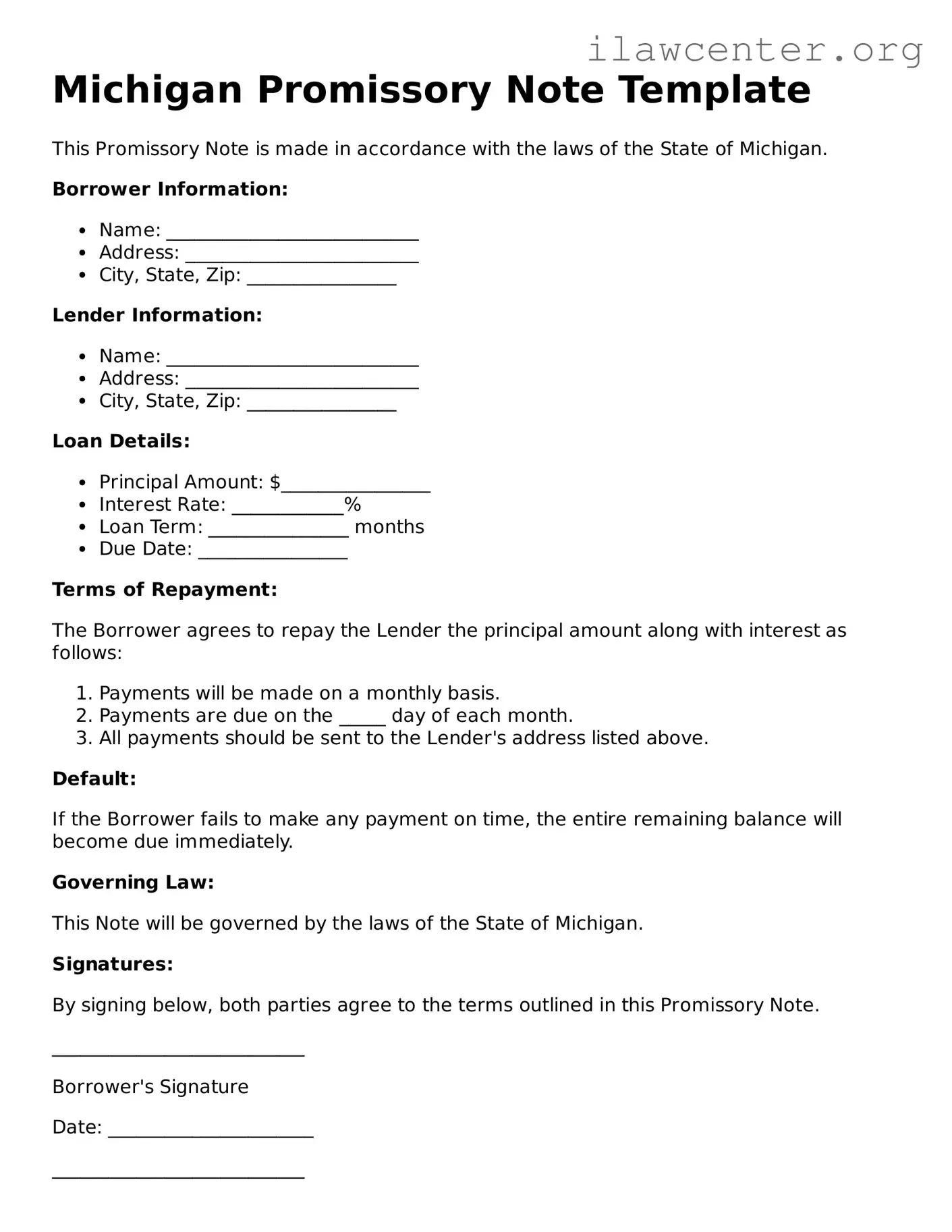
Michigan Promissory Note Preview

Michigan Promissory Note Template

This Promissory Note is made in accordance with the laws of the State of Michigan.

Borrower Information:

  • Name: ___________________________
  • Address: _________________________
  • City, State, Zip: ________________

Lender Information:

  • Name: ___________________________
  • Address: _________________________
  • City, State, Zip: ________________

Loan Details:

  • Principal Amount: $________________
  • Interest Rate: ____________%
  • Loan Term: _______________ months
  • Due Date: ________________

Terms of Repayment:

The Borrower agrees to repay the Lender the principal amount along with interest as follows:

  1. Payments will be made on a monthly basis.
  2. Payments are due on the _____ day of each month.
  3. All payments should be sent to the Lender's address listed above.

Default:

If the Borrower fails to make any payment on time, the entire remaining balance will become due immediately.

Governing Law:

This Note will be governed by the laws of the State of Michigan.

Signatures:

By signing below, both parties agree to the terms outlined in this Promissory Note.

___________________________

Borrower's Signature

Date: ______________________

___________________________

Lender's Signature

Date: ______________________

PDF Form Characteristics

Fact Name Description
Definition A Michigan Promissory Note is a written promise to pay a specified amount of money to a designated person or entity at a specified time or on demand.
Governing Law The Michigan Promissory Note is governed by the Michigan Uniform Commercial Code (UCC), specifically Article 3, which deals with negotiable instruments.
Parties Involved There are typically two parties involved: the borrower (or maker) who promises to pay and the lender (or payee) who receives the payment.
Interest Rate The note can specify an interest rate, which can be fixed or variable, depending on the agreement between the parties.
Payment Terms Payment terms, including the amount due and the payment schedule, must be clearly outlined in the document to avoid confusion.
Default Clause A default clause may be included, outlining the consequences if the borrower fails to make payments as agreed.
Signatures Both parties must sign the note for it to be legally binding, and it is advisable to have witnesses or notarization for added security.

Instructions on Utilizing Michigan Promissory Note

Once you have the Michigan Promissory Note form in hand, it is important to ensure that all necessary information is filled out accurately. This document serves as a record of the loan agreement between the lender and the borrower. Completing the form correctly will help protect the interests of both parties involved.

  1. Begin by entering the date at the top of the form. This is the date when the promissory note is created.
  2. Next, provide the name and address of the borrower. This identifies the individual or entity responsible for repaying the loan.
  3. Following that, fill in the lender's name and address. This information is essential for identifying who is providing the loan.
  4. Specify the principal amount of the loan. This is the total sum that the borrower is agreeing to repay.
  5. Indicate the interest rate. This should be clearly stated as an annual percentage rate.
  6. State the repayment terms. Include how often payments are due (monthly, quarterly, etc.) and the duration of the loan.
  7. Include any late fees or penalties for missed payments. This section clarifies the consequences of non-compliance.
  8. Finally, both the borrower and lender should sign and date the form. This signifies their agreement to the terms outlined in the document.

Important Facts about Michigan Promissory Note

What is a Michigan Promissory Note?

A Michigan Promissory Note is a written agreement between a borrower and a lender. It outlines the terms of a loan, including the amount borrowed, interest rate, repayment schedule, and consequences of default. This document serves as a legal record of the debt and the obligations of both parties.

Who can use a Promissory Note in Michigan?

Any individual or business in Michigan can use a Promissory Note. Whether you are lending money to a friend, family member, or a business, this document can help clarify the terms of the loan and protect your interests.

What information is required in a Michigan Promissory Note?

A Promissory Note should include the names and addresses of both the borrower and lender, the principal amount of the loan, the interest rate, repayment terms, and any late fees or penalties. Additionally, it may specify the purpose of the loan and any collateral involved.

Is it necessary to have a Promissory Note in writing?

While verbal agreements can be legally binding, having a Promissory Note in writing is highly recommended. A written document provides clear evidence of the loan terms and can help prevent misunderstandings or disputes in the future.

Can a Promissory Note be modified after it is signed?

Yes, a Promissory Note can be modified if both parties agree to the changes. It is advisable to document any modifications in writing and have both parties sign the revised agreement to ensure clarity and enforceability.

What happens if the borrower defaults on the Promissory Note?

If the borrower defaults, the lender has the right to take legal action to recover the owed amount. This may include filing a lawsuit or seeking a judgment against the borrower. The specific consequences of default should be outlined in the Promissory Note.

Do I need a lawyer to create a Promissory Note in Michigan?

While it is not legally required to have a lawyer, consulting with one can be beneficial. A legal professional can help ensure that the document meets all legal requirements and adequately protects your interests.

Where can I find a Michigan Promissory Note template?

Templates for Michigan Promissory Notes can be found online through various legal document preparation services. It is important to choose a reputable source to ensure that the template complies with Michigan laws and meets your specific needs.

Common mistakes

When filling out the Michigan Promissory Note form, many individuals inadvertently make mistakes that can lead to complications down the line. One common error is failing to provide complete information about the borrower and lender. It’s essential to include full names, addresses, and contact details. Omitting any of this information can cause confusion and may even render the document unenforceable.

Another frequent mistake is not specifying the loan amount clearly. The amount should be written both in numbers and words to avoid any ambiguity. For example, if the loan is for $5,000, it should be noted as “Five Thousand Dollars ($5,000).” This clarity helps prevent disputes over the loan amount in the future.

People often overlook the importance of stating the interest rate. If the loan carries an interest rate, it must be explicitly mentioned. Some individuals assume that the default interest rate applies, but this is not always the case. Without a clearly defined interest rate, the terms of repayment can become contentious.

Another mistake involves the repayment terms. It is crucial to outline how and when the borrower will repay the loan. This includes specifying the payment schedule—whether it’s monthly, quarterly, or in a lump sum. Vague terms can lead to misunderstandings, so clarity is key.

Signatures are often taken for granted. Both the borrower and lender must sign the document to make it legally binding. Failing to do so can invalidate the agreement, leaving both parties without legal recourse if a dispute arises. Additionally, consider having a witness or notary present during the signing for added protection.

Lastly, many individuals neglect to keep copies of the signed Promissory Note. It’s vital for both parties to retain a copy for their records. This ensures that everyone has access to the agreed-upon terms, which can be crucial if any issues come up in the future. Keeping a copy also serves as a reminder of the obligations each party has agreed to fulfill.

Documents used along the form

When entering into a loan agreement in Michigan, the Promissory Note is a crucial document. However, several other forms and documents complement this agreement, ensuring clarity and protection for all parties involved. Here are four important documents often used alongside the Michigan Promissory Note:

  • Loan Agreement: This document outlines the terms and conditions of the loan, including the interest rate, repayment schedule, and any collateral involved. It serves as a comprehensive guide to the obligations of both the lender and borrower.
  • Security Agreement: If the loan is secured by collateral, a Security Agreement is essential. It details the specific assets that back the loan and the lender's rights in the event of default. This document provides additional assurance to the lender.
  • Disclosure Statement: This document provides transparency about the loan's terms, including any fees, penalties, and the total cost of borrowing. It helps borrowers understand their financial commitments and ensures compliance with state and federal regulations.
  • Personal Guarantee: In cases where a business is borrowing, a Personal Guarantee may be required from an individual, typically a business owner. This document makes the individual personally liable for the loan, adding an extra layer of security for the lender.

Understanding these documents is vital for anyone involved in a loan transaction. Each one plays a significant role in safeguarding interests and clarifying responsibilities, ensuring a smoother lending process.

Similar forms

A Promissory Note is a financial document that outlines a promise to pay a specific amount of money to a designated person or entity. Several other documents serve similar purposes or share characteristics with a Promissory Note. Here are eight such documents:

  • Loan Agreement: This document details the terms of a loan, including the amount borrowed, interest rates, and repayment schedule. Like a Promissory Note, it establishes the borrower's obligation to repay the lender.
  • Mortgage: A mortgage is a specific type of loan used to purchase real estate. It includes a Promissory Note as part of the agreement, outlining the borrower's promise to repay the loan.
  • IOU (I Owe You): An informal document acknowledging a debt. It serves as a simple promise to repay a borrowed amount, similar to a Promissory Note but less formal.
  • Secured Note: This is a Promissory Note backed by collateral. It ensures that the lender has a claim on specific assets if the borrower defaults.
  • Unsecured Note: Unlike a secured note, this Promissory Note is not backed by collateral. It relies solely on the borrower's promise to repay.
  • Convertible Note: Often used in startup financing, this note can convert into equity at a later date. It combines features of a loan and an investment, similar to a Promissory Note.
  • Bill of Exchange: This document orders one party to pay a specific amount to another party. It serves a similar function to a Promissory Note, facilitating payment between parties.
  • Credit Agreement: This document outlines the terms under which credit is extended to a borrower. It includes repayment terms and obligations, much like a Promissory Note.

Dos and Don'ts

When filling out the Michigan Promissory Note form, there are several important guidelines to follow. Adhering to these can help ensure that the document is completed correctly and is legally binding.

  • Do read the entire form carefully before starting to fill it out.
  • Do provide accurate information, including names, addresses, and amounts.
  • Do sign and date the document in the appropriate sections.
  • Don't leave any required fields blank; this could invalidate the note.
  • Don't use correction fluid or tape; any mistakes should be crossed out and initialed.
  • Don't forget to keep a copy of the completed form for your records.

Following these guidelines will help ensure that your Promissory Note is properly executed and can be enforced if necessary.

Misconceptions

There are several misconceptions about the Michigan Promissory Note form that can lead to confusion. Here are five common ones:

  1. It must be notarized to be valid.

    Many people believe that notarization is required for a promissory note to be legally binding. In Michigan, notarization is not a requirement. A signed note is sufficient.

  2. Only banks can issue promissory notes.

    This is not true. Any individual or entity can create a promissory note. It’s a flexible tool for personal loans, not just for financial institutions.

  3. All promissory notes are the same.

    Each promissory note can be tailored to fit specific terms and conditions. The Michigan form may have standard elements, but the details can vary widely based on the agreement between the parties.

  4. Promissory notes are only for large loans.

    People often think promissory notes are only suitable for significant amounts. In reality, they can be used for any loan amount, regardless of size.

  5. Once signed, a promissory note cannot be changed.

    This is a misconception. Parties can amend a promissory note if both agree to the changes. It’s essential to document any amendments properly.

Key takeaways

When dealing with the Michigan Promissory Note form, there are several important points to keep in mind. Here are some key takeaways that can guide you through the process:

  • Understand the Purpose: A promissory note is a legal document that outlines a borrower's promise to repay a loan under specific terms.
  • Include Essential Information: Make sure to include the names of both the borrower and the lender, the loan amount, and the interest rate.
  • Specify Payment Terms: Clearly outline the repayment schedule, including due dates and any grace periods.
  • Consider Interest Rates: Be aware of Michigan's usury laws to ensure the interest rate you set is legal and enforceable.
  • Signatures Required: Both parties must sign the document for it to be valid. Witnesses or notarization may be necessary for added security.
  • Keep Copies: After filling out the form, both the borrower and lender should keep copies for their records.
  • Review for Accuracy: Before finalizing, double-check all details to avoid any misunderstandings in the future.
  • Seek Legal Advice if Needed: If you have questions or concerns, consulting with a legal professional can provide clarity and peace of mind.

By following these guidelines, you can ensure that your Michigan Promissory Note is properly filled out and serves its intended purpose effectively.