Attorney-Verified  Quitclaim Deed Document for Michigan

Attorney-Verified Quitclaim Deed Document for Michigan

A Michigan Quitclaim Deed is a legal document used to transfer ownership of real estate from one party to another without any warranties. This form is often utilized in situations where the parties know each other, such as family transfers or between friends. To get started on your property transfer, fill out the form by clicking the button below.

Article Guide

The Michigan Quitclaim Deed form serves as a vital tool for transferring property ownership in the state of Michigan. This legal document allows one party, known as the grantor, to convey their interest in real estate to another party, referred to as the grantee, without making any guarantees about the property’s title. Unlike other types of deeds, such as warranty deeds, a quitclaim deed does not provide any warranties or assurances regarding the property's condition or any encumbrances. This makes it a popular choice for transactions between family members or friends, where trust is established. The form requires specific information, including the names of the parties involved, a legal description of the property, and the signatures of the grantor and grantee. Additionally, it must be notarized to be legally valid. Understanding the implications of using a quitclaim deed is essential, as it can significantly impact property rights and future claims. Therefore, those considering this form should be aware of its simplicity and potential risks, ensuring that they approach the transfer of property with the necessary caution and awareness.

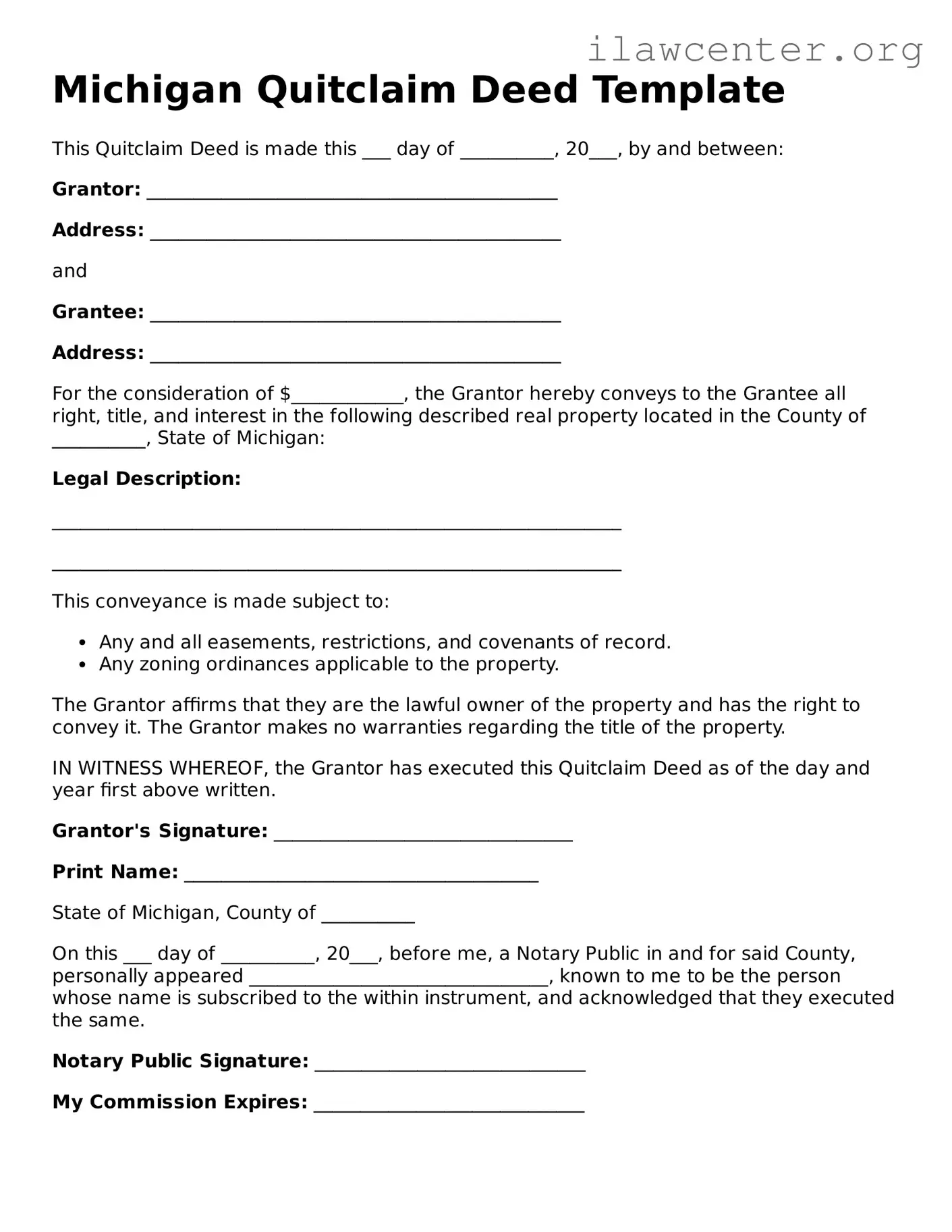
Michigan Quitclaim Deed Preview

Michigan Quitclaim Deed Template

This Quitclaim Deed is made this ___ day of __________, 20___, by and between:

Grantor: ____________________________________________

Address: ____________________________________________

and

Grantee: ____________________________________________

Address: ____________________________________________

For the consideration of $____________, the Grantor hereby conveys to the Grantee all right, title, and interest in the following described real property located in the County of __________, State of Michigan:

Legal Description:

_____________________________________________________________

_____________________________________________________________

This conveyance is made subject to:

  • Any and all easements, restrictions, and covenants of record.
  • Any zoning ordinances applicable to the property.

The Grantor affirms that they are the lawful owner of the property and has the right to convey it. The Grantor makes no warranties regarding the title of the property.

IN WITNESS WHEREOF, the Grantor has executed this Quitclaim Deed as of the day and year first above written.

Grantor's Signature: ________________________________

Print Name: ______________________________________

State of Michigan, County of __________

On this ___ day of __________, 20___, before me, a Notary Public in and for said County, personally appeared ________________________________, known to me to be the person whose name is subscribed to the within instrument, and acknowledged that they executed the same.

Notary Public Signature: _____________________________

My Commission Expires: _____________________________

PDF Form Characteristics

Fact Name Description
Definition A quitclaim deed is a legal document used to transfer ownership of real estate without any warranties regarding the title.
Governing Law The Michigan Quitclaim Deed is governed by the Michigan Compiled Laws, specifically MCL 565.25.
Use Cases Commonly used in transfers between family members, divorces, or to clear up title issues.
Requirements The deed must be signed by the grantor and notarized to be valid in Michigan.
Consideration While a nominal consideration is often stated, it is not required for the deed to be valid.
Recording To provide public notice, the deed should be recorded with the county clerk's office where the property is located.
Tax Implications Transfer taxes may apply depending on the value of the property being transferred.
Limitations A quitclaim deed does not guarantee that the grantor has clear title to the property; it simply transfers whatever interest the grantor has.

Instructions on Utilizing Michigan Quitclaim Deed

After completing the Michigan Quitclaim Deed form, the next step is to ensure that it is signed and notarized. This is essential for the document to be legally valid. Once signed, you will need to file the deed with the appropriate county register of deeds office. Make sure to keep a copy for your records.

  1. Obtain the Michigan Quitclaim Deed form from a reliable source.
  2. Fill in the names of the grantor (the person giving the property) and grantee (the person receiving the property) in the designated spaces.
  3. Provide the address of the property being transferred.
  4. Include a legal description of the property. This may require a survey or previous deed for accuracy.
  5. Indicate the date of the transfer.
  6. Sign the form in the presence of a notary public.
  7. Have the notary public sign and stamp the document to verify the signatures.
  8. Make copies of the completed deed for your records.
  9. File the original Quitclaim Deed with the county register of deeds office where the property is located.

Important Facts about Michigan Quitclaim Deed

What is a Michigan Quitclaim Deed?

A Michigan Quitclaim Deed is a legal document used to transfer ownership of real estate from one party to another without any warranties. The grantor (the person transferring the property) relinquishes their interest in the property, but does not guarantee that the title is clear or free of encumbrances. This type of deed is often used among family members or in situations where the parties know each other well.

When should I use a Quitclaim Deed?

Use a Quitclaim Deed when you want to transfer property ownership without the need for extensive title searches or guarantees. Common scenarios include transferring property between family members, adding a spouse to a title, or removing an ex-spouse after a divorce. It’s important to note that this deed does not protect the grantee (the person receiving the property) against any claims or liens on the property.

How do I complete a Quitclaim Deed in Michigan?

To complete a Quitclaim Deed in Michigan, you need to include specific information: the names and addresses of both the grantor and grantee, a legal description of the property, and the date of transfer. After filling out the form, the grantor must sign it in the presence of a notary public. Ensure that the deed is then filed with the county register of deeds where the property is located.

Is a Quitclaim Deed the same as a Warranty Deed?

No, a Quitclaim Deed is not the same as a Warranty Deed. A Warranty Deed provides guarantees about the title, assuring the grantee that the property is free from claims or liens. In contrast, a Quitclaim Deed offers no such assurances. It simply transfers whatever interest the grantor has in the property, if any.

Do I need an attorney to prepare a Quitclaim Deed?

Are there any fees associated with filing a Quitclaim Deed?

Yes, there are typically fees associated with filing a Quitclaim Deed in Michigan. These fees vary by county but generally include a recording fee charged by the county register of deeds. It’s wise to check with your local office for the exact amount and any additional costs that may apply.

Can a Quitclaim Deed be revoked?

Once a Quitclaim Deed is executed and recorded, it cannot be revoked unilaterally. However, the grantor may create a new deed to transfer the property back, or both parties may agree to rescind the transaction through a legal process. Always consult a legal professional for guidance on reversing a property transfer.

What happens if the grantor has no ownership interest?

If the grantor has no ownership interest in the property, the Quitclaim Deed will still be valid, but it will not transfer any actual ownership rights to the grantee. The grantee may face challenges if they attempt to assert ownership based on a Quitclaim Deed from someone who does not own the property. Due diligence is crucial before proceeding with such a transfer.

Common mistakes

Filling out a Michigan Quitclaim Deed form can be straightforward, but there are common mistakes that individuals often make. One of the most frequent errors is failing to include the legal description of the property. This description must be precise and should match the information on the property’s title. Omitting or inaccurately describing the property can lead to complications in ownership transfer.

Another mistake is not properly identifying the grantor and grantee. The grantor is the person transferring the property, while the grantee is the recipient. Using incorrect names or failing to include middle initials can create confusion and may render the deed invalid. Always ensure that both parties are clearly identified with accurate legal names.

Many people neglect to sign the Quitclaim Deed in the presence of a notary public. In Michigan, notarization is crucial for the deed to be legally binding. Without a valid signature and notarization, the document may not be accepted by the county register of deeds, leading to potential disputes over property ownership.

In addition, individuals often overlook the importance of recording the deed after it is signed and notarized. Failing to file the Quitclaim Deed with the appropriate county office can result in the deed not being recognized in public records. This oversight can create issues when trying to sell or transfer the property in the future.

Another common error is not including the date of execution on the Quitclaim Deed. This date is essential for establishing when the transfer of ownership takes place. Without it, there could be questions about the timing of the transaction, which can complicate matters if disputes arise later.

People sometimes forget to include a statement of consideration, which indicates the value exchanged for the property. While a Quitclaim Deed does not require a monetary exchange, including this information can provide clarity and serve as a record of the transaction.

Additionally, individuals may make mistakes regarding the property’s tax identification number. This number is critical for property tax purposes and should be accurately listed on the form. Errors in this area can lead to complications with local tax authorities.

Finally, not seeking legal advice can be a significant mistake. While the Quitclaim Deed form may appear simple, the implications of errors can be far-reaching. Consulting with a legal expert can help ensure that all details are correctly addressed, providing peace of mind during the property transfer process.

Documents used along the form

When preparing to execute a Michigan Quitclaim Deed, several additional documents may be necessary to ensure a smooth transfer of property. Below is a list of common forms and documents that are often used in conjunction with the Quitclaim Deed.

  • Property Transfer Affidavit: This document provides information about the property being transferred and is required by the state for tax purposes.
  • Affidavit of Value: This form states the value of the property being transferred and may be needed for assessing transfer taxes.
  • Title Insurance Policy: Obtaining title insurance protects the buyer from potential claims against the property title after the transfer.
  • Warranty Deed: In some cases, a warranty deed may accompany a quitclaim deed to provide additional assurances regarding the title's validity.
  • Closing Statement: This document outlines the financial details of the transaction, including costs and fees associated with the property transfer.
  • Disclosure Statement: Sellers may need to provide this statement to inform buyers of any known issues with the property.
  • Power of Attorney: If someone is signing on behalf of the property owner, a power of attorney document is required to authorize that individual.

Ensuring that all necessary documents are prepared and submitted will facilitate a successful property transfer. It is advisable to consult with a legal professional to confirm that all requirements are met.

Similar forms

  • Warranty Deed: Similar to a Quitclaim Deed, a Warranty Deed transfers property ownership but provides a guarantee that the grantor holds clear title to the property. This means the buyer is protected against any future claims to the property.
  • Grant Deed: Like a Quitclaim Deed, a Grant Deed transfers ownership of real estate. However, it also includes implied warranties that the property has not been sold to someone else and that there are no undisclosed encumbrances.
  • Deed of Trust: This document secures a loan by transferring property title to a trustee until the borrower pays off the loan. While it serves a different purpose, it involves the transfer of property rights, similar to a Quitclaim Deed.
  • Special Purpose Deed: This type of deed is used for specific situations, such as transferring property between family members or in divorce settlements. It functions similarly by transferring ownership without warranties.
  • Life Estate Deed: A Life Estate Deed allows the property owner to retain rights to the property during their lifetime, while transferring future ownership to another party. It shares the characteristic of transferring property rights like a Quitclaim Deed.
  • Affidavit of Heirship: This document establishes the heirs of a deceased property owner and can facilitate the transfer of property without a formal probate process. It serves to clarify ownership similar to a Quitclaim Deed.
  • Partition Deed: Used when co-owners of property want to divide their interests, a Partition Deed transfers ownership rights among co-owners. It shares the intent of transferring property rights, akin to a Quitclaim Deed.
  • Transfer on Death Deed: This deed allows an individual to transfer property to a beneficiary upon their death, avoiding probate. It operates similarly by facilitating the transfer of property rights without immediate ownership changes.

Dos and Don'ts

When filling out the Michigan Quitclaim Deed form, it is essential to approach the process with care. This document transfers property ownership and requires attention to detail. Here are some important dos and don'ts to keep in mind:

  • Do ensure that all names are spelled correctly. This helps avoid any potential legal disputes in the future.
  • Do include the correct legal description of the property. This information can typically be found on the property tax bill or in the previous deed.
  • Do sign the document in the presence of a notary public. This step is crucial for the deed to be legally valid.
  • Do keep a copy of the completed deed for your records. Having a personal copy can be helpful for future reference.
  • Do check for any local requirements or fees associated with filing the deed. Each county may have different regulations.
  • Don't leave any sections of the form blank. Incomplete forms may lead to delays or rejections.
  • Don't use vague terms to describe the property. Clarity is key to ensuring the deed is enforceable.
  • Don't forget to date the document. An undated deed may raise questions about its validity.
  • Don't overlook the importance of consulting with a real estate professional if you have questions. Their expertise can guide you through the process.
  • Don't assume that all quitclaim deeds are the same. Variations may exist based on specific situations or local laws.

By following these guidelines, you can navigate the process of completing the Michigan Quitclaim Deed form with greater confidence and clarity.

Misconceptions

The Michigan Quitclaim Deed is often misunderstood. Here are eight common misconceptions about this legal document, along with clarifications for each.

  1. Quitclaim Deeds Transfer Ownership Completely.

    Many believe that a quitclaim deed guarantees a full transfer of ownership. In reality, it transfers whatever interest the grantor has in the property, which may not be complete or even valid.

  2. Quitclaim Deeds Are Only Used for Family Transfers.

    While quitclaim deeds are frequently used among family members, they can also be used in various other situations, such as transferring property in divorce settlements or between business partners.

  3. Quitclaim Deeds Provide Title Insurance.

    Many people assume that using a quitclaim deed automatically provides title insurance. However, title insurance is a separate product and must be purchased independently.

  4. Quitclaim Deeds Are Irrevocable.

    Some individuals think that once a quitclaim deed is signed, it cannot be changed. In fact, it can be revoked or modified, provided that both parties agree to the changes.

  5. Quitclaim Deeds Eliminate Liens.

    There is a misconception that transferring property via a quitclaim deed removes any existing liens. This is not true; liens remain attached to the property regardless of the ownership change.

  6. Quitclaim Deeds Are Only for Real Estate.

    Some people think quitclaim deeds apply solely to real estate transactions. However, they can also be used to transfer interests in other types of property, such as vehicles or personal belongings.

  7. Quitclaim Deeds Require Notarization.

    While notarization is recommended for validity and to ensure proper execution, it is not strictly required for a quitclaim deed in Michigan. However, it may be necessary for recording purposes.

  8. Quitclaim Deeds Are Only Valid in Michigan.

    Many believe that quitclaim deeds are exclusive to Michigan. In fact, quitclaim deeds are recognized in many states across the U.S., although the specific requirements may vary.

Key takeaways

When dealing with property transfers in Michigan, the Quitclaim Deed form is a commonly used document. Here are some essential takeaways to keep in mind:

  • The Quitclaim Deed allows a property owner to transfer their interest in a property without making any guarantees about the title.
  • This form is often used between family members or in situations where the parties trust each other.
  • Filling out the form requires accurate information about the grantor (the person transferring the property) and the grantee (the person receiving the property).
  • It is important to include a legal description of the property, which can typically be found on the property’s tax documents or previous deeds.
  • Once completed, the Quitclaim Deed must be signed by the grantor in the presence of a notary public.
  • After notarization, the deed should be recorded with the county register of deeds to make the transfer official.
  • Recording the deed protects the grantee’s interest in the property and provides public notice of the ownership change.
  • Consider consulting with a legal professional to ensure the form is filled out correctly and to understand the implications of the transfer.