Attorney-Verified  Rental Application Document for Michigan

Attorney-Verified Rental Application Document for Michigan

The Michigan Rental Application form is a crucial document that potential tenants complete to apply for rental housing. This form collects essential information about the applicant, including their rental history, employment details, and references. To get started on your rental journey, fill out the form by clicking the button below.

Article Guide

The Michigan Rental Application form serves as a vital tool for both landlords and prospective tenants in the rental process. This form typically collects essential information about the applicant, including their personal details, employment history, and rental history. It often requires applicants to disclose their income, which helps landlords assess their financial stability and ability to pay rent. Additionally, the form may include questions about credit history and references, providing landlords with insight into the applicant’s reliability as a tenant. By gathering this information, the rental application aims to create a comprehensive profile of the individual seeking housing, allowing landlords to make informed decisions. Understanding the various components of the Michigan Rental Application form can help applicants prepare effectively and present themselves favorably in a competitive rental market.

Michigan Rental Application Preview

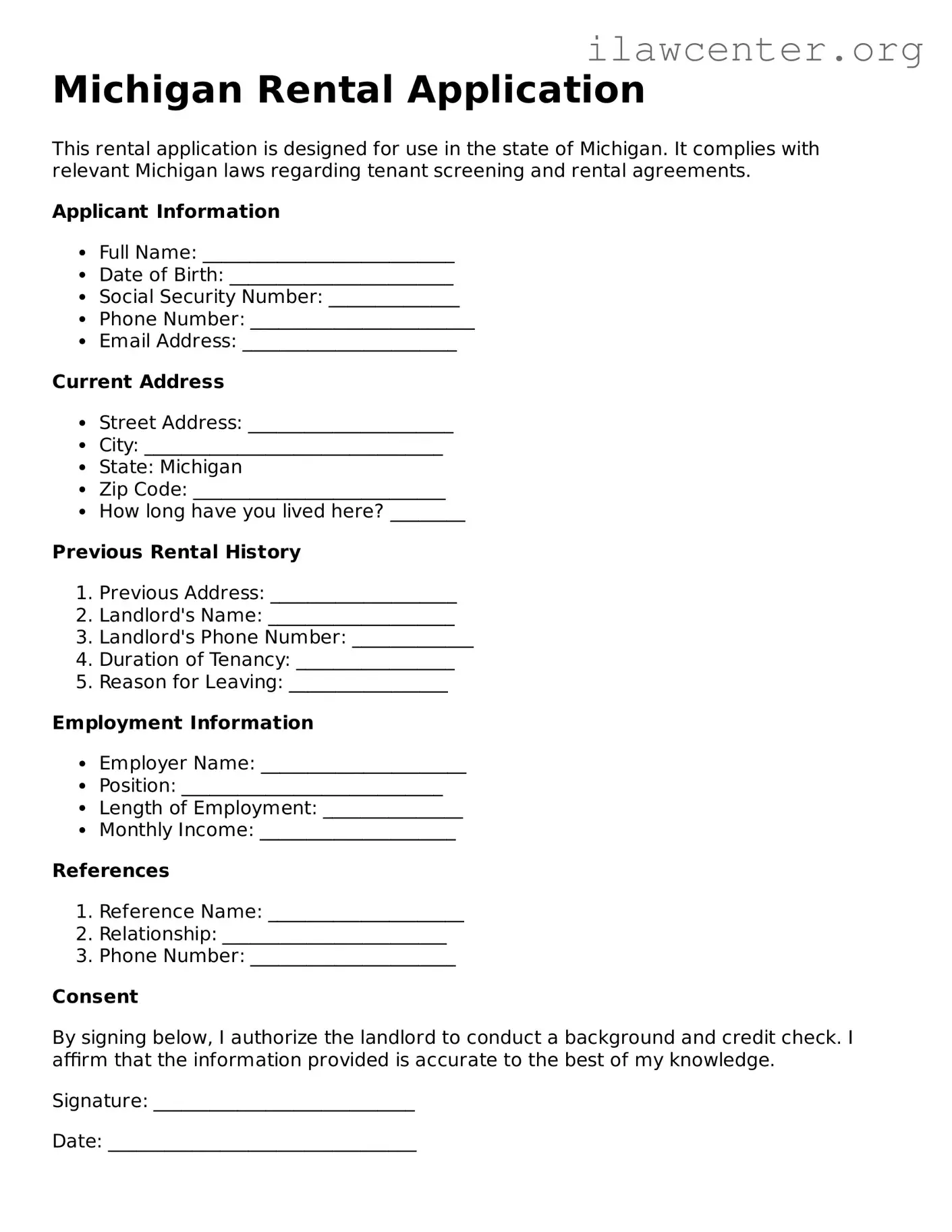
Michigan Rental Application

This rental application is designed for use in the state of Michigan. It complies with relevant Michigan laws regarding tenant screening and rental agreements.

Applicant Information

  • Full Name: ___________________________
  • Date of Birth: ________________________
  • Social Security Number: ______________
  • Phone Number: ________________________
  • Email Address: _______________________

Current Address

  • Street Address: ______________________
  • City: ________________________________
  • State: Michigan
  • Zip Code: ___________________________
  • How long have you lived here? ________

Previous Rental History

  1. Previous Address: ____________________
  2. Landlord's Name: ____________________
  3. Landlord's Phone Number: _____________
  4. Duration of Tenancy: _________________
  5. Reason for Leaving: _________________

Employment Information

  • Employer Name: ______________________
  • Position: ____________________________
  • Length of Employment: _______________
  • Monthly Income: _____________________

References

  1. Reference Name: _____________________
  2. Relationship: ________________________
  3. Phone Number: ______________________

Consent

By signing below, I authorize the landlord to conduct a background and credit check. I affirm that the information provided is accurate to the best of my knowledge.

Signature: ____________________________

Date: _________________________________

PDF Form Characteristics

Fact Name Description
Governing Law The Michigan Rental Application is governed by the Michigan Compiled Laws, particularly MCL 554.601 et seq., which outlines landlord-tenant relationships.
Application Fee Landlords in Michigan may charge an application fee to cover the cost of background checks, but this fee must be reasonable and disclosed upfront.
Personal Information The application typically requires personal information such as the applicant's name, address, and contact details.
Employment History Applicants are often asked to provide their employment history, including current and previous employers, to assess financial stability.
Credit Check Authorization Most rental applications include a section for applicants to authorize a credit check, which landlords use to evaluate creditworthiness.
Rental History Information about previous rental history is typically required, including addresses, landlord contact information, and duration of tenancy.
Co-Signer Information If applicable, the application may request information about a co-signer, including their financial details and relationship to the applicant.
Disclosure of Criminal History Applicants may be asked to disclose any criminal history, although Michigan law restricts how this information can be used in the application process.
Signature Requirement A signature is typically required to confirm that the information provided is accurate and that the applicant consents to the terms of the application.

Instructions on Utilizing Michigan Rental Application

Filling out a rental application in Michigan is an important step in the process of securing a new home. By providing accurate and complete information, you can help landlords assess your suitability as a tenant. Follow these steps to ensure you fill out the application correctly.

  1. Begin by reading the application form carefully. Make sure you understand all the sections before you start filling it out.
  2. Provide your personal information. This typically includes your full name, date of birth, and contact details such as your phone number and email address.
  3. List your current address. Include the street address, city, state, and zip code. If you have lived at your current address for less than two years, also provide your previous address.
  4. Fill in your employment information. Include your current employer's name, your job title, the length of employment, and your monthly income.
  5. Disclose any additional sources of income. This could include side jobs, investments, or financial support from family members.
  6. Provide references. Most applications will ask for personal or professional references who can vouch for your character and reliability as a tenant.
  7. Complete the background check section. You may need to provide your Social Security number and consent to a background check.
  8. Sign and date the application. Make sure you understand any terms or agreements before signing.
  9. Submit the application along with any required fees. This may include an application fee or a deposit.

Once you have completed the application and submitted it, the landlord or property manager will review your information. They may contact you for further details or to inform you of their decision regarding your rental application.

Important Facts about Michigan Rental Application

What is a Michigan Rental Application form?

The Michigan Rental Application form is a document used by landlords to collect important information from prospective tenants. It typically includes sections for personal details, rental history, employment information, and references. This application helps landlords assess the suitability of applicants for their rental properties.

What information do I need to provide on the application?

When filling out the Michigan Rental Application, you will generally need to provide your full name, contact information, Social Security number, and employment details. Additionally, you may be asked for your rental history, including previous addresses and landlord contact information. It’s also common to provide personal references and financial information, such as income and credit history.

Is there a fee associated with the rental application?

Many landlords charge a fee to process rental applications. This fee covers the cost of background checks and credit reports. In Michigan, there is no specific limit on the amount landlords can charge, but it should be reasonable. Always confirm the fee upfront before submitting your application to avoid any surprises.

What happens after I submit my application?

Once you submit your Michigan Rental Application, the landlord will review your information. They may conduct a background check and contact your references. This process can take anywhere from a few hours to several days. After the review, the landlord will inform you of their decision. If approved, you may be asked to sign a lease agreement and provide a security deposit.

Common mistakes

Completing a Michigan Rental Application form is a crucial step in securing a rental property. However, many applicants make common mistakes that can hinder their chances of approval. One frequent error is providing incomplete information. Applicants often overlook sections that require details about employment history, income, or references. This omission can raise red flags for landlords, who may interpret it as a lack of transparency.

Another common mistake is failing to provide accurate contact information. Some individuals may list outdated phone numbers or email addresses, making it difficult for landlords to reach them for follow-up questions or to schedule viewings. Ensuring that all contact details are current and correct is essential. This simple step can greatly improve communication and demonstrate reliability.

In addition, many applicants neglect to review their credit history before submitting the application. A poor credit score can significantly impact a landlord's decision. By not checking their credit reports in advance, applicants may be unaware of potential issues that could be addressed beforehand. Taking the time to review and rectify any discrepancies can strengthen an application.

Lastly, applicants often fail to provide adequate documentation to support their application. This may include pay stubs, bank statements, or identification. Landlords typically require proof of income and identity to verify an applicant's ability to pay rent. Submitting a complete set of documents can enhance credibility and increase the likelihood of approval.

Documents used along the form

When applying for a rental property in Michigan, the rental application form is just the beginning. Several other documents may be required to provide a complete picture of a potential tenant's qualifications. These documents help landlords make informed decisions and ensure a smooth rental process. Here’s a list of essential forms and documents often used alongside the Michigan Rental Application form:

  • Credit Report: A credit report provides insights into an applicant's credit history, including payment history, outstanding debts, and credit score. This helps landlords assess financial responsibility.
  • Background Check Authorization: This document allows landlords to conduct a background check on the applicant. It typically includes consent for checking criminal history, which can be crucial for safety considerations.
  • Proof of Income: Applicants often need to submit pay stubs, bank statements, or tax returns to demonstrate their ability to pay rent. This verification reassures landlords of the applicant's financial stability.
  • Rental History Verification: This form may include contact information for previous landlords. It helps current landlords confirm an applicant's rental history, including payment habits and behavior as a tenant.
  • Application Fee Receipt: Many landlords require a fee to process rental applications. A receipt for this fee serves as proof that the applicant has initiated the application process.
  • Pet Policy Agreement: If pets are allowed, applicants may need to provide details about their pets. This document outlines any additional fees or rules regarding pet ownership in the rental unit.
  • Identification: A copy of a government-issued ID, such as a driver's license or passport, is often required. This verifies the identity of the applicant and helps prevent fraud.
  • Guarantor Agreement: If an applicant has insufficient income or credit history, a guarantor may be required. This document outlines the responsibilities of the guarantor in case the tenant fails to meet obligations.

Having these documents ready can streamline the application process and increase the chances of securing a rental property. Being organized and transparent not only builds trust with potential landlords but also sets the stage for a positive rental experience.

Similar forms

When applying for a rental property, the Rental Application form serves a specific purpose, but it shares similarities with several other documents. Each of these documents plays a role in assessing an individual's qualifications for a particular opportunity, whether it be housing, employment, or credit. Here are ten documents that are similar to the Rental Application form:

  • Job Application Form: Like the Rental Application, a job application collects personal information, employment history, and references to evaluate a candidate's suitability for a position.
  • Credit Application: This document requests financial information to assess an individual's creditworthiness, similar to how a rental application evaluates a tenant's ability to pay rent.
  • Lease Agreement: While primarily a contract, a lease agreement often requires the same personal and financial information as a rental application to ensure both parties understand their obligations.
  • Background Check Authorization: This document allows landlords to conduct a background check on potential tenants, paralleling the information gathered in a rental application.
  • Tenant Screening Report: Similar to a rental application, this report compiles credit history, criminal background, and rental history to help landlords make informed decisions.
  • Loan Application: When applying for a loan, individuals provide personal and financial details to assess their credit risk, much like the information requested in a rental application.
  • Membership Application: Organizations often require personal information and references to determine eligibility for membership, akin to the vetting process in rental applications.
  • Insurance Application: This document gathers personal and financial data to evaluate risk and determine coverage options, reflecting the assessment nature of rental applications.
  • College Admission Application: Students submit personal information, academic history, and references to gain admission, similar to how renters provide details to secure housing.
  • Volunteer Application: Nonprofit organizations often require personal details and references to assess a volunteer's suitability, paralleling the tenant evaluation process in rental applications.

Understanding these similarities can help individuals recognize the common threads in various application processes, fostering a clearer perspective on what is typically required in each scenario.

Dos and Don'ts

When filling out the Michigan Rental Application form, it's important to approach the process carefully. Here are some essential do's and don'ts to keep in mind.

  • Do read the entire application carefully before starting.
  • Do provide accurate and complete information about your income and employment.
  • Do include references who can vouch for your reliability as a tenant.
  • Do check your credit history before applying to understand what landlords might see.
  • Don't leave any sections blank; if something doesn't apply, write "N/A."
  • Don't provide false information; this can lead to immediate denial of your application.
  • Don't forget to sign and date the application.
  • Don't rush through the process; take your time to ensure accuracy.

Misconceptions

When it comes to renting a home in Michigan, the rental application form is a crucial document. However, several misconceptions surround its use and requirements. Understanding these misconceptions can help both landlords and tenants navigate the rental process more effectively.

  • All rental applications are the same. Many people believe that all rental applications are identical, but this is far from the truth. Each landlord or property management company may have its own specific requirements and questions.
  • A rental application guarantees approval. Submitting a rental application does not guarantee that a tenant will be approved. Landlords consider various factors, such as credit history, income, and rental history before making a decision.
  • Only tenants need to fill out the application. While it is true that tenants complete the rental application, co-signers or guarantors may also need to fill out their own applications to provide additional financial security for the landlord.
  • Landlords cannot charge a fee for the application. Some people think that landlords are prohibited from charging an application fee. In Michigan, landlords can charge a fee to cover the cost of background checks, but this fee must be reasonable and disclosed upfront.
  • Providing false information is harmless. Many tenants believe that exaggerating or providing false information on a rental application is harmless. In reality, this can lead to denial of the application or even eviction if discovered later.
  • Landlords must accept all applications. A common misconception is that landlords are obligated to accept every application. In fact, landlords have the right to deny applications based on their criteria, provided they do not violate fair housing laws.
  • Rental applications are only for new tenants. Some individuals think rental applications are only necessary for new tenants. However, existing tenants may also need to fill out an application if they are renewing their lease or changing rental terms.
  • Once submitted, the application cannot be changed. Many believe that once a rental application is submitted, it cannot be altered. In reality, applicants can often update their information or clarify any discrepancies before the landlord makes a decision.

By dispelling these misconceptions, both tenants and landlords can approach the rental process with a clearer understanding, fostering a more positive rental experience for everyone involved.

Key takeaways

When filling out and using the Michigan Rental Application form, it’s important to keep several key points in mind. Below are essential takeaways that can help ensure a smooth application process.

  1. Complete Accuracy: Ensure all information is accurate. Incomplete or incorrect details can delay the application process.
  2. Personal Information: Provide your full name, current address, and contact information. This helps landlords reach you easily.
  3. Employment History: Include your current and previous employment details. Landlords often check this to verify your income stability.
  4. Income Verification: Be prepared to provide proof of income, such as pay stubs or bank statements. This demonstrates your ability to pay rent.
  5. Rental History: List your previous addresses and landlords. This gives landlords a sense of your rental background.
  6. References: Include personal or professional references. Good references can strengthen your application.
  7. Credit Check: Be aware that landlords may conduct a credit check. A good credit score can improve your chances of approval.
  8. Application Fees: Some landlords charge a fee to process applications. Know this in advance to avoid surprises.
  9. Timeliness: Submit your application as soon as possible. Rental properties can be in high demand, and promptness may give you an edge.
  10. Follow Up: After submitting, follow up with the landlord. This shows your interest and can keep you on their radar.

By keeping these points in mind, you can navigate the Michigan Rental Application process more effectively.