Attorney-Verified  Transfer-on-Death Deed Document for Michigan

Attorney-Verified Transfer-on-Death Deed Document for Michigan

The Michigan Transfer-on-Death Deed is a legal document that allows property owners to designate beneficiaries who will receive their real estate upon their death, bypassing the probate process. This form provides a straightforward way to transfer ownership without the complexities often associated with estate planning. To get started on securing your property for your loved ones, fill out the form by clicking the button below.

Article Guide

The Michigan Transfer-on-Death Deed form serves as a vital tool for property owners looking to simplify the transfer of real estate to their beneficiaries upon their death. This form allows individuals to designate one or more beneficiaries, ensuring that the property passes directly to them without the need for probate. By using this deed, property owners can maintain control over their real estate during their lifetime, while also providing a clear and efficient pathway for their heirs. The form requires specific information, including the property description and the names of the beneficiaries, making it essential to complete it accurately. Once executed and recorded, the Transfer-on-Death Deed takes effect automatically upon the owner’s death, streamlining the process and reducing potential complications. Understanding how to properly utilize this form can significantly ease the burden on loved ones during a difficult time, making it an important consideration for estate planning in Michigan.

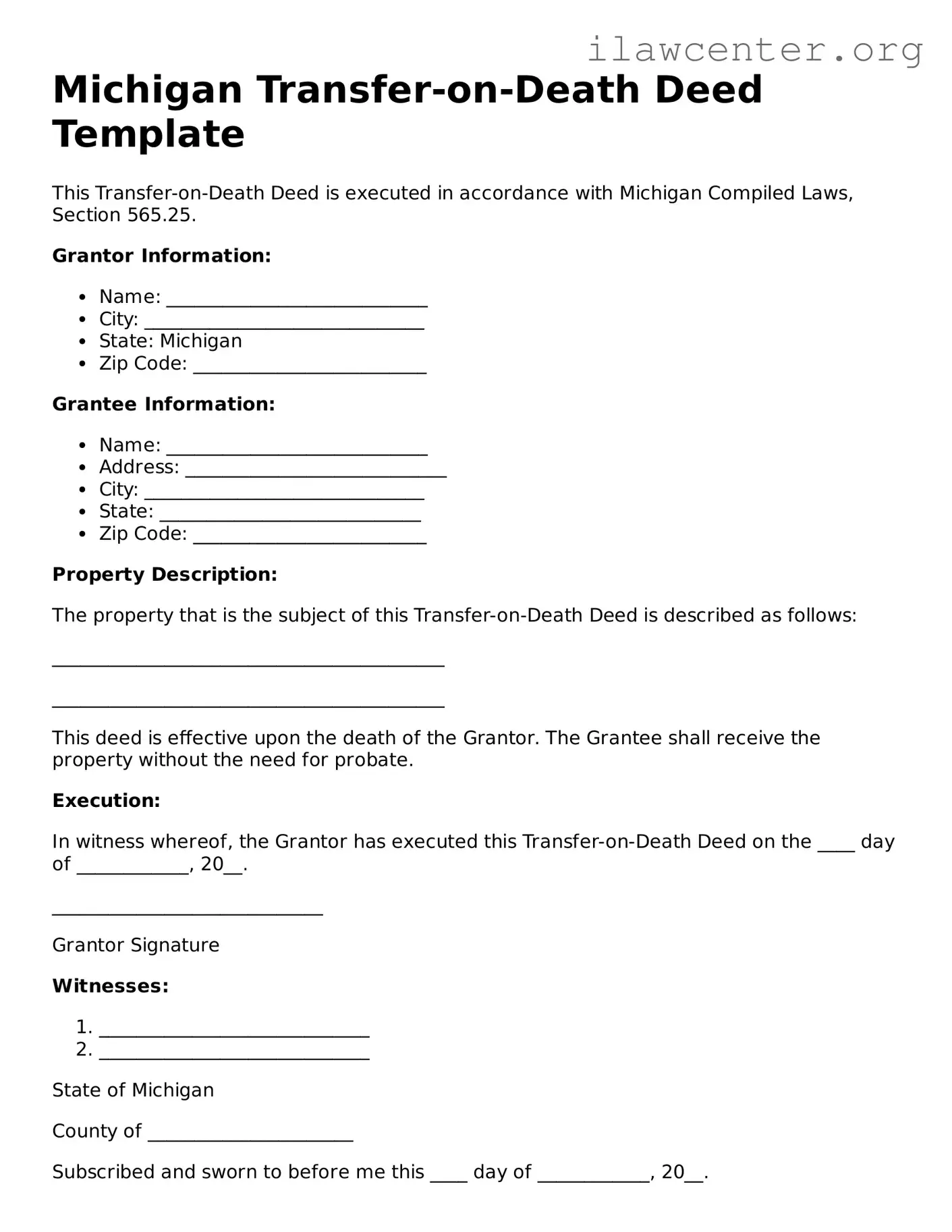
Michigan Transfer-on-Death Deed Preview

Michigan Transfer-on-Death Deed Template

This Transfer-on-Death Deed is executed in accordance with Michigan Compiled Laws, Section 565.25.

Grantor Information:

  • Name: ____________________________
  • City: ______________________________
  • State: Michigan
  • Zip Code: _________________________

Grantee Information:

  • Name: ____________________________
  • Address: ____________________________
  • City: ______________________________
  • State: ____________________________
  • Zip Code: _________________________

Property Description:

The property that is the subject of this Transfer-on-Death Deed is described as follows:

__________________________________________

__________________________________________

This deed is effective upon the death of the Grantor. The Grantee shall receive the property without the need for probate.

Execution:

In witness whereof, the Grantor has executed this Transfer-on-Death Deed on the ____ day of ____________, 20__.

_____________________________

Grantor Signature

Witnesses:

  1. _____________________________
  2. _____________________________

State of Michigan

County of ______________________

Subscribed and sworn to before me this ____ day of ____________, 20__.

_____________________________

Notary Public

My Commission Expires: ___________

PDF Form Characteristics

Fact Name Details
Definition A Transfer-on-Death Deed allows property owners to transfer real estate to beneficiaries upon death without going through probate.
Governing Law The Transfer-on-Death Deed is governed by the Michigan Compiled Laws, specifically MCL 565.25a.
Eligibility Any individual who owns real property in Michigan can create a Transfer-on-Death Deed.
Beneficiaries Multiple beneficiaries can be named in the deed, and they can be individuals or entities.
Revocation A Transfer-on-Death Deed can be revoked at any time by the property owner, using a written document.
Filing Requirement The deed must be recorded with the county register of deeds where the property is located to be effective.
Tax Implications Property transferred via a Transfer-on-Death Deed may be subject to estate taxes, depending on the overall estate value.
Effect on Creditors The property remains part of the deceased's estate for creditor claims until all debts are settled.
Joint Ownership If property is jointly owned, the Transfer-on-Death Deed does not affect the rights of the surviving owner.
Legal Assistance While not required, consulting with a legal professional is advisable to ensure the deed is completed correctly.

Instructions on Utilizing Michigan Transfer-on-Death Deed

Filling out the Michigan Transfer-on-Death Deed form is a straightforward process that allows you to designate beneficiaries for your property. Once completed, this form will need to be filed with the appropriate county register of deeds office to ensure your wishes are honored in the future.

  1. Obtain the Michigan Transfer-on-Death Deed form from the Michigan Department of Treasury website or your local county office.
  2. Enter your name and address in the designated fields at the top of the form.
  3. Provide a description of the property you wish to transfer, including the address and any relevant legal descriptions.
  4. List the names and addresses of the beneficiaries who will receive the property upon your passing.
  5. Indicate whether the transfer is to be made to multiple beneficiaries and how the property will be divided among them.
  6. Sign the form in the presence of a notary public. Ensure that the notary signs and stamps the form as required.
  7. Make copies of the completed form for your records.
  8. Submit the original signed and notarized form to the county register of deeds office where the property is located.

Important Facts about Michigan Transfer-on-Death Deed

What is a Transfer-on-Death Deed in Michigan?

A Transfer-on-Death Deed (TODD) is a legal document that allows a property owner in Michigan to designate one or more beneficiaries to receive their property upon their death. This deed does not require the property to go through probate, making the transfer process simpler and more efficient. The property owner retains full control of the property during their lifetime and can sell or change the deed at any time before their death.

How do I create a Transfer-on-Death Deed in Michigan?

To create a TODD in Michigan, you must fill out the appropriate form, which is available through the Michigan Department of Treasury or local government offices. The form must include the legal description of the property and the names of the beneficiaries. After completing the form, you must sign it in the presence of a notary public. Finally, the deed must be recorded with the county register of deeds where the property is located to be legally effective.

Can I change or revoke a Transfer-on-Death Deed after it is created?

Yes, you can change or revoke a Transfer-on-Death Deed at any time before your death. To do this, you must create a new deed or a revocation form and follow the same process of signing and recording it with the county register of deeds. It’s important to ensure that the new or revoked deed is properly recorded to avoid any confusion about your intentions regarding the property.

What happens if I die without a Transfer-on-Death Deed?

If you pass away without a Transfer-on-Death Deed, your property will typically go through the probate process. This legal procedure can be time-consuming and costly, as it involves validating your will (if you have one) and distributing your assets according to state law. Without a TODD, your heirs may face delays and additional expenses in accessing the property you intended for them.

Common mistakes

When individuals fill out the Michigan Transfer-on-Death Deed form, they often make several common mistakes that can lead to complications in the future. One prevalent error is failing to provide accurate legal descriptions of the property. The legal description must be precise and should match the information found in the property’s deed. Inaccuracies in this section can result in disputes or delays in the transfer process.

Another frequent mistake involves not properly identifying the beneficiaries. Individuals may neglect to include the full names of the beneficiaries or may use nicknames instead of legal names. This oversight can create confusion and potentially invalidate the deed. It is crucial that all beneficiaries are clearly identified to ensure that the property is transferred as intended.

In addition, some people overlook the requirement for signatures. The Michigan Transfer-on-Death Deed must be signed by the property owner, and in some cases, it may also need to be witnessed or notarized. Failing to obtain the necessary signatures can render the deed ineffective, leaving the property in limbo after the owner's death.

Another mistake involves not recording the deed with the appropriate county register of deeds. Simply completing the form does not complete the transfer process. The deed must be filed to be legally recognized. Without this step, the intended transfer may not occur, leading to complications for the heirs.

Lastly, individuals may not consider the implications of transferring property upon death. They might not fully understand how this decision could affect their estate planning or the tax implications for their beneficiaries. It is advisable to consult with a legal professional to ensure that the transfer aligns with broader estate planning goals and does not inadvertently create tax burdens or other issues for heirs.

Documents used along the form

The Michigan Transfer-on-Death Deed form allows property owners to transfer their real estate to beneficiaries upon their death without going through probate. This form is part of a broader set of documents that may be necessary to ensure a smooth transition of property ownership. Below is a list of other forms and documents commonly used in conjunction with the Transfer-on-Death Deed in Michigan.

  • Last Will and Testament: This document outlines an individual's wishes regarding the distribution of their assets after death. It can include provisions for guardianship of minors and specific bequests.
  • Durable Power of Attorney: This form allows an individual to appoint someone else to make financial or legal decisions on their behalf if they become incapacitated.
  • Healthcare Power of Attorney: This document designates a person to make medical decisions for an individual if they are unable to do so themselves.
  • Living Will: A living will expresses a person's wishes regarding medical treatment and end-of-life care, ensuring their preferences are honored when they cannot communicate them.
  • Beneficiary Designation Forms: These forms are used for accounts like life insurance policies or retirement accounts to specify who will receive the assets upon the account holder's death.
  • Property Deed: This document serves as the legal proof of ownership for real estate. It includes details about the property and the current owner.
  • Affidavit of Heirship: This sworn statement is used to establish the heirs of a deceased person, particularly when no will exists, aiding in the transfer of property.
  • Transfer Tax Affidavit: This form is required to report the transfer of property and may be used to calculate any applicable taxes during the transfer process.

These documents play vital roles in estate planning and property transfer. Having them prepared can help ensure that your wishes are respected and that your loved ones are taken care of during a difficult time.

Similar forms

A Transfer-on-Death Deed (TOD Deed) allows a property owner to designate a beneficiary who will receive the property upon the owner's death. This document has similarities to several other legal documents that also facilitate the transfer of assets or property. Here are eight documents that share similarities with the Transfer-on-Death Deed:

  • Will: A will specifies how a person's assets should be distributed after their death. Like a TOD Deed, it allows individuals to designate beneficiaries, but a will typically goes through probate.
  • Living Trust: A living trust holds assets during a person's lifetime and specifies how they should be distributed after death. This document avoids probate, similar to a TOD Deed.
  • Beneficiary Designation Form: Commonly used for life insurance policies and retirement accounts, this form allows individuals to name beneficiaries who will receive benefits directly upon death, similar to the TOD Deed's function for real estate.
  • Joint Tenancy Agreement: This agreement allows two or more people to own property together. When one owner passes away, the property automatically transfers to the surviving owner, much like a TOD Deed.
  • Payable-on-Death Account: This banking arrangement allows individuals to designate beneficiaries for bank accounts. Upon the account holder's death, the funds transfer directly to the designated beneficiary, similar to the TOD Deed process.
  • Transfer-on-Death Registration for Securities: This allows individuals to name beneficiaries for stocks and bonds. Upon death, ownership transfers directly to the beneficiary, mirroring the TOD Deed's approach to real property.
  • Life Estate Deed: This deed grants someone the right to use a property during their lifetime, with the property transferring to another person upon their death. It shares the intention of transferring property without probate.
  • Durable Power of Attorney: While primarily used for managing financial and legal matters, a durable power of attorney can allow the agent to handle property transfers, similar to the way a TOD Deed facilitates the transfer of real estate after death.

Understanding these documents can help individuals make informed decisions about how to manage and transfer their assets effectively.

Dos and Don'ts

When completing the Michigan Transfer-on-Death Deed form, it's crucial to follow certain guidelines to ensure accuracy and compliance. Here’s a list of things you should and shouldn’t do:

  • Do read the entire form carefully before starting.
  • Do provide accurate property descriptions.
  • Do include the names and addresses of all beneficiaries.
  • Do sign the deed in the presence of a notary public.
  • Do keep a copy of the completed deed for your records.
  • Don't leave any sections blank unless instructed.
  • Don't use incorrect legal terminology.
  • Don't forget to check local recording requirements.
  • Don't submit the form without proper signatures.

Misconceptions

When it comes to the Michigan Transfer-on-Death (TOD) Deed, several misconceptions can lead to confusion. Understanding these myths can help individuals make informed decisions about estate planning. Here is a list of common misconceptions:

  1. The TOD Deed is the same as a will. Many people think that a TOD Deed functions like a will, but it actually allows for the direct transfer of property upon the owner's death, bypassing probate.
  2. Only real estate can be transferred using a TOD Deed. While the TOD Deed is primarily used for real estate, it does not apply to personal property or financial accounts.
  3. Once a TOD Deed is created, it cannot be changed. In fact, the property owner can revoke or modify the TOD Deed at any time before their death.
  4. The TOD Deed automatically transfers all assets upon death. The TOD Deed only transfers the specific property listed in the deed, not all assets owned by the deceased.
  5. Using a TOD Deed eliminates the need for any estate planning. While a TOD Deed can simplify the transfer of certain properties, comprehensive estate planning is still essential for addressing other assets and wishes.
  6. A TOD Deed avoids all taxes. Although a TOD Deed can help avoid probate, it does not exempt the estate from potential estate taxes or other obligations.
  7. The TOD Deed can be used for joint ownership. A TOD Deed is not designed for joint ownership; it applies to individual property owners who wish to designate a beneficiary.
  8. There are no costs associated with creating a TOD Deed. While the process may be simpler than a will, there may still be costs involved, such as filing fees or attorney fees.
  9. Once a beneficiary is named, they cannot be changed. Beneficiaries can be updated or changed at any time before the property owner's death.
  10. The TOD Deed ensures that the property will be distributed according to the owner's wishes. While it does facilitate the transfer of property, it is crucial to ensure that all legal requirements are met for the deed to be valid.

Understanding these misconceptions can provide clarity and assist individuals in making the best choices for their estate planning needs.

Key takeaways

The Michigan Transfer-on-Death Deed form allows property owners to transfer real estate to beneficiaries upon their death without the need for probate. Here are key takeaways regarding its use:

  1. The deed must be signed by the property owner in the presence of a notary public.
  2. It is essential to include a legal description of the property being transferred.
  3. Beneficiaries should be clearly identified by name.
  4. The deed becomes effective only upon the death of the property owner.
  5. Property owners can revoke or change the deed at any time before their death.
  6. Filing the deed with the county register of deeds is necessary for it to be valid.
  7. Tax implications may arise upon the transfer, so consulting a tax advisor is recommended.
  8. Unlike a will, the Transfer-on-Death Deed bypasses the probate process.
  9. It is advisable to inform beneficiaries about the deed to avoid confusion later.

Understanding these points can help ensure a smooth transfer of property in accordance with the owner's wishes.