
Mineral Deed PDF Template

Mineral Deed PDF Template

A Mineral Deed is a legal document that facilitates the transfer of ownership rights to minerals found beneath a specific piece of land. This form outlines the details of the transaction between the Grantor, who sells their mineral rights, and the Grantee, who acquires those rights. Understanding the implications of this deed is essential for anyone involved in mineral transactions, and you can start the process by filling out the form below.

Article Guide

The Mineral Deed form is a crucial legal document used to transfer ownership of mineral rights from one party to another. This form outlines the specifics of the transaction, including the identities of the Grantor and Grantee, the consideration paid, and the precise mineral interests being conveyed. It covers various types of minerals, such as oil, gas, and sulfur, and grants the Grantee rights to explore, drill, and transport these resources from the specified land. The document also addresses the rights of ingress and egress, allowing the Grantee access to the property for necessary operations. Importantly, the Mineral Deed establishes that the Grantee is not obligated to drill or mine but can choose to do so at their discretion. Additionally, it includes provisions for the handling of any existing leases and ensures that the Grantee receives benefits like bonuses and royalties associated with the mineral interests. This form not only protects the interests of both parties but also facilitates a clear understanding of rights and responsibilities related to the mineral assets being transferred.

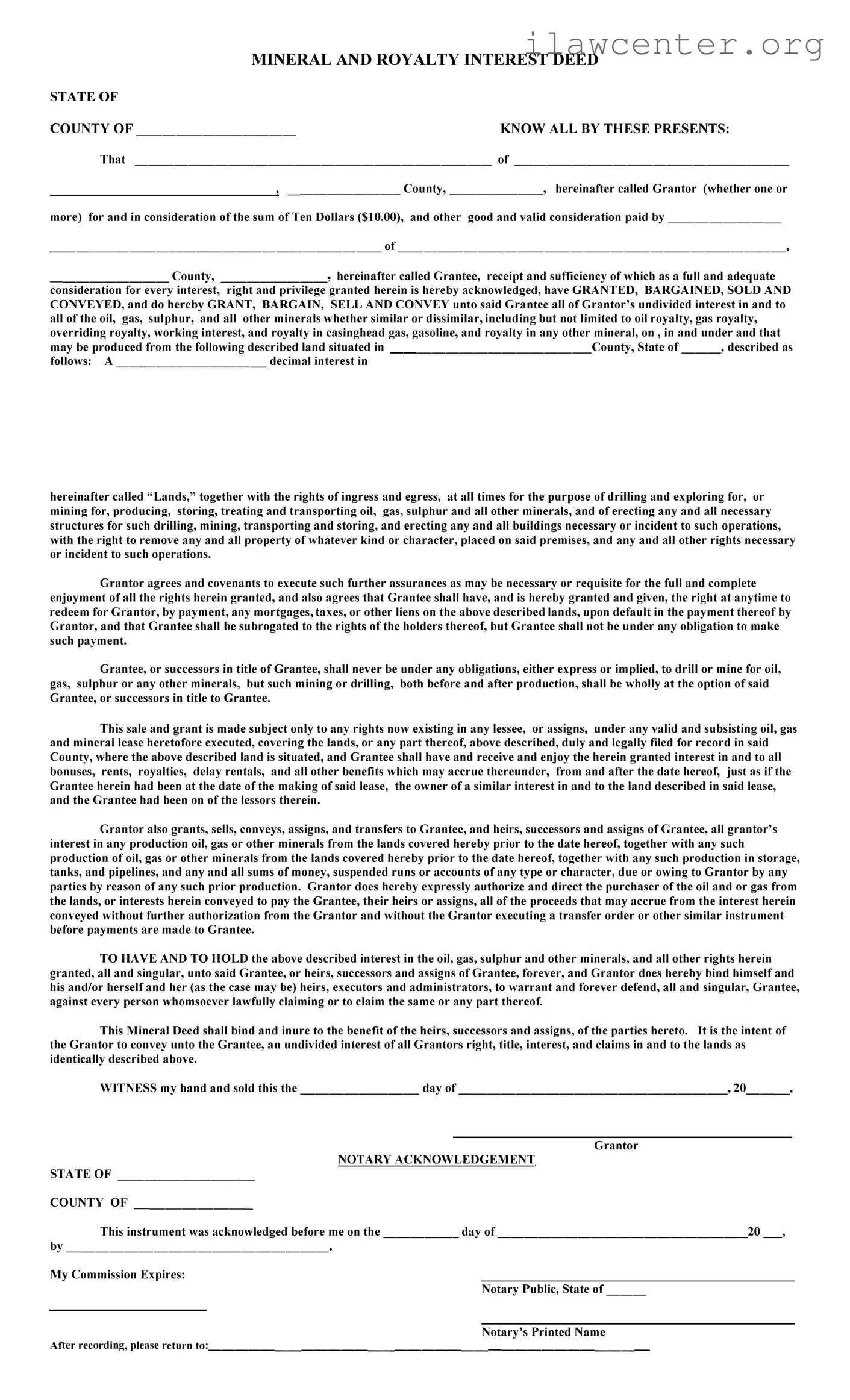
Mineral Deed Preview

MINERAL AND ROYALTY INTEREST DEED
STATE OF
KNOW ALL BY THESE PRESENTS:
COUNTY OF





 

 

   




  
  
  
    

 
 
  
  









   

  


      
 





 







 







  













File Properties

Fact Name Description
Definition A Mineral Deed is a legal document that transfers ownership of mineral rights from one party (Grantor) to another (Grantee).
Consideration The deed often includes a nominal payment, such as Ten Dollars ($10.00), to signify a valid transaction.
Rights Granted The Grantee receives rights to explore, drill, and produce oil, gas, and other minerals from the specified land.
State-Specific Forms Each state may have its own version of the Mineral Deed, governed by state laws regarding property and mineral rights.
Grantor Obligations The Grantor must execute further assurances if necessary for the Grantee to fully enjoy the rights granted.
Subrogation Rights The Grantee may pay any existing liens on the property and will be subrogated to the rights of those lienholders.
Production Rights The Grantee is not obligated to drill or mine but has the option to do so at their discretion.
Transfer of Proceeds The deed allows the Grantee to receive proceeds from oil and gas sales directly, without further authorization from the Grantor.

Instructions on Utilizing Mineral Deed

Completing the Mineral Deed form is a straightforward process that requires careful attention to detail. After filling out the form, it should be signed and notarized to ensure its validity. Below are the steps to guide you through the process.

  1. Begin by entering the state and county where the deed will be executed at the top of the form.
  2. In the first blank line, write the name of the Grantor, the individual or entity transferring the mineral rights.
  3. On the next line, fill in the address of the Grantor.
  4. In the next blank, indicate the county where the Grantor resides.
  5. Next, write the name of the Grantee, the individual or entity receiving the mineral rights.
  6. Fill in the address of the Grantee on the following line.
  7. In the next blank, specify the county where the Grantee resides.
  8. State the consideration amount, typically Ten Dollars ($10.00), in the designated space.
  9. Provide a description of the land involved in the transaction, including the county and state.
  10. Indicate the decimal interest being conveyed in the minerals.
  11. Review the rights and obligations outlined in the form, ensuring that they align with your intentions.
  12. Sign the form in the space provided, including the date of signing.
  13. Seek a notary public to acknowledge your signature. They will complete the notary acknowledgment section.
  14. After notarization, ensure that the form is properly recorded with the appropriate county office.
  15. Finally, return the recorded document to the address specified in the form.

Important Facts about Mineral Deed

What is a Mineral Deed?

A Mineral Deed is a legal document used to transfer ownership of mineral rights from one party (the Grantor) to another (the Grantee). This deed specifically conveys rights to extract and profit from minerals such as oil, gas, and other natural resources found beneath the surface of a specified piece of land. The document outlines the interests being transferred, any associated rights, and the responsibilities of both parties involved in the transaction.

What rights does a Grantee receive through a Mineral Deed?

The Grantee receives an undivided interest in the minerals located on or under the specified land. This includes rights to explore, drill, and produce oil, gas, and other minerals. The Grantee also gains access rights for necessary activities such as drilling and transporting these resources. Additionally, the Grantee has the right to receive any bonuses, rents, and royalties associated with existing leases on the property, as well as any production that occurred prior to the deed's execution.

Are there any obligations for the Grantee after receiving the Mineral Deed?

No, the Grantee is not obligated to drill or mine for minerals after receiving the Mineral Deed. The decision to engage in such activities is entirely at the Grantee's discretion. This means that the Grantee can choose to hold the rights without any requirement to produce minerals or invest in drilling operations.

What happens if there are existing leases on the property?

The Mineral Deed is subject to any existing leases that were in place prior to the transfer. The Grantee will inherit the rights to any benefits arising from those leases, such as royalties and rents. However, the Grantee must respect the terms of those leases, as they will still govern the relationship between the lessee and the lessor, even after the transfer of mineral rights.

Common mistakes

Filling out a Mineral Deed form can be a straightforward process, but several common mistakes can lead to complications. Understanding these pitfalls can help ensure that the deed is completed correctly and serves its intended purpose.

One frequent error is failing to provide complete and accurate information about the parties involved. Both the Grantor and Grantee must be clearly identified, including their full names and addresses. Omitting any details can create confusion and may lead to disputes over ownership later on.

Another mistake is neglecting to specify the interest being conveyed. The form requires clarity on the exact percentage of mineral rights being transferred. If this information is vague or missing, it can result in legal challenges regarding the extent of the rights granted.

People often forget to include a legal description of the property. This description should be precise and detailed, outlining the exact location of the land in question. A lack of specificity can make it difficult to enforce the deed or could even render it invalid.

Inaccuracies in the consideration amount can also pose problems. The form mentions a nominal amount, typically ten dollars, but it is essential to ensure that this figure is consistent throughout the document. Any discrepancies can raise questions about the validity of the transaction.

Many individuals overlook the need for notarization. A Mineral Deed must be acknowledged by a notary public to be legally binding. Skipping this step can lead to issues in the future when trying to enforce the deed or when it is presented for recording.

Lastly, failing to record the deed with the appropriate county office is a critical mistake. Recording provides public notice of the transfer and protects the Grantee's rights. Without this step, the Grantee may face difficulties asserting their ownership against third parties.

Documents used along the form

When engaging in transactions involving mineral rights, several important documents may accompany the Mineral Deed form. Each of these documents serves a specific purpose, helping to clarify rights, obligations, and the overall intent of the parties involved. Below is a list of commonly used forms and documents that often accompany the Mineral Deed.

  • Title Opinion: This document is prepared by an attorney and provides an analysis of the ownership of mineral rights. It outlines any potential issues with the title, ensuring that the buyer understands what rights are being transferred.
  • Lease Agreement: A lease agreement outlines the terms under which a lessee can explore for and extract minerals from a property. This document is crucial for establishing the relationship between the landowner and the mineral rights holder.
  • Royalty Agreement: This agreement specifies the percentage of revenue that the mineral rights owner will receive from the sale of the extracted minerals. It details how royalties will be calculated and distributed.
  • Assignment of Interest: This document is used when a mineral rights holder transfers their interest to another party. It is essential for maintaining clear records of ownership and ensuring that all parties are aware of their rights.
  • Affidavit of Heirship: In cases where mineral rights are inherited, this affidavit provides legal proof of the heirs' rights to the mineral interests. It helps clarify ownership and prevent disputes among potential claimants.
  • Surface Use Agreement: This document outlines the terms under which the mineral rights holder can use the surface of the land for exploration and extraction. It addresses concerns related to land use and environmental impact.
  • Joint Operating Agreement: When multiple parties are involved in mineral exploration or production, this agreement outlines how operations will be managed and how costs and profits will be shared among the parties.
  • Production Report: This report provides detailed information about the quantity of minerals extracted, the revenue generated, and other relevant operational data. It is essential for transparency and accountability between the parties involved.

Understanding these documents can significantly enhance the clarity and effectiveness of mineral transactions. Each form plays a vital role in protecting the interests of all parties involved, ensuring that rights are clearly defined and obligations are met. Proper documentation fosters trust and helps prevent potential disputes in the future.

Similar forms

The Mineral Deed form shares similarities with several other documents used in real estate and mineral rights transactions. Understanding these documents can provide clarity on how mineral rights are conveyed and managed. Here’s a breakdown of eight documents that are similar to the Mineral Deed:

  • Oil and Gas Lease: This document grants a lessee the right to explore and extract oil and gas from a property for a specified time, while the landowner retains ownership of the minerals.
  • Royalty Deed: Similar to a Mineral Deed, this document conveys a specific share of the royalties generated from oil and gas production, without transferring the underlying mineral rights.
  • Assignment of Mineral Rights: This is a transfer of ownership of mineral rights from one party to another, often used to formalize the sale or conveyance of mineral interests.
  • Surface Use Agreement: This agreement outlines the rights of a surface owner when mineral rights are owned by another party, detailing how the surface can be used for mineral extraction.
  • Joint Operating Agreement: This document establishes the terms under which multiple parties will collaborate in the exploration and production of oil and gas, similar to the collaborative rights outlined in a Mineral Deed.
  • Mineral Rights Lease: This is a contract that allows a company to extract minerals from a property, while the landowner retains ownership of the land and the right to receive royalties.
  • Quitclaim Deed: This document transfers whatever interest the grantor has in the property without any guarantees, often used to convey mineral rights without warranties.
  • Exploration Agreement: This agreement allows a party to explore a property for minerals and typically includes terms regarding the rights and responsibilities of both parties involved.

Each of these documents plays a crucial role in the management and transfer of mineral rights, helping to clarify the rights and obligations of the parties involved. Understanding their similarities to the Mineral Deed can aid in navigating the complexities of mineral transactions.

Dos and Don'ts

When filling out the Mineral Deed form, it is important to pay attention to detail. Here are some guidelines to follow:

  • Do ensure all names are spelled correctly.
  • Do include the correct county and state information.
  • Do specify the decimal interest clearly.
  • Do sign the document in the presence of a notary.
  • Do keep a copy for your records.
  • Don't leave any sections blank.
  • Don't use abbreviations that may cause confusion.
  • Don't forget to date the document.
  • Don't overlook the notary acknowledgment section.

Misconceptions

Understanding the Mineral Deed form is essential for anyone involved in the transfer of mineral rights. However, there are several misconceptions that can lead to confusion. Here’s a list of eight common misunderstandings:

  • Mineral Deeds are the same as Real Estate Deeds. Many people think that a mineral deed functions like a standard real estate deed. While both transfer ownership, a mineral deed specifically conveys rights to minerals beneath the surface, not the land itself.
  • All mineral rights are automatically included in a sale. Some assume that selling land includes all mineral rights. This is not always the case. Sellers must explicitly state whether mineral rights are included in the transaction.
  • Mineral rights cannot be separated from land ownership. A common belief is that mineral rights must stay with the land. In reality, landowners can sell or lease their mineral rights independently of the surface property.
  • Once a mineral deed is signed, it cannot be changed. Many think that a mineral deed is set in stone once executed. However, parties can negotiate changes or even revoke the deed if both agree.
  • Mineral deeds are only for oil and gas. Some people believe that mineral deeds only pertain to oil and gas. In fact, they can cover a variety of minerals, including coal, gold, and other valuable resources.
  • Grantees are obligated to extract minerals. It is a misconception that grantees must drill or mine for minerals once they acquire rights. The grantee has the option to explore or produce, but there is no obligation to do so.
  • Mineral deeds are not subject to existing leases. Some think that a new mineral deed overrides any existing leases. However, the deed is subject to any prior agreements made regarding the land.
  • Mineral deeds do not require notarization. There is a belief that notarization is unnecessary for mineral deeds. In reality, notarization is often required to ensure the document's validity and to prevent fraud.

By understanding these misconceptions, individuals can navigate the complexities of mineral rights more effectively. This knowledge is crucial for making informed decisions in transactions involving mineral deeds.

Key takeaways

Here are key takeaways regarding the Mineral Deed form:

  • The Mineral Deed transfers mineral rights from the Grantor to the Grantee.
  • It is important to specify the exact land and the interest being conveyed.
  • Consideration for the transfer is often nominal, such as Ten Dollars ($10.00).
  • Grantors must acknowledge receipt of consideration to validate the deed.
  • The deed grants rights to explore, drill, and transport minerals from the specified land.
  • Grantees are not obligated to drill or mine; this is at their discretion.
  • Existing leases on the property may affect the rights being conveyed.
  • Grantors authorize payment of proceeds directly to Grantees without additional consent.
  • Proper execution and notarization are essential for the deed to be legally binding.