




Motion Maricopa County PDF Template

Motion Maricopa County PDF Template

The Motion Maricopa County form is a legal document used to request a specific order from the court. This form is essential for individuals seeking to communicate their needs to a judge, whether it’s for changes in a case or other legal matters. Properly completing and submitting this motion is crucial to ensure your request is considered by the court.

Ready to fill out the Motion Maricopa County form? Click the button below to get started.

Article Guide

The Motion Maricopa County form is a crucial document for individuals seeking to make formal requests to the court regarding their case. This form is not just a simple piece of paper; it represents your opportunity to communicate specific needs or changes to the judge. When filling out the motion, it’s essential to prepare multiple copies, including conformed copies that serve as proof of filing. Along with the motion, you will need to submit an accompanying order that outlines what you want the court to decide. Properly addressing envelopes for both yourself and the other party ensures that everyone involved receives necessary documents in a timely manner. After submission, patience is key, as you will wait for a notice from the court. The judge may either sign your order or provide a minute entry detailing the decision. It’s important to follow these steps carefully, as any oversight could delay your case. Additionally, if you’re unsure about the process or need assistance, resources are available through the Self-Service Center or the Superior Court Law Library. Consulting a lawyer before filing is always a wise choice to avoid potential pitfalls.

Motion Maricopa County Preview

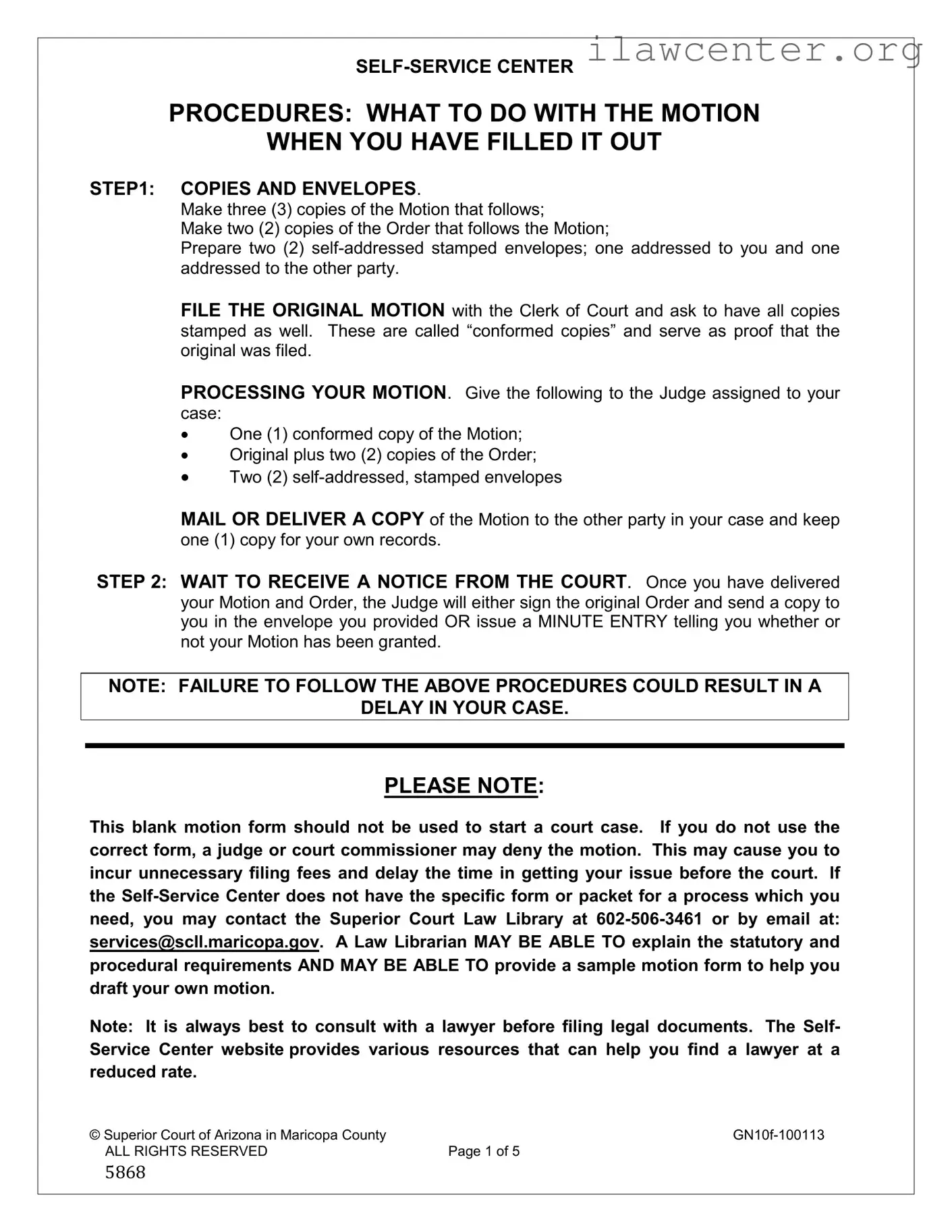
SELF-SERVICE CENTER
PROCEDURES: WHAT TO DO WITH THE MOTION
WHEN YOU HAVE FILLED IT OUT
STEP1: COPIES AND ENVELOPES.
Make three (3) copies of the Motion that follows;
Make two (2) copies of the Order that follows the Motion;
Prepare two (2) self-addressed stamped envelopes; one addressed to you and one
addressed to the other party.
FILE THE ORIGINAL MOTION with the Clerk of Court and ask to have all copies
stamped as well. These are called “conformed copies” and serve as proof that the
original was filed.
PROCESSING YOUR MOTION. Give the following to the Judge assigned to your
case:
One (1) conformed copy of the Motion;
Original plus two (2) copies of the Order;
Two (2) self-addressed, stamped envelopes
MAIL OR DELIVER A COPY of the Motion to the other party in your case and keep
one (1) copy for your own records.
STEP 2: WAIT TO RECEIVE A NOTICE FROM THE COURT. Once you have delivered
your Motion and Order, the Judge will either sign the original Order and send a copy to
you in the envelope you provided OR issue a MINUTE ENTRY telling you whether or
not your Motion has been granted.
NOTE: FAILURE TO FOLLOW THE ABOVE PROCEDURES COULD RESULT IN A
DELAY IN YOUR CASE.
PLEASE NOTE:
This blank motion form should not be used to start a court case. If you do not use the
correct form, a judge or court commissioner may deny the motion. This may cause you to
incur unnecessary filing fees and delay the time in getting your issue before the court. If
the Self-Service Center does not have the specific form or packet for a process which you
need, you may contact the Superior Court Law Library at 602-506-3461 or by email at:
services@scll.maricopa.gov.
A Law Librarian MAY BE ABLE TO explain the statutory and
procedural requirements AND MAY BE ABLE TO provide a sample motion form to help you
draft your own motion.
Note: It is always best to consult with a lawyer before filing legal documents. The Self-
Service Center website provides various resources that can help you find a lawyer at a
reduced rate.
© Superior Court of Arizona in Maricopa County GN10f-100113
ALL RIGHTS RESERVED Page 1 of 5
5868
Person Filing:
Address (if not protected):
City, State, Zip Code:
Telephone:
Email Address:
Lawyer’s Bar Number:
Representing Self, without a Lawyer or Attorney for Petitioner OR Respondent
SUPERIOR COURT OF ARIZONA
IN MARICOPA COUNTY
Case Number:
Name of Plaintiff or Petitioner
Title:
Name of Defendant or Respondent
Explain what you want the Court to order. The Judge may grant, deny, or change your
request (or “motion”). A ruling will be issued by “minute entry.”
FOR CLERK’S USE ONLY
© Superior Court of Arizona in Maricopa County GN10f-100113
ALL RIGHTS RESERVED Page 2 of 5
5868
Today’s Date:
Your Signature
© Superior Court of Arizona in Maricopa County GN10f-100113
ALL RIGHTS RESERVED Page 3 of 5
5868
Case No.
This page must be completed and attached
to the LAST page of your Motion/Request
I filed the ORIGINAL of the attached document(s) with the Clerk of the Superior Court
in Maricopa County on:
.
Month Date Year
I mailed/delivered a COPY of the attached document(s) to the Judicial Officer assigned
to my case, Judge (or Commissioner):
,
on
(Judicial Officer assigned to your case)
Month Date Year
I mailed/delivered a COPY of the attached document(s) on this date:
To: __________________________________
Month Date Year
(You must mail a copy of all documents to the other side and his/her lawyer)
Name of Other Side Name of Other Side’s Lawyer
Address Lawyer’s Address
City, State, Zip City, State, Zip
By signing below, I state to the Court, under penalty of law, that the information stated on
these pages is true and correct to the best of my knowledge and belief.
I further state that I have filed/mailed the attached document(s) as shown above. I
understand that if I do not file/mail the attached document(s) as shown above, the judge in
my case will not read my request/motion.
Your signature
© Superior Court of Arizona in Maricopa County GN10f-100113
ALL RIGHTS RESERVED Page 4 of 5
5868
Person Filing:
Address (if not protected):
City, State, Zip Code:
Telephone:
Email Address:
Lawyer’s Bar Number:
Representing Self, without a Lawyer or Attorney for Petitioner OR Respondent
SUPERIOR COURT OF ARIZONA
IN MARICOPA COUNTY
Case Number:
Name of Plaintiff or Petitioner
ORDER
Name of Defendant or Respondent
When you submit a motion [a request] to the Court, you may submit your own proposed version of the
Order you want the Judge to sign. IF this motion is a stipulation [an agreement or joint request]
presented by two or more parties, you MUST submit your own proposed version of the Order. [Maricopa
County Local Rule 3.2 (i)(1)].
The Judicial Officer will make a decision on your request and may sign the page that you submitted, or
more likely will direct the Clerk to make a “minute entry” recording the decision. A “minute entry” is a
note in the records of the Court’s proceedings. The minute entry will be printed, reviewed, approved
and signed by the Judge, and sent to all parties.
If you have submitted your own proposed Order, you must include a copy of the Request and the Order
and a stamped envelope addressed to each party who has “entered an appearance” in the case. This
means named parties or anyone that has filed papers in the case. [Maricopa County Local Rule 3.2 (i)(1)].
IT IS ORDERED THAT:
DONE IN OPEN COURT: .
JUDGE/COMMISSIONER
FOR CLERK’S USE ONLY
© Superior Court of Arizona in Maricopa County GN10f-100113
ALL RIGHTS RESERVED Page 5 of 5
5868

File Properties

Fact Name Description
Required Copies When filing the Motion, you must make three copies of the Motion and two copies of the Order. Additionally, prepare two self-addressed stamped envelopes, one for yourself and one for the other party.
Filing Process The original Motion must be filed with the Clerk of Court. You should request that all copies be stamped as “conformed copies,” which serve as proof of filing.
Waiting for Court Response After submitting your Motion, you will receive either a signed copy of the Order or a MINUTE ENTRY from the Judge indicating whether your Motion was granted or denied.
Legal Consultation It is advisable to consult with a lawyer before filing any legal documents to avoid potential delays and unnecessary fees. The Self-Service Center provides resources to help find affordable legal assistance.

Instructions on Utilizing Motion Maricopa County

After filling out the Motion Maricopa County form, it is important to follow specific steps to ensure that your motion is processed correctly. This involves making copies, filing with the court, and notifying the other party involved in your case. Adhering to these procedures will help prevent delays in your case.

  1. Make Copies and Prepare Envelopes: Create three (3) copies of the completed Motion form. Additionally, prepare two (2) copies of the accompanying Order. You will also need two (2) self-addressed stamped envelopes—one for yourself and one for the other party.
  2. File the Original Motion: Take the original Motion to the Clerk of Court. Request that all copies be stamped as “conformed copies.” This serves as proof that the original was filed.
  3. Provide Documents to the Judge: Deliver the following to the Judge assigned to your case: one (1) conformed copy of the Motion, the original plus two (2) copies of the Order, and the two (2) self-addressed stamped envelopes.
  4. Notify the Other Party: Mail or deliver a copy of the Motion to the other party involved in your case. Keep one (1) copy for your own records.
  5. Await Court Notice: After submitting your Motion and Order, wait to receive a notice from the court. The Judge will either sign the original Order and return a copy to you or issue a Minute Entry indicating whether your Motion has been granted.

Important Facts about Motion Maricopa County

What is the Motion Maricopa County form used for?

The Motion Maricopa County form is a legal document used to request a specific order from the court. It allows individuals to present their case to a judge. The motion can cover various issues, such as changes in custody, modifications of support, or other requests relevant to a case. It is essential to use the correct form to avoid delays or denials.

How do I prepare the Motion Maricopa County form?

To prepare the form, fill it out completely with your information and the details of your request. After completing the motion, make three copies of it. You will also need to prepare two copies of the order that follows the motion. Additionally, prepare two self-addressed stamped envelopes—one for yourself and one for the other party involved in the case.

What should I do after filling out the Motion?

After filling out the Motion, file the original with the Clerk of Court. Ask the clerk to stamp all your copies as “conformed copies.” This stamping serves as proof that you filed the original motion. Then, provide the judge with one conformed copy of the Motion, the original plus two copies of the Order, and the two self-addressed stamped envelopes. Finally, mail or deliver a copy of the Motion to the other party and keep one for your records.

What happens after I submit the Motion?

Once you have submitted your Motion and Order, the judge will review your request. The judge may either sign the original Order and return a copy to you using the envelope you provided or issue a minute entry. This entry will inform you whether your Motion has been granted or denied. It is important to wait for this notice from the court.

What should I do if I don’t follow the procedures correctly?

If you do not follow the procedures outlined, it could delay your case. For example, failing to provide the correct documents or not mailing copies to the other party may result in the judge not reviewing your request. This could lead to additional filing fees and a longer wait to address your issue in court.

Can I use this Motion form to start a new court case?

No, this Motion form should not be used to start a new court case. It is specifically designed for requesting orders in existing cases. Using the wrong form may lead to the judge denying your motion, which can cause unnecessary delays and costs.

What should I do if I need help with my Motion?

If you need assistance, you can contact the Superior Court Law Library. They can explain the statutory and procedural requirements and may provide a sample motion form to help you draft your own. It is also advisable to consult with a lawyer before filing legal documents to ensure that you are on the right track.

Where can I find resources to help me with legal issues?

The Self-Service Center website offers various resources to help you find a lawyer at a reduced rate. This can be beneficial if you are unsure about the legal process or need professional guidance with your case.

Common mistakes

Filling out the Motion Maricopa County form can be a straightforward process, but several common mistakes can lead to complications. One significant error is failing to make the required number of copies. The instructions specify that individuals must create three copies of the Motion and two copies of the Order. Omitting even one copy can result in delays, as the court requires these documents to process the motion effectively.

Another frequent mistake is neglecting to prepare self-addressed stamped envelopes. The form requires two envelopes—one for the filer and one for the other party. Without these envelopes, the court may not be able to send necessary documents back to the parties involved, causing further delays in the process.

People often overlook the importance of filing the original Motion with the Clerk of Court. This step is critical because it serves as the official record of the filing. If the original is not filed, the motion may not be recognized by the court, leading to potential denial or dismissal of the request.

Additionally, some individuals fail to mail or deliver a copy of the Motion to the other party. This step is not only a procedural requirement but also a matter of fairness, ensuring that all parties are informed about the motion being filed. Neglecting this can result in the other party being unprepared to respond, which may affect the outcome of the case.

Another common error is not waiting for a notice from the court after submitting the Motion and Order. Individuals may assume that their motion has been granted or denied without receiving official communication. This can lead to misunderstandings and missteps in subsequent legal actions.

Moreover, some filers use the wrong form altogether. The Motion Maricopa County form is specific in its purpose, and using an incorrect form can lead to denial of the motion. This mistake can incur unnecessary filing fees and prolong the time it takes to resolve the issue at hand.

Lastly, individuals often do not consult with a lawyer before filing their motions. While the Self-Service Center provides resources, legal advice can be invaluable in navigating the complexities of the court system. Engaging a lawyer can help ensure that all forms are completed correctly and that the motion is appropriately presented to the court.

Documents used along the form

When filing a Motion in Maricopa County, several additional forms and documents may be required to ensure the process runs smoothly. Below is a list of common documents that often accompany the Motion form, along with brief descriptions of each.

  • Order Form: This document outlines the specific ruling or decision the judge is being asked to make. It should be submitted alongside the Motion, especially if it is a stipulation agreed upon by multiple parties.
  • Notice of Hearing: This form informs all parties involved of the date and time of the hearing regarding the Motion. It ensures that everyone has the opportunity to attend and present their case.
  • Affidavit: A written statement confirmed by oath, this document provides factual evidence to support the Motion. It must be signed in front of a notary public.
  • Certificate of Service: This form verifies that all parties have been served with the Motion and related documents. It is essential for maintaining transparency in the legal process.
  • Response to Motion: If the other party wishes to contest the Motion, they will file a Response. This document outlines their arguments against the Motion and is critical for the judge’s consideration.
  • Exhibit List: This document lists any additional evidence or documents that will be presented in support of the Motion. It helps the court understand the context and relevance of the materials submitted.
  • Request for Continuance: If a party needs more time to prepare for the hearing, they can file this request. It must provide valid reasons for the delay.
  • Minute Entry: After the hearing, the judge will issue a Minute Entry, summarizing the court's decision regarding the Motion. This document becomes part of the official court record.
  • Self-Addressed Stamped Envelopes: These are required for mailing copies of the Order and Minute Entry to the parties involved. They ensure that everyone receives timely notifications.
  • Case Information Sheet: This form provides essential details about the case, such as the names of the parties involved, the case number, and the nature of the Motion. It helps the court manage the case efficiently.

Utilizing these documents correctly can significantly impact the outcome of your Motion. Ensure that all forms are completed accurately and submitted in a timely manner to avoid any delays in your case.

Similar forms

The Motion Maricopa County form shares similarities with several other legal documents used in various court proceedings. Understanding these documents can help streamline the filing process and ensure compliance with court requirements. Below is a list of documents that are similar to the Motion Maricopa County form:

  • Motion for Summary Judgment: Like the Motion Maricopa County form, this document requests the court to make a ruling based on the facts presented, without proceeding to a full trial.
  • Motion to Dismiss: This form is similar in that it seeks a court ruling to dismiss a case, often due to lack of legal basis or jurisdiction.
  • Motion for Continuance: Similar to the Motion Maricopa County form, this document requests the court to postpone a hearing or trial date for valid reasons.
  • Motion for Default Judgment: This document requests the court to rule in favor of one party due to the other party's failure to respond, mirroring the request nature of the Motion Maricopa County form.
  • Motion to Compel: Like the Motion Maricopa County form, this document asks the court to order a party to comply with a request, such as providing evidence or information.
  • Motion for Protective Order: This form seeks to protect a party from certain legal actions or disclosures, similar in its request for court intervention.
  • Motion for Reconsideration: This document asks the court to review and change a previous decision, reflecting the appeal-like nature of the Motion Maricopa County form.
  • Motion to Intervene: Similar in its request for the court's approval, this document allows a third party to join ongoing litigation, highlighting the participatory aspect of legal motions.

Each of these documents serves a specific purpose but shares the fundamental structure and procedural requirements of the Motion Maricopa County form. Ensuring that all necessary copies and envelopes are prepared, as outlined in the instructions, is crucial for the timely processing of any motion.

Dos and Don'ts

Filing a Motion in Maricopa County requires careful attention to detail. Here are five essential things to remember, as well as some common pitfalls to avoid.

  • Make multiple copies: Always prepare three copies of your Motion and two copies of the Order. This ensures you have enough for the court and the other party.
  • Include self-addressed stamped envelopes: Prepare two envelopes—one for yourself and one for the other party. This step is crucial for receiving important documents back from the court.
  • File the original Motion: Submit the original Motion to the Clerk of Court and request that all copies be stamped. These stamped copies serve as proof of filing.
  • Mail or deliver a copy: After filing, ensure you send a copy of the Motion to the other party. Keep a copy for your records as well.
  • Wait for a response: Be patient. The Judge will either sign the original Order or issue a Minute Entry regarding your Motion.
  • Don’t forget to follow procedures: Skipping any steps can lead to delays in your case. Each requirement is there for a reason.
  • Don’t use the wrong form: Ensure you’re using the correct Motion form. Using an incorrect form can lead to denial and additional fees.
  • Don’t neglect communication: If you have questions, reach out to the Superior Court Law Library. They can provide guidance and resources.
  • Don’t skip legal advice: Consulting with a lawyer before filing can help avoid mistakes that may hinder your case.
  • Don’t assume everything is automatic: Just because you file a Motion doesn’t mean it will be granted. Understand that the Judge has discretion in these matters.

By following these guidelines, you can navigate the filing process with greater confidence. Remember, attention to detail and adherence to procedure can make a significant difference in the outcome of your case.

Misconceptions

Understanding the Motion Maricopa County form is crucial for anyone navigating the legal system. However, several misconceptions can lead to confusion. Here are nine common misunderstandings:

  • Only one copy is needed. Many believe that filing just the original motion is sufficient. In reality, three copies of the motion and two copies of the order are required.
  • The motion can be filed without envelopes. Some think they can submit their motion without self-addressed stamped envelopes. However, two envelopes are necessary to ensure that all parties receive the court's decision.
  • Filing the motion is the last step. It’s a misconception that filing the motion is the end of the process. After filing, you must wait for a notice from the court regarding the outcome.
  • Any form can be used for motions. Some individuals assume they can use any motion form. It's essential to use the correct form specific to your case to avoid delays or denial.
  • Consulting a lawyer is unnecessary. Many believe they can handle everything independently. While self-filing is possible, consulting with a lawyer can provide valuable guidance.
  • All motions are granted. There's a belief that submitting a motion guarantees approval. The judge has the discretion to grant, deny, or modify your request.
  • Minute entries are informal. Some think that minute entries are not significant. In fact, they are official records of the court’s decisions and should be taken seriously.
  • Only the judge needs copies. A common misunderstanding is that only the judge requires copies of the documents. All parties involved must receive copies as well.
  • Filing fees are always the same. People often think that filing fees are fixed. Fees can vary based on the type of motion and the specifics of the case.

Being aware of these misconceptions can help streamline the process and avoid unnecessary complications. Always follow the outlined procedures carefully to ensure your motion is handled correctly.

Key takeaways

Filling out and using the Motion Maricopa County form involves several important steps.

  • Make three copies of the Motion and two copies of the Order.
  • Prepare two self-addressed stamped envelopes, one for yourself and one for the other party.
  • File the original Motion with the Clerk of Court and request conformed copies.
  • Deliver one conformed copy of the Motion and the original plus two copies of the Order to the assigned Judge.
  • Mail or deliver a copy of the Motion to the other party, keeping one for your records.
  • Wait for a notice from the Court regarding the Judge's decision on your Motion.
  • Ensure you use the correct form to avoid delays or denial of your Motion.
  • Consult a lawyer if possible, as they can provide valuable guidance.

Following these steps carefully can help streamline your process. Remember, mistakes can lead to unnecessary delays and additional costs.