Fillable Motor Vehicle Power of Attorney Document

Fillable Motor Vehicle Power of Attorney Document

The Motor Vehicle Power of Attorney form is a legal document that allows one person to authorize another to act on their behalf in matters related to their vehicle, such as registration, title transfer, and other transactions. This form is essential for ensuring that your vehicle-related affairs can be handled smoothly, especially when you are unable to do so yourself. If you need to fill out this form, click the button below to get started.

Article Guide

The Motor Vehicle Power of Attorney form is a crucial legal document that empowers an individual to act on behalf of another person regarding vehicle-related matters. This form is particularly important when you need to delegate authority for tasks such as transferring ownership, registering a vehicle, or handling title issues. Whether you’re selling your car while away or managing the affairs of a loved one, this document ensures that the designated agent can carry out necessary actions without delay. It typically includes essential details like the names of both the principal and the agent, a description of the vehicle in question, and the specific powers granted. By completing this form, you can ensure that your vehicle transactions proceed smoothly, without unnecessary complications or legal hurdles. Understanding its significance and proper usage can save time and prevent misunderstandings in the future.

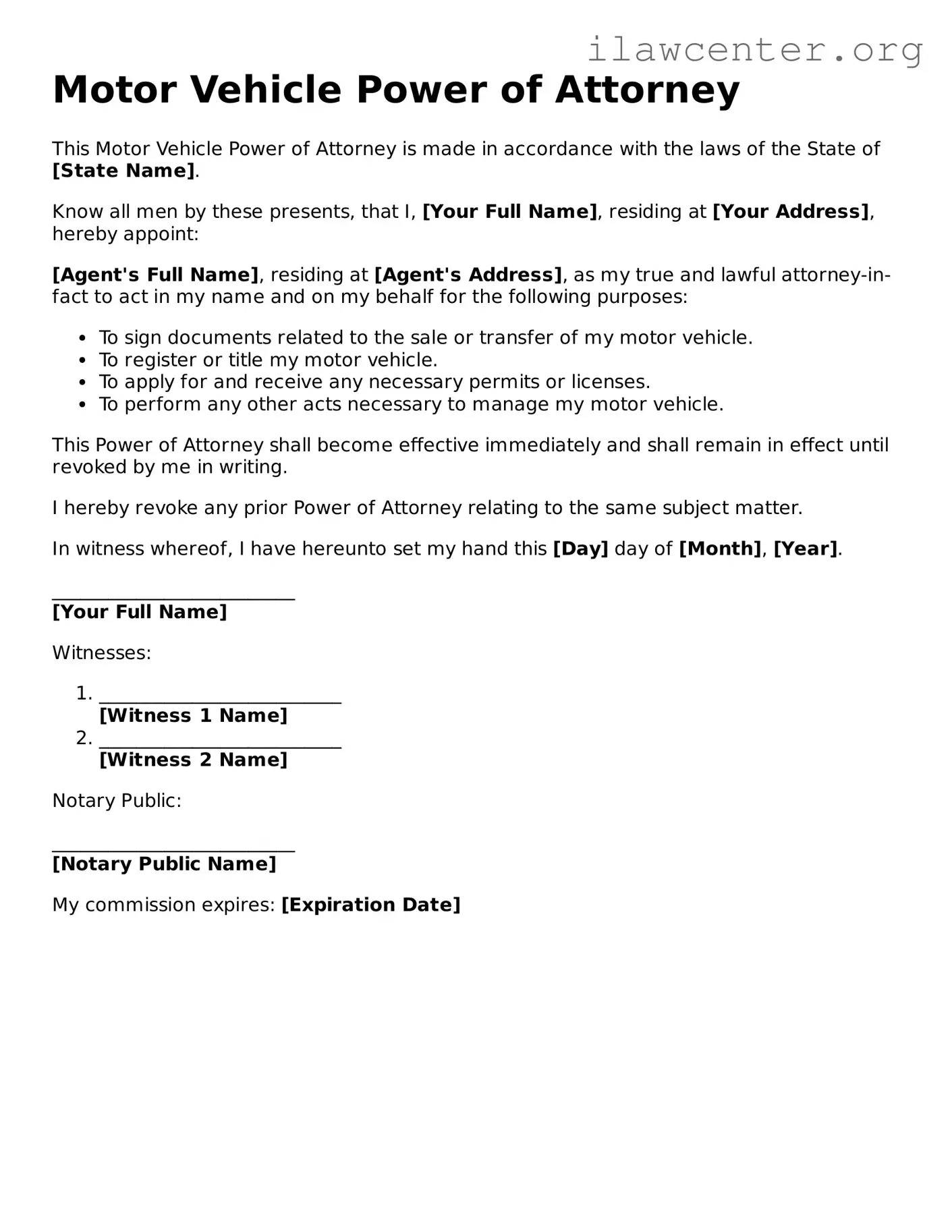
Motor Vehicle Power of Attorney Preview

Motor Vehicle Power of Attorney

This Motor Vehicle Power of Attorney is made in accordance with the laws of the State of [State Name].

Know all men by these presents, that I, [Your Full Name], residing at [Your Address], hereby appoint:

[Agent's Full Name], residing at [Agent's Address], as my true and lawful attorney-in-fact to act in my name and on my behalf for the following purposes:

  • To sign documents related to the sale or transfer of my motor vehicle.
  • To register or title my motor vehicle.
  • To apply for and receive any necessary permits or licenses.
  • To perform any other acts necessary to manage my motor vehicle.

This Power of Attorney shall become effective immediately and shall remain in effect until revoked by me in writing.

I hereby revoke any prior Power of Attorney relating to the same subject matter.

In witness whereof, I have hereunto set my hand this [Day] day of [Month], [Year].

__________________________
[Your Full Name]

Witnesses:

  1. __________________________
    [Witness 1 Name]
  2. __________________________
    [Witness 2 Name]

Notary Public:

__________________________
[Notary Public Name]

My commission expires: [Expiration Date]

PDF Form Characteristics

Fact Name Description
Purpose The Motor Vehicle Power of Attorney form allows a person to designate another individual to handle vehicle-related transactions on their behalf.
Governing Law Each state has its own laws governing the use of this form. For example, in California, it is governed by the California Vehicle Code.
Common Uses This form is often used for tasks such as transferring title, registering a vehicle, or obtaining license plates.
Requirements Typically, both the principal (the person granting authority) and the agent (the person receiving authority) must sign the form. Some states may require notarization.
Validity Period The power of attorney can be set for a specific duration or remain in effect until revoked by the principal.
Revocation The principal can revoke the power of attorney at any time, but they must notify the agent and any relevant parties.
State-Specific Forms Some states provide their own specific forms for motor vehicle power of attorney, which may include additional requirements or information.

Instructions on Utilizing Motor Vehicle Power of Attorney

Filling out the Motor Vehicle Power of Attorney form is a straightforward process. This form allows you to designate someone to act on your behalf regarding vehicle-related matters. Follow the steps below to ensure that you complete the form accurately.

  1. Begin by entering your full name in the designated space at the top of the form.
  2. Provide your address, including city, state, and ZIP code.
  3. Next, fill in the name of the person you are granting power of attorney to. This person will act on your behalf.
  4. Include the address of the person you are granting power of attorney to, ensuring it is complete.
  5. Specify the vehicle details, including the make, model, year, and Vehicle Identification Number (VIN).
  6. Indicate the specific powers you are granting. This may include tasks like signing documents or transferring ownership.
  7. Sign and date the form at the bottom. Your signature is essential for the form to be valid.
  8. If required, have the form notarized to add an extra layer of authenticity.

Once you have completed the form, review it for accuracy. Ensure all information is correct and legible. Keep a copy for your records, and provide the original to the person you designated. They will need it to act on your behalf regarding vehicle matters.

Important Facts about Motor Vehicle Power of Attorney

What is a Motor Vehicle Power of Attorney form?

A Motor Vehicle Power of Attorney form is a legal document that allows an individual to appoint another person to act on their behalf regarding specific matters related to motor vehicles. This can include tasks such as signing titles, registering vehicles, or handling transactions with the Department of Motor Vehicles (DMV).

Who can be appointed as an agent in this form?

The agent can be any competent adult, typically a trusted individual such as a family member, friend, or legal representative. It is important that the appointed agent understands their responsibilities and is willing to act in the best interest of the person granting the power.

What powers can be granted through this form?

The powers granted can vary based on the individual's needs. Common powers include the ability to sign documents related to the sale or transfer of a vehicle, apply for a duplicate title, or register a vehicle in the owner’s name. The form can be customized to specify the exact powers being granted.

Is a Motor Vehicle Power of Attorney form permanent?

No, this form is not necessarily permanent. The powers granted can be revoked at any time by the person who created the form, provided that they are competent to do so. It is advisable to formally revoke the power in writing and notify the agent and relevant authorities.

Do I need to have the form notarized?

While notarization is not always required, it is recommended to ensure the document is legally binding and to prevent any disputes. Some states may have specific requirements regarding notarization, so it is wise to check local laws.

Can I use this form for transactions in multiple states?

The Motor Vehicle Power of Attorney form may be valid across state lines, but each state has its own laws regarding such documents. It is essential to verify that the form meets the requirements of the state where the transaction will occur.

How do I obtain a Motor Vehicle Power of Attorney form?

These forms can often be obtained from state DMV websites, legal stationery stores, or online legal services. It is important to ensure that the form is appropriate for the specific state and situation to ensure compliance with local laws.

Common mistakes

Filling out a Motor Vehicle Power of Attorney form is a crucial step for anyone looking to authorize another person to handle vehicle-related transactions on their behalf. However, many individuals make common mistakes that can lead to delays or complications. One frequent error is not providing complete information about the vehicle. This includes the vehicle identification number (VIN), make, model, and year. Omitting any of these details can result in the form being rejected.

Another mistake often seen is failing to sign the form. A signature is essential for validating the document. Without it, the power of attorney cannot be executed. Additionally, individuals sometimes overlook the need for a witness or notary. Depending on state requirements, having a witness or notarizing the document may be necessary for it to be legally binding.

People also tend to forget to specify the powers granted. The form allows for different levels of authority, such as selling the vehicle or transferring ownership. Not clearly indicating the desired powers can create confusion and may prevent the agent from acting effectively.

Moreover, using outdated forms can lead to problems. Laws and regulations change, and it’s important to ensure that the most current version of the form is used. Using an old version may result in the form being invalid, causing delays in processing.

Another common error is not providing proper identification for both the principal and the agent. Identification is often required to verify the identities of both parties. Without this, the form may not be accepted by the Department of Motor Vehicles (DMV).

Individuals sometimes neglect to check for typos or errors in the information provided. Simple mistakes, such as misspelled names or incorrect dates, can lead to significant issues. Always double-check the information to ensure accuracy.

Additionally, some people fail to understand the implications of granting power of attorney. It’s essential to choose someone trustworthy, as this person will have the authority to make decisions regarding the vehicle. Not considering this aspect can lead to potential misuse of power.

Lastly, individuals might forget to keep a copy of the completed form. Retaining a copy is important for personal records and can be useful if any questions arise in the future. Keeping track of documentation helps in maintaining clarity and accountability.

Documents used along the form

The Motor Vehicle Power of Attorney form is a vital document that allows one person to authorize another to act on their behalf regarding motor vehicle transactions. However, several other forms and documents often accompany this form to ensure a smooth process in handling vehicle-related matters. Below is a list of these essential documents, each serving a unique purpose.

  • Vehicle Title Transfer Form: This document is used to officially transfer ownership of a vehicle from one party to another. It includes details about the vehicle, such as its VIN, make, model, and the names of the buyer and seller.
  • Bill of Sale: A bill of sale serves as a receipt that confirms the sale of a vehicle. It outlines the terms of the sale, including the purchase price and any conditions agreed upon by both parties.
  • Application for Certificate of Title: This form is necessary for registering a vehicle in the new owner's name. It typically requires information about the vehicle and proof of ownership.
  • Odometer Disclosure Statement: Required by federal law, this document ensures that the seller provides accurate information regarding the vehicle's mileage at the time of sale, preventing fraud.
  • Affidavit of Heirship: In cases where a vehicle owner has passed away, this document can help establish rightful ownership among heirs without going through probate.
  • Release of Liability: This form protects the seller from future liability once the vehicle is sold. It informs the DMV that the seller is no longer responsible for the vehicle.
  • Insurance Information: While not a formal document, providing proof of insurance is often necessary when transferring ownership or registering a vehicle.
  • Vehicle Registration Application: This form is used to register a vehicle with the state, ensuring that the vehicle is legally recognized and can be driven on public roads.

Understanding these forms and their functions can significantly ease the process of vehicle transactions. Each document plays a crucial role in ensuring that ownership transfers are clear, legal, and binding, thus protecting the interests of all parties involved.

Similar forms

The Motor Vehicle Power of Attorney form is an essential document that allows one person to authorize another to act on their behalf regarding vehicle-related matters. Several other documents share similarities with this form, particularly in granting authority and facilitating transactions. Here are eight documents that are comparable:

  • General Power of Attorney: This document allows an individual to appoint someone else to manage a wide range of affairs, including financial and legal matters, not limited to vehicle transactions.
  • Limited Power of Attorney: Similar to the general version, this document restricts the authority granted to specific tasks or timeframes, such as handling the sale of a vehicle.
  • Durable Power of Attorney: This form remains effective even if the principal becomes incapacitated. It can be used for vehicle matters and other financial decisions.
  • Vehicle Title Transfer Form: This document is specifically used to transfer ownership of a vehicle from one party to another, often requiring a signature from both the seller and buyer.
  • Bill of Sale: This legal document records the sale of a vehicle, detailing the transaction and the parties involved, similar to the authority granted in a Power of Attorney.
  • Registration Application: When registering a vehicle, this form may require authorization from the owner, similar to how a Power of Attorney allows someone to register a vehicle on behalf of another.
  • Insurance Authorization Form: This document allows one person to authorize another to discuss or manage insurance matters related to a vehicle, akin to the powers granted in a Motor Vehicle Power of Attorney.
  • Consent to Release Information Form: This document permits the release of personal information for vehicle-related purposes, allowing a designated person to act on behalf of the vehicle owner.

Understanding these documents can help you navigate the complexities of vehicle ownership and transactions more effectively. Each document serves a unique purpose but shares the common goal of facilitating authority and representation in vehicle matters.

Dos and Don'ts

When completing the Motor Vehicle Power of Attorney form, it’s crucial to follow specific guidelines to ensure the document is valid and effective. Here’s a list of things you should and shouldn't do:

  • Do read the entire form carefully before filling it out.
  • Do provide accurate and complete information about both the principal and the agent.
  • Do sign the form in the presence of a notary public, if required by your state.
  • Do keep a copy of the completed form for your records.
  • Don't leave any blank spaces on the form; if a section does not apply, write "N/A."
  • Don't use outdated versions of the form; ensure you have the most current one.
  • Don't forget to specify the powers you are granting to your agent clearly.

Following these guidelines will help ensure that your Motor Vehicle Power of Attorney form is completed correctly and serves its intended purpose.

Misconceptions

Many people have misconceptions about the Motor Vehicle Power of Attorney (MVPOA) form. Understanding these misconceptions can help individuals navigate the process more effectively. Here are ten common misunderstandings:

  1. It is only for buying or selling vehicles.

    While the MVPOA is often used for transactions like buying or selling, it can also be used for other purposes, such as registering a vehicle, obtaining a title, or handling repairs.

  2. Only a lawyer can prepare it.

    Individuals can fill out the MVPOA themselves. However, seeking legal advice can be beneficial to ensure all details are correctly addressed.

  3. It must be notarized to be valid.

    Notarization is not always required. Each state has its own rules regarding the need for a notary, so checking local laws is essential.

  4. It is permanent and cannot be revoked.

    The MVPOA can be revoked at any time by the person who granted it, as long as they are mentally competent.

  5. It can only be used in the state where it was created.

    While some states have specific requirements, many states recognize MVPOA forms from other jurisdictions, especially if they meet certain criteria.

  6. It gives complete control over all assets.

    The MVPOA is limited to vehicle-related matters. It does not grant authority over other financial or legal matters unless explicitly stated.

  7. Anyone can be appointed as an agent.

    While many people appoint family members or friends, it is important to choose someone trustworthy and responsible, as they will act on your behalf.

  8. There is a standard form used across the country.

    Each state may have its own version of the MVPOA, with different requirements and language. It's crucial to use the correct form for your state.

  9. It cannot be used if the principal is incapacitated.

    If a durable power of attorney is in place, it can still be effective even if the principal becomes incapacitated, but this needs to be specified in the document.

  10. There are no consequences for misuse.

    Misusing an MVPOA can lead to legal consequences, including criminal charges. It is important for both the principal and the agent to understand their rights and responsibilities.

By dispelling these misconceptions, individuals can better understand how the Motor Vehicle Power of Attorney form works and how it can be effectively utilized.

Key takeaways

When considering the Motor Vehicle Power of Attorney form, there are several important points to keep in mind. This document allows someone to act on your behalf regarding motor vehicle transactions. Here are key takeaways to help you navigate this process:

  1. Understand the Purpose: This form is designed to give another person the authority to handle specific tasks related to your vehicle, such as registration, title transfers, and more.
  2. Choose the Right Agent: Select someone you trust completely. This person will have significant control over your vehicle-related matters.
  3. Specify the Powers: Clearly outline what your agent can and cannot do. The more specific you are, the less room there is for misunderstanding.
  4. Check State Requirements: Each state may have different rules regarding the form. Make sure you comply with local laws to ensure validity.
  5. Provide Identification: Both you and your agent may need to provide identification. This helps verify identities and protect against fraud.
  6. Consider Duration: Decide if the power of attorney is temporary or permanent. If it's temporary, specify the end date or conditions for termination.
  7. Sign and Date Properly: Ensure that you sign and date the form according to your state’s requirements. This step is crucial for the document's legality.
  8. Keep Copies: Once completed, keep copies of the signed form for your records and provide a copy to your agent.
  9. Revocation Process: Understand how to revoke the power of attorney if needed. You should know the steps to take if you no longer wish for the agent to act on your behalf.

By keeping these points in mind, you can confidently fill out and utilize the Motor Vehicle Power of Attorney form, ensuring that your vehicle-related matters are handled smoothly and efficiently.