
Move Out Notice Letter PDF Template

Move Out Notice Letter PDF Template

A Move Out Notice Letter is a formal document that informs your landlord of your intention to vacate the rental property. This letter not only communicates your departure date but also requests the return of your security deposit. To ensure a smooth transition, it’s essential to fill out this form accurately and send it via Certified Mail.

Ready to get started? Fill out the form by clicking the button below.

Article Guide

When it's time to move out of a rental property, submitting a Move Out Notice Letter to your landlord is a crucial step in ensuring a smooth transition. This letter serves as formal notification of your intent to vacate the premises, and it also requests the return of your security deposit. It is important to send this letter via Certified Mail, as this provides proof of delivery and ensures that your landlord receives your notice in a timely manner. In the letter, you will need to include your name, current address, and the date you plan to move out. Additionally, you should specify the forwarding address where you wish to receive your security deposit. Cleaning the apartment according to the provided move-out instructions is also essential to avoid any deductions from your deposit. Closing the letter with a note of thanks for the landlord's services can foster goodwill, which may be beneficial for future references. Keeping a copy of this letter for your records is recommended, as it can serve as documentation of your notice and any agreements made during the move-out process.

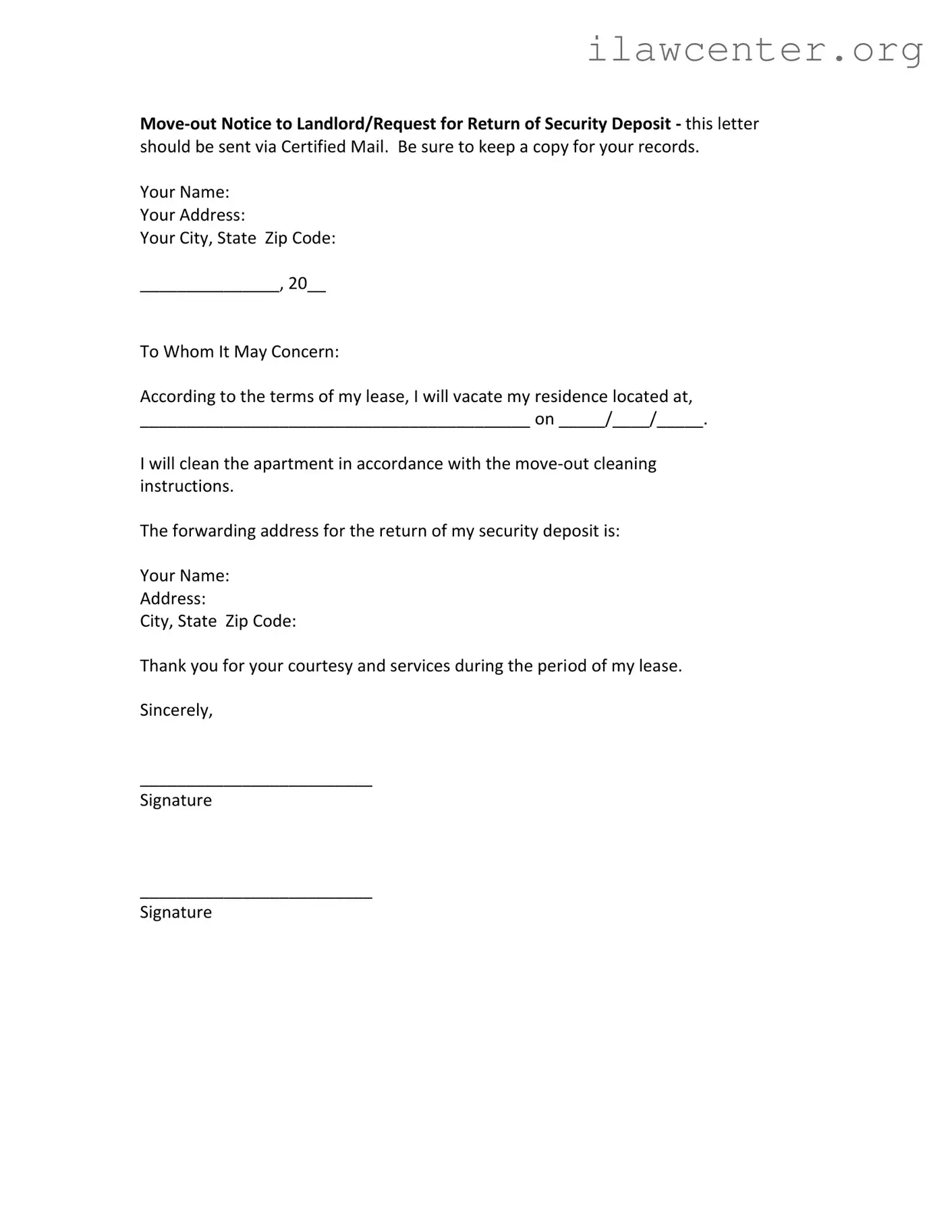
Move Out Notice Letter Preview

Move-out Notice to Landlord/Request for Return of Security Deposit - this letter
should be sent via Certified Mail. Be sure to keep a copy for your records.
Your Name:
Your Address:
Your City, State Zip Code:
_______________, 20__
To Whom It May Concern:
According to the terms of my lease, I will vacate my residence located at,
__________________________________________ on _____/____/_____.
I will clean the apartment in accordance with the move-out cleaning
instructions.
The forwarding address for the return of my security deposit is:
Your Name:
Address:
City, State Zip Code:
Thank you for your courtesy and services during the period of my lease.
Sincerely,
_________________________
Signature
_________________________
Signature

File Properties

Fact Name Description
Purpose The Move Out Notice Letter serves as formal communication to the landlord about the tenant's intention to vacate the rental property.
Delivery Method This letter should be sent via Certified Mail to ensure that there is proof of delivery.
Record Keeping It is crucial for tenants to keep a copy of the letter for their records, as it may be needed for future reference.
Lease Terms The notice should reference the terms of the lease, indicating that the tenant is complying with the agreed-upon conditions.
Cleaning Obligations Tenants are expected to clean the apartment according to the move-out cleaning instructions provided in the lease.
Forwarding Address The letter must include a forwarding address for the return of the security deposit, ensuring the landlord knows where to send it.
State-Specific Laws Different states have varying laws regarding notice periods and security deposit returns. For example, California requires a 30-day notice for month-to-month leases.
Professional Courtesy Including a note of thanks to the landlord for their services during the lease period is a polite gesture that can help maintain a positive relationship.

Instructions on Utilizing Move Out Notice Letter

Completing the Move Out Notice Letter form is an important step in ensuring a smooth transition from your current residence. After filling out the form, you will need to send it to your landlord via Certified Mail. This method provides proof of delivery and ensures that your notice is officially recognized. Remember to keep a copy of the letter for your records.

  1. Begin by entering your name at the top of the form.
  2. Next, fill in your current address, including the street address, city, state, and zip code.
  3. Write the date in the format of month, day, and year.
  4. Address the letter to "To Whom It May Concern."
  5. State your intention to vacate the residence, including the complete address of the property you are leaving.
  6. Specify the date you plan to move out, using the format of month, day, and year.
  7. Indicate that you will clean the apartment according to the move-out cleaning instructions.
  8. Provide your forwarding address where your security deposit should be sent, including your name, address, city, state, and zip code.
  9. Express gratitude for the landlord's courtesy and services during your lease period.
  10. Sign the letter in the designated area, ensuring your signature is clear.
  11. Make a copy of the completed letter for your records.
  12. Finally, send the letter via Certified Mail to your landlord.

Important Facts about Move Out Notice Letter

What is a Move Out Notice Letter?

A Move Out Notice Letter is a formal communication from a tenant to their landlord, indicating the tenant's intention to vacate the rental property. This letter serves as a notice period as specified in the lease agreement, ensuring that both parties are aware of the upcoming move-out date. It also typically includes a request for the return of the security deposit.

Why should I send my Move Out Notice Letter via Certified Mail?

Sending your Move Out Notice Letter via Certified Mail provides you with proof that the letter was sent and received by the landlord. This is important because it establishes a record of your notice, which can be beneficial if any disputes arise regarding the move-out process or the return of your security deposit.

What information should be included in the Move Out Notice Letter?

Your Move Out Notice Letter should include your name, current address, and the date you plan to vacate the property. Additionally, it should mention that you will clean the apartment according to the move-out cleaning instructions. Finally, provide your forwarding address for the return of your security deposit to ensure that the landlord knows where to send it.

How much notice do I need to give my landlord?

The amount of notice required typically depends on the terms outlined in your lease agreement. Most leases require a notice period of 30 days, but this can vary. It is essential to review your lease to determine the specific requirements to avoid any potential issues.

What should I do if my landlord does not return my security deposit?

If your landlord fails to return your security deposit after you have provided the appropriate notice and vacated the property, you should first attempt to communicate with them. Document all correspondence. If the issue remains unresolved, you may consider seeking legal advice or contacting your local housing authority for guidance on your rights and possible next steps.

Is it necessary to thank my landlord in the Move Out Notice Letter?

While it is not mandatory to thank your landlord in the Move Out Notice Letter, doing so can help maintain a positive relationship. A courteous closing statement can foster goodwill and may be beneficial if you need to contact your landlord in the future or if you require references for future rental applications.

Common mistakes

When filling out the Move Out Notice Letter form, many people overlook important details that can lead to misunderstandings or delays. One common mistake is failing to include the correct date of the move-out. This date is crucial, as it informs the landlord when you plan to vacate the property. If the date is incorrect, it may result in confusion regarding your lease termination.

Another frequent error involves not providing a forwarding address for the return of the security deposit. Landlords need this information to send the deposit back. Omitting this detail can lead to complications and potential loss of your deposit.

Many individuals neglect to specify their current address clearly. The form requires your name and complete address, including city, state, and zip code. Incomplete or unclear information can hinder the landlord's ability to process your notice effectively.

Some people forget to send the letter via certified mail. This step is essential, as it provides proof that you sent the notice and allows you to track its delivery. Skipping this can lead to disputes about whether or not the landlord received your notice.

Another mistake is not keeping a copy of the letter for personal records. Retaining a copy is vital for your documentation, especially if any issues arise regarding your security deposit or lease termination.

Failing to mention the condition of the apartment can also be problematic. While the form includes a statement about cleaning, it's beneficial to clarify your commitment to leaving the apartment in good condition. This can help avoid disputes over cleaning fees.

In some cases, individuals forget to sign the letter. A signature is necessary to validate the notice. Without it, the letter may not be considered official by the landlord.

Another common oversight is not expressing gratitude or courtesy in the letter. While it may seem trivial, a polite tone can foster goodwill and may influence the landlord's actions regarding your security deposit.

Some people fail to double-check for typos or grammatical errors. Mistakes in the letter can create confusion or make it seem unprofessional. Taking a moment to proofread can enhance clarity and professionalism.

Finally, many individuals do not follow up after sending the letter. It’s wise to confirm with the landlord that they received the notice and to discuss any next steps. This proactive approach can prevent misunderstandings and ensure a smoother transition.

Documents used along the form

When preparing to move out of a rental property, several important documents may accompany the Move Out Notice Letter. These documents help ensure a smooth transition and protect the rights of both the tenant and the landlord. Below are five commonly used forms and documents.

  • Lease Agreement - This document outlines the terms and conditions agreed upon by both the tenant and landlord at the start of the rental period. It includes details such as rent amount, duration of the lease, and responsibilities of each party.
  • Move-Out Checklist - A checklist that helps tenants ensure they complete all necessary tasks before leaving the property. It typically includes items like cleaning requirements, repairs, and the return of keys.
  • Security Deposit Return Request - This form formally requests the return of the security deposit after the tenant has vacated the property. It may specify the forwarding address and include any deductions the tenant believes should not be taken from the deposit.
  • Condition Report - A document that records the state of the property at the time of move-out. It can help resolve disputes regarding damages or necessary repairs that may affect the return of the security deposit.
  • Final Utility Bill Statements - These statements confirm that all utility bills have been paid in full. Providing proof of payment can help avoid disputes over outstanding charges after moving out.

Utilizing these documents alongside the Move Out Notice Letter can facilitate a clearer communication process and help protect the interests of both parties involved. Proper documentation is key to ensuring a successful move-out experience.

Similar forms

The Move Out Notice Letter form shares similarities with several other important documents in the rental process. Here are four such documents:

  • Lease Termination Letter: This document formally notifies the landlord of a tenant's intention to end the lease agreement. Like the Move Out Notice, it specifies the date of termination and may include details about the condition of the property upon leaving.
  • Security Deposit Return Request: After moving out, tenants often submit this request to ensure the return of their security deposit. Similar to the Move Out Notice, it provides the landlord with a forwarding address and may reference the condition of the property.
  • Notice of Intent to Vacate: This notice serves as an official declaration of a tenant's plan to leave the rental unit. It typically includes the move-out date and aligns with the requirements set forth in the lease agreement, much like the Move Out Notice Letter.
  • Move-In Condition Report: While this document is filled out at the beginning of a tenancy, it serves as a reference point when moving out. It details the state of the property upon move-in and can be compared to the condition upon move-out, similar to the cleaning instructions mentioned in the Move Out Notice.

Dos and Don'ts

When filling out the Move Out Notice Letter form, it’s important to approach the task with care. Here are some essential dos and don’ts to keep in mind:

  • Do send the letter via Certified Mail to ensure it is received.
  • Do keep a copy of the letter for your records.
  • Do include your full name and address clearly at the top of the letter.
  • Do specify the exact date you plan to vacate the premises.
  • Don't forget to mention your forwarding address for the return of your security deposit.
  • Don't use vague language; be clear and concise in your communication.
  • Don't forget to thank your landlord for their services during your lease period.

By following these guidelines, you can ensure that your move-out process goes smoothly and that your rights are protected. Taking the time to fill out the form correctly can save you headaches down the line.

Misconceptions

Here are nine common misconceptions about the Move Out Notice Letter form, along with explanations to clarify each point.

  • It is not necessary to send the letter via Certified Mail. Some people believe any form of communication is acceptable. However, sending it via Certified Mail provides proof that the landlord received the notice.
  • You don’t need to keep a copy of the letter. Many assume that keeping a copy is optional. In reality, having a copy is essential for your records and can be useful in case of disputes.
  • The letter can be informal. Some think a casual note will suffice. In fact, the letter should be professional and clearly state your intent to vacate.
  • Cleaning the apartment is not your responsibility. Many tenants believe they can leave the apartment as is. However, it is typically required to clean the apartment according to the move-out instructions.
  • You don’t need to provide a forwarding address. Some people think this is optional. However, providing a forwarding address is important for the return of your security deposit.
  • There is no deadline for sending the notice. Many believe they can send it at any time. However, most leases specify a notice period that must be adhered to.
  • Only the primary tenant needs to sign the letter. Some think that only one signature is necessary. In shared living situations, all tenants may need to sign to avoid complications.
  • It’s acceptable to verbally inform the landlord instead of writing a letter. Many people believe a verbal notice is enough. However, a written notice is legally required in most cases to protect your rights.
  • The letter does not need to mention the security deposit. Some tenants think they can leave this out. Including a request for the return of your security deposit is crucial to ensure it is addressed.

Key takeaways

When preparing to fill out and use the Move Out Notice Letter form, keep these key takeaways in mind:

  • Send via Certified Mail: Always send your notice through certified mail. This provides proof that your landlord received the letter, which can be important if disputes arise later.
  • Keep a Copy: Retain a copy of the letter for your records. This can serve as evidence of your notice and the date it was sent.
  • Include Important Details: Fill in your name, address, and the exact date you plan to vacate. Clarity is essential to avoid misunderstandings.
  • Follow Cleaning Instructions: Make sure to clean the apartment according to the move-out cleaning instructions outlined in your lease. This can help ensure the return of your security deposit.
  • Provide a Forwarding Address: Include your forwarding address for the return of your security deposit. This ensures that your landlord knows where to send any remaining funds.