Fillable Multiple Members Operating Agreement Document

Fillable Multiple Members Operating Agreement Document

The Multiple Members Operating Agreement is a crucial document that outlines the management structure and operational procedures for a multi-member limited liability company (LLC). This agreement helps define the roles, responsibilities, and profit-sharing arrangements among members, ensuring clarity and reducing potential conflicts. To get started on establishing your LLC, fill out the form by clicking the button below.

Article Guide

The Multiple Members Operating Agreement form is a crucial document for any business entity that operates as a limited liability company (LLC) with multiple members. This agreement outlines the roles, responsibilities, and rights of each member, ensuring clarity and preventing potential disputes. It typically includes provisions regarding the management structure, decision-making processes, profit distribution, and procedures for adding or removing members. Additionally, the agreement addresses important aspects such as the duration of the LLC, capital contributions, and the process for handling disputes among members. By establishing these guidelines, the Multiple Members Operating Agreement serves as a foundational tool for effective collaboration and governance within the LLC, promoting transparency and accountability among all parties involved.

Multiple Members Operating Agreement Preview

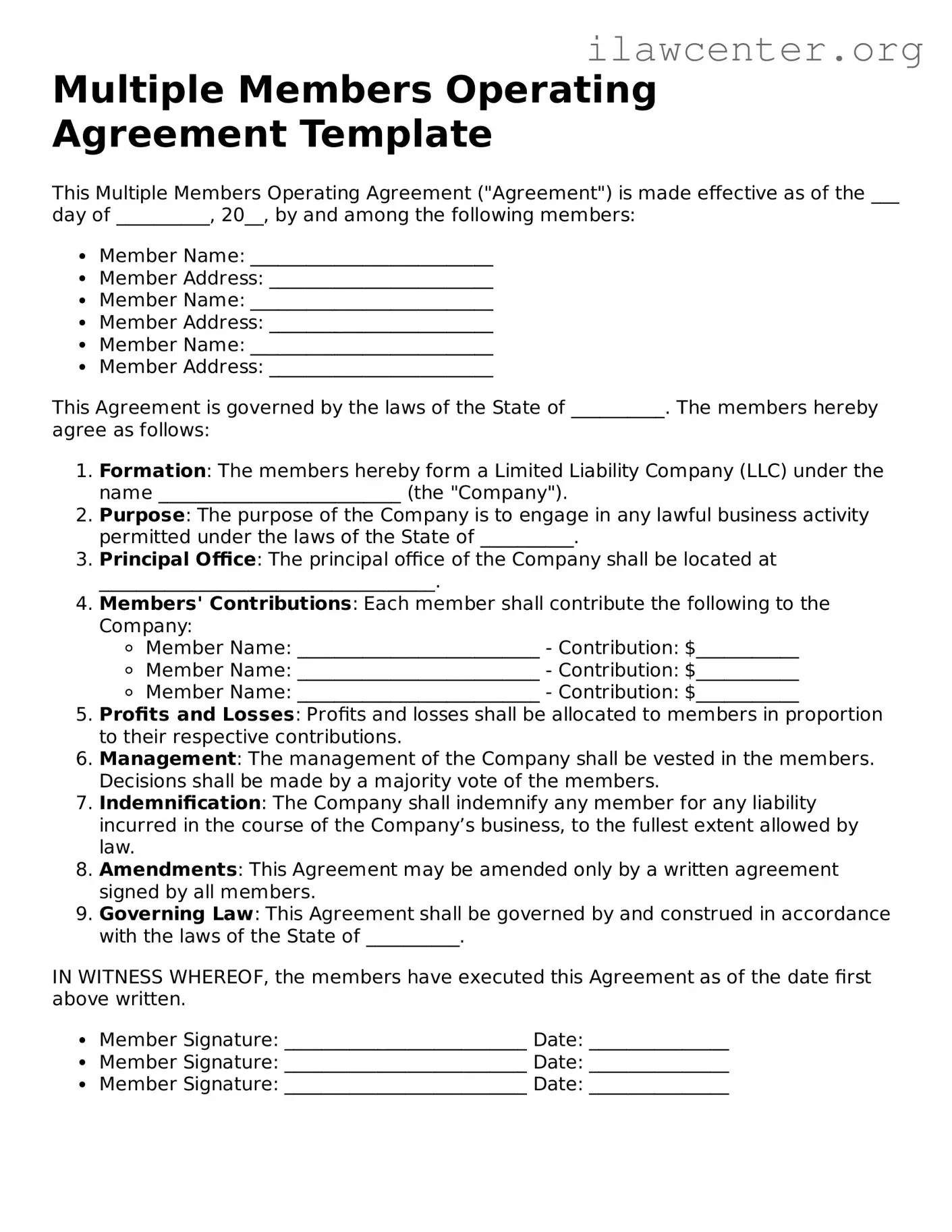
Multiple Members Operating Agreement Template

This Multiple Members Operating Agreement ("Agreement") is made effective as of the ___ day of __________, 20__, by and among the following members:

  • Member Name: __________________________
  • Member Address: ________________________
  • Member Name: __________________________
  • Member Address: ________________________
  • Member Name: __________________________
  • Member Address: ________________________

This Agreement is governed by the laws of the State of __________. The members hereby agree as follows:

  1. Formation: The members hereby form a Limited Liability Company (LLC) under the name __________________________ (the "Company").
  2. Purpose: The purpose of the Company is to engage in any lawful business activity permitted under the laws of the State of __________.
  3. Principal Office: The principal office of the Company shall be located at ____________________________________.
  4. Members' Contributions: Each member shall contribute the following to the Company:
    • Member Name: __________________________ - Contribution: $___________
    • Member Name: __________________________ - Contribution: $___________
    • Member Name: __________________________ - Contribution: $___________
  5. Profits and Losses: Profits and losses shall be allocated to members in proportion to their respective contributions.
  6. Management: The management of the Company shall be vested in the members. Decisions shall be made by a majority vote of the members.
  7. Indemnification: The Company shall indemnify any member for any liability incurred in the course of the Company’s business, to the fullest extent allowed by law.
  8. Amendments: This Agreement may be amended only by a written agreement signed by all members.
  9. Governing Law: This Agreement shall be governed by and construed in accordance with the laws of the State of __________.

IN WITNESS WHEREOF, the members have executed this Agreement as of the date first above written.

  • Member Signature: __________________________ Date: _______________
  • Member Signature: __________________________ Date: _______________
  • Member Signature: __________________________ Date: _______________

PDF Form Characteristics

Fact Name Description
Purpose The Multiple Members Operating Agreement outlines the management structure and operational procedures for a multi-member LLC.
Members' Rights This agreement defines the rights and responsibilities of each member, ensuring clarity in decision-making processes.
Profit Distribution It specifies how profits and losses will be distributed among members, which can be based on ownership percentages or other agreed-upon methods.
Governing Law The governing law typically corresponds to the state in which the LLC is formed, such as Delaware, California, or Texas.
Amendments The agreement includes provisions for how amendments can be made, ensuring that all members are involved in significant changes.
Dispute Resolution It often outlines the process for resolving disputes among members, which may include mediation or arbitration.
Duration The agreement may specify the duration of the LLC's existence, whether it is perpetual or for a defined term.
Initial Contributions Members' initial contributions, whether cash, property, or services, are documented, establishing the basis for ownership interests.

Instructions on Utilizing Multiple Members Operating Agreement

Filling out the Multiple Members Operating Agreement form is an important step for ensuring clarity and structure in your business operations. Once you have completed the form, it will serve as a foundational document that outlines the roles, responsibilities, and expectations of each member involved in the business.

  1. Begin by entering the name of your business at the top of the form. Make sure to use the official name as registered with the state.
  2. Next, list the names and addresses of all members involved in the business. Include each member’s full legal name and current address for accurate identification.
  3. Specify the percentage of ownership for each member. This should reflect the agreed-upon distribution of shares or interests in the business.
  4. Detail the management structure. Indicate whether the business will be member-managed or manager-managed, and provide the names of any appointed managers if applicable.
  5. Outline the voting rights of each member. Clearly state how decisions will be made and what percentage of votes is required for various actions.
  6. Include provisions for adding new members. Describe the process for admitting new members to the agreement.
  7. Address the process for member withdrawal or removal. Specify how a member can exit the agreement and any conditions that apply.
  8. Define how profits and losses will be distributed among members. This section should clarify the method of distribution based on ownership percentages.
  9. Provide a section for signatures. Each member must sign and date the document to indicate their agreement to the terms outlined.

After completing these steps, review the entire document carefully. Ensure that all information is accurate and that all members have a clear understanding of their roles and responsibilities. Once everything is in order, it may be beneficial to consult with a professional before finalizing the agreement.

Important Facts about Multiple Members Operating Agreement

What is a Multiple Members Operating Agreement?

A Multiple Members Operating Agreement is a legal document that outlines the management structure and operating procedures of a limited liability company (LLC) with multiple members. It serves as a blueprint for how the business will be run, detailing each member's rights, responsibilities, and ownership stakes. This agreement helps prevent disputes and ensures that all members are on the same page regarding the company's operations.

Why is it important to have an Operating Agreement?

An Operating Agreement is crucial for several reasons. First, it provides clarity on how decisions are made and how profits and losses are distributed among members. Second, it helps protect the limited liability status of the LLC by demonstrating that it is a separate legal entity. Additionally, having this agreement in place can prevent misunderstandings and conflicts between members, which can lead to costly legal disputes.

What should be included in the Operating Agreement?

The Operating Agreement should include essential elements such as the names of the members, their ownership percentages, management structure, voting rights, and procedures for adding or removing members. It should also outline how profits and losses will be allocated, how disputes will be resolved, and what happens if a member wants to exit the business. Including these details can help ensure smooth operations and protect the interests of all members.

Do all states require an Operating Agreement?

Not all states require LLCs to have an Operating Agreement, but it is highly recommended. Even in states where it is not mandatory, having an Operating Agreement can provide significant benefits. It serves as a formal record of the members' intentions and can be referenced in case of disputes. It also reinforces the legitimacy of the LLC in the eyes of banks and investors.

Can the Operating Agreement be amended?

Yes, the Operating Agreement can be amended. It is important to include a procedure for making amendments within the document itself. Typically, amendments require the consent of all members or a specified majority. Keeping the agreement up to date ensures that it reflects the current structure and needs of the business as it evolves over time.

What happens if there is no Operating Agreement?

If there is no Operating Agreement, the LLC will be governed by the default rules set by state law. These rules may not align with the members' intentions and can lead to unintended consequences. For example, decisions may require a unanimous vote, or profits may be divided equally, regardless of members' contributions. This can create confusion and conflict among members, making it even more important to have a clear and comprehensive Operating Agreement in place.

Common mistakes

Filling out the Multiple Members Operating Agreement form can be a complex process. One common mistake is failing to clearly define the roles and responsibilities of each member. Without this clarity, misunderstandings can arise, leading to disputes down the line. Each member should know their specific duties and what is expected of them to ensure smooth operations.

Another frequent error is neglecting to outline the decision-making process. It is crucial to establish how decisions will be made within the organization. Whether decisions require a simple majority, a supermajority, or unanimous consent, specifying this in the agreement helps prevent confusion and conflict among members.

Many individuals also overlook the importance of including provisions for handling disputes. Without a clear method for resolving conflicts, disagreements can escalate and jeopardize the functioning of the business. Including mediation or arbitration clauses can provide a structured approach to resolving issues amicably.

Lastly, some people make the mistake of not updating the agreement as circumstances change. As the business evolves, so too should the operating agreement. Regular reviews and updates ensure that the document remains relevant and reflects the current state of the business and its members.

Documents used along the form

When forming a multi-member LLC, several documents work hand-in-hand with the Multiple Members Operating Agreement. Each of these documents serves a specific purpose, ensuring that the business operates smoothly and legally. Here’s a brief overview of some key forms and documents often used alongside the operating agreement.

  • Articles of Organization: This foundational document is filed with the state to officially create the LLC. It includes basic information like the LLC's name, address, and the names of its members.
  • Member Consent Forms: These forms capture the agreement of all members regarding decisions made before the LLC is officially formed. They ensure that everyone is on the same page from the start.
  • Bylaws: While not always required for LLCs, bylaws outline the internal rules and procedures for managing the LLC. They can help clarify roles and responsibilities among members.
  • Membership Certificates: These certificates serve as proof of membership in the LLC. They can help formalize ownership stakes and are useful for record-keeping.
  • Initial Capital Contribution Agreement: This document details the contributions each member is making to the LLC, whether in cash, property, or services. It sets expectations for financial input from the outset.
  • Tax Identification Number (EIN) Application: An EIN is essential for tax purposes. This application is submitted to the IRS to obtain a unique number for the LLC, allowing it to operate as a separate legal entity.
  • Operating Procedures Document: This document outlines the day-to-day operations of the LLC. It can include everything from how meetings are conducted to how profits are distributed.
  • Amendment Agreement: If changes need to be made to the original operating agreement or other documents, this agreement formally records those modifications, ensuring that all members are aware and in agreement.

These documents collectively create a robust framework for managing a multi-member LLC. Each plays a crucial role in establishing clear guidelines, protecting the interests of all members, and ensuring compliance with state laws. Understanding and utilizing these forms can pave the way for a successful business venture.

Similar forms

  • Partnership Agreement: This document outlines the terms and conditions between partners in a business. Like the Multiple Members Operating Agreement, it specifies the roles, responsibilities, and profit-sharing arrangements among partners.
  • Bylaws: Bylaws govern the internal management of a corporation. Similar to the Operating Agreement, they detail the rules for governance, including the election of directors and the frequency of meetings.
  • Shareholder Agreement: This document is used among shareholders to define their rights and obligations. It parallels the Operating Agreement by addressing ownership interests, voting rights, and transfer of shares.
  • Joint Venture Agreement: This agreement outlines the terms of a partnership between two or more parties for a specific project. Like the Operating Agreement, it defines contributions, profit distribution, and management responsibilities.
  • LLC Formation Documents: These documents include articles of organization and other filings required to establish a limited liability company. They serve as a foundation, similar to the Operating Agreement, by establishing the entity's legal structure.
  • Franchise Agreement: This contract between a franchisor and franchisee outlines the terms of the franchise relationship. It shares similarities with the Operating Agreement in detailing obligations, rights, and operational guidelines.
  • Employment Agreement: This document specifies the terms of employment between an employer and employee. It is akin to the Operating Agreement in that it clarifies roles, responsibilities, and compensation.
  • Confidentiality Agreement: Also known as a non-disclosure agreement, this document protects sensitive information shared between parties. Like the Operating Agreement, it establishes clear expectations and obligations regarding confidentiality.
  • Sales Agreement: This contract outlines the terms of sale between a buyer and seller. It mirrors the Operating Agreement by detailing the responsibilities of each party and the conditions of the transaction.

Dos and Don'ts

When filling out the Multiple Members Operating Agreement form, it's essential to approach the task with care. Here are some helpful tips on what to do and what to avoid.

  • Do read the entire form thoroughly before starting. Understanding each section will help you provide accurate information.
  • Do gather all necessary information about each member. This includes names, addresses, and contributions to the business.
  • Do be clear and concise in your language. Avoid ambiguity to prevent misunderstandings among members.
  • Do consult with a legal professional if you have questions. Their expertise can provide valuable guidance.
  • Don't rush through the form. Taking your time will help ensure that all details are correct.
  • Don't leave any sections blank unless instructed. Incomplete forms can lead to delays or complications.
  • Don't ignore the importance of signatures. Ensure all members sign the agreement to make it valid.

By following these tips, you can navigate the Multiple Members Operating Agreement form with confidence and clarity.

Misconceptions

Understanding the Multiple Members Operating Agreement is crucial for anyone involved in a multi-member business. However, several misconceptions often cloud the reality of this important document. Below are five common misconceptions, along with clarifications to help you navigate this topic more effectively.

  • Misconception 1: The Operating Agreement is optional.
  • Many believe that having an Operating Agreement is not necessary, especially in informal partnerships. However, this document is essential as it outlines the structure, responsibilities, and procedures of the business. Without it, members may face disputes and misunderstandings.

  • Misconception 2: All members must have equal say in the agreement.
  • Some think that every member must have an equal vote on all matters. While it is common for members to have equal say, the Operating Agreement can specify different voting rights based on ownership percentages or other factors. This flexibility allows for tailored governance.

  • Misconception 3: The Operating Agreement cannot be changed once established.
  • There is a belief that once an Operating Agreement is signed, it is set in stone. In reality, this document can be amended as needed, provided that all members agree to the changes. This adaptability is vital for responding to evolving business needs.

  • Misconception 4: The Operating Agreement only addresses financial matters.
  • Some individuals assume that the agreement solely focuses on financial distributions and obligations. In truth, it encompasses a wide range of topics, including management structure, decision-making processes, and dispute resolution. This comprehensive approach is key to smooth operations.

  • Misconception 5: You can use a generic template for any business.
  • Many believe that a one-size-fits-all template will suffice for any business. However, each business has unique needs and circumstances. Customizing the Operating Agreement to reflect the specific goals and dynamics of your partnership is essential for its effectiveness.

Key takeaways

When filling out and using the Multiple Members Operating Agreement form, several key considerations can enhance understanding and effectiveness. Below are essential takeaways to keep in mind:

  • Clarity of Purpose: Clearly define the purpose of the agreement. This document serves as a foundational element for the operation of the business.
  • Member Roles: Specify the roles and responsibilities of each member. This helps to avoid confusion and ensures accountability.
  • Decision-Making Process: Outline how decisions will be made within the organization. Establishing a voting mechanism can streamline operations.
  • Profit and Loss Distribution: Detail how profits and losses will be allocated among members. This is crucial for financial transparency.
  • Amendment Procedures: Include a process for making changes to the agreement. Flexibility can be important as the business evolves.
  • Dispute Resolution: Incorporate a method for resolving conflicts among members. This can prevent disputes from escalating and ensure a smoother operation.

These takeaways provide a framework for effectively utilizing the Multiple Members Operating Agreement form, fostering clarity and cooperation among business members.