Navy Evaluation PDF Template

Navy Evaluation PDF Template

The Navy Evaluation Form, officially known as the Evaluation Report & Counseling Record (E1 - E6), is a critical document used to assess the performance and potential of enlisted personnel. This form captures essential information, including personal details, performance traits, and recommendations for future assignments. Completing this form accurately is vital for ensuring fair evaluations and career progression within the Navy.

To fill out the Navy Evaluation Form, click the button below.

Article Guide

The Navy Evaluation form, formally known as the Evaluation Report & Counseling Record, serves as a crucial tool for assessing the performance of enlisted personnel from E1 to E6. This comprehensive document captures essential information, including the service member's name, rate, social security number, and unit identification code, alongside their promotion status and reporting details. The form is designed to facilitate mid-term counseling and periodic evaluations, ensuring that individuals receive constructive feedback on their performance. Key sections of the form address various performance traits, such as professional knowledge, quality of work, military bearing, and leadership abilities. Each trait is scored on a scale from 1.0 to 5.0, allowing for a nuanced assessment of an individual's strengths and areas for improvement. Additionally, the form includes sections for documenting qualifications, achievements, and recommendations for future assignments, thus providing a holistic view of the service member's contributions to the Navy. By emphasizing personal accountability and professional development, the Navy Evaluation form plays a vital role in shaping the careers of enlisted personnel and enhancing overall command effectiveness.

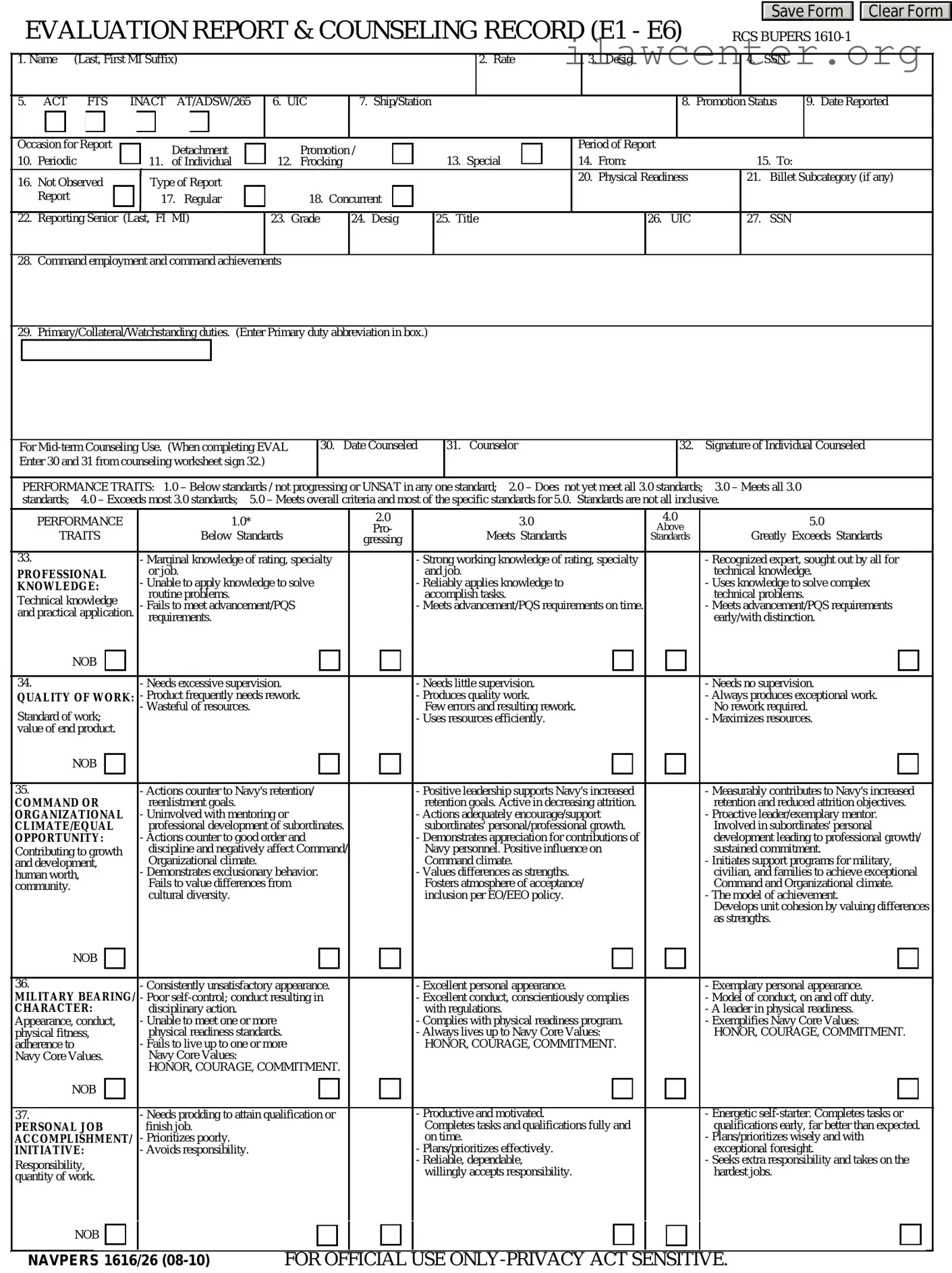
EVALUATION REPORT & COUNSELING RECORD (E1 - E6)
RCS BUPERS 1610-1
1. Name (Last, First MI Suffix)
2. Rate
3. Desig
4. SSN
5. ACT FTS INACT AT/ADSW/265
6. UIC
8. Promotion Status
9. Date Reported
Occasion for Report
10. Periodic
Detachment
11. of Individual
Promotion /
12. Frocking
13. Special
Period of Report
14. From:
15. To:
16. Not Observed
Report
Type of Report
17. Regular
18. Concurrent
20. Physical Readiness
21. Billet Subcategory (if any)
22. Reporting Senior (Last, FI MI)
23. Grade
24. Desig
25. Title
26. UIC
27. SSN
For Mid-term Counseling Use. (When completing EVAL
Enter 30 and 31 from counseling worksheet sign 32.)
30. Date Counseled
31. Counselor
32. Signature of Individual Counseled
PERFORMANCE TRAITS: 1.0 – Below standards / not progressing or UNSAT in any one standard; 2.0 – Does not yet meet all 3.0 standards; 3.0 – Meets all 3.0
standards; 4.0 – Exceeds most 3.0 standards; 5.0 – Meets overall criteria and most of the specific standards for 5.0. Standards are not all inclusive.
PERFORMANCE
TRAITS
1.0*
Below Standards
3.0
Meets Standards
2.0
Pro-
gressing
5.0
Greatly Exceeds Standards
4.0
Above
Standards
Technical knowledge
and practical application.
COMMAND OR
ORGANIZATIONAL
CLIMATE/EQUAL
OPPORTUNITY:
33.
34.
35.
36.
- Actions counter to Navy's retention/
reenlistment goals.
- Uninvolved with mentoring or
professional development of subordinates.
- Actions counter to good order and
discipline and negatively affect Command/
Organizational climate.
- Demonstrates exclusionary behavior.
Fails to value differences from
cultural diversity.
- Positive leadership supports Navy's increased
retention goals. Active in decreasing attrition.
- Actions adequately encourage/support
subordinates' personal/professional growth.
- Demonstrates appreciation for contributions of
Navy personnel. Positive influence on
Command climate.
- Values differences as strengths.
Fosters atmosphere of acceptance/
inclusion per EO/EEO policy.
- Measurably contributes to Navy's increased
retention and reduced attrition objectives.
- Proactive leader/exemplary mentor.
Involved in subordinates' personal
development leading to professional growth/
sustained commitment.
- Initiates support programs for military,
civilian, and families to achieve exceptional
Command and Organizational climate.
- The model of achievement.
Develops unit cohesion by valuing differences
as strengths.
- Needs excessive supervision.
- Product frequently needs rework.
- Wasteful of resources.
- Needs little supervision.
- Produces quality work.
Few errors and resulting rework.
- Uses resources efficiently.
- Needs no supervision.
- Always produces exceptional work.
No rework required.
- Maximizes resources.
- Marginal knowledge of rating, specialty
or job.
- Unable to apply knowledge to solve
routine problems.
- Fails to meet advancement/PQS
requirements.
- Strong working knowledge of rating, specialty
and job.
- Reliably applies knowledge to
accomplish tasks.
- Meets advancement/PQS requirements on time.
- Recognized expert, sought out by all for
technical knowledge.
- Uses knowledge to solve complex
technical problems.
- Meets advancement/PQS requirements
early/with distinction.
- Consistently unsatisfactory appearance.
- Poor self-control; conduct resulting in
disciplinary action.
- Unable to meet one or more
physical readiness standards.
- Fails to live up to one or more
Navy Core Values:
HONOR, COURAGE, COMMITMENT.
- Excellent personal appearance.
- Excellent conduct, conscientiously complies
with regulations.
- Complies with physical readiness program.
- Always lives up to Navy Core Values:
HONOR, COURAGE, COMMITMENT.
- Exemplary personal appearance.
- Model of conduct, on and off duty.
- A leader in physical readiness.
- Exemplifies Navy Core Values:
HONOR, COURAGE, COMMITMENT.
NOB
NOB
NOB
NOB
28. Command employment and command achievements
NAVPERS 1616/26 (08-10) FOR OFFICIAL USE ONLY-PRIVACY ACT SENSITIVE.
29. Primary/Collateral/Watchstanding duties. (Enter Primary duty abbreviation in box.)
QUALITY OF WORK:
Standard of work;
value of end product.
Contributing to growth
and development,
human worth,
community.
Appearance, conduct,
physical fitness,
adherence to
Navy Core Values.
37.
PERSONAL JOB
ACCOMPLISHMENT/
INITIATIVE:
Responsibility,
quantity of work.
- Needs prodding to attain qualification or
finish job.
- Prioritizes poorly.
- Avoids responsibility.
- Energetic self-starter. Completes tasks or
qualifications early, far better than expected.
- Plans/prioritizes wisely and with
exceptional foresight.
- Seeks extra responsibility and takes on the
hardest jobs.
NOB
PROFESSIONAL
KNOWLEDGE:
MILITARY BEARING/
CHARACTER:
- Productive and motivated.
Completes tasks and qualifications fully and
on time.
- Plans/prioritizes effectively.
- Reliable, dependable,
willingly accepts responsibility.
Clear Form
Save Form
Not Recommended Recommended
I intend to submit a statement do not intend to submit a statement
NAVPERS 1616/26 (08-10) FOR OFFICIAL USE ONLY-PRIVACY ACT SENSITIVE.
TEAMWORK:
Contributions to
team building and
team results.
LEADERSHIP:
Organizing, motivating
and developing others
to accomplish goals.
EVALUATION REPORT & COUNSELING RECORD (E1 - E6 ) (cont'd)
RCS BUPERS 1610-1
1. Name (Last, First MI Suffix)
2. Rate
3. Desig
4. SSN
PERFORMANCE
TRAITS
1.0*
Below Standards
3.0
Meets Standards
2.0
Pro-
gressing
5.0
Greatly Exceeds Standards
4.0
Above
Standards
41. I recommend this individual for (maximum of two): Assignment in Rating,
Sea Special Programs, Shore Special Programs, Commissioning Programs,
Special Warfare Programs, Rating Instructor Duty, Other. (Be specific.)
43. COMMENTS ON PERFORMANCE. *All 1.0 marks, three 2.0 marks, and 2.0 marks in Block 37 must be specifically substantiated in comments. Comments must be verifiable.
Font must be 10 or 12 pitch (10 to 12 point) only. Use upper and lower case.
Promotion
Recommendation
NOB
Significant
Problems
Progressing
Promotable
Must
Promote
Early
Promote
48. Reporting Senior Address
45.
INDIVIDUAL
46.
SUMMARY
50. Signature of Reporting Senior
Date:
51. Signature of individual evaluated. “I have seen this report, been apprised of my
performance, and understand my right to make a statement.”
Date:
Date:
52. Typed name, grade, command, UIC, and signature of Regular Reporting Senior on Concurrent Report
Summary Group Average:
38.
39.
NOB
- Creates conflict,
unwilling to work with others,
puts self above team.
- Fails to understand team goals or
teamwork techniques.
- Does not take direction well.
- Reinforces others' efforts,
meets commitments to team.
- Understands goals,
employs good teamwork techniques.
- Accepts and offers team direction.
- Team builder,
inspires cooperation and progress.
- Focuses goals and techniques for teams.
- The best at accepting and offering
team direction.
NOB
- Neglects growth/development or welfare
of subordinates.
- Fails to organize, creates problems
for subordinates.
- Does not set or achieve goals relevant to
command mission and vision.
- Lacks ability to cope with or
tolerate stress.
- Inadequate communicator.
- Tolerates hazards or unsafe practices.
- Effectively stimulates growth/development in
subordinates.
- Organizes successfully, implementing
process improvements and efficiencies.
- Sets/achieves useful, realistic goals
that support command mission.
- Performs well in stressful situations.
- Clear, timely communicator.
- Ensures safety of personnel and equipment.
- Inspiring motivator and trainer, subordinates
reach highest level of growth and development.
- Superb organizer, great foresight, develops
process improvements and efficiencies.
- Leadership achievements dramatically further
command mission and vision.
- Perseveres through the toughest challenges
and inspires others.
- Exceptional communicator.
- Makes subordinates safety-conscious,
maintains top safety record.
- Constantly improves the personal and
professional lives of others.
Font
40. Individual Trait Average.
Total of trait scores divided by
number of graded traits.
42. Signature of Rater (Typed Name & Rate): I have evaluated this member against
the above performance standards and have forwarded written explanation of marks
of 1.0 and 5.0.
Date:
44. QUALIFICATIONS/ACHIEVEMENTS - Education, awards, community involvement, etc., during this period.
47. Retention :
49. Signature of Senior Rater (Typed Name & Grade/Rate): I have reviewed the evaluation of this
member against these performance standards and have provided written explanation to support
marks of 1.0 and 5.0.
Date:
10

File Properties

Fact Name Details
Form Purpose The Navy Evaluation form is used to assess the performance of enlisted personnel (E1 - E6) and to provide counseling records.
Governing Regulations This evaluation form is governed by the Bureau of Naval Personnel Instruction (BUPERSINST) 1610.10.
Performance Traits Performance is rated on a scale from 1.0 to 5.0, with specific criteria defining each rating level.
Mid-term Counseling Mid-term counseling is encouraged and must be documented on the form to support performance evaluations.
Privacy Considerations The form contains sensitive information and is marked as "FOR OFFICIAL USE ONLY - PRIVACY ACT SENSITIVE."

Instructions on Utilizing Navy Evaluation

Filling out the Navy Evaluation form requires attention to detail and accuracy. This process involves several steps to ensure that all necessary information is captured correctly. Following these steps will help facilitate a smooth evaluation process.

  1. Begin by entering the individual's full name in the format: Last, First MI Suffix.
  2. Fill in the Rate and Designation of the individual.
  3. Provide the Social Security Number (SSN).
  4. Indicate the Active, Full-Time Support (FTS), Inactive, Active Duty for Special Work (ADSW), or 265 status.
  5. Enter the Unit Identification Code (UIC).
  6. Specify the Ship or Station where the individual is assigned.
  7. Document the individual's Promotion Status.
  8. Record the Date Reported and the Occasion for the Report (Detachment, Promotion, or Period of Report).
  9. Check the appropriate box for the Type of Report (Periodic, Frocking, Special, Not Observed).
  10. Fill in the Physical Readiness Report and any applicable Billet Subcategory.
  11. Enter the Reporting Senior's details, including Last, First MI, Grade, Designation, Title, UIC, and SSN.
  12. Detail command employment and achievements, including primary, collateral, and watchstanding duties.
  13. For Mid-term Counseling, enter the Date Counseled, Counselor's name, and the Signature of the Individual Counseled.
  14. Evaluate performance traits using the provided scale (1.0 to 5.0) for each category listed.
  15. Provide comments on performance, ensuring that all 1.0 and 2.0 marks are substantiated with verifiable information.
  16. List any qualifications or achievements such as education, awards, and community involvement during the evaluation period.
  17. Indicate retention recommendations and any issues regarding promotion.
  18. Complete the signatures for the Rater, Reporting Senior, and the individual evaluated, ensuring dates are included.

Important Facts about Navy Evaluation

What is the purpose of the Navy Evaluation form?

The Navy Evaluation form, officially known as the Evaluation Report & Counseling Record (E1 - E6), serves several important functions. It is primarily used to assess the performance and potential of enlisted personnel in the Navy. This form provides a structured way for supervisors to document an individual’s achievements, strengths, and areas for improvement. It also plays a critical role in decisions related to promotions, assignments, and career development. By maintaining a record of evaluations, the Navy ensures that personnel are recognized for their contributions and guided in their professional growth.

How is performance rated on the Navy Evaluation form?

Performance on the Navy Evaluation form is rated using a scale from 1.0 to 5.0. A score of 1.0 indicates that the individual is below standards, while a score of 5.0 reflects exceptional performance. Each performance trait is assessed based on specific criteria, such as knowledge, quality of work, leadership, and teamwork. Evaluators must substantiate any low scores (1.0 or 2.0) with comments that can be verified. This ensures that evaluations are fair and based on observable performance rather than subjective opinions.

What should be included in the comments section of the evaluation?

The comments section of the evaluation is crucial for providing context to the scores given. Evaluators should include specific examples that illustrate the individual's performance in relation to the traits being assessed. For instance, if a person receives a low score, the evaluator must provide clear, verifiable reasons for that score. Positive comments should also highlight achievements, contributions, and any notable qualities that set the individual apart. This section helps to create a complete picture of the individual’s performance during the evaluation period.

How does the counseling process work in conjunction with the evaluation?

The counseling process is an integral part of the evaluation system. It typically occurs mid-way through the evaluation period. During counseling, supervisors discuss the individual’s performance, provide feedback, and set goals for improvement. This conversation allows personnel to understand their strengths and areas needing attention before the final evaluation is completed. The counseling record is referenced when filling out the evaluation form, ensuring that the feedback provided is consistent and constructive. This ongoing dialogue helps to foster professional development and enhance job performance.

Common mistakes

Filling out the Navy Evaluation form can be a daunting task, and many individuals make common mistakes that can impact their evaluations significantly. One frequent error is neglecting to include complete names. The form requires the full name in the correct format: last name, first name, middle initial, and suffix if applicable. Omitting any part can lead to confusion and delays in processing.

Another common mistake is failing to accurately report the Social Security Number (SSN). This number is crucial for identification and must be entered correctly. An incorrect SSN can lead to administrative errors that might affect pay and benefits.

Many people also overlook the importance of the reporting period. The form requires specific dates for the evaluation period. Not specifying the correct dates or using vague terms like "current" can lead to misunderstandings about the evaluation timeframe.

Some individuals may forget to sign the form. The signature of the individual being evaluated is necessary to confirm that they have seen and understand the report. Without this signature, the evaluation may be considered incomplete.

Another mistake involves the performance traits section. Some evaluators fail to provide specific comments to substantiate scores, particularly for low marks (1.0) or high marks (5.0). Comments should be verifiable and directly related to the scores given. This lack of detail can lead to questions about the evaluation's fairness and accuracy.

In addition, individuals sometimes neglect to indicate their primary duties clearly. The form asks for primary, collateral, and watchstanding duties, and failing to specify these can obscure an individual’s contributions and responsibilities.

People may also confuse the evaluation type. The form allows for different types of reports, such as regular or concurrent. Choosing the wrong type can lead to misinterpretation of the evaluation's intent and purpose.

Another frequent oversight is in the area of qualifications and achievements. Individuals often fail to list significant accomplishments or education during the evaluation period. This section is crucial for demonstrating professional growth and readiness for promotion.

Lastly, some evaluators may not take the time to proofread their submissions. Typos and grammatical errors can detract from the professionalism of the evaluation and might even affect the perceived credibility of the individual being evaluated.

By being aware of these common pitfalls, individuals can ensure that their Navy Evaluation forms are filled out accurately and reflect their true contributions and capabilities.

Documents used along the form

The Navy Evaluation form is a critical document used to assess the performance and potential of personnel in the Navy. However, it is often accompanied by other forms and documents that provide additional context and support for the evaluation process. Understanding these documents can help you navigate your evaluation and ensure that all aspects of your service are accurately represented.

  • NAVPERS 1616/27 (Evaluation Report & Counseling Record E7-E9): This form is similar to the Navy Evaluation form but is specifically designed for personnel at the E7 to E9 ranks. It assesses leadership, performance, and potential for advancement, helping to ensure that evaluations are consistent across different ranks.
  • NAVPERS 1070/604 (Enlisted Qualification Record): This record provides a comprehensive overview of an individual's qualifications, training, and experience. It serves as a reference for evaluators to understand the skills and competencies of the evaluated personnel, ensuring that evaluations are based on complete information.
  • NAVPERS 1616/26 (Fitness Report): This report is used for officers and provides a detailed evaluation of their performance and potential. While it is distinct from the Navy Evaluation form, it serves a similar purpose for officer evaluations, allowing for a comprehensive assessment of leadership and performance.
  • NAVPERS 1610/1 (Annual Performance Evaluation): This document is used to summarize an individual's performance over a specific period. It includes key achievements and areas for improvement, providing a broader context for the evaluation process and helping to guide future development.
  • Mid-term Counseling Worksheet: This worksheet is used during mid-term evaluations to document discussions between the evaluator and the individual being evaluated. It helps set expectations and goals, ensuring that both parties are aligned on performance standards and areas for improvement.

Being familiar with these accompanying documents can enhance your understanding of the evaluation process. Each form plays a vital role in ensuring that evaluations are fair, comprehensive, and reflective of an individual's true performance and potential. By preparing and reviewing these documents, you can contribute to a more accurate and supportive evaluation experience.

Similar forms

  • Performance Appraisal Form: Similar to the Navy Evaluation form, a performance appraisal form evaluates an employee's job performance over a specific period. It often includes ratings on various performance metrics and provides feedback for improvement.
  • Employee Evaluation Report: This document assesses an employee's work and contributions within an organization. Like the Navy Evaluation, it typically includes a rating system and comments on performance strengths and weaknesses.
  • Self-Assessment Form: Employees use this form to evaluate their own performance. It mirrors the Navy Evaluation by requiring individuals to reflect on their achievements and areas for growth.
  • Annual Review Document: An annual review summarizes an employee’s performance throughout the year. Similar to the Navy Evaluation, it often includes a scoring system and feedback from supervisors.
  • 360-Degree Feedback Form: This form collects performance feedback from various sources, including peers and supervisors. It shares similarities with the Navy Evaluation in providing a comprehensive view of an individual's performance.
  • Promotion Recommendation Form: This document is used to recommend individuals for promotion based on their performance. It aligns with the Navy Evaluation by emphasizing accomplishments and potential for advancement.
  • Training and Development Plan: This plan outlines an employee's training needs and career goals. Like the Navy Evaluation, it focuses on professional growth and development opportunities.
  • Competency Assessment Tool: This tool evaluates specific skills and competencies required for a job. It parallels the Navy Evaluation by assessing areas of proficiency and identifying skill gaps.
  • Job Description and Evaluation Form: This document outlines job responsibilities and evaluates performance against those duties. It shares the structured approach found in the Navy Evaluation.
  • Feedback and Coaching Record: This record documents ongoing feedback and coaching sessions. It is similar to the Navy Evaluation in that it aims to improve performance through constructive feedback.

Dos and Don'ts

When filling out the Navy Evaluation form, here are four important things to do and avoid:

  • Do: Ensure all personal information is accurate and complete.
  • Do: Use clear and concise language when describing performance and achievements.
  • Do: Provide specific examples to support your evaluations and comments.
  • Do: Review the form thoroughly before submission to catch any errors.
  • Don't: Use jargon or overly complex terms that may confuse the reader.
  • Don't: Leave any sections blank; provide information for all required fields.
  • Don't: Make vague statements without evidence or examples.
  • Don't: Rush through the process; take your time to ensure accuracy.

Misconceptions

  • Misconception 1: The Navy Evaluation form is only for promotions.
  • Many believe the evaluation form serves solely as a tool for promotions. In reality, it also tracks performance, provides feedback, and documents professional development throughout a sailor's career.

  • Misconception 2: All evaluations are the same for every sailor.
  • Each evaluation is tailored to the individual’s specific duties and accomplishments. Performance traits and achievements are unique to each sailor, reflecting their contributions and growth.

  • Misconception 3: A high score guarantees promotion.
  • A high score on the evaluation form does not automatically lead to promotion. Other factors, such as availability of positions and overall competition, also play significant roles.

  • Misconception 4: Evaluations can be completed without input from the sailor.
  • Sailors are encouraged to participate in the evaluation process. Their input during counseling sessions can provide valuable context to their performance and goals.

  • Misconception 5: Only the Reporting Senior writes the evaluation.
  • While the Reporting Senior holds primary responsibility, input from other leaders and peers may be considered. This collaborative approach enhances the accuracy of the evaluation.

  • Misconception 6: Negative marks are always detrimental.
  • Negative marks can provide constructive feedback. When substantiated with comments, they highlight areas for improvement and can guide future performance.

  • Misconception 7: The evaluation form is a one-time document.
  • The evaluation form is part of an ongoing process. Regular counseling and periodic evaluations ensure continuous feedback and development throughout a sailor's career.

  • Misconception 8: All sailors should aim for a perfect score.
  • Aiming for a perfect score may not be realistic or necessary. The focus should be on consistent improvement and meeting the standards relevant to their specific roles.

  • Misconception 9: Evaluations are only about individual performance.
  • While individual performance is crucial, evaluations also consider contributions to team dynamics, leadership, and the overall command environment.

  • Misconception 10: The evaluation process is overly complicated.
  • While the evaluation form contains various components, understanding its purpose and structure can simplify the process. Clear guidelines and training help navigate the requirements effectively.

Key takeaways

Filling out the Navy Evaluation form is a crucial task that can significantly impact a service member's career. Here are some key takeaways to consider:

  • Accuracy is Essential: Ensure that all personal information, such as name, rate, and SSN, is filled out correctly. Mistakes can lead to delays or complications in processing the evaluation.
  • Understand Performance Traits: Familiarize yourself with the performance traits and their corresponding scoring system. This understanding will help in providing accurate assessments of an individual’s performance.
  • Be Specific in Comments: When providing comments on performance, be specific and verifiable. Each score of 1.0 or 5.0 must have a written explanation that supports the mark.
  • Utilize Mid-term Counseling: Take advantage of mid-term counseling to discuss performance and expectations. This can guide improvements before the final evaluation.
  • Highlight Achievements: Include significant accomplishments, education, and community involvement in the qualifications section. This can enhance the overall evaluation.
  • Review Before Submission: Always review the completed form for clarity and completeness. A thorough review can prevent misunderstandings and ensure that all necessary information is included.

By keeping these points in mind, you can navigate the evaluation process more effectively, contributing to a fair and accurate assessment of performance.