Attorney-Verified  Commercial Lease Agreement Document for New York

Attorney-Verified Commercial Lease Agreement Document for New York

The New York Commercial Lease Agreement is a legal document that outlines the terms and conditions between a landlord and a business tenant for renting commercial property. This form serves as a crucial tool for both parties, ensuring clarity and protection of rights throughout the lease period. Ready to secure your commercial space? Fill out the form by clicking the button below.

Article Guide

When entering into a commercial lease agreement in New York, both landlords and tenants must navigate a complex landscape of legal obligations and expectations. This essential document lays the groundwork for the relationship between the two parties, outlining critical details such as the duration of the lease, the rental amount, and the specific use of the property. Additionally, it addresses maintenance responsibilities, insurance requirements, and the terms surrounding security deposits. A well-structured lease agreement not only protects the interests of both parties but also helps prevent disputes by clearly defining rights and responsibilities. Understanding the nuances of this form is crucial for anyone looking to lease commercial property in New York, as it can significantly impact business operations and financial stability. Whether you are a seasoned business owner or a first-time tenant, familiarity with the key components of the New York Commercial Lease Agreement will empower you to make informed decisions and foster a successful leasing experience.

New York Commercial Lease Agreement Preview

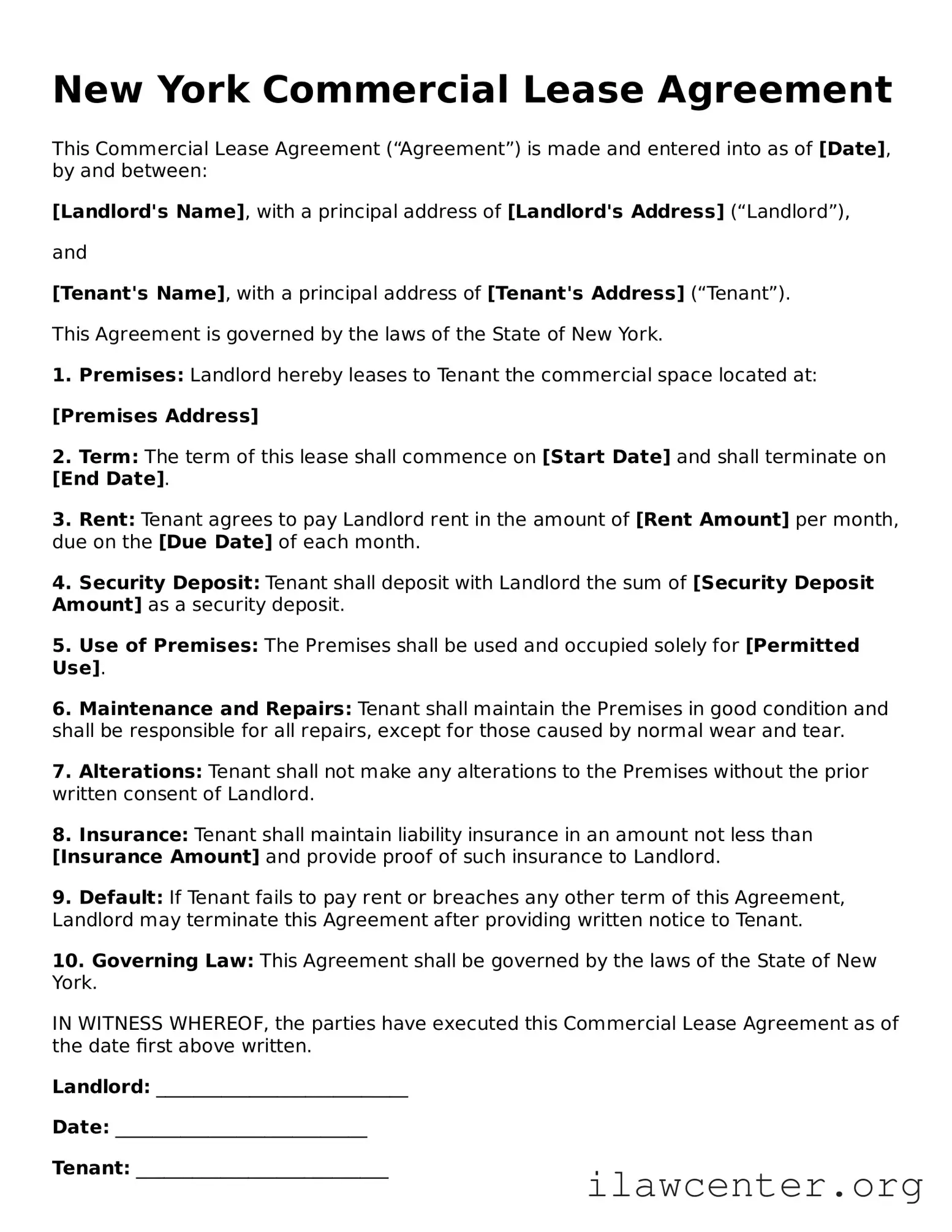
New York Commercial Lease Agreement

This Commercial Lease Agreement (“Agreement”) is made and entered into as of [Date], by and between:

[Landlord's Name], with a principal address of [Landlord's Address] (“Landlord”),

and

[Tenant's Name], with a principal address of [Tenant's Address] (“Tenant”).

This Agreement is governed by the laws of the State of New York.

1. Premises: Landlord hereby leases to Tenant the commercial space located at:

[Premises Address]

2. Term: The term of this lease shall commence on [Start Date] and shall terminate on [End Date].

3. Rent: Tenant agrees to pay Landlord rent in the amount of [Rent Amount] per month, due on the [Due Date] of each month.

4. Security Deposit: Tenant shall deposit with Landlord the sum of [Security Deposit Amount] as a security deposit.

5. Use of Premises: The Premises shall be used and occupied solely for [Permitted Use].

6. Maintenance and Repairs: Tenant shall maintain the Premises in good condition and shall be responsible for all repairs, except for those caused by normal wear and tear.

7. Alterations: Tenant shall not make any alterations to the Premises without the prior written consent of Landlord.

8. Insurance: Tenant shall maintain liability insurance in an amount not less than [Insurance Amount] and provide proof of such insurance to Landlord.

9. Default: If Tenant fails to pay rent or breaches any other term of this Agreement, Landlord may terminate this Agreement after providing written notice to Tenant.

10. Governing Law: This Agreement shall be governed by the laws of the State of New York.

IN WITNESS WHEREOF, the parties have executed this Commercial Lease Agreement as of the date first above written.

Landlord: ___________________________

Date: ___________________________

Tenant: ___________________________

Date: ___________________________

PDF Form Characteristics

Fact Name Details
Governing Law The New York Commercial Lease Agreement is governed by New York state law.
Purpose This form is used to outline the terms and conditions between a landlord and a tenant for commercial property leasing.
Lease Duration The agreement typically specifies the length of the lease, which can vary from a few months to several years.
Rent Payment Terms It details the amount of rent, payment schedule, and accepted payment methods.
Security Deposit The form usually requires a security deposit, which serves as protection for the landlord against damages or unpaid rent.
Maintenance Responsibilities Responsibilities for maintenance and repairs are typically outlined, indicating what the landlord and tenant are responsible for.
Termination Clause There is often a termination clause that specifies the conditions under which either party can end the lease early.
Use of Premises The agreement specifies the permitted use of the commercial space, which can include restrictions on certain activities.

Instructions on Utilizing New York Commercial Lease Agreement

Filling out the New York Commercial Lease Agreement form requires attention to detail. Each section must be completed accurately to ensure clarity between the landlord and tenant. Follow these steps carefully to complete the form correctly.

  1. Begin with the date at the top of the form. Write the date when the lease agreement is being executed.
  2. Enter the names of the landlord and tenant in the designated fields. Ensure that the names are spelled correctly.
  3. Provide the address of the property being leased. Include the street address, city, state, and zip code.
  4. Specify the term of the lease. Indicate the start date and the end date of the lease period.
  5. Fill in the rental amount. Clearly state the monthly rent and any additional fees, if applicable.
  6. Indicate the security deposit amount. This is typically a sum equal to one or two months' rent.
  7. Complete the section on permitted use. Describe the intended use of the leased property.
  8. Review the maintenance responsibilities. Specify who is responsible for repairs and maintenance of the property.
  9. Include any additional terms or conditions that are relevant to the lease agreement. This could cover alterations, subleasing, or termination clauses.
  10. Finally, both parties should sign and date the form. Ensure that signatures are legible and dated appropriately.

After completing the form, it is advisable to keep a copy for your records. Both parties should retain their signed copies for future reference and to ensure compliance with the lease terms.

Important Facts about New York Commercial Lease Agreement

What is a New York Commercial Lease Agreement?

A New York Commercial Lease Agreement is a legally binding document that outlines the terms and conditions under which a landlord rents commercial property to a tenant. This agreement typically includes details such as the rental amount, lease duration, maintenance responsibilities, and any restrictions or obligations for both parties. It serves to protect the interests of both the landlord and tenant, ensuring clarity in the rental relationship.

What key terms should be included in the agreement?

Essential terms to include in a New York Commercial Lease Agreement are the names of the parties involved, the property address, lease duration, rent amount, payment schedule, security deposit details, and maintenance responsibilities. Additionally, it’s crucial to specify any permitted uses of the property, renewal options, and conditions for termination. Clear definitions of these terms help prevent misunderstandings in the future.

How long does a typical commercial lease last?

The duration of a commercial lease can vary significantly, but it commonly ranges from one to five years. Some leases may extend for longer periods, depending on the needs of the tenant and the landlord’s willingness to commit. Shorter leases might offer flexibility, while longer leases often provide stability for businesses. It’s important to consider future growth and changes when determining the length of the lease.

Can a commercial lease be modified after it is signed?

Yes, a commercial lease can be modified after it has been signed, but any changes must be documented in writing and signed by both parties. This is often done through an amendment or addendum to the original lease. Verbal agreements or informal changes are generally not enforceable, so it’s essential to ensure that any modifications are clearly stated and agreed upon to avoid disputes later on.

What happens if a tenant wants to terminate the lease early?

If a tenant wishes to terminate the lease early, they must first review the lease agreement for any early termination clauses. Some leases may allow for early termination under specific conditions, while others may impose penalties or require the tenant to pay rent until the end of the lease term. Open communication with the landlord is crucial, as negotiating a mutual agreement can sometimes lead to a more favorable outcome for both parties.

What should I do if I have a dispute regarding the lease?

In the event of a dispute regarding the lease, the first step is to review the lease terms to understand each party's rights and obligations. Open dialogue with the other party can often resolve misunderstandings. If that fails, mediation or arbitration may be options to consider, as these processes can be less costly and time-consuming than litigation. If necessary, consulting with a legal professional experienced in commercial real estate can provide guidance tailored to your situation.

Common mistakes

When filling out the New York Commercial Lease Agreement form, individuals often overlook critical details that can lead to misunderstandings or disputes down the line. One common mistake is failing to accurately identify the parties involved. It is essential to clearly state the names of the landlord and tenant, as well as any additional parties, to avoid confusion. Missing or incorrect names can create complications in enforcing the lease terms.

Another frequent error is neglecting to specify the lease term. The duration of the lease should be explicitly stated, including the start and end dates. Without this information, both parties may have different interpretations of the lease's validity, potentially resulting in legal challenges. Clearly defining the lease term helps ensure that both the landlord and tenant have a mutual understanding of their obligations.

Additionally, individuals often make the mistake of not detailing the rent payment structure. The agreement should outline the amount of rent, the due date, and any penalties for late payments. Omitting this information can lead to disputes over payment expectations. A well-defined payment structure fosters transparency and helps maintain a positive landlord-tenant relationship.

Finally, many people forget to include provisions for maintenance and repairs. The lease should specify who is responsible for maintaining the property and how repairs will be handled. This oversight can lead to disagreements about property upkeep and responsibilities. By addressing maintenance and repair obligations in the lease, both parties can avoid potential conflicts and ensure a smoother rental experience.

Documents used along the form

When entering into a commercial lease agreement in New York, several additional forms and documents may be necessary to ensure clarity and compliance with local laws. These documents help define the terms of the lease, outline responsibilities, and protect the interests of both parties involved.

  • Letter of Intent: This document outlines the preliminary terms of the lease agreement before the final contract is drafted. It serves as a starting point for negotiations.
  • Personal Guarantee: A personal guarantee may be required from the tenant, ensuring that an individual will be responsible for fulfilling the lease obligations if the business cannot.
  • Sublease Agreement: If the tenant wishes to sublet the space, this document outlines the terms and conditions under which the subletting will occur.
  • Security Deposit Receipt: This receipt confirms the amount of the security deposit paid by the tenant and outlines the conditions under which it may be retained or returned.
  • Tenant Estoppel Certificate: This document is signed by the tenant and confirms the status of the lease, including any agreements made with the landlord and the current rent being paid.
  • Disclosure Statement: In certain situations, landlords must provide a disclosure statement that informs tenants about the property’s condition and any potential issues.
  • Insurance Certificate: This document verifies that the tenant has the required insurance coverage, which protects both the tenant and the landlord from potential liabilities.
  • Maintenance Agreement: This outlines the responsibilities of both the landlord and tenant regarding maintenance and repairs of the leased property.

Understanding these documents can help tenants and landlords navigate the leasing process more effectively. Each form plays a critical role in establishing a clear and enforceable agreement, ensuring that all parties are informed of their rights and obligations.

Similar forms

  • Residential Lease Agreement: Similar to a commercial lease, this document outlines the terms for renting a residential property. It includes details about rent, duration, and responsibilities of both landlord and tenant.
  • Sublease Agreement: This agreement allows a tenant to rent out their leased space to another party. It maintains similar terms as the original lease but requires the landlord's approval.
  • Rental Application: This document collects information from prospective tenants. It assesses their suitability for a lease, similar to how a commercial lease evaluates tenant qualifications.
  • Lease Renewal Agreement: This is used to extend the terms of an existing lease. It outlines any changes and reaffirms the original lease conditions, akin to a commercial lease renewal.
  • Letter of Intent (LOI): Often used in commercial real estate, this document expresses a party's intention to enter into a lease agreement. It outlines key terms before the formal lease is drafted.
  • Commercial Purchase Agreement: While focused on buying a property, this document shares similarities with a lease by detailing terms, conditions, and obligations related to the property.
  • Property Management Agreement: This document outlines the responsibilities of a property manager, similar to how a lease defines tenant and landlord responsibilities.
  • Eviction Notice: This document initiates the process of terminating a lease due to violations. It is related to the lease agreement by enforcing its terms and conditions.

Dos and Don'ts

When filling out the New York Commercial Lease Agreement form, attention to detail is crucial. Here are five important do's and don'ts to consider:

  • Do read the entire lease agreement carefully before filling it out.
  • Do ensure all parties involved sign the agreement.
  • Do provide accurate information regarding the property and terms.
  • Do consult with a legal professional if you have questions.
  • Do keep a copy of the signed agreement for your records.
  • Don't leave any sections blank unless instructed to do so.
  • Don't rush through the process; mistakes can be costly.
  • Don't ignore any clauses or terms that seem unclear.
  • Don't sign the lease without fully understanding your obligations.
  • Don't forget to check for any additional fees or costs not mentioned upfront.

Misconceptions

Understanding the New York Commercial Lease Agreement can be challenging due to various misconceptions. Here are five common misunderstandings that often arise:

  1. All lease agreements are the same.

    Many people assume that all commercial lease agreements follow a standard format. In reality, each lease can vary significantly based on the specific terms negotiated between the landlord and tenant.

  2. Verbal agreements are sufficient.

    Some individuals believe that a verbal agreement is enough to secure a commercial space. However, without a written lease, parties may face difficulties in enforcing their rights and obligations.

  3. Only rent is negotiable.

    It is a common misconception that only the rental price is open for negotiation. In fact, many other terms, such as maintenance responsibilities, lease duration, and renewal options, can also be negotiated.

  4. All lease terms are set in stone.

    Some tenants think that once a lease is signed, all terms are unchangeable. However, amendments can often be made if both parties agree, allowing for flexibility in the agreement.

  5. Commercial leases offer less protection than residential leases.

    This belief overlooks the fact that commercial leases are governed by different laws and can provide substantial protections for tenants, depending on the terms agreed upon.

Key takeaways

Filling out and using the New York Commercial Lease Agreement form can be a significant step for both landlords and tenants. Understanding the key aspects of this document is essential for a smooth leasing experience. Here are some important takeaways:

  • Understand the Purpose: The Commercial Lease Agreement outlines the terms and conditions under which a tenant can occupy a commercial space. It serves to protect both parties' rights.
  • Identify the Parties: Clearly state the names and contact information of both the landlord and the tenant. Accurate identification helps avoid confusion later.
  • Specify the Premises: Clearly describe the commercial space being leased. Include details such as the address, square footage, and any specific areas included in the lease.
  • Define Lease Terms: Include the duration of the lease, renewal options, and any termination conditions. This clarity helps both parties understand their commitments.
  • Outline Rent Payment Details: Specify the amount of rent, payment due dates, and acceptable payment methods. This section is crucial for maintaining a good landlord-tenant relationship.
  • Address Maintenance Responsibilities: Clearly delineate who is responsible for maintenance and repairs. This prevents disputes over property upkeep.
  • Include Terms for Alterations: If the tenant wishes to make changes to the space, outline the procedures and approvals needed. This protects the integrity of the property.
  • Discuss Insurance Requirements: Specify any insurance that the tenant must carry, such as liability insurance. This is important for protecting both parties in case of accidents.
  • Consult Legal Advice: Before signing, it is wise for both parties to seek legal counsel. A lawyer can help ensure that the lease is fair and legally binding.

By keeping these key points in mind, both landlords and tenants can navigate the leasing process more effectively and with greater confidence.