Attorney-Verified  Divorce Settlement Agreement Document for New York

Attorney-Verified Divorce Settlement Agreement Document for New York

A New York Divorce Settlement Agreement form is a legal document that outlines the terms agreed upon by both parties during a divorce. This form typically addresses issues such as asset division, child custody, and support arrangements, ensuring that both individuals have a clear understanding of their rights and responsibilities. To begin the process, consider filling out the form by clicking the button below.

Article Guide

Divorce can be a challenging and emotional process, and navigating the legal requirements is often overwhelming. In New York, a Divorce Settlement Agreement form plays a crucial role in finalizing the terms of a divorce. This document outlines the agreements between both parties regarding critical issues such as property division, child custody, visitation rights, and spousal support. By clearly detailing each party's responsibilities and entitlements, the form aims to prevent future disputes and provide a clear path forward. It's essential for both individuals to understand the significance of this agreement, as it can have lasting implications on their lives. Completing the form accurately and comprehensively is vital, as it ensures that all important aspects are addressed and legally recognized. With the right approach, this form can serve as a foundation for a smoother transition into the next chapter of life.

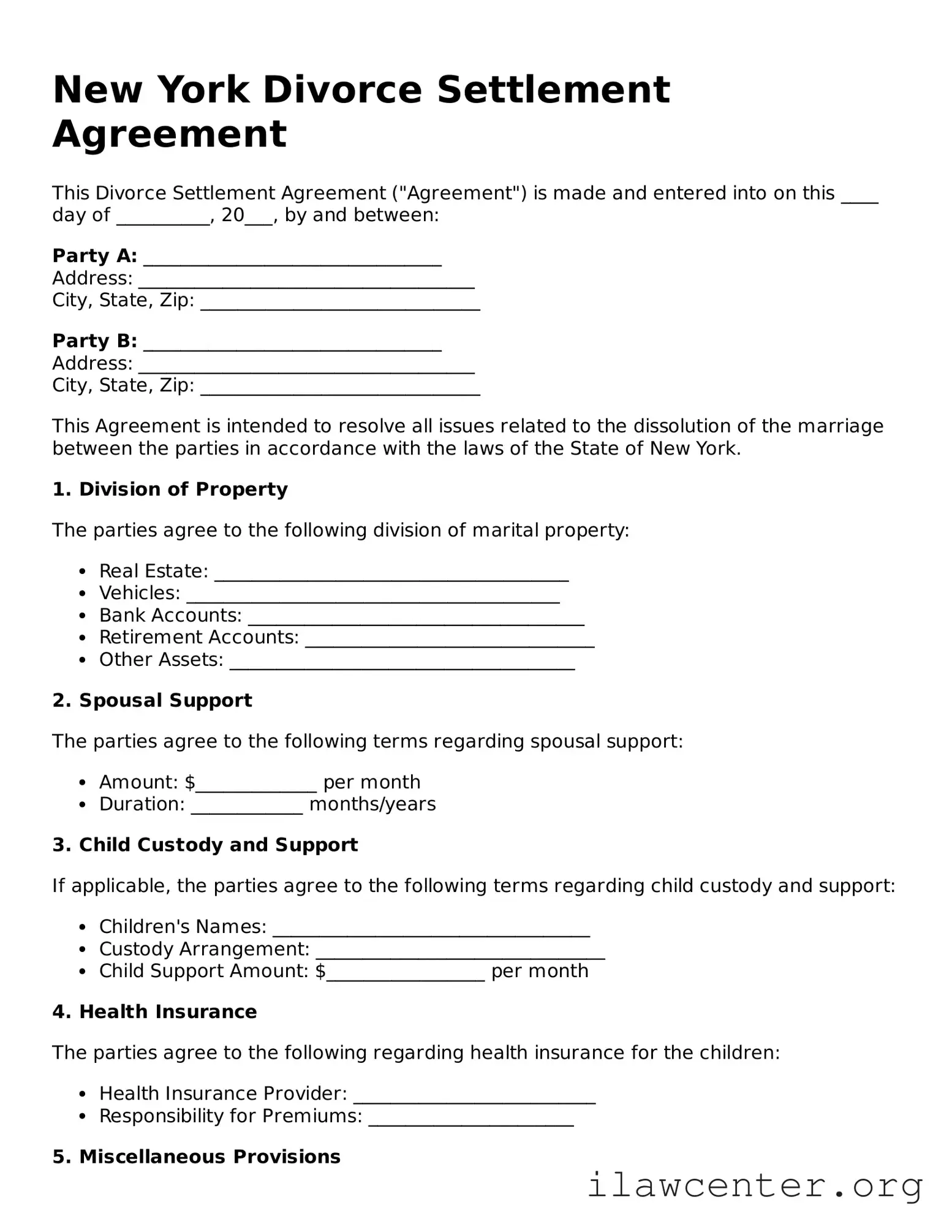
New York Divorce Settlement Agreement Preview

New York Divorce Settlement Agreement

This Divorce Settlement Agreement ("Agreement") is made and entered into on this ____ day of __________, 20___, by and between:

Party A: ________________________________
Address: ____________________________________
City, State, Zip: ______________________________

Party B: ________________________________
Address: ____________________________________
City, State, Zip: ______________________________

This Agreement is intended to resolve all issues related to the dissolution of the marriage between the parties in accordance with the laws of the State of New York.

1. Division of Property

The parties agree to the following division of marital property:

  • Real Estate: ______________________________________
  • Vehicles: ________________________________________
  • Bank Accounts: ____________________________________
  • Retirement Accounts: _______________________________
  • Other Assets: _____________________________________

2. Spousal Support

The parties agree to the following terms regarding spousal support:

  • Amount: $_____________ per month
  • Duration: ____________ months/years

3. Child Custody and Support

If applicable, the parties agree to the following terms regarding child custody and support:

  • Children's Names: __________________________________
  • Custody Arrangement: _______________________________
  • Child Support Amount: $_________________ per month

4. Health Insurance

The parties agree to the following regarding health insurance for the children:

  • Health Insurance Provider: __________________________
  • Responsibility for Premiums: ______________________

5. Miscellaneous Provisions

The parties agree to the following additional terms:

  • Dispute Resolution: _________________________________
  • Governing Law: State of New York

IN WITNESS WHEREOF, the parties have executed this Divorce Settlement Agreement as of the date first above written.

______________________________
Party A Signature

______________________________
Party B Signature

______________________________
Date

PDF Form Characteristics

Fact Name Details
Governing Law The New York Divorce Settlement Agreement is governed by New York Domestic Relations Law.
Purpose This form outlines the terms agreed upon by both parties regarding the dissolution of marriage.
Mutual Agreement Both spouses must voluntarily agree to the terms outlined in the settlement.
Contents The agreement typically includes provisions related to property division, child custody, and spousal support.
Filing Requirement The completed agreement must be filed with the court as part of the divorce proceedings.
Enforceability Once approved by the court, the agreement is legally binding on both parties.
Modification Changes to the agreement may be made only with mutual consent and court approval.
Legal Representation While not required, it is advisable for both parties to seek legal counsel before signing the agreement.

Instructions on Utilizing New York Divorce Settlement Agreement

After gathering the necessary information and documents, you are ready to begin filling out the New York Divorce Settlement Agreement form. This form will require you to provide details about various aspects of your marriage, including asset division, child custody, and support arrangements. Taking your time to ensure accuracy will help facilitate the next steps in the divorce process.

  1. Begin by entering your full name and the full name of your spouse at the top of the form.
  2. Provide the date of your marriage and the date of separation. Ensure these dates are accurate, as they are critical for legal purposes.
  3. List all marital assets, including property, bank accounts, and investments. Clearly indicate how you propose to divide these assets.
  4. Detail any debts incurred during the marriage. Specify how these debts will be divided between you and your spouse.
  5. Address child custody arrangements if applicable. Include details about physical and legal custody, visitation schedules, and decision-making responsibilities.
  6. Outline child support obligations, including the amount and frequency of payments. Consider any special needs or circumstances that may affect this arrangement.
  7. Discuss spousal support, if applicable. Specify the amount and duration of any support payments.
  8. Review the entire form for completeness and accuracy. Make sure all sections are filled out and that your proposals are clear.
  9. Sign and date the form. Your spouse should also sign and date the document to acknowledge agreement.
  10. Make copies of the completed form for your records and for your spouse.

Important Facts about New York Divorce Settlement Agreement

What is a Divorce Settlement Agreement in New York?

A Divorce Settlement Agreement is a legally binding document that outlines the terms of a divorce. It covers issues such as property division, child custody, child support, and spousal support. This agreement is crucial for ensuring both parties understand their rights and responsibilities after the divorce is finalized.

Do I need a lawyer to create a Divorce Settlement Agreement?

While it is not legally required to have a lawyer, it is highly advisable. A lawyer can help ensure that the agreement is fair and complies with New York laws. They can also provide valuable insights and help you avoid potential pitfalls.

What happens if we can't agree on the terms?

If you and your spouse cannot reach an agreement, you may need to go to court. A judge will then make decisions regarding the contested issues. This can be time-consuming and costly, so it’s often best to try to negotiate an agreement outside of court.

Can a Divorce Settlement Agreement be modified later?

How long does it take to finalize a Divorce Settlement Agreement?

The time it takes to finalize a Divorce Settlement Agreement varies. If both parties agree on the terms, it can be completed relatively quickly, often within a few weeks. However, if there are disputes, it can take months or even longer to resolve.

What should be included in the Divorce Settlement Agreement?

Your Divorce Settlement Agreement should include details about property division, debt responsibility, child custody arrangements, visitation schedules, child support amounts, and spousal support. It’s essential to cover all relevant issues to avoid future conflicts.

Is the Divorce Settlement Agreement enforceable?

What if my spouse refuses to sign the Divorce Settlement Agreement?

If your spouse refuses to sign, you may need to negotiate further or consider mediation. If negotiations fail, you may have to take the matter to court, where a judge can make decisions on the contested issues.

Can I use a template for the Divorce Settlement Agreement?

While you can find templates online, it’s important to use them cautiously. Every divorce is unique, and a template may not cover all your specific needs. Consulting with a lawyer can help tailor the agreement to your situation.

Where do I file the Divorce Settlement Agreement?

You file the Divorce Settlement Agreement with the court where your divorce is being processed. This is typically the Supreme Court in the county where either spouse resides. Ensure you follow all local rules and procedures for filing.

Common mistakes

Filling out the New York Divorce Settlement Agreement form is a critical step in the divorce process. However, many individuals make common mistakes that can complicate or even invalidate their agreements. Understanding these pitfalls can help ensure a smoother transition into the next chapter of life.

One frequent error is failing to provide complete and accurate information. Incomplete forms can lead to delays or rejections. It is essential to double-check all personal details, including names, addresses, and financial information. Even a small typo can create confusion and result in legal complications.

Another mistake involves overlooking the importance of full disclosure. Parties must disclose all assets and debts. Attempting to hide or downplay certain items can lead to serious consequences later on. Courts take financial honesty seriously, and any attempt to mislead can result in penalties or a loss of rights to certain assets.

People often neglect to consider the tax implications of their agreements. For instance, alimony and property settlements can have significant tax consequences. Failing to understand these implications may lead to unexpected financial burdens after the divorce is finalized. Consulting with a tax professional can provide clarity and help avoid future surprises.

Additionally, many individuals rush through the negotiation process. It’s tempting to reach a quick resolution, but taking the time to carefully consider each term is vital. Important aspects like child custody, visitation rights, and support payments deserve thorough discussion and consideration. Rushed decisions can lead to regret and disputes down the line.

Another common oversight is not seeking legal advice. While some may believe they can handle the process on their own, having an attorney review the settlement agreement can provide invaluable insights. Legal professionals can identify potential issues that may not be apparent to someone without legal training.

Finally, people often forget to account for future changes in circumstances. Life is unpredictable, and what works today may not be suitable tomorrow. Including provisions for modification in the agreement can help address potential future changes, such as job loss or relocation. This foresight can save both parties considerable stress later on.

By being aware of these common mistakes, individuals can approach the New York Divorce Settlement Agreement form with greater confidence and clarity. Taking the time to carefully consider each aspect of the agreement can lead to a more equitable and sustainable resolution.

Documents used along the form

When going through a divorce in New York, several documents may accompany the Divorce Settlement Agreement. Each document serves a specific purpose and helps ensure that all aspects of the divorce are addressed properly. Here’s a brief overview of some commonly used forms and documents:

  • Summons with Notice: This document initiates the divorce process. It informs the other spouse that a divorce action has been filed and outlines the basic relief sought.
  • Affidavit of Service: This form proves that the other spouse has been officially notified of the divorce proceedings. It is essential for moving forward in the case.
  • Financial Disclosure Affidavit: Both parties must provide detailed information about their finances. This includes income, expenses, assets, and debts, helping to ensure fair negotiations.
  • Child Support Worksheet: If children are involved, this form calculates the amount of child support one parent may owe to the other based on state guidelines.
  • Parenting Plan: This document outlines how parents will share responsibilities and make decisions regarding their children after the divorce. It covers custody, visitation, and other important aspects of parenting.
  • Qualified Domestic Relations Order (QDRO): If retirement accounts are being divided, a QDRO is necessary. It allows for the division of retirement benefits without incurring taxes or penalties.
  • Notice of Entry: Once the divorce is finalized, this document is filed to officially notify all parties involved that the judgment has been entered.

Understanding these documents can help make the divorce process smoother. Each form plays a vital role in ensuring that all legal requirements are met and that both parties' rights are protected. Always consider seeking guidance to navigate these forms effectively.

Similar forms

  • Separation Agreement: This document outlines the terms agreed upon by both spouses during a period of separation. It can cover similar topics such as property division, child custody, and support obligations.
  • Marital Settlement Agreement: This is often used interchangeably with a divorce settlement agreement. It details the terms of the divorce, including asset division and responsibilities, and is typically presented to the court for approval.
  • Child Custody Agreement: This specific document focuses solely on the arrangements for child custody and visitation. It aims to ensure that both parents understand their rights and responsibilities regarding their children.
  • Child Support Agreement: This document outlines the financial obligations of one parent to the other for the support of their child. It can be part of a divorce settlement but can also exist independently.
  • Property Settlement Agreement: This agreement details how marital property will be divided between spouses. It can be a standalone document or part of a broader divorce settlement agreement.
  • Spousal Support Agreement: This document specifies any financial support one spouse will provide to the other after separation or divorce. It can include terms regarding duration and amount of support.
  • Postnuptial Agreement: Similar to a prenuptial agreement, this document is created after marriage and outlines how assets and debts will be handled in the event of divorce. It can address many of the same issues as a divorce settlement agreement.
  • Consent Order: This is a court order that incorporates the terms of an agreement made by both parties regarding divorce issues. It is legally binding and ensures that the agreed-upon terms are enforceable by the court.

Dos and Don'ts

When filling out the New York Divorce Settlement Agreement form, it's important to approach the process thoughtfully. Here are some key dos and don'ts to keep in mind:

  • Do read the entire form carefully before starting. Understanding the requirements will help you avoid mistakes.
  • Do provide accurate and complete information. Double-check your entries to ensure everything is correct.
  • Do discuss the terms with your spouse, if possible. Open communication can lead to a smoother process.
  • Do seek legal advice if you have questions. A professional can offer valuable insights tailored to your situation.
  • Do keep copies of all documents for your records. This will be useful for future reference.
  • Don't rush through the form. Take your time to ensure everything is filled out properly.
  • Don't omit important details. Missing information can delay the process or lead to complications.
  • Don't ignore deadlines. Timely submission is crucial to avoid unnecessary delays.
  • Don't use vague language. Be clear and specific in your descriptions to prevent misunderstandings.
  • Don't hesitate to ask for help if you're unsure about something. It's better to clarify than to guess.

Misconceptions

Understanding the New York Divorce Settlement Agreement form is crucial for anyone going through a divorce. However, several misconceptions can lead to confusion and potentially impact the outcome of the settlement. Below are nine common misconceptions, along with clarifications.

  1. It is only for couples without children. Many believe that the Divorce Settlement Agreement is only applicable to childless couples. In reality, it is essential for all divorcing couples, regardless of whether children are involved.
  2. It must be filed in court to be valid. Some people think that the agreement is invalid unless filed with the court. While filing can provide legal recognition, the agreement itself is valid once both parties sign it.
  3. It is a one-size-fits-all document. Many assume that the form is standard and does not require customization. However, each couple's circumstances are unique, and the agreement should reflect specific needs and arrangements.
  4. Only lawyers can draft the agreement. A common belief is that only attorneys can prepare this document. While legal assistance is beneficial, individuals can draft the agreement themselves as long as they adhere to legal requirements.
  5. It covers only financial matters. Some think the agreement only addresses financial aspects like asset division. In fact, it can also include custody arrangements, visitation schedules, and other personal matters.
  6. Once signed, it cannot be changed. There is a misconception that the agreement is final and cannot be modified. Changes can be made if both parties agree, and it is advisable to document any amendments properly.
  7. It is unnecessary if there is a prenuptial agreement. Many assume that a prenuptial agreement eliminates the need for a Divorce Settlement Agreement. However, the latter is still essential for addressing post-marital issues.
  8. All assets will be split 50/50. Some believe that all assets must be divided equally. While equitable distribution is the norm, the actual division depends on various factors, including each party’s contributions and needs.
  9. It is a quick process. There is a misconception that completing the agreement is a simple and fast process. In reality, it often requires careful negotiation and consideration, which can take time.

Being aware of these misconceptions can help individuals navigate the divorce process more effectively. It is essential to approach the Divorce Settlement Agreement with clarity and understanding.

Key takeaways

Filling out and using the New York Divorce Settlement Agreement form is a critical step in the divorce process. Understanding the nuances of this form can save time and reduce stress. Here are five key takeaways to keep in mind:

  1. Clarity is Crucial: Ensure that all terms are clearly defined. Ambiguities can lead to misunderstandings and complications later on.
  2. Complete All Sections: Every section of the form needs to be filled out. Incomplete forms can delay the divorce process and may require additional court appearances.
  3. Be Honest and Transparent: Disclose all assets and liabilities. Hiding information can have serious legal repercussions and can affect the final settlement.
  4. Consider Legal Advice: Consulting with a legal professional can provide valuable insights and help you navigate complex issues, especially regarding custody and asset division.
  5. Review Before Submission: Double-check the entire document for accuracy. Small mistakes can lead to significant issues down the line.

By keeping these takeaways in mind, you can approach the Divorce Settlement Agreement with confidence and clarity, paving the way for a smoother transition into the next chapter of your life.