Attorney-Verified  Employee Handbook Document for New York

Attorney-Verified Employee Handbook Document for New York

The New York Employee Handbook form serves as a crucial document that outlines workplace policies, employee rights, and company expectations. This form helps ensure that both employers and employees are on the same page regarding workplace conduct and procedures. To get started, fill out the form by clicking the button below.

Article Guide

Creating a comprehensive employee handbook is essential for any business operating in New York. This document serves as a crucial resource for both employers and employees, outlining workplace policies, procedures, and expectations. Key aspects of the New York Employee Handbook form include guidelines on employee rights, anti-discrimination policies, workplace safety, and procedures for reporting grievances. It also addresses issues like attendance, dress code, and the use of company property. By clearly defining these elements, the handbook helps foster a positive work environment and ensures compliance with state and federal laws. A well-crafted employee handbook can serve as a valuable tool for onboarding new hires and maintaining consistent practices across the organization.

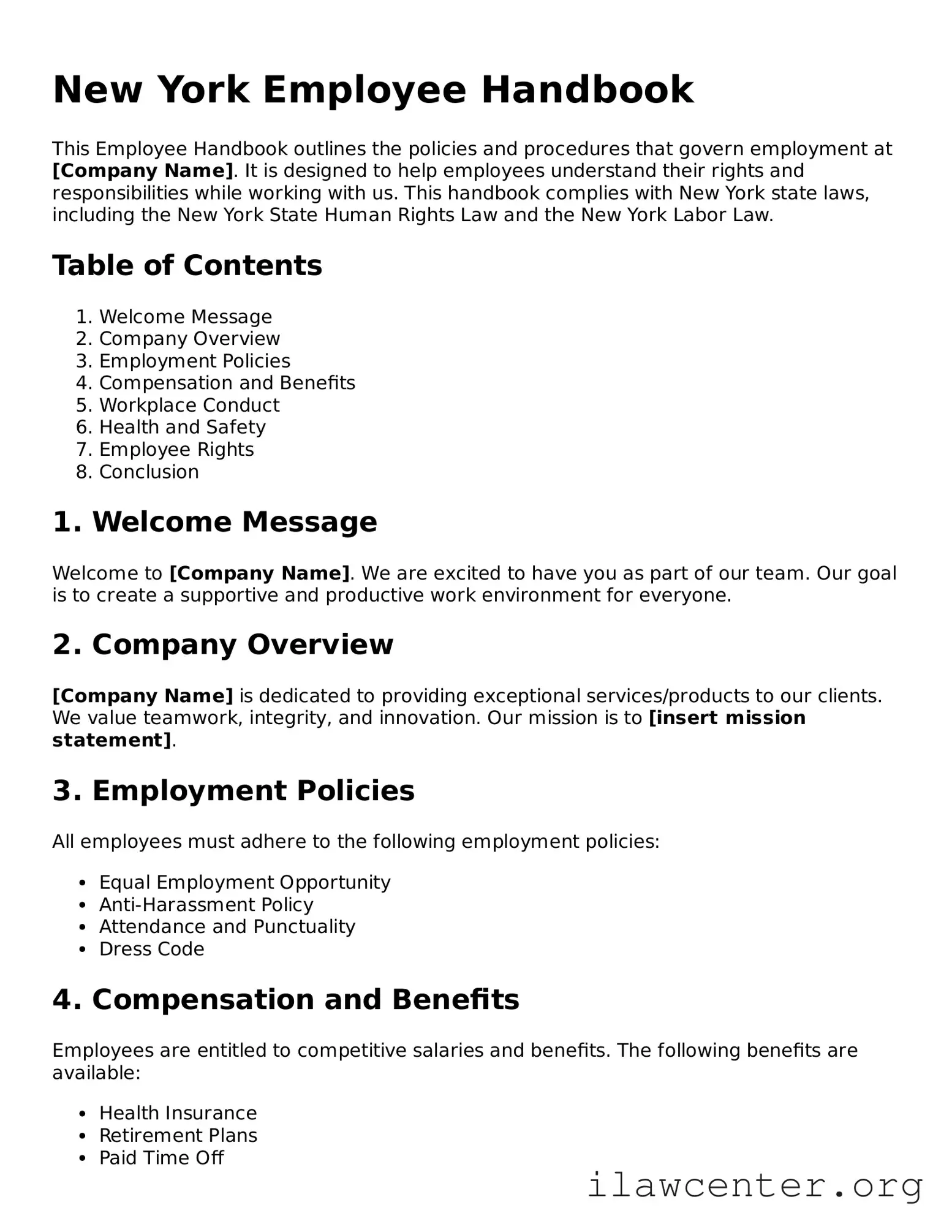
New York Employee Handbook Preview

New York Employee Handbook

This Employee Handbook outlines the policies and procedures that govern employment at [Company Name]. It is designed to help employees understand their rights and responsibilities while working with us. This handbook complies with New York state laws, including the New York State Human Rights Law and the New York Labor Law.

Table of Contents

  1. Welcome Message
  2. Company Overview
  3. Employment Policies
  4. Compensation and Benefits
  5. Workplace Conduct
  6. Health and Safety
  7. Employee Rights
  8. Conclusion

1. Welcome Message

Welcome to [Company Name]. We are excited to have you as part of our team. Our goal is to create a supportive and productive work environment for everyone.

2. Company Overview

[Company Name] is dedicated to providing exceptional services/products to our clients. We value teamwork, integrity, and innovation. Our mission is to [insert mission statement].

3. Employment Policies

All employees must adhere to the following employment policies:

  • Equal Employment Opportunity
  • Anti-Harassment Policy
  • Attendance and Punctuality
  • Dress Code

4. Compensation and Benefits

Employees are entitled to competitive salaries and benefits. The following benefits are available:

  • Health Insurance
  • Retirement Plans
  • Paid Time Off
  • Employee Assistance Programs

5. Workplace Conduct

We expect all employees to maintain a professional demeanor. Key conduct expectations include:

  • Respectful Communication
  • Collaboration with Team Members
  • Compliance with Company Policies

6. Health and Safety

Your safety is our priority. Please be aware of the following:

  • Emergency Procedures
  • Workplace Safety Guidelines
  • Reporting Unsafe Conditions

7. Employee Rights

As an employee in New York, you have the right to:

  • Fair Wages
  • A Safe Work Environment
  • Report Discrimination or Harassment

8. Conclusion

We hope this handbook provides clarity on our policies and your rights. If you have any questions, please reach out to your supervisor or the HR department.

Welcome aboard!

PDF Form Characteristics

Fact Name Description
Purpose The New York Employee Handbook serves as a guide for employees, outlining company policies, procedures, and expectations.
Mandatory Contents Employers must include information on workplace rights, anti-discrimination policies, and safety regulations.
Governing Law The handbook must comply with New York State Labor Law and applicable federal regulations.
Distribution Requirement Employers are required to provide the handbook to all employees and ensure they acknowledge receipt.

Instructions on Utilizing New York Employee Handbook

Completing the New York Employee Handbook form is a straightforward process that helps ensure you understand your rights and responsibilities at work. Follow these steps carefully to fill out the form correctly.

  1. Begin by reading through the entire form to familiarize yourself with the sections.
  2. In the first section, enter your full name as it appears on your official documents.
  3. Next, provide your employee ID number, if applicable. If you do not have one, leave this section blank.
  4. Fill in your job title and the department where you work.
  5. In the following section, indicate the date of hire. This is the date you officially started working for the company.
  6. Read through the company policies outlined in the handbook. Make sure you understand each policy.
  7. Sign and date the form at the bottom to acknowledge that you have read and understood the handbook.
  8. Finally, submit the completed form to your HR department or the designated person.

Important Facts about New York Employee Handbook

What is the purpose of the New York Employee Handbook form?

The New York Employee Handbook form serves as a guide for employees, outlining the company's policies, procedures, and expectations. It helps create a clear understanding of workplace rules and benefits. This form can also protect the company by ensuring that employees are informed about their rights and responsibilities. A well-structured handbook promotes a positive work environment and can reduce misunderstandings or disputes.

Who should receive a copy of the Employee Handbook?

Every employee should receive a copy of the Employee Handbook. This includes full-time, part-time, and temporary workers. Providing a handbook to all employees ensures that everyone is aware of the company's policies. It's also a good idea to have employees sign an acknowledgment form, confirming that they have received and read the handbook. This step can help prevent potential issues in the future.

How often should the Employee Handbook be updated?

What should be included in the Employee Handbook?

The Employee Handbook should cover various topics to ensure comprehensive guidance. Key sections often include company history, mission statement, workplace policies, employee benefits, code of conduct, and procedures for reporting issues. Additionally, it should outline disciplinary procedures and the process for handling grievances. Including this information helps employees understand their rights and the company's expectations.

Common mistakes

Filling out the New York Employee Handbook form can seem straightforward, but many individuals make common mistakes that can lead to confusion or even legal issues. One frequent error is failing to read the entire document carefully. Employees often skim through the handbook, missing important sections that outline their rights and responsibilities. This oversight can result in misunderstandings about workplace policies.

Another mistake involves providing incomplete or inaccurate personal information. Employees sometimes forget to include essential details such as their current address or emergency contact information. This can create complications in communication and may hinder the employer's ability to reach out in case of an emergency.

Many individuals also neglect to sign and date the form. A signature serves as a confirmation that the employee has received and understood the handbook. Without it, there could be disputes regarding whether the employee was aware of company policies, which can complicate matters later on.

Some employees fail to ask questions about unclear sections. If there are policies or procedures that seem confusing, it is crucial to seek clarification. Ignoring this step can lead to unintentional violations of workplace rules, resulting in disciplinary actions.

Another common pitfall is not keeping a copy of the signed handbook for personal records. Employees should always retain a copy for themselves. This can serve as a reference point if any questions or issues arise in the future regarding company policies.

Lastly, many people overlook the importance of updating the form when personal circumstances change. If an employee moves, changes their name, or has a new emergency contact, it is essential to update this information promptly. Failing to do so can lead to significant issues, especially in urgent situations.

Documents used along the form

The New York Employee Handbook serves as a vital resource for both employers and employees, outlining workplace policies, procedures, and expectations. Along with this handbook, several other documents are commonly utilized to ensure clarity and compliance within the workplace. Below are five important forms and documents that often accompany the Employee Handbook.

  • Employment Application: This document collects essential information from job applicants, including their work history, education, and references. It serves as the first step in the hiring process and helps employers assess candidates' qualifications.
  • Offer Letter: An offer letter is a formal document that outlines the terms of employment for a new hire. It typically includes details such as job title, salary, benefits, and start date, providing clarity for both the employer and the employee.
  • Non-Disclosure Agreement (NDA): An NDA protects sensitive company information by legally binding employees to confidentiality. This document is crucial for maintaining trade secrets and proprietary information within the organization.
  • Employee Evaluation Form: This form is used to assess employee performance periodically. It provides a structured way to give feedback, set goals, and document progress, fostering professional development and accountability.
  • Exit Interview Form: Conducting exit interviews helps organizations gather insights from departing employees. This form facilitates discussions about the employee's experience, reasons for leaving, and suggestions for improvement, aiding in future retention efforts.

These documents, when used in conjunction with the New York Employee Handbook, contribute to a well-structured and legally compliant workplace. They help clarify roles, responsibilities, and expectations, ultimately fostering a positive work environment.

Similar forms

  • Company Policies Manual: Similar to the Employee Handbook, this document outlines the company's rules and regulations, providing clarity on expected behavior and procedures.

  • Onboarding Guide: This document serves as an introduction for new employees, detailing initial training, company culture, and essential resources, much like the Employee Handbook.

  • Code of Conduct: The Code of Conduct specifies acceptable behaviors within the workplace, paralleling the guidelines found in the Employee Handbook.

  • Safety Procedures Manual: This manual outlines safety protocols and emergency procedures, ensuring employee well-being, similar to the safety sections often included in the Employee Handbook.

  • Benefits Overview: This document summarizes employee benefits, including health insurance and retirement plans, akin to the benefits section typically found in the Employee Handbook.

  • Performance Evaluation Guidelines: These guidelines explain the performance review process, much like the evaluation criteria that may be addressed in the Employee Handbook.

  • Leave of Absence Policy: This policy outlines the procedures and eligibility for taking leave, similar to the leave policies included in the Employee Handbook.

  • Employee Grievance Procedure: This document details the steps employees can take to report issues, paralleling the grievance processes outlined in the Employee Handbook.

  • Training and Development Policy: This policy describes opportunities for professional growth and training, which may also be addressed in the Employee Handbook.

Dos and Don'ts

When filling out the New York Employee Handbook form, it's important to approach the task thoughtfully. Here’s a list of things you should and shouldn’t do to ensure a smooth process.

  • Do read the entire handbook before filling out the form. Understanding company policies is crucial.
  • Do provide accurate and up-to-date information. Double-check names, addresses, and contact details.
  • Do ask questions if you’re unsure about any section of the form. Clarification can prevent mistakes.
  • Do sign and date the form where required. An unsigned form may be considered incomplete.
  • Do keep a copy of the completed form for your records. This can be useful for future reference.
  • Don't leave any sections blank unless instructed. Missing information can delay processing.
  • Don't rush through the form. Take your time to ensure everything is filled out correctly.
  • Don't provide false information. Misrepresentation can lead to serious consequences.
  • Don't ignore deadlines for submission. Timely completion is often required.

By following these guidelines, you can complete the Employee Handbook form with confidence and clarity.

Misconceptions

Employee handbooks are essential tools for both employers and employees, serving as a guide to workplace policies, expectations, and rights. However, several misconceptions surround the New York Employee Handbook form. Understanding these misconceptions can help clarify the purpose and importance of this document.

  • Misconception 1: The employee handbook is optional for employers.
  • While not legally required, having an employee handbook is highly recommended. It helps establish clear guidelines and can protect employers from potential legal issues.

  • Misconception 2: All employee handbooks must follow a specific template.
  • There is no one-size-fits-all template for employee handbooks. Each handbook should reflect the unique culture, policies, and legal requirements of the organization.

  • Misconception 3: Once created, the handbook doesn’t need to be updated.
  • Policies and laws change frequently. Regularly reviewing and updating the handbook ensures it remains relevant and compliant with current regulations.

  • Misconception 4: The handbook serves as a legally binding contract.
  • Typically, employee handbooks are not considered contracts. They often include disclaimers stating that employment is at-will, meaning either party can terminate the employment relationship at any time.

  • Misconception 5: Employees automatically understand all policies in the handbook.
  • Assuming employees will understand every policy can lead to confusion. It is crucial to provide training and encourage questions to ensure comprehension.

  • Misconception 6: A handbook only needs to address basic policies.
  • A comprehensive handbook should cover a wide range of topics, including workplace behavior, discrimination policies, and safety procedures, among others.

  • Misconception 7: The handbook is only for new employees.
  • While new hires benefit from the handbook, it serves as a valuable resource for all employees. Regular reference can help reinforce policies and expectations.

  • Misconception 8: Digital handbooks are less effective than printed ones.
  • Digital handbooks can be just as effective, if not more so, than printed versions. They allow for easy updates and can be more accessible for employees.

  • Misconception 9: The handbook is irrelevant in small businesses.
  • Even small businesses benefit from having an employee handbook. It helps establish professionalism and can prevent misunderstandings as the business grows.

By dispelling these misconceptions, both employers and employees can appreciate the true value of the New York Employee Handbook form. It serves as a vital resource for fostering a positive and informed workplace environment.

Key takeaways

Filling out and using the New York Employee Handbook form is an important step for both employers and employees. Here are some key takeaways to keep in mind:

  • Understand the Purpose: The handbook serves as a guide for employees, outlining company policies, procedures, and expectations.
  • Be Clear and Concise: Use straightforward language to ensure that all employees can easily understand the content.
  • Include Essential Policies: Make sure to cover critical topics such as workplace conduct, attendance, and benefits.
  • Regular Updates: Review and update the handbook regularly to reflect any changes in laws or company policies.
  • Seek Legal Advice: Consulting with a legal professional can help ensure compliance with state and federal laws.
  • Encourage Employee Acknowledgment: Have employees sign an acknowledgment form to confirm they have read and understood the handbook.

By following these guidelines, companies can create an effective employee handbook that promotes a positive work environment and clarifies expectations.