Attorney-Verified  Independent Contractor Agreement Document for New York

Attorney-Verified Independent Contractor Agreement Document for New York

The New York Independent Contractor Agreement is a vital legal document that outlines the relationship between a business and an independent contractor. This agreement specifies the terms of work, payment, and responsibilities, ensuring clarity and protection for both parties involved. To get started on your own agreement, fill out the form by clicking the button below.

Article Guide

In the bustling landscape of New York's economy, many individuals choose to work as independent contractors, enjoying the flexibility and autonomy that comes with this arrangement. A key component of establishing a successful independent contractor relationship is the New York Independent Contractor Agreement form. This document outlines the terms and conditions under which the contractor will operate, ensuring clarity and mutual understanding between both parties. Key elements include the scope of work, payment terms, deadlines, and confidentiality obligations. By addressing these aspects, the agreement helps prevent misunderstandings and sets clear expectations. Additionally, it often includes provisions for termination and dispute resolution, further safeguarding the interests of both the contractor and the client. Understanding the importance of this form is essential for anyone looking to navigate the independent contracting landscape in New York effectively.

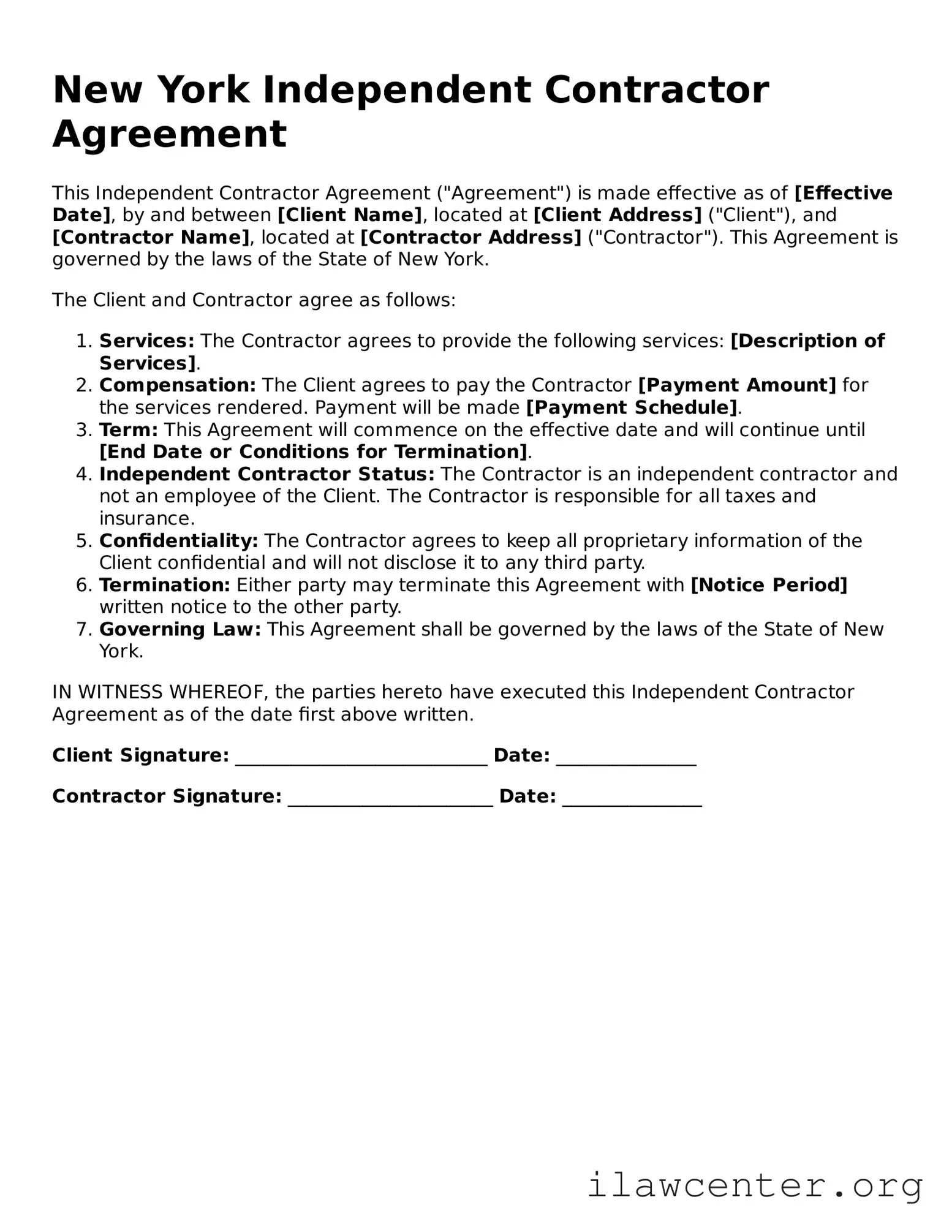
New York Independent Contractor Agreement Preview

New York Independent Contractor Agreement

This Independent Contractor Agreement ("Agreement") is made effective as of [Effective Date], by and between [Client Name], located at [Client Address] ("Client"), and [Contractor Name], located at [Contractor Address] ("Contractor"). This Agreement is governed by the laws of the State of New York.

The Client and Contractor agree as follows:

  1. Services: The Contractor agrees to provide the following services: [Description of Services].
  2. Compensation: The Client agrees to pay the Contractor [Payment Amount] for the services rendered. Payment will be made [Payment Schedule].
  3. Term: This Agreement will commence on the effective date and will continue until [End Date or Conditions for Termination].
  4. Independent Contractor Status: The Contractor is an independent contractor and not an employee of the Client. The Contractor is responsible for all taxes and insurance.
  5. Confidentiality: The Contractor agrees to keep all proprietary information of the Client confidential and will not disclose it to any third party.
  6. Termination: Either party may terminate this Agreement with [Notice Period] written notice to the other party.
  7. Governing Law: This Agreement shall be governed by the laws of the State of New York.

IN WITNESS WHEREOF, the parties hereto have executed this Independent Contractor Agreement as of the date first above written.

Client Signature: ___________________________ Date: _______________

Contractor Signature: ______________________ Date: _______________

PDF Form Characteristics

Fact Name Description
Definition The New York Independent Contractor Agreement outlines the relationship between a contractor and a client.
Purpose This agreement clarifies the scope of work, payment terms, and responsibilities of both parties.
Governing Law The agreement is governed by the laws of the State of New York.
Independent Status It emphasizes that the contractor is not an employee, which affects tax obligations.
Termination Clause The agreement typically includes terms for termination by either party.
Confidentiality Many agreements include clauses to protect sensitive information shared during the contract.
Payment Terms Payment details, including rates and schedules, should be clearly outlined in the agreement.
Dispute Resolution Provisions for resolving disputes may be included, such as mediation or arbitration.
Intellectual Property The agreement may specify ownership of work products created during the contract period.
Amendments Any changes to the agreement must be documented in writing and agreed upon by both parties.

Instructions on Utilizing New York Independent Contractor Agreement

Filling out the New York Independent Contractor Agreement form requires careful attention to detail. Each section of the form must be completed accurately to ensure clarity in the working relationship between the contractor and the hiring party. Following the steps outlined below will help in completing the form correctly.

  1. Begin by entering the date at the top of the form.
  2. Provide the name and address of the hiring party in the designated section.
  3. Next, enter the name and address of the independent contractor.
  4. Clearly define the scope of work in the appropriate area. Be specific about the tasks to be performed.
  5. Indicate the payment terms, including the amount to be paid and the schedule for payment.
  6. Fill in the duration of the agreement, specifying the start and end dates.
  7. Review any additional clauses or terms that may be included in the form, such as confidentiality or termination conditions.
  8. Both parties should sign and date the form at the bottom to validate the agreement.

Important Facts about New York Independent Contractor Agreement

What is a New York Independent Contractor Agreement?

A New York Independent Contractor Agreement is a legal document that outlines the terms and conditions under which an independent contractor will provide services to a client. This agreement clarifies the relationship between the contractor and the client, ensuring that both parties understand their rights and responsibilities. It typically includes details such as the scope of work, payment terms, confidentiality clauses, and the duration of the contract. By having a written agreement, both parties can avoid misunderstandings and establish a clear framework for their professional relationship.

Why is it important to have an Independent Contractor Agreement?

Having an Independent Contractor Agreement is crucial for several reasons. First, it protects both parties by clearly defining the expectations and obligations involved in the working relationship. This can help prevent disputes that may arise from miscommunication. Additionally, the agreement can serve as a legal safeguard, outlining the rights of both the contractor and the client. In the event of a disagreement, having a written document can provide evidence of what was agreed upon, making it easier to resolve conflicts. Furthermore, it helps to clarify the contractor's status as an independent worker, which can have implications for tax and liability issues.

What should be included in a New York Independent Contractor Agreement?

A comprehensive New York Independent Contractor Agreement should include several key components. First, it should identify both parties, including their names and contact information. Next, the agreement should detail the specific services to be provided, along with any deadlines or milestones. Payment terms, such as rates and payment schedules, should also be clearly outlined. Additionally, clauses addressing confidentiality, intellectual property rights, and termination conditions are important to include. Lastly, both parties should sign the agreement to confirm their acceptance of the terms laid out within the document.

Can an Independent Contractor Agreement be modified?

Yes, an Independent Contractor Agreement can be modified, but any changes should be made in writing and signed by both parties. It's essential to ensure that both the contractor and the client agree to any amendments to avoid future disputes. Modifications may be necessary due to changes in the scope of work, payment arrangements, or other circumstances that arise during the course of the contract. Keeping an updated and mutually agreed-upon document helps maintain clarity and trust between both parties.

Common mistakes

Filling out the New York Independent Contractor Agreement form can be a straightforward process, but many individuals make common mistakes that can lead to complications down the line. One of the most frequent errors is failing to clearly define the scope of work. Without a detailed description, both parties may have different expectations, which can lead to disputes. It is crucial to outline specific tasks, deadlines, and deliverables to ensure clarity.

Another common mistake is neglecting to include payment terms. It’s essential to specify how much the contractor will be paid, the payment schedule, and any conditions tied to payments. This omission can create confusion and lead to payment delays, which can strain the working relationship.

Some individuals forget to check the classification of the worker. Misclassifying an employee as an independent contractor can have serious legal implications, including tax liabilities and penalties. It’s important to understand the criteria that distinguish an independent contractor from an employee to avoid these issues.

People often overlook the importance of including a termination clause. This clause outlines the conditions under which either party can terminate the agreement. Without it, one party may feel trapped in a contract that no longer serves their interests, leading to potential legal disputes.

Additionally, failing to address confidentiality can be a significant oversight. If the contractor will have access to sensitive information, it’s vital to include a confidentiality clause. This protects both parties and ensures that proprietary information remains secure.

Another mistake is not addressing intellectual property rights. If the contractor creates original work, it’s important to clarify who owns that work. Without a clear agreement, disputes over ownership can arise, complicating future use of the created materials.

People sometimes forget to include the necessary signatures. An unsigned agreement is not legally binding, which can lead to misunderstandings about the terms. Ensure that both parties sign and date the document to validate the agreement.

Some individuals also neglect to review the entire document before submission. Skimming through the form can lead to missed details or errors that could have been easily corrected. Taking the time to read through the entire agreement can prevent future complications.

Another frequent oversight is not consulting with a legal professional. While it may seem like a straightforward process, having an expert review the agreement can help identify potential pitfalls and ensure that the contract complies with state laws.

Lastly, failing to keep a copy of the signed agreement is a mistake many make. Retaining a copy ensures that both parties have access to the terms of the contract, which is essential for reference in case of disputes. Keeping organized records is a best practice that can save time and effort in the future.
Documents used along the form

When engaging an independent contractor in New York, several additional forms and documents may be necessary to ensure clarity and compliance. Each document serves a specific purpose and can help protect both parties involved in the agreement. Here is a list of commonly used forms alongside the Independent Contractor Agreement.

  • W-9 Form: This form is used to provide the contractor's taxpayer identification number to the hiring entity. It is essential for tax reporting purposes and ensures that the contractor is properly classified for IRS requirements.
  • Invoice: An invoice outlines the services provided, the agreed-upon fees, and payment terms. It serves as a formal request for payment and helps maintain clear financial records for both parties.
  • Non-Disclosure Agreement (NDA): An NDA protects sensitive information shared between the contractor and the hiring party. It ensures that confidential information remains private and is not disclosed to third parties.
  • Scope of Work Document: This document details the specific tasks and responsibilities of the contractor. It helps set clear expectations and can prevent misunderstandings regarding the work to be completed.
  • Termination Agreement: In cases where the working relationship needs to be ended, this document outlines the terms of termination. It ensures that both parties understand their rights and obligations upon ending the contract.

These documents can enhance the independent contractor relationship by providing clarity and protecting both parties' interests. Using them in conjunction with the Independent Contractor Agreement can lead to a smoother working arrangement and minimize potential disputes.

Similar forms

  • Employment Agreement: This document outlines the terms of employment between an employer and an employee. Similar to the Independent Contractor Agreement, it specifies duties, compensation, and duration, but it establishes an employer-employee relationship rather than a contractor relationship.

  • Service Agreement: A Service Agreement details the services to be provided by one party to another. Like the Independent Contractor Agreement, it defines the scope of work, payment terms, and responsibilities, but it can apply to various types of service providers beyond independent contractors.

  • Consulting Agreement: This document is used when hiring a consultant to provide expert advice or services. It shares similarities with the Independent Contractor Agreement in that it outlines the project scope, compensation, and confidentiality terms, focusing on specialized services.

  • Freelance Agreement: A Freelance Agreement is tailored for freelancers who offer their services on a project basis. It is similar to the Independent Contractor Agreement in defining work specifics, payment, and deadlines, emphasizing the independent nature of the work.

  • Partnership Agreement: This document governs the relationship between business partners. While it is more comprehensive in terms of ownership and profit-sharing, it shares common elements with the Independent Contractor Agreement in defining roles and responsibilities.

  • Non-Disclosure Agreement (NDA): An NDA protects confidential information shared between parties. While not directly an agreement for services, it often accompanies Independent Contractor Agreements to ensure sensitive information remains private.

  • Work for Hire Agreement: This agreement specifies that work created by a contractor is owned by the client. It is similar to the Independent Contractor Agreement in that it outlines the terms of work and compensation, but it emphasizes ownership rights of the produced work.

Dos and Don'ts

When filling out the New York Independent Contractor Agreement form, attention to detail is crucial. Here are five important dos and don'ts to keep in mind:

  • Do read the entire agreement carefully before filling it out. Understanding the terms and conditions is essential.
  • Don't leave any sections blank. Incomplete forms can lead to delays or misunderstandings.
  • Do provide accurate information about both parties. This includes names, addresses, and contact details.
  • Don't ignore the payment terms. Clearly outline the compensation structure to avoid future disputes.
  • Do keep a copy of the signed agreement for your records. This will be helpful for reference in the future.

By following these guidelines, you can ensure a smoother process when completing the Independent Contractor Agreement form in New York.

Misconceptions

Many people have misunderstandings about the New York Independent Contractor Agreement form. Here are some common misconceptions, along with explanations to clarify them.

  1. Independent contractors are not protected by any laws.

    This is not true. While independent contractors do not have the same protections as employees, they are still covered by certain laws, such as anti-discrimination and wage laws.

  2. All independent contractor agreements are the same.

    Each agreement can vary significantly based on the specific needs of the parties involved. It’s important to tailor the agreement to reflect the unique terms of the working relationship.

  3. Signing an agreement means you are automatically an independent contractor.

    Simply signing an agreement does not guarantee independent contractor status. The nature of the work relationship must also meet specific criteria set by law.

  4. Independent contractors cannot negotiate their terms.

    This is a misconception. Independent contractors have the right to negotiate terms, including payment, deadlines, and project scope.

  5. Independent contractors are not responsible for their own taxes.

    In fact, independent contractors are responsible for paying their own taxes, including self-employment tax. This is a crucial aspect of their financial obligations.

  6. Once signed, an independent contractor agreement cannot be changed.

    Agreements can be modified if both parties agree to the changes. Communication is key to ensuring that the terms remain relevant and fair.

  7. Independent contractors have no rights to benefits.

    While independent contractors typically do not receive employee benefits, they can negotiate for certain benefits, like payment for expenses or bonuses, as part of their agreement.

  8. Independent contractor agreements are not legally binding.

    These agreements are legally binding as long as they meet the necessary legal requirements. It’s important to ensure that all terms are clear and agreed upon by both parties.

Understanding these misconceptions can help both independent contractors and businesses create fair and effective agreements. Clarity in these matters fosters better working relationships.

Key takeaways

When filling out and using the New York Independent Contractor Agreement form, there are several important points to keep in mind. Here are key takeaways that can help ensure a smooth process:

  • Understand the Purpose: This agreement outlines the relationship between the contractor and the hiring party, clarifying expectations and responsibilities.
  • Identify the Parties: Clearly state the names and addresses of both the contractor and the hiring entity to avoid confusion.
  • Define the Scope of Work: Be specific about the services the contractor will provide. A detailed description helps prevent misunderstandings.
  • Payment Terms: Include the payment amount, schedule, and method. This clarity helps both parties manage their finances effectively.
  • Independent Contractor Status: Clearly state that the contractor is not an employee. This distinction affects taxes and benefits.
  • Confidentiality Clause: If applicable, include terms that protect sensitive information shared during the contract period.
  • Termination Conditions: Outline the circumstances under which either party can terminate the agreement. This provides a clear exit strategy.
  • Governing Law: Specify that New York law will govern the agreement. This is important for resolving disputes.
  • Signatures: Ensure both parties sign and date the agreement. This step formalizes the contract and makes it legally binding.

By paying attention to these key elements, both contractors and hiring entities can foster a clearer and more effective working relationship.