Attorney-Verified  Loan Agreement Document for New York

Attorney-Verified Loan Agreement Document for New York

The New York Loan Agreement form is a legal document that outlines the terms and conditions of a loan between a lender and a borrower in New York. This form specifies the loan amount, interest rate, repayment schedule, and other important details to ensure clarity and protection for both parties. To get started, fill out the form by clicking the button below.

Article Guide

When navigating the world of borrowing and lending in New York, understanding the Loan Agreement form is essential for both parties involved. This document serves as a formal contract that outlines the terms and conditions of a loan, ensuring clarity and protection for the lender and the borrower. Key aspects of the form include the principal amount being borrowed, the interest rate, repayment schedule, and any collateral that may be required. Additionally, it specifies the rights and responsibilities of each party, including what happens in the event of a default. By detailing these elements, the Loan Agreement not only helps to prevent misunderstandings but also provides a framework for resolving disputes should they arise. Familiarity with this form can empower individuals to make informed decisions about their financial commitments, paving the way for successful borrowing experiences.

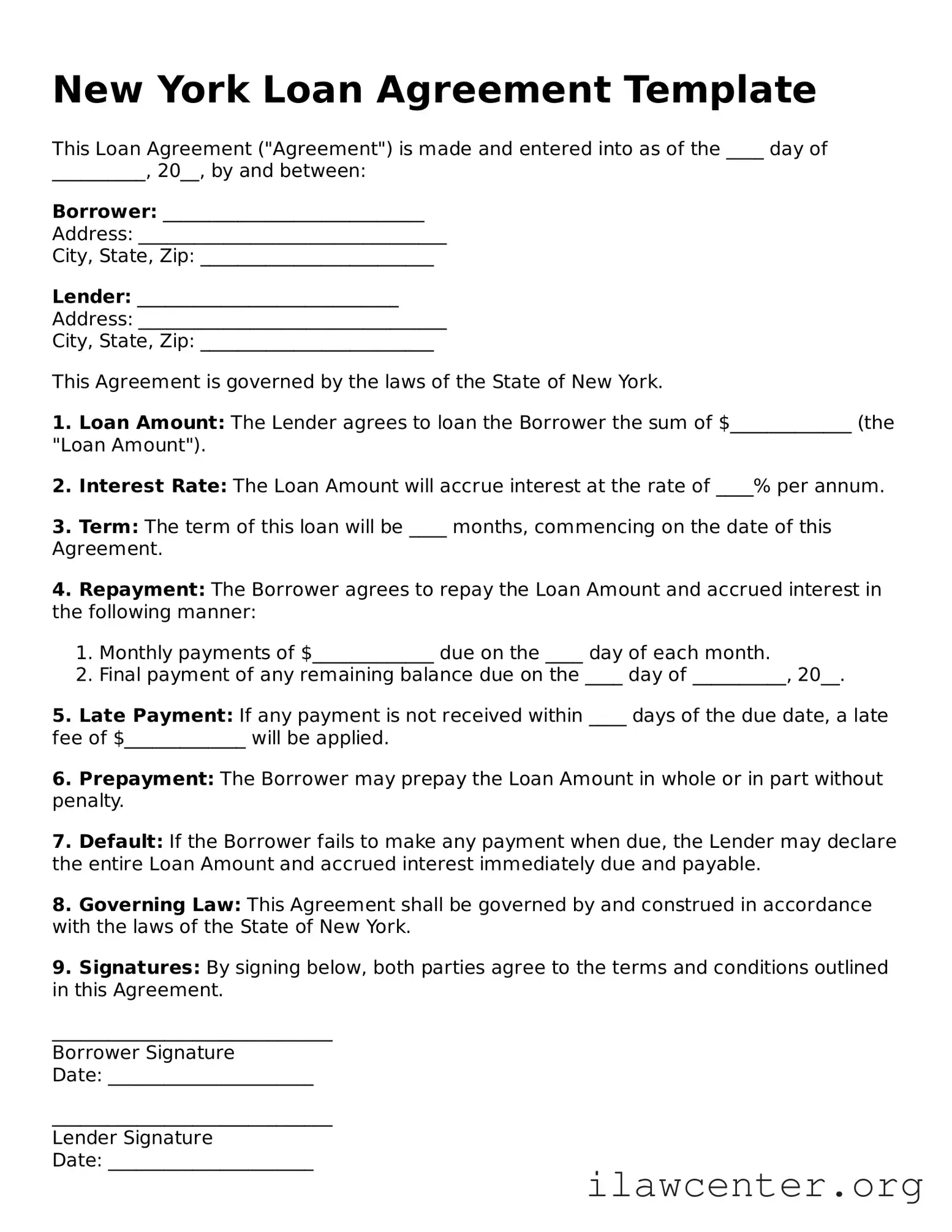
New York Loan Agreement Preview

New York Loan Agreement Template

This Loan Agreement ("Agreement") is made and entered into as of the ____ day of __________, 20__, by and between:

Borrower: ____________________________
Address: _________________________________
City, State, Zip: _________________________

Lender: ____________________________
Address: _________________________________
City, State, Zip: _________________________

This Agreement is governed by the laws of the State of New York.

1. Loan Amount: The Lender agrees to loan the Borrower the sum of $_____________ (the "Loan Amount").

2. Interest Rate: The Loan Amount will accrue interest at the rate of ____% per annum.

3. Term: The term of this loan will be ____ months, commencing on the date of this Agreement.

4. Repayment: The Borrower agrees to repay the Loan Amount and accrued interest in the following manner:

  1. Monthly payments of $_____________ due on the ____ day of each month.
  2. Final payment of any remaining balance due on the ____ day of __________, 20__.

5. Late Payment: If any payment is not received within ____ days of the due date, a late fee of $_____________ will be applied.

6. Prepayment: The Borrower may prepay the Loan Amount in whole or in part without penalty.

7. Default: If the Borrower fails to make any payment when due, the Lender may declare the entire Loan Amount and accrued interest immediately due and payable.

8. Governing Law: This Agreement shall be governed by and construed in accordance with the laws of the State of New York.

9. Signatures: By signing below, both parties agree to the terms and conditions outlined in this Agreement.

______________________________
Borrower Signature
Date: ______________________

______________________________
Lender Signature
Date: ______________________

PDF Form Characteristics

Fact Name Description
Purpose The New York Loan Agreement form serves as a legally binding document outlining the terms and conditions of a loan between a lender and a borrower.
Governing Law This agreement is governed by the laws of the State of New York, ensuring that any disputes are resolved according to New York law.
Essential Components Key components typically include the loan amount, interest rate, repayment schedule, and any collateral required.
Signatures Both parties must sign the agreement for it to be enforceable, indicating their acceptance of the loan terms.

Instructions on Utilizing New York Loan Agreement

Filling out the New York Loan Agreement form is a straightforward process. It involves providing specific information about the loan, the parties involved, and the terms of repayment. Careful attention to detail will ensure that all necessary information is accurately captured.

  1. Begin by entering the date at the top of the form.
  2. Fill in the names and addresses of both the lender and the borrower.
  3. Specify the loan amount in the designated section.
  4. Clearly outline the interest rate and any applicable fees.
  5. Detail the repayment schedule, including due dates and payment amounts.
  6. Include any collateral information, if applicable.
  7. Sign and date the form at the bottom.
  8. Have the other party sign and date the form as well.

Important Facts about New York Loan Agreement

What is a New York Loan Agreement form?

A New York Loan Agreement form is a legal document that outlines the terms and conditions of a loan between a lender and a borrower. It specifies the amount borrowed, interest rates, repayment schedule, and any collateral involved. This form serves to protect both parties by clearly defining their rights and obligations.

Who should use a New York Loan Agreement?

Anyone who is lending or borrowing money in New York should consider using this agreement. This includes individuals, businesses, and financial institutions. It is especially important for larger loans or when the terms are complex to ensure clarity and legal protection.

What are the key components of a New York Loan Agreement?

A typical New York Loan Agreement includes the loan amount, interest rate, repayment terms, maturity date, and any fees. It may also detail the consequences of default, collateral requirements, and governing law. Each component is crucial for understanding the full scope of the agreement.

Do I need a lawyer to create a New York Loan Agreement?

While it is not legally required to have a lawyer draft a Loan Agreement, consulting one can be beneficial. A lawyer can help ensure that the agreement complies with New York laws and adequately protects your interests. This is especially recommended for significant loans or complex terms.

Can I modify a New York Loan Agreement after it has been signed?

Yes, modifications can be made to a New York Loan Agreement after it has been signed, but they must be documented in writing and signed by both parties. Verbal agreements or informal changes are generally not enforceable, so it’s essential to keep all modifications formal.

What happens if a borrower defaults on the loan?

If a borrower defaults, the lender has several options depending on the terms outlined in the agreement. This may include pursuing legal action to recover the owed amount or seizing collateral if one was specified. The agreement should clearly state the consequences of default to avoid misunderstandings.

Is a New York Loan Agreement enforceable in court?

Yes, a properly executed New York Loan Agreement is generally enforceable in court. However, to be enforceable, the agreement must meet certain legal requirements, such as having clear terms and being signed by both parties. If disputes arise, the agreement serves as a key piece of evidence.

Are there any specific laws governing Loan Agreements in New York?

Yes, Loan Agreements in New York are subject to various state laws, including those related to interest rates, consumer protection, and lending practices. The New York General Obligations Law and the New York Banking Law are particularly relevant. Understanding these laws can help ensure compliance and protect both parties.

What should I do if I have a dispute regarding a Loan Agreement?

If a dispute arises, the first step is to review the terms of the Loan Agreement. Open communication between the parties can often resolve misunderstandings. If necessary, mediation or arbitration may be pursued. If these methods fail, legal action may be the final resort.

Can a New York Loan Agreement be used for personal loans?

Yes, a New York Loan Agreement can be used for personal loans. Whether borrowing from a friend, family member, or a financial institution, having a written agreement helps clarify the terms and protects both parties. It is advisable to document any personal loan, especially if the amount is significant.
Common mistakes

Filling out a loan agreement can be a daunting task, especially for those unfamiliar with the process. In New York, the loan agreement form has specific requirements that must be met. One common mistake people make is failing to read the entire document carefully. Skimming through the form can lead to missed details that may have significant implications later.

Another frequent error is not providing accurate personal information. Borrowers often rush to complete the form and may inadvertently enter incorrect names, addresses, or Social Security numbers. Such inaccuracies can delay the approval process or even result in a denial of the loan.

Additionally, many individuals neglect to include all necessary financial details. This includes income, expenses, and existing debts. Omitting this information can create a misleading picture of one’s financial situation, potentially impacting the lender’s decision.

Some borrowers also overlook the importance of reading the terms and conditions thoroughly. The loan agreement includes critical information about interest rates, repayment schedules, and penalties for late payments. Ignoring these details can lead to unexpected financial burdens.

Another mistake is failing to sign the document where required. A loan agreement is not legally binding without the appropriate signatures. Missing signatures can render the entire agreement void, causing frustration and delays.

People sometimes forget to date the agreement. A missing date may raise questions about when the agreement was made, complicating the legal standing of the document. It is essential to ensure that all dates are accurately filled in to avoid confusion.

In some cases, borrowers do not keep a copy of the signed agreement for their records. Having a personal copy is crucial for future reference, especially if disputes arise regarding the terms of the loan.

Another common oversight is failing to disclose all relevant information about co-signers or guarantors. If a co-signer is involved, their details must be included in the agreement. This transparency is vital for the lender’s assessment of risk.

Moreover, individuals often misunderstand the implications of adjustable interest rates. Many borrowers select loans with variable rates without fully comprehending how these rates can change over time. This misunderstanding can lead to financial strain if rates increase significantly.

Lastly, some people do not seek professional advice when needed. Consulting with a financial advisor or attorney can provide valuable insights into the terms of the loan and help avoid costly mistakes. Taking this step can lead to more informed decision-making and a smoother loan process.

Documents used along the form

A New York Loan Agreement is a critical document in the lending process, outlining the terms and conditions between the borrower and the lender. However, several other forms and documents often accompany this agreement to ensure clarity and legal compliance. Here are five commonly used documents:

  • Promissory Note: This document serves as a written promise from the borrower to repay the loan. It specifies the loan amount, interest rate, repayment schedule, and any penalties for late payments.
  • Loan Disclosure Statement: Required by federal law, this statement provides borrowers with essential information about the loan terms, including fees, interest rates, and the total cost of the loan over its lifetime.
  • Security Agreement: If the loan is secured by collateral, this document outlines the specific assets pledged as security. It protects the lender’s interests by detailing what happens if the borrower defaults.
  • Personal Guarantee: This document may be required if the borrower is a business entity. It holds an individual personally responsible for repaying the loan if the business fails to do so.
  • Loan Application: The borrower submits this form to request the loan. It typically includes personal and financial information to help the lender assess creditworthiness.

Each of these documents plays a vital role in the lending process, ensuring that both parties are protected and informed. Understanding these forms can facilitate smoother transactions and reduce the risk of misunderstandings in the future.

Similar forms

  • Promissory Note: This document outlines a borrower's promise to repay a loan under specified terms. Like a Loan Agreement, it details the amount borrowed, interest rates, and repayment schedule, but it typically does not include the terms of collateral.
  • Mortgage Agreement: This is a specific type of loan agreement used for real estate transactions. It secures the loan with the property itself, similar to how a Loan Agreement may secure the loan with collateral.
  • Security Agreement: This document establishes a security interest in collateral for a loan. It shares similarities with a Loan Agreement in that it specifies the obligations of the borrower and the rights of the lender concerning the collateral.
  • Lease Agreement: While primarily used for renting property, a lease agreement can resemble a Loan Agreement when it involves a lease-to-own arrangement. Both documents outline payment terms and conditions for the use of an asset.
  • Line of Credit Agreement: This document allows a borrower to access funds up to a certain limit. Like a Loan Agreement, it details repayment terms and interest rates, but it offers more flexibility in terms of borrowing as needed.
  • Debt Settlement Agreement: This agreement outlines the terms under which a borrower can settle their debt for less than the full amount owed. It is similar to a Loan Agreement in that it involves negotiations and terms for repayment, albeit in a context of resolving outstanding debts.

Dos and Don'ts

When filling out the New York Loan Agreement form, attention to detail is crucial. Here are five essential dos and don'ts to consider:

  • Do read the entire agreement carefully before filling it out. Understanding the terms is vital.
  • Do provide accurate and complete information. Inaccuracies can lead to delays or legal issues.
  • Do consult with a legal professional if you have any questions. Getting clarity can prevent future problems.
  • Don't rush through the form. Taking your time ensures that you don’t overlook important details.
  • Don't sign the agreement until you are fully satisfied with the terms. Signing prematurely can bind you to unfavorable conditions.

Misconceptions

When dealing with the New York Loan Agreement form, several misconceptions can lead to confusion. Understanding these common misunderstandings can help borrowers and lenders navigate the process more effectively.

  • Misconception 1: The Loan Agreement is a standard document that can be used for any type of loan.
  • This is not true. The New York Loan Agreement form is specifically tailored to comply with state laws and regulations. Different types of loans, such as personal loans, business loans, or mortgages, may require different terms and conditions.

  • Misconception 2: Signing the Loan Agreement means you are immediately receiving the funds.
  • Signing the agreement does not guarantee that funds will be disbursed right away. There may be additional steps, such as credit checks or verification processes, that must be completed before funds are released.

  • Misconception 3: All loan agreements are the same regardless of the lender.
  • This is misleading. Each lender may have unique terms, interest rates, and repayment schedules. It is essential to read and understand the specific terms outlined in the agreement with each lender.

  • Misconception 4: Once you sign a Loan Agreement, you cannot make changes.
  • While it is true that changes may be challenging to implement after signing, it is not impossible. Borrowers can negotiate terms before signing, and in some cases, lenders may be willing to amend the agreement if both parties agree.

Key takeaways

When filling out and utilizing the New York Loan Agreement form, there are several important considerations to keep in mind. Below are key takeaways that can help ensure a smooth process.

  • Understand the purpose of the loan agreement. It serves as a legally binding document outlining the terms of the loan between the lender and the borrower.
  • Ensure that all parties involved are clearly identified. This includes full names, addresses, and contact information to avoid any confusion.
  • Specify the loan amount and interest rate. Clarity on these figures is essential for both parties to understand their obligations.
  • Detail the repayment terms. Include the payment schedule, due dates, and any grace periods to prevent misunderstandings.
  • Include provisions for default. This section should outline what happens if the borrower fails to meet the repayment terms.
  • Consider including collateral. If applicable, specifying collateral can provide additional security for the lender.
  • Consult with a legal professional if needed. Having an expert review the agreement can help ensure that all legal requirements are met and that the document is fair to both parties.

By keeping these key points in mind, individuals can navigate the process of completing and using the New York Loan Agreement form more effectively.