Attorney-Verified  Marital Separation Agreement Document for New York

Attorney-Verified Marital Separation Agreement Document for New York

A New York Marital Separation Agreement is a legal document that outlines the terms of separation between spouses. It addresses important issues such as property division, child custody, and support obligations. To ensure clarity and mutual understanding, it is essential to complete this form accurately.

Ready to take the next step? Fill out the form by clicking the button below.

Article Guide

In the state of New York, couples contemplating separation often turn to the Marital Separation Agreement form as a crucial tool for navigating the complexities of their relationship status. This document serves as a comprehensive outline of the terms agreed upon by both parties, addressing vital aspects such as the division of assets and liabilities, child custody arrangements, and spousal support. By clearly delineating responsibilities and expectations, the agreement aims to minimize potential conflicts during the separation process. Additionally, it provides a framework for future decision-making regarding children and finances, which can be particularly beneficial in maintaining a cooperative relationship post-separation. Legal requirements and considerations, such as the necessity for both parties to voluntarily sign the agreement, also play a significant role in its formation. Understanding these components can empower individuals to make informed decisions as they navigate this challenging life transition.

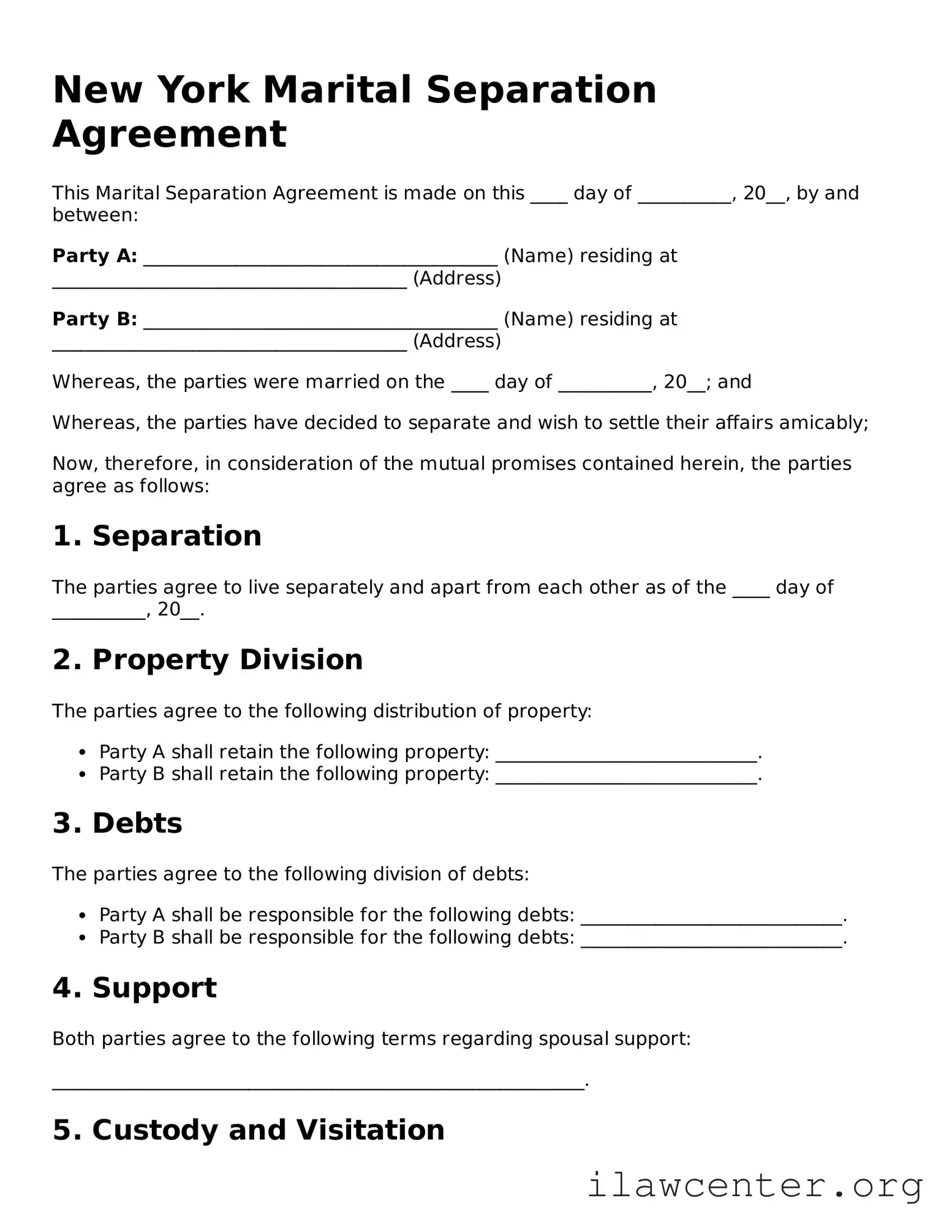
New York Marital Separation Agreement Preview

New York Marital Separation Agreement

This Marital Separation Agreement is made on this ____ day of __________, 20__, by and between:

Party A: ______________________________________ (Name) residing at ______________________________________ (Address)

Party B: ______________________________________ (Name) residing at ______________________________________ (Address)

Whereas, the parties were married on the ____ day of __________, 20__; and

Whereas, the parties have decided to separate and wish to settle their affairs amicably;

Now, therefore, in consideration of the mutual promises contained herein, the parties agree as follows:

1. Separation

The parties agree to live separately and apart from each other as of the ____ day of __________, 20__.

2. Property Division

The parties agree to the following distribution of property:

  • Party A shall retain the following property: ____________________________.
  • Party B shall retain the following property: ____________________________.

3. Debts

The parties agree to the following division of debts:

  • Party A shall be responsible for the following debts: ____________________________.
  • Party B shall be responsible for the following debts: ____________________________.

4. Support

Both parties agree to the following terms regarding spousal support:

_________________________________________________________.

5. Custody and Visitation

If applicable, the parties agree to the following arrangements regarding children:

  • Custody shall be shared/sole (choose one) between Party A and Party B.
  • Visitation rights shall be as follows: ____________________________________.

6. Miscellaneous

This Agreement shall be governed by the laws of the State of New York.

Both parties acknowledge that they have had the opportunity to consult with independent legal counsel before signing this Agreement.

7. Signatures

In witness whereof, the parties hereto have executed this Marital Separation Agreement as of the date first above written.

______________________________
Party A Signature

______________________________
Party B Signature

______________________________
Date

PDF Form Characteristics

Fact Name Description
Purpose The New York Marital Separation Agreement is designed to outline the terms of a couple's separation, including financial and child custody arrangements.
Governing Law This agreement is governed by New York State laws, particularly under the Domestic Relations Law.
Voluntary Agreement Both parties must willingly agree to the terms laid out in the separation agreement. It cannot be imposed by one spouse on the other.
Written Document The agreement must be in writing to be enforceable. Oral agreements regarding separation are not recognized.
Child Custody The separation agreement can include specific provisions for child custody and visitation, ensuring that the best interests of the child are prioritized.
Financial Obligations It outlines the financial responsibilities of each spouse, including alimony, child support, and division of assets.
Legal Advice While not mandatory, it is highly recommended that both parties seek independent legal advice before signing the agreement to ensure their rights are protected.

Instructions on Utilizing New York Marital Separation Agreement

Completing the New York Marital Separation Agreement form is an important step in the process of separating from your spouse. After you have filled out the form, you will need to review it carefully to ensure all information is accurate and complete. This agreement will serve as a foundation for your separation, outlining the terms that both parties have agreed upon.

  1. Begin by entering the full names of both spouses at the top of the form. Make sure to include any middle names or initials.
  2. Next, provide the date of marriage. This should be the official date recorded on your marriage certificate.
  3. Fill in the date of separation. This is the date when you and your spouse began living apart.
  4. Indicate the address where you and your spouse last lived together. Include the full street address, city, state, and zip code.
  5. Outline the terms of property division. Clearly list any assets and debts, specifying who will retain ownership or responsibility for each item.
  6. Address any spousal support or alimony arrangements. Specify if one spouse will provide financial support to the other and under what conditions.
  7. If there are children involved, include their names and ages. Clearly outline custody arrangements, visitation rights, and child support obligations.
  8. Both spouses should review the agreement for accuracy. Make any necessary changes before signing.
  9. Once everything is correct, both parties need to sign and date the agreement. It may be beneficial to have the signatures notarized for added legal protection.

Important Facts about New York Marital Separation Agreement

What is a New York Marital Separation Agreement?

A New York Marital Separation Agreement is a legal document that outlines the terms of a couple's separation. It addresses issues such as property division, spousal support, child custody, and visitation rights. This agreement helps clarify each party's rights and responsibilities during the separation period.

Is a Marital Separation Agreement legally binding?

Yes, a properly executed Marital Separation Agreement is legally binding in New York. Both parties must voluntarily agree to the terms and sign the document. It is advisable to have the agreement reviewed by a lawyer to ensure it complies with state laws and adequately protects your interests.

Do I need a lawyer to create a Marital Separation Agreement?

What should be included in the Marital Separation Agreement?

The agreement should cover several key areas: division of assets and debts, spousal support or alimony, child custody arrangements, visitation schedules, and child support obligations. It may also address how to handle future disputes and any other specific issues relevant to your situation.

Can the Marital Separation Agreement be modified?

Yes, the agreement can be modified if both parties agree to the changes. It is essential to document any modifications in writing and have both parties sign the updated agreement. This ensures that any changes are legally recognized and enforceable.

How does a Marital Separation Agreement affect divorce proceedings?

A Marital Separation Agreement can simplify the divorce process. If both parties have already agreed on key issues, the divorce can proceed more smoothly. However, if you later decide to divorce, the agreement may need to be incorporated into the final divorce decree.

What happens if one party violates the Marital Separation Agreement?

If one party violates the terms of the agreement, the other party can seek legal remedies. This may include going to court to enforce the agreement or seeking damages. It is important to keep a record of any violations and to seek legal advice on how to proceed.

Common mistakes

Filling out a New York Marital Separation Agreement form can be a daunting task. It is essential to approach this process with care and attention to detail. One common mistake individuals make is not fully understanding the implications of the agreement. Many people rush through the document, thinking it is merely a formality. However, this agreement can have significant long-term effects on your financial and personal life. It is crucial to take the time to comprehend each section thoroughly.

Another frequent error is failing to include all relevant assets and debts. When completing the form, individuals may overlook certain items, such as retirement accounts or shared debts. This omission can lead to disputes down the line, as both parties may have different expectations regarding what was included in the agreement. It is advisable to create a comprehensive list of all assets and liabilities before beginning to fill out the form.

Inaccurate or incomplete information can also be a significant pitfall. Some people may provide incorrect figures for income or expenses, while others might leave sections blank. This can create confusion and lead to potential legal issues later. Always double-check your entries for accuracy. Providing the right information ensures that the agreement reflects your true financial situation.

Lastly, many individuals forget the importance of having the agreement reviewed by a legal professional. While it may seem like an unnecessary expense, a lawyer can provide valuable insights and help avoid future complications. They can ensure that the agreement complies with New York laws and adequately protects your interests. Seeking professional guidance can make a considerable difference in the outcome of your separation.

Documents used along the form

When couples decide to separate, they often use a variety of documents to ensure that the process is as smooth and clear as possible. The New York Marital Separation Agreement is one key document, but it is typically accompanied by several others that serve different purposes in the separation process. Here’s a brief overview of some commonly used forms and documents.

  • Separation Agreement: This document outlines the terms of the separation, including division of property, child custody arrangements, and financial responsibilities. It serves as a legally binding contract between the parties.
  • Child Custody Agreement: If children are involved, this document specifies the custody arrangement, visitation rights, and decision-making responsibilities regarding the children’s upbringing.
  • Child Support Agreement: This form details the financial support one parent will provide to the other for the care of the children. It includes the amount, frequency of payments, and duration of support.
  • Property Settlement Agreement: This document outlines how the couple's assets and debts will be divided. It addresses everything from real estate to personal property and financial accounts.
  • Financial Disclosure Statement: This form requires both parties to provide a complete picture of their financial situation, including income, expenses, assets, and liabilities. Transparency is key in negotiations.
  • Affidavit of Service: This document proves that one party has delivered the separation agreement to the other party. It is important for ensuring that all legal requirements are met.
  • Notice of Motion: If one party seeks to modify any terms of the separation agreement, this document formally requests the court to consider the changes. It initiates the legal process for amendments.

Each of these documents plays a vital role in the separation process, helping to clarify responsibilities and protect the rights of all parties involved. By understanding these forms, individuals can navigate their separation with greater confidence and clarity.

Similar forms

A Marital Separation Agreement is an important document for couples who choose to live apart while still legally married. It outlines the terms of the separation, including division of assets, child custody, and support obligations. Several other documents serve similar purposes in different contexts. Here’s a list of ten documents that share similarities with a Marital Separation Agreement:

  • Divorce Agreement: This document is finalized when a couple decides to end their marriage. Like a Marital Separation Agreement, it addresses property division, child custody, and support, but it results in the legal dissolution of the marriage.
  • Child Custody Agreement: This agreement specifically focuses on the arrangements for children following a separation or divorce. It details physical and legal custody, visitation rights, and decision-making responsibilities, similar to the child-related provisions in a Marital Separation Agreement.
  • Property Settlement Agreement: This document outlines how a couple will divide their assets and debts. It is often part of a divorce process but can also be relevant during separation, just like the property division clauses in a Marital Separation Agreement.
  • Separation Agreement: This is a general term that can refer to any agreement made between spouses who are separating. It may cover similar topics as a Marital Separation Agreement, such as support and custody, but might not have the same legal weight in all jurisdictions.
  • Postnuptial Agreement: Created after marriage, this document outlines how a couple will handle their finances and property in the event of separation or divorce. It serves a similar purpose to a Marital Separation Agreement in terms of asset protection and support obligations.
  • Prenuptial Agreement: This agreement is made before marriage and outlines how assets will be divided in case of divorce or separation. While it is proactive, its focus on asset division is similar to that found in a Marital Separation Agreement.
  • Spousal Support Agreement: This document specifically addresses financial support one spouse will provide to the other after separation or divorce. It is a key component of a Marital Separation Agreement, where support terms are also established.
  • Custody Modification Agreement: When circumstances change, parents may need to modify existing custody arrangements. This document serves a similar purpose to a Marital Separation Agreement in that it outlines how custody will be adjusted based on new situations.
  • Visitation Agreement: This document details the visitation rights of a non-custodial parent. Like the custody arrangements in a Marital Separation Agreement, it ensures that both parents understand their rights and responsibilities regarding their children.
  • Mutual Consent Agreement: This document is used when both parties agree to certain terms regarding their separation. It can cover various aspects, similar to a Marital Separation Agreement, but is often less formal and may not be legally binding unless filed with a court.

Each of these documents serves a unique purpose but shares common themes with a Marital Separation Agreement, particularly in terms of outlining responsibilities and rights for couples who are separating.

Dos and Don'ts

When filling out the New York Marital Separation Agreement form, it's crucial to approach the process with care. This document can significantly impact your future, so consider the following dos and don'ts.

  • Do read the entire form carefully before starting. Understanding each section will help you provide accurate information.
  • Do consult with a legal professional if you have questions. Their guidance can clarify complex terms and ensure your rights are protected.
  • Do be honest and transparent about your assets and liabilities. Full disclosure is essential for a fair agreement.
  • Do discuss the terms with your spouse, if possible. Open communication can lead to a more amicable resolution.
  • Don't rush through the process. Taking your time can prevent mistakes that might complicate matters later.
  • Don't omit any important details. Leaving out information can lead to disputes down the line.
  • Don't sign the agreement without fully understanding its implications. Ensure you are comfortable with all terms before finalizing.

Being diligent and thoughtful while completing the Marital Separation Agreement form can help facilitate a smoother transition during a challenging time.

Misconceptions

When dealing with the New York Marital Separation Agreement form, several misconceptions often arise. Understanding these can help individuals navigate the process more effectively.

  • Misconception 1: The agreement is legally binding immediately upon signing.
  • While both parties must sign the agreement for it to be valid, it does not become legally binding until it is filed with the court. Until that point, either party may change their mind.

  • Misconception 2: A marital separation agreement is the same as a divorce.
  • A marital separation agreement allows couples to live apart while remaining legally married. In contrast, a divorce legally ends the marriage. The separation agreement can be a step toward divorce, but it does not finalize it.

  • Misconception 3: The agreement covers all future disputes.
  • While the agreement addresses many aspects of separation, it may not cover every potential future dispute. Issues like child custody or support may require further legal intervention, depending on circumstances.

  • Misconception 4: Only one spouse needs to agree to the terms.
  • Both spouses must agree to the terms outlined in the marital separation agreement. If one party does not agree, the document cannot be finalized, and negotiations will be necessary.

Key takeaways

Filling out and using the New York Marital Separation Agreement form is a crucial step for couples considering separation. Here are some key takeaways to keep in mind:

  1. Understand the Purpose: This form outlines the terms of your separation, including property division, child custody, and support obligations.
  2. Full Disclosure: Both parties must provide complete and honest information about their assets and debts. Transparency is essential.
  3. Legal Requirements: Ensure that the agreement complies with New York laws. This includes specific provisions that must be included.
  4. Consider Mediation: Engaging a mediator can help facilitate discussions and lead to a more amicable agreement.
  5. Review Child Custody: If children are involved, detail custody arrangements, visitation schedules, and child support obligations.
  6. Property Division: Clearly outline how marital property will be divided. This includes real estate, bank accounts, and personal belongings.
  7. Signatures Required: Both parties must sign the agreement. Witnesses or notarization may also be necessary for the document to be legally binding.
  8. Review Period: Allow time for both parties to review the agreement before signing. This ensures that everyone fully understands the terms.
  9. Seek Legal Advice: Consulting with an attorney can provide guidance and ensure that your rights are protected throughout the process.
  10. Keep Copies: After signing, make sure to keep copies of the agreement for your records. This will be important for future reference.

Following these guidelines can help ensure that the separation process is as smooth and fair as possible.