Attorney-Verified  Medical Power of Attorney Document for New York

Attorney-Verified Medical Power of Attorney Document for New York

The New York Medical Power of Attorney form is a legal document that allows an individual to appoint someone else to make healthcare decisions on their behalf in the event they become unable to do so. This form ensures that your medical preferences are respected and followed, even if you cannot communicate them yourself. To get started on protecting your healthcare choices, fill out the form by clicking the button below.

Article Guide

In the bustling landscape of healthcare decisions, the New York Medical Power of Attorney form serves as a crucial tool for individuals seeking to ensure their medical preferences are honored, even when they cannot voice them themselves. This legal document empowers a designated agent to make healthcare choices on behalf of the principal, reflecting their values and wishes during critical moments. It encompasses a range of decisions, from treatment options to end-of-life care, thus providing a framework for navigating the complexities of medical interventions. Importantly, the form requires careful consideration of who will serve as the agent, as this person will be entrusted with significant responsibilities. Additionally, the document must be executed in accordance with specific state requirements, including the need for witnesses or notarization, to ensure its validity. By understanding the nuances of the New York Medical Power of Attorney form, individuals can take proactive steps in safeguarding their health care preferences, thereby alleviating potential burdens on family members during challenging times.

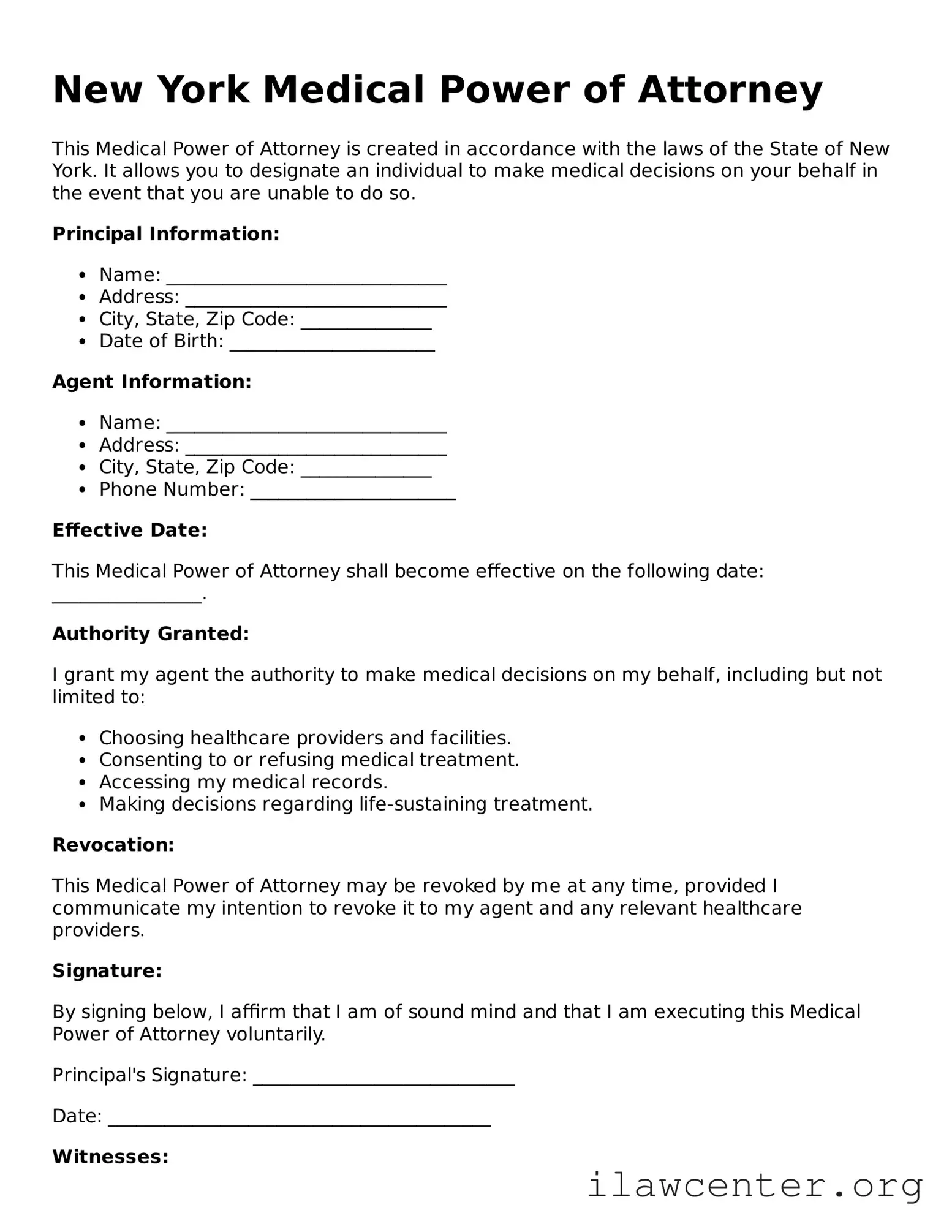
New York Medical Power of Attorney Preview

New York Medical Power of Attorney

This Medical Power of Attorney is created in accordance with the laws of the State of New York. It allows you to designate an individual to make medical decisions on your behalf in the event that you are unable to do so.

Principal Information:

  • Name: ______________________________
  • Address: ____________________________
  • City, State, Zip Code: ______________
  • Date of Birth: ______________________

Agent Information:

  • Name: ______________________________
  • Address: ____________________________
  • City, State, Zip Code: ______________
  • Phone Number: ______________________

Effective Date:

This Medical Power of Attorney shall become effective on the following date: ________________.

Authority Granted:

I grant my agent the authority to make medical decisions on my behalf, including but not limited to:

  • Choosing healthcare providers and facilities.
  • Consenting to or refusing medical treatment.
  • Accessing my medical records.
  • Making decisions regarding life-sustaining treatment.

Revocation:

This Medical Power of Attorney may be revoked by me at any time, provided I communicate my intention to revoke it to my agent and any relevant healthcare providers.

Signature:

By signing below, I affirm that I am of sound mind and that I am executing this Medical Power of Attorney voluntarily.

Principal's Signature: ____________________________

Date: _________________________________________

Witnesses:

This document must be signed in the presence of two witnesses who are not related to the principal or the agent. Witnesses must also not be entitled to any portion of the principal's estate.

  1. Witness 1 Signature: ____________________________
  2. Witness 1 Name: ______________________________
  3. Witness 2 Signature: ____________________________
  4. Witness 2 Name: ______________________________

Notary Public:

This document may also be notarized for additional validity.

Notary Signature: ______________________________

Date: _________________________________________

PDF Form Characteristics

Fact Name Description
Definition A New York Medical Power of Attorney allows an individual to designate someone to make healthcare decisions on their behalf if they become unable to do so.
Governing Law The form is governed by New York Public Health Law, specifically Section 2981.
Eligibility Any adult who is of sound mind can create a Medical Power of Attorney in New York.
Agent Responsibilities The appointed agent must act in the best interests of the principal and make decisions based on their known wishes.
Revocation The principal can revoke the Medical Power of Attorney at any time, as long as they are still competent.
Witness Requirements The form must be signed in the presence of two witnesses, who cannot be the appointed agent or related to the principal.
Durability This document remains effective even if the principal becomes incapacitated, ensuring continuous decision-making authority for the agent.

Instructions on Utilizing New York Medical Power of Attorney

Filling out the New York Medical Power of Attorney form is a significant step in ensuring that your healthcare preferences are honored. Once the form is completed, it will need to be signed and witnessed, after which it can be shared with your healthcare providers and family members.

  1. Obtain the New York Medical Power of Attorney form. This can typically be found online or through legal offices.
  2. Read the form carefully to understand the sections that require your input.
  3. In the designated area, fill in your full name, address, and contact information.
  4. Identify the individual you wish to designate as your healthcare agent. Provide their full name, address, and contact information.
  5. Clearly outline any specific medical preferences or limitations you wish to include. This may involve detailing certain treatments you do or do not want.
  6. Sign and date the form in the presence of a witness. Ensure that the witness is not your designated healthcare agent.
  7. Have the witness sign and date the form as well, confirming they observed your signature.
  8. Make copies of the completed form for your records and share it with your healthcare agent and medical providers.

Important Facts about New York Medical Power of Attorney

What is a New York Medical Power of Attorney form?

The New York Medical Power of Attorney form allows you to appoint someone to make healthcare decisions on your behalf if you become unable to do so. This person, known as your agent, will have the authority to discuss your medical treatment options and make decisions based on your wishes and best interests.

Who can be my agent in the Medical Power of Attorney?

You can choose any competent adult as your agent. This could be a family member, friend, or trusted individual. It is essential that the person you select understands your values and preferences regarding medical care. They should also be willing to take on this responsibility and act in your best interests.

How do I create a Medical Power of Attorney in New York?

To create a Medical Power of Attorney, you need to fill out the form provided by New York State. Make sure to include your personal information and that of your chosen agent. After completing the form, sign it in the presence of two witnesses or a notary public. This ensures that your document is valid and legally recognized.

Can I change or revoke my Medical Power of Attorney?

Yes, you can change or revoke your Medical Power of Attorney at any time, as long as you are still competent. To do this, you should create a new form and clearly state that it revokes any previous documents. Inform your agent and any relevant healthcare providers about the change to ensure they have the most current information.

What happens if I don’t have a Medical Power of Attorney?

If you do not have a Medical Power of Attorney and become unable to make decisions for yourself, your healthcare providers may turn to family members or seek a court-appointed guardian to make decisions on your behalf. This process can be lengthy and may not reflect your personal wishes, which is why it’s advisable to have a Medical Power of Attorney in place.

Common mistakes

Filling out the New York Medical Power of Attorney form can be a crucial step in ensuring that your healthcare preferences are respected. However, many individuals make common mistakes that can lead to complications. One frequent error is not specifying the agent clearly. It is essential to provide the full name and contact information of the person you trust to make medical decisions on your behalf.

Another mistake is failing to sign the document in the presence of a witness. New York law requires that the form be signed by the principal and witnessed by at least one person. Not adhering to this requirement can render the document invalid. Additionally, people often overlook the importance of discussing their wishes with the appointed agent. Without this conversation, the agent may not fully understand the principal’s healthcare preferences.

In some cases, individuals neglect to date the form. A missing date can lead to confusion about when the document was executed, which is vital for determining its validity. Furthermore, using vague language can create ambiguity. Clear and specific instructions are necessary to ensure that the agent knows exactly what decisions they are authorized to make.

Another common error is not reviewing the form after filling it out. Changes in health status or personal circumstances may necessitate updates to the document. Failing to keep it current can lead to misunderstandings. Additionally, people may mistakenly believe that a Medical Power of Attorney automatically grants the agent authority to make all medical decisions. It is important to specify any limitations on the agent's authority to avoid potential conflicts.

Lastly, individuals often forget to provide copies of the completed form to relevant parties. Distributing copies to healthcare providers and family members ensures that everyone involved is aware of the designated agent and the principal’s wishes. Taking these steps can help avoid confusion and ensure that your healthcare preferences are honored.

Documents used along the form

When creating a New York Medical Power of Attorney, it’s often beneficial to consider additional forms and documents that can complement this important legal tool. Each document serves a unique purpose and can help ensure that your healthcare wishes are respected and followed. Below is a list of commonly used forms alongside the Medical Power of Attorney.

  • Living Will: This document outlines your preferences for medical treatment in situations where you cannot communicate your wishes. It specifies the types of life-sustaining treatments you do or do not want.
  • Health Care Proxy: Similar to a Medical Power of Attorney, this form designates someone to make healthcare decisions on your behalf if you are unable to do so. It can be used in conjunction with the Medical Power of Attorney for comprehensive coverage.
  • Do Not Resuscitate (DNR) Order: A DNR order instructs medical personnel not to perform CPR if your heart stops or if you stop breathing. This document is crucial for ensuring your wishes are honored in emergency situations.
  • HIPAA Release Form: This form allows you to grant permission for specific individuals to access your medical records. It ensures that your healthcare proxy or power of attorney can obtain necessary information to make informed decisions.
  • Advance Directive: An advance directive is a broader term that includes both living wills and health care proxies. It provides guidance to your loved ones and healthcare providers about your treatment preferences.
  • Organ Donation Form: If you wish to donate your organs upon death, this form specifies your intentions. It can be included with other medical documents to clarify your wishes regarding organ donation.

Having these documents in place can provide peace of mind for you and your loved ones. They help ensure that your healthcare preferences are clear and legally recognized, making it easier for your appointed agents to act on your behalf when necessary.

Similar forms

The Medical Power of Attorney form is an important document that allows someone to make healthcare decisions on your behalf if you are unable to do so. There are several other documents that serve similar purposes. Here’s a list of six documents that are comparable to the Medical Power of Attorney:

  • Durable Power of Attorney: This document allows someone to handle your financial and legal matters if you become incapacitated. Like the Medical Power of Attorney, it gives authority to another person to act on your behalf.
  • Living Will: A Living Will outlines your wishes regarding medical treatment at the end of life. It complements the Medical Power of Attorney by providing guidance on what kind of care you want or don’t want.
  • Health Care Proxy: Similar to the Medical Power of Attorney, a Health Care Proxy designates someone to make medical decisions for you. The key difference is that it often focuses more on specific health care choices rather than broader powers.
  • Advance Directive: This is a general term that includes documents like Living Wills and Medical Powers of Attorney. It sets forth your preferences for medical treatment and who can make decisions for you.
  • Do Not Resuscitate (DNR) Order: A DNR order specifically instructs medical personnel not to perform CPR if your heart stops. While it focuses on a specific aspect of care, it aligns with the intentions of a Medical Power of Attorney.
  • Physician Orders for Life-Sustaining Treatment (POLST): This document provides specific medical orders based on your preferences and is signed by a doctor. It works alongside the Medical Power of Attorney to ensure your wishes are honored in emergency situations.

Dos and Don'ts

When filling out the New York Medical Power of Attorney form, it's important to approach the task with care. Here are five things you should and shouldn't do to ensure the process goes smoothly.

  • Do read the instructions carefully before starting.
  • Do choose a trusted person as your agent who understands your medical wishes.
  • Do sign the form in the presence of a notary public or witnesses, as required.
  • Don't rush through the form; take your time to think about your decisions.
  • Don't forget to provide copies to your healthcare provider and your agent.

Following these guidelines will help ensure that your Medical Power of Attorney accurately reflects your wishes and is legally valid. Always consider consulting with a professional if you have questions.

Misconceptions

Understanding the New York Medical Power of Attorney form is crucial for ensuring that healthcare decisions align with an individual's wishes. However, several misconceptions persist about this important document. Below are eight common misconceptions, along with clarifications for each.

  1. Misconception 1: The Medical Power of Attorney is the same as a Living Will.

    A Medical Power of Attorney grants someone the authority to make healthcare decisions on your behalf, while a Living Will outlines your preferences for medical treatment in specific situations.

  2. Misconception 2: You can only designate a family member as your agent.

    While many choose family members, you can appoint any competent adult as your agent, including friends or professionals.

  3. Misconception 3: The form must be notarized to be valid.

    In New York, the Medical Power of Attorney does not require notarization. It must be signed by the principal and two witnesses.

  4. Misconception 4: Once the form is signed, it cannot be changed.

    You can revoke or modify your Medical Power of Attorney at any time, as long as you are mentally competent to do so.

  5. Misconception 5: The agent can make any decision they want.

    Your agent is obligated to follow your wishes as expressed in the document. They cannot make decisions that contradict your stated preferences.

  6. Misconception 6: The Medical Power of Attorney is only for end-of-life situations.

    This document is useful for any medical situation where you may be unable to communicate your wishes, not just end-of-life care.

  7. Misconception 7: You need a lawyer to create a Medical Power of Attorney.

    While consulting a lawyer can be beneficial, individuals can complete the form themselves using templates available online or through healthcare providers.

  8. Misconception 8: The Medical Power of Attorney is effective immediately after signing.

    The form can be set to take effect immediately or only when you become incapacitated, depending on how you choose to structure it.

By clarifying these misconceptions, individuals can better navigate the process of creating a Medical Power of Attorney in New York, ensuring their healthcare preferences are honored.

Key takeaways

Filling out a Medical Power of Attorney form in New York is an important step in ensuring your healthcare wishes are respected. Here are some key takeaways to keep in mind:

  1. Understand the Purpose: A Medical Power of Attorney allows you to designate someone to make healthcare decisions on your behalf if you become unable to do so.
  2. Choose Your Agent Wisely: Select someone you trust to act in your best interest. This person should understand your values and wishes regarding medical treatment.
  3. Be Specific: Clearly outline the types of medical decisions your agent can make. This can include decisions about treatments, surgeries, and end-of-life care.
  4. Consider a Backup: It’s wise to name an alternate agent in case your primary choice is unavailable or unable to serve.
  5. Sign in Front of Witnesses: New York law requires you to sign the form in the presence of two witnesses or a notary public. Make sure they are not related to you or your agent.
  6. Keep Copies: After completing the form, make copies for yourself, your agent, and your healthcare provider. This ensures everyone is informed of your wishes.
  7. Review Regularly: Your medical preferences may change over time. Review and update your Medical Power of Attorney periodically to reflect your current wishes.
  8. Discuss with Your Agent: Have an open conversation with your agent about your healthcare preferences. This discussion can help them make informed decisions on your behalf.
  9. Know the Limitations: A Medical Power of Attorney does not cover financial decisions. Consider setting up a separate financial power of attorney for those matters.
  10. Seek Legal Advice if Needed: If you have questions or unique circumstances, consult with a legal professional to ensure your form meets all requirements.

By keeping these points in mind, you can ensure that your Medical Power of Attorney form effectively communicates your healthcare wishes.