Attorney-Verified  Non-compete Agreement Document for New York

Attorney-Verified Non-compete Agreement Document for New York

A New York Non-compete Agreement is a legal document that restricts an employee from working for competitors or starting a similar business for a specified period after leaving their job. This form helps protect a company's trade secrets and business interests. If you're considering a non-compete agreement, fill out the form by clicking the button below.

Article Guide

In the competitive landscape of New York's job market, employers often seek to protect their business interests through non-compete agreements. These legal documents serve to restrict employees from engaging in similar work with competing companies for a specified period after leaving their current position. The New York Non-compete Agreement form outlines key components such as the duration of the restriction, the geographic area it covers, and the types of activities that are prohibited. By clearly defining these elements, the form aims to balance the employer's need for protection with the employee's right to seek new opportunities. Understanding this agreement is crucial for both parties, as it can significantly impact career trajectories and business operations. Additionally, the enforceability of non-compete agreements in New York is subject to specific legal standards, making it essential to navigate the nuances of this form carefully.

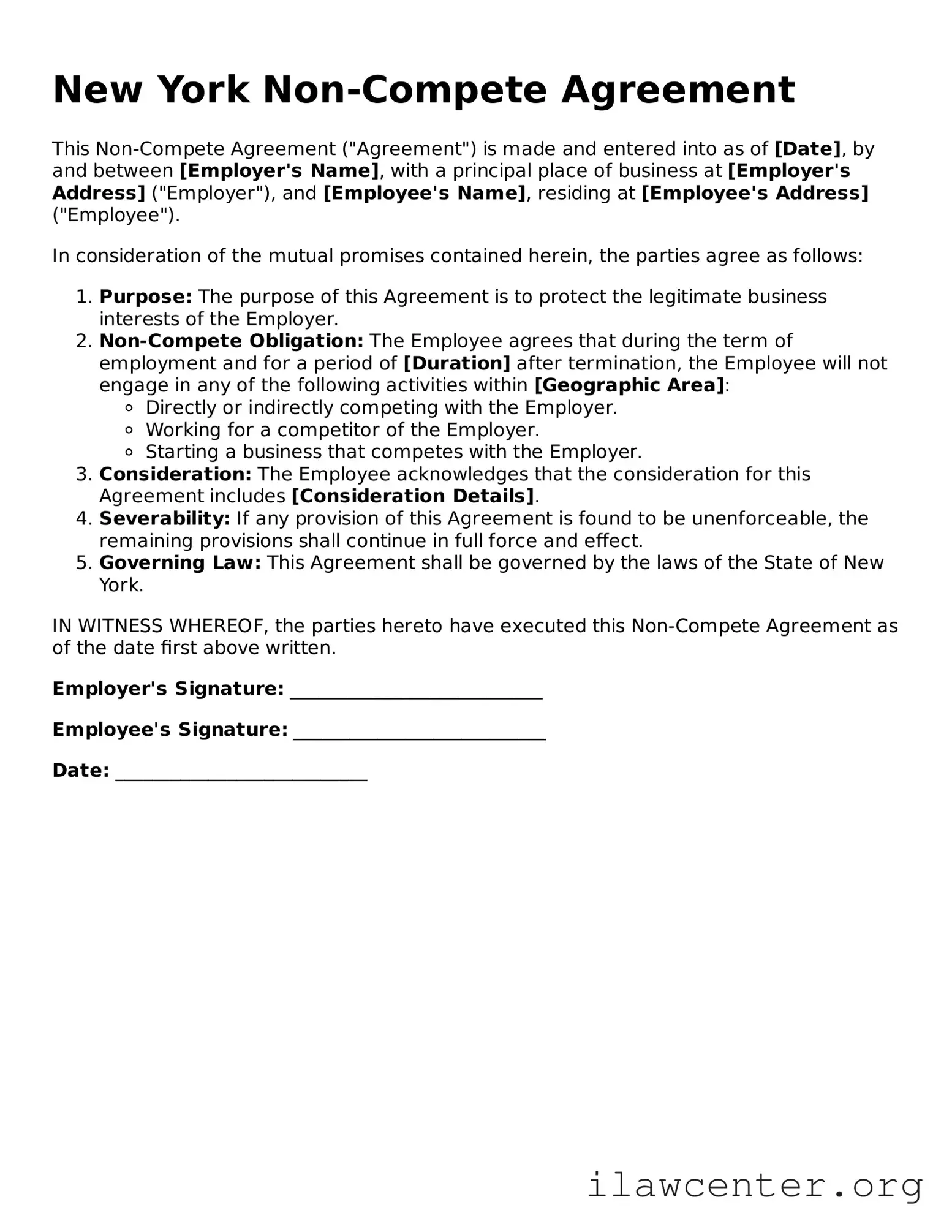
New York Non-compete Agreement Preview

New York Non-Compete Agreement

This Non-Compete Agreement ("Agreement") is made and entered into as of [Date], by and between [Employer's Name], with a principal place of business at [Employer's Address] ("Employer"), and [Employee's Name], residing at [Employee's Address] ("Employee").

In consideration of the mutual promises contained herein, the parties agree as follows:

  1. Purpose: The purpose of this Agreement is to protect the legitimate business interests of the Employer.
  2. Non-Compete Obligation: The Employee agrees that during the term of employment and for a period of [Duration] after termination, the Employee will not engage in any of the following activities within [Geographic Area]:
    • Directly or indirectly competing with the Employer.
    • Working for a competitor of the Employer.
    • Starting a business that competes with the Employer.
  3. Consideration: The Employee acknowledges that the consideration for this Agreement includes [Consideration Details].
  4. Severability: If any provision of this Agreement is found to be unenforceable, the remaining provisions shall continue in full force and effect.
  5. Governing Law: This Agreement shall be governed by the laws of the State of New York.

IN WITNESS WHEREOF, the parties hereto have executed this Non-Compete Agreement as of the date first above written.

Employer's Signature: ___________________________

Employee's Signature: ___________________________

Date: ___________________________

PDF Form Characteristics

Fact Name Description
Definition A non-compete agreement is a contract that prevents an employee from working for competitors or starting a competing business for a specified period after leaving a job.
Enforceability In New York, non-compete agreements are enforceable if they are reasonable in time, geographic scope, and purpose.
Governing Law New York law governs non-compete agreements, particularly under the principles established in the case law.
Consideration For a non-compete agreement to be valid, there must be consideration, such as employment or a promotion, provided to the employee.
Judicial Scrutiny Courts in New York closely scrutinize non-compete agreements to ensure they do not unduly restrict an individual's right to work.

Instructions on Utilizing New York Non-compete Agreement

Filling out a Non-compete Agreement form in New York is a crucial step in establishing the terms of employment and protecting business interests. This process requires careful attention to detail to ensure that all necessary information is accurately provided. Once you have completed the form, it will be ready for review and signature by all parties involved.

  1. Begin by downloading the New York Non-compete Agreement form from a reliable source.
  2. Read through the entire form to understand the requirements and implications of the agreement.
  3. In the first section, enter the full legal name of the employer or company.
  4. Next, provide the full legal name of the employee who will be bound by the agreement.
  5. Fill in the employee's job title and a brief description of their role within the company.
  6. Specify the duration of the non-compete period. This is the length of time the employee agrees not to engage in competing activities after leaving the company.
  7. Indicate the geographical area where the non-compete restrictions will apply. Be specific to avoid ambiguity.
  8. Detail the specific activities that are restricted under the agreement. Clearly outline what constitutes competition.
  9. Include any additional clauses or conditions that may apply, such as exceptions or limitations.
  10. Review the completed form for accuracy and completeness. Make any necessary corrections.
  11. Once satisfied, sign and date the form. Ensure that the employer or authorized representative also signs and dates the document.
  12. Make copies of the signed agreement for both the employer and employee for their records.

Important Facts about New York Non-compete Agreement

What is a non-compete agreement in New York?

A non-compete agreement is a contract between an employer and an employee that restricts the employee from engaging in certain competitive activities after leaving the company. In New York, these agreements are generally enforceable, but they must meet specific criteria to be valid. The agreement should protect legitimate business interests, be reasonable in scope, and not unduly restrict the employee's ability to find work.

Are non-compete agreements enforceable in New York?

Yes, non-compete agreements can be enforceable in New York, but they are subject to scrutiny by the courts. The agreement must be reasonable in duration, geographic area, and the nature of the restricted activities. Courts will evaluate whether the restrictions are necessary to protect the employer's legitimate interests without imposing an undue burden on the employee's ability to earn a living.

What are legitimate business interests that a non-compete agreement can protect?

Legitimate business interests include trade secrets, proprietary information, customer relationships, and specialized training. Employers may seek to protect their investments in these areas through non-compete agreements. However, the protection must be tailored and not overly broad, ensuring that it does not inhibit fair competition.

How long can a non-compete agreement last in New York?

The duration of a non-compete agreement in New York varies depending on the circumstances. Generally, courts may find agreements lasting six months to two years to be reasonable. However, the specific context of the employment and the nature of the industry will influence what is considered acceptable.

Can an employee negotiate the terms of a non-compete agreement?

Yes, employees can negotiate the terms of a non-compete agreement before signing it. It is advisable for employees to seek modifications that make the agreement more favorable, such as reducing the duration or geographic scope. Open communication with the employer can lead to a more balanced agreement.

What should an employee do if they believe a non-compete agreement is unfair?

If an employee believes that a non-compete agreement is overly restrictive or unfair, they should consult with a legal professional who specializes in employment law. The attorney can help assess the enforceability of the agreement and advise on potential options, including negotiation or legal action.

What happens if an employee violates a non-compete agreement?

If an employee violates a non-compete agreement, the employer may take legal action to enforce the terms of the contract. This could involve seeking an injunction to prevent the employee from working for a competitor or claiming damages for any losses incurred. The outcome will depend on the specifics of the case and the enforceability of the agreement under New York law.

Common mistakes

Filling out the New York Non-compete Agreement form can be a straightforward process, but many individuals make common mistakes that can lead to complications down the line. Understanding these pitfalls is essential for ensuring that the agreement is both enforceable and tailored to specific needs.

One frequent error is failing to clearly define the scope of the agreement. Without a precise description of the restricted activities, the agreement may become overly broad, which could render it unenforceable. Parties should take care to specify exactly what actions are prohibited and in what contexts.

Another mistake involves neglecting to include a reasonable time frame. Non-compete agreements must have a defined duration to be valid. An indefinite term can raise legal challenges, so it is advisable to set a clear timeline that reflects the nature of the business and the industry.

Some individuals overlook the importance of geographic limitations. A non-compete should specify the geographical area where the restrictions apply. Without this, the agreement may be deemed too restrictive, which can lead to legal disputes.

Additionally, many people fail to consider the necessity of consideration. For a non-compete agreement to be enforceable, there must be something of value exchanged. This could be a job offer, training, or access to proprietary information. Without this element, the agreement may lack legal standing.

Another common mistake is not seeking legal advice before signing. Many individuals assume that they can navigate the agreement independently. However, consulting a legal professional can provide insights into potential issues and help tailor the agreement to specific circumstances.

Some individuals also make the error of using boilerplate language without modification. While templates can be helpful, they often do not reflect the unique aspects of a particular situation. Customizing the language ensures that the agreement is relevant and enforceable.

Moreover, failing to review the agreement thoroughly before signing is a significant oversight. Rushing through the process can lead to misunderstandings about the terms and conditions, which can have serious consequences later on.

Another mistake involves ignoring state-specific laws. New York has particular regulations regarding non-compete agreements. Being unaware of these can result in agreements that do not comply with state requirements, jeopardizing their enforceability.

Lastly, many individuals do not consider the impact on future employment. Signing a non-compete agreement can limit future job opportunities. It is crucial to evaluate how the terms may affect career prospects before agreeing to the restrictions laid out in the document.

Documents used along the form

When drafting a New York Non-compete Agreement, several other forms and documents may accompany it to ensure clarity and enforceability. Each document serves a specific purpose, helping to outline the terms of employment and protect the interests of both the employer and the employee.

  • Employment Agreement: This foundational document outlines the terms of employment, including job responsibilities, compensation, and duration of employment. It often includes clauses related to confidentiality and non-compete stipulations.
  • Confidentiality Agreement: Also known as a non-disclosure agreement (NDA), this document protects sensitive company information. Employees agree not to share proprietary information with third parties during and after their employment.
  • Intellectual Property Assignment Agreement: This agreement ensures that any inventions, designs, or creations developed by an employee during their tenure belong to the employer. It helps protect the company’s intellectual assets.
  • Severance Agreement: Often provided when an employee leaves the company, this document outlines any severance pay and conditions. It may also include a reaffirmation of the non-compete and confidentiality obligations.
  • Offer Letter: This document formally extends a job offer to a candidate. It typically includes details about the position, salary, and any conditions related to the acceptance of the offer, including signing a non-compete.
  • Employee Handbook: This comprehensive guide outlines company policies, procedures, and expectations. It often includes sections on non-compete agreements and confidentiality, ensuring employees are aware of their obligations.
  • Performance Review Documents: These records assess an employee’s performance and may include discussions about adherence to the non-compete agreement. They can be crucial in evaluating compliance over time.
  • Termination Letter: When an employment relationship ends, this letter formally communicates the termination. It may reiterate the employee’s ongoing obligations under the non-compete agreement.

Incorporating these documents alongside the New York Non-compete Agreement can provide a comprehensive framework for employment relationships. Each serves to clarify roles, responsibilities, and expectations, ultimately fostering a more transparent and secure working environment.

Similar forms

  • Non-disclosure Agreement (NDA): This document protects confidential information shared between parties. Like a non-compete agreement, it restricts the sharing of sensitive information to prevent competitive harm.
  • Non-solicitation Agreement: This agreement prevents one party from soliciting clients or employees of another party. It shares similarities with a non-compete agreement in that it aims to protect business interests and relationships.
  • Employment Agreement: An employment agreement outlines the terms of employment, including responsibilities and compensation. It may include non-compete clauses to restrict an employee's future job opportunities within the same industry.
  • Confidentiality Agreement: This document ensures that parties keep certain information private. It serves a similar purpose to a non-compete agreement by safeguarding proprietary information that could benefit competitors.
  • Partnership Agreement: A partnership agreement governs the relationship between business partners. It may contain non-compete provisions to protect the partnership's interests if one partner leaves.
  • Severance Agreement: This agreement outlines the terms under which an employee receives severance pay upon leaving a job. It often includes non-compete clauses to prevent the employee from joining competitors after departure.

Dos and Don'ts

When filling out the New York Non-compete Agreement form, it is important to approach the task with care. Here are some essential dos and don'ts to consider:

  • Do read the entire agreement carefully before signing.
  • Do ensure you understand the terms and conditions outlined in the agreement.
  • Do consult with a legal advisor if you have questions or concerns.
  • Do provide accurate and truthful information throughout the form.
  • Do keep a copy of the signed agreement for your records.
  • Don't rush through the form without reviewing it.
  • Don't ignore any clauses that seem unclear or overly restrictive.
  • Don't sign the agreement if you feel pressured or uncertain.
  • Don't forget to check for any deadlines related to the agreement.

Misconceptions

Non-compete agreements are often misunderstood. Here are five common misconceptions about the New York Non-compete Agreement form:

  1. Non-compete agreements are always enforceable.

    This is not true. In New York, these agreements must be reasonable in scope, duration, and geographic area to be enforceable. Courts often scrutinize them closely.

  2. Signing a non-compete means you cannot work in your field again.

    While a non-compete may limit your ability to work for specific competitors, it does not necessarily bar you from working in your field altogether. You may still have opportunities with other companies.

  3. All non-compete agreements are the same.

    Each non-compete agreement can differ significantly based on the employer, the industry, and the specifics of the job. It is crucial to review each agreement carefully.

  4. Non-compete agreements are only for executives or high-level employees.

    While they are more common among executives, non-compete agreements can be used for employees at various levels, depending on the employer's needs and the nature of the work.

  5. You cannot negotiate the terms of a non-compete agreement.

    This misconception is misleading. Many employers are open to negotiation. It is advisable to discuss any concerns or desired changes before signing.

Understanding these misconceptions can help you navigate the complexities of non-compete agreements more effectively.

Key takeaways

When dealing with a Non-compete Agreement in New York, it is essential to understand the implications and requirements associated with this form. Here are some key takeaways to consider:

  • Understand the Purpose: A Non-compete Agreement is designed to protect a company's proprietary information and prevent employees from joining competitors for a specified period after leaving the company.
  • Know the Duration: The agreement should clearly specify the duration of the non-compete clause. In New York, a reasonable duration typically ranges from six months to two years.
  • Geographic Scope Matters: The agreement must outline the geographic area where the restrictions apply. This area should be reasonable and not overly broad, as courts may not enforce overly restrictive agreements.
  • Consideration is Key: For a Non-compete Agreement to be enforceable, there must be some form of consideration. This could be a job offer, training, or other benefits provided to the employee.
  • Clarity in Language: Use clear and precise language in the agreement to avoid ambiguity. Vague terms may lead to disputes and challenges in enforcement.
  • Legal Review is Recommended: Before finalizing the agreement, having it reviewed by a legal professional can help ensure compliance with New York laws and increase its enforceability.

These takeaways can serve as a guide when navigating the complexities of Non-compete Agreements in New York, ensuring that both employers and employees understand their rights and responsibilities.