Attorney-Verified  Notary Acknowledgement Document for New York

Attorney-Verified Notary Acknowledgement Document for New York

The New York Notary Acknowledgement form is a legal document used to verify the identity of individuals signing a document. This form ensures that signatures are authentic and that the signers are aware of the contents of the document. To get started on your notary acknowledgment, fill out the form by clicking the button below.

Article Guide

The New York Notary Acknowledgement form plays a crucial role in the realm of legal documentation, ensuring that signatures on important documents are authentic and verifiable. This form serves as a formal declaration by a notary public, affirming that the individual signing the document has done so willingly and is who they claim to be. Typically utilized in various transactions, including real estate deals and legal agreements, the form requires specific details, such as the name of the signer, the date of the acknowledgment, and the notary's signature and seal. Understanding the nuances of this form is essential for anyone engaged in legal or financial matters in New York. The proper execution of the Notary Acknowledgement not only enhances the credibility of the document but also helps to prevent fraud and disputes in the future. Given its importance, individuals should be aware of the requirements and implications associated with this form to ensure that their documents hold up under scrutiny.

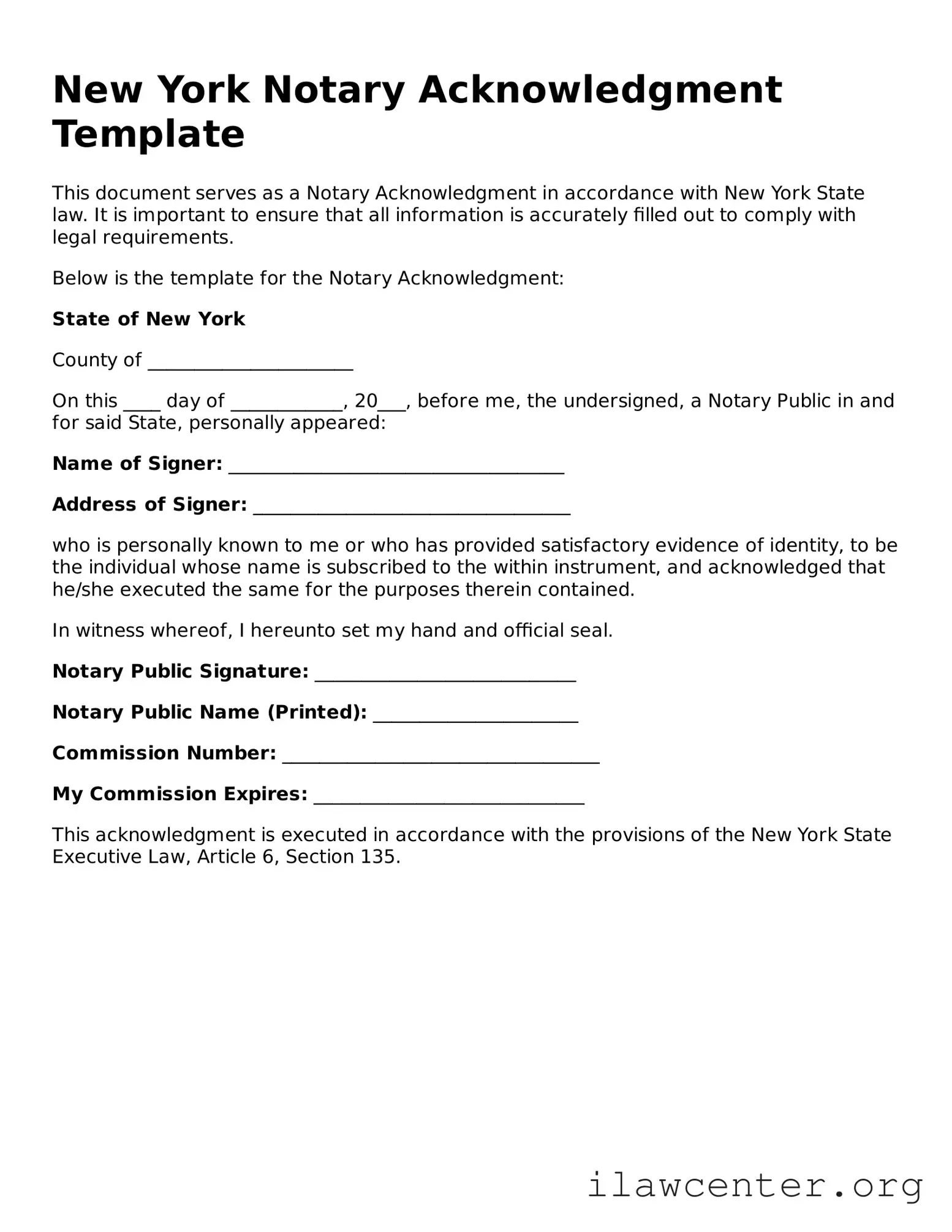
New York Notary Acknowledgement Preview

New York Notary Acknowledgment Template

This document serves as a Notary Acknowledgment in accordance with New York State law. It is important to ensure that all information is accurately filled out to comply with legal requirements.

Below is the template for the Notary Acknowledgment:

State of New York

County of ______________________

On this ____ day of ____________, 20___, before me, the undersigned, a Notary Public in and for said State, personally appeared:

Name of Signer: ____________________________________

Address of Signer: __________________________________

who is personally known to me or who has provided satisfactory evidence of identity, to be the individual whose name is subscribed to the within instrument, and acknowledged that he/she executed the same for the purposes therein contained.

In witness whereof, I hereunto set my hand and official seal.

Notary Public Signature: ____________________________

Notary Public Name (Printed): ______________________

Commission Number: __________________________________

My Commission Expires: _____________________________

This acknowledgment is executed in accordance with the provisions of the New York State Executive Law, Article 6, Section 135.

PDF Form Characteristics

Fact Name Description
Purpose The New York Notary Acknowledgement form is used to verify the identity of a signer and confirm that they willingly signed a document.
Governing Law This form is governed by New York State Executive Law, Section 135.
Signature Requirement The signer must personally appear before the notary to provide their signature on the document.
Identification Notaries must verify the identity of the signer through a valid form of identification, such as a driver’s license or passport.
Form Components The form typically includes the notary's signature, seal, date of acknowledgment, and the details of the signer.
Record Keeping Notaries are required to keep a record of all acknowledgments in a journal, detailing the date, type of document, and signer’s information.

Instructions on Utilizing New York Notary Acknowledgement

After obtaining the New York Notary Acknowledgement form, you will need to fill it out accurately to ensure it meets the necessary requirements. Following these steps will help you complete the form correctly.

  1. Begin by writing the date at the top of the form.
  2. In the first blank space, enter the name of the person whose signature is being acknowledged.
  3. Next, provide the address of the individual named above.
  4. In the section labeled "State of New York," write the county where the acknowledgment is taking place.
  5. Below that, include the name of the notary public who will be performing the acknowledgment.
  6. Next, the notary public should sign their name in the designated area.
  7. Finally, print the notary's name beneath their signature and include their title, if applicable.

Once you have completed these steps, the form is ready for submission or further use as needed. Ensure that all information is clear and legible.

Important Facts about New York Notary Acknowledgement

What is a New York Notary Acknowledgement form?

The New York Notary Acknowledgement form is a legal document used to confirm that a person has appeared before a notary public and has signed a document willingly. This form serves as proof that the signature is authentic and that the signer is who they claim to be. It is commonly used in various transactions, including real estate deals and legal filings.

Who can act as a notary public in New York?

In New York, a notary public can be any individual who is at least 18 years old, a resident of the state, or a non-resident who is an attorney. The individual must also pass an exam and be appointed by the state. Notaries are authorized to perform specific duties, including witnessing signatures and administering oaths.

When is a Notary Acknowledgement form required?

How do I complete a Notary Acknowledgement form?

To complete a Notary Acknowledgement form, the signer must first appear before the notary public. The signer should provide a valid form of identification. The notary will then complete the form by filling in details such as the date, the signer's name, and the type of document being acknowledged. Finally, the notary will sign and stamp the form to finalize the acknowledgment.

Is there a fee for notarization in New York?

Yes, notaries in New York are allowed to charge a fee for their services. The maximum fee for a standard notarization is $2 per signature. However, notaries may charge additional fees for services such as travel or additional documents. It is advisable to confirm the fees with the notary before proceeding.

Common mistakes

Filling out the New York Notary Acknowledgment form requires attention to detail. One common mistake individuals make is failing to include the correct date. The date is crucial as it indicates when the acknowledgment took place. Without this information, the document may be considered incomplete, leading to potential legal complications.

Another frequent error involves the omission of the signer's name. It is essential to ensure that the name matches the one on the identification presented to the notary. If there is a discrepancy, the notary may refuse to acknowledge the signature. This can create unnecessary delays and complications in the notarization process.

Additionally, people often neglect to check the notary's commission details. Each notary public has a commission that specifies their authority to perform notarial acts. If the commission has expired or is not properly recorded on the form, the acknowledgment may be invalid. Ensuring that the notary's information is accurate and current is vital for the legitimacy of the document.

Lastly, individuals sometimes forget to sign the form in the presence of the notary. The acknowledgment must be performed while the signer is present. If the signer signs the document beforehand, the notary cannot properly verify the signature, rendering the acknowledgment ineffective. It is crucial to follow the correct procedure to avoid this common pitfall.

Documents used along the form

When preparing documents that require a New York Notary Acknowledgement, you may encounter several other forms and documents that are often used in conjunction. Each of these documents serves a specific purpose and can help facilitate various legal processes. Here’s a brief overview of some commonly associated documents.

  • Power of Attorney: This document allows one person to authorize another to act on their behalf in legal or financial matters. It often requires notarization to ensure its validity.
  • Affidavit: An affidavit is a written statement confirmed by oath or affirmation, used as evidence in court. Notarization adds credibility to the document.
  • Real Estate Deed: This document transfers ownership of real property from one party to another. A notary acknowledgment is typically required to validate the transaction.
  • Trust Agreement: A trust agreement outlines the terms of a trust, detailing how assets are managed and distributed. Notarization helps verify the identities of the parties involved.
  • Will: A will is a legal document that expresses a person's wishes regarding the distribution of their property after death. While not always required, notarization can enhance its validity.
  • Loan Documents: Various loan agreements and related documents often need notarization to confirm the identities of the parties and the authenticity of their signatures.
  • Lease Agreements: These contracts outline the terms under which one party agrees to rent property from another. Notarization can provide additional assurance of the agreement's legitimacy.
  • Certificate of Incorporation: This document is necessary for forming a corporation. Notarization may be required to authenticate the signatures of the incorporators.
  • Release of Liability: This document releases one party from legal claims made by another. Notarization can help confirm that all parties understand and agree to the terms.

Understanding these documents can help streamline the process when working with a New York Notary Acknowledgement. Each document plays a crucial role in ensuring that legal matters are handled efficiently and correctly. Always consider consulting with a professional if you have questions about specific forms or their requirements.

Similar forms

The Notary Acknowledgement form shares similarities with several other documents. Here are six such documents, along with a brief explanation of how they are similar:

  • Affidavit: Both documents require a sworn statement made before a notary public, confirming the truth of the information provided.
  • Power of Attorney: Each document involves a notary verifying the identity of the signers, ensuring that they understand the authority they are granting.
  • Deed: Like the Notary Acknowledgement, a deed must be notarized to confirm that the signatures are authentic and voluntary.
  • Mortgage Agreement: This document also requires notarization to validate the agreement and protect the parties involved from fraud.
  • Trust Agreement: Similar to the Notary Acknowledgement, a trust agreement often needs notarization to ensure the proper execution of the document.
  • Will: A will may require notarization in some states, similar to a Notary Acknowledgement, to confirm that the testator signed it willingly and with sound mind.

Dos and Don'ts

When filling out the New York Notary Acknowledgment form, it’s essential to follow specific guidelines to ensure the document is valid. Here’s a list of things you should and shouldn’t do:

  • Do: Confirm that the signer is present during the notarization.
  • Do: Verify the identity of the signer using a government-issued ID.
  • Do: Complete all required fields on the form accurately.
  • Do: Sign and date the acknowledgment form in the appropriate sections.
  • Don’t: Allow the signer to sign the document before the notarization takes place.
  • Don’t: Use the form if the signer is not physically present.

By adhering to these guidelines, you can ensure that the notarization process is smooth and compliant with New York law.

Misconceptions

Understanding the New York Notary Acknowledgment form is crucial for ensuring that documents are executed correctly. However, several misconceptions can lead to confusion and errors. Here are nine common misconceptions:

  1. Notaries can prepare legal documents. Many people believe that notaries can draft or prepare legal documents. In reality, notaries are not authorized to provide legal advice or prepare documents; their role is to witness signatures and verify identities.
  2. All notaries are lawyers. A common assumption is that all notaries are attorneys. This is false. While some notaries are lawyers, many are not. Notaries come from various professional backgrounds and do not need to have a legal education.
  3. A notary’s signature is a guarantee of legality. Some individuals mistakenly think that a notary’s signature guarantees the legality of a document. In truth, a notary only verifies the identity of the signer and their willingness to sign; they do not verify the content of the document.
  4. Notary acknowledgments are only needed for real estate transactions. Many people believe that notary acknowledgments are exclusively for real estate documents. However, these acknowledgments can be required for a variety of legal documents, including wills, powers of attorney, and contracts.
  5. Once a document is notarized, it cannot be challenged. Some assume that notarization makes a document immune to challenges. In reality, even notarized documents can be contested in court if there are issues related to fraud, coercion, or other legal concerns.
  6. Notaries can perform their duties anywhere. It is a common misconception that notaries can notarize documents in any location. In New York, notaries must operate within the state and adhere to specific regulations regarding their notarial acts.
  7. Identification is not necessary for notarization. Many believe that notarization can occur without proper identification. This is incorrect. Notaries are required to verify the identity of signers, typically through government-issued identification.
  8. Notaries can refuse to notarize documents at will. Some think that notaries can refuse to notarize documents for any reason. While notaries do have discretion, they must have a valid reason, such as concerns about the signer’s identity or mental capacity.
  9. Notarization is a one-size-fits-all process. Many people believe that the notarization process is the same for all documents. However, different types of documents may require specific procedures or additional steps to ensure compliance with the law.

Being aware of these misconceptions can help individuals navigate the notarization process more effectively. Understanding the role and limitations of notaries is essential for ensuring that documents are properly executed and legally binding.

Key takeaways

When filling out and using the New York Notary Acknowledgment form, it’s important to keep several key points in mind. These takeaways will help ensure that the process goes smoothly and that the document is valid.

  • Understand the Purpose: The Notary Acknowledgment form is used to confirm that a signer is who they claim to be and that they signed the document willingly.
  • Complete Information: Ensure all required fields are filled out accurately, including the name of the signer and the date of the acknowledgment.
  • Signature Requirement: The signer must be present when the notary completes the acknowledgment. They should sign the document in front of the notary.
  • Identification: The notary must verify the identity of the signer. Acceptable forms of ID include a driver’s license or passport.
  • Notary Seal: The notary must affix their official seal on the form. This seal is essential for the document’s validity.
  • Record Keeping: Notaries should keep a record of the acknowledgment in their journal, noting the date, signer, and type of document.
  • State Compliance: Ensure that the form complies with New York state laws. Any discrepancies could render the acknowledgment invalid.

Following these key takeaways will help ensure that the New York Notary Acknowledgment form is completed correctly and serves its intended purpose.