Attorney-Verified  Self-Proving Affidavit Document for New York

Attorney-Verified Self-Proving Affidavit Document for New York

The New York Self-Proving Affidavit form is a legal document that allows a testator's will to be validated without the need for witnesses to appear in court. This form simplifies the probate process, making it easier for loved ones to manage the estate after a person's passing. If you are ready to fill out the form, please click the button below.

Article Guide

The New York Self-Proving Affidavit is an essential tool in the realm of estate planning, serving to simplify the probate process for individuals and families alike. This form allows a testator—the person who creates a will—to affirm the validity of their will through the sworn testimony of witnesses. By incorporating this affidavit into the will, the need for witnesses to appear in court can often be eliminated, streamlining the legal proceedings following a person's death. The affidavit must be signed by the testator and witnessed by at least two individuals, who also provide their signatures. This not only reinforces the authenticity of the will but also provides a layer of protection against potential disputes. In New York, the self-proving affidavit is governed by specific statutory requirements, ensuring that it meets the necessary legal standards. As such, understanding how to properly execute this form is crucial for anyone involved in the estate planning process, as it can significantly ease the burden on loved ones during a challenging time.

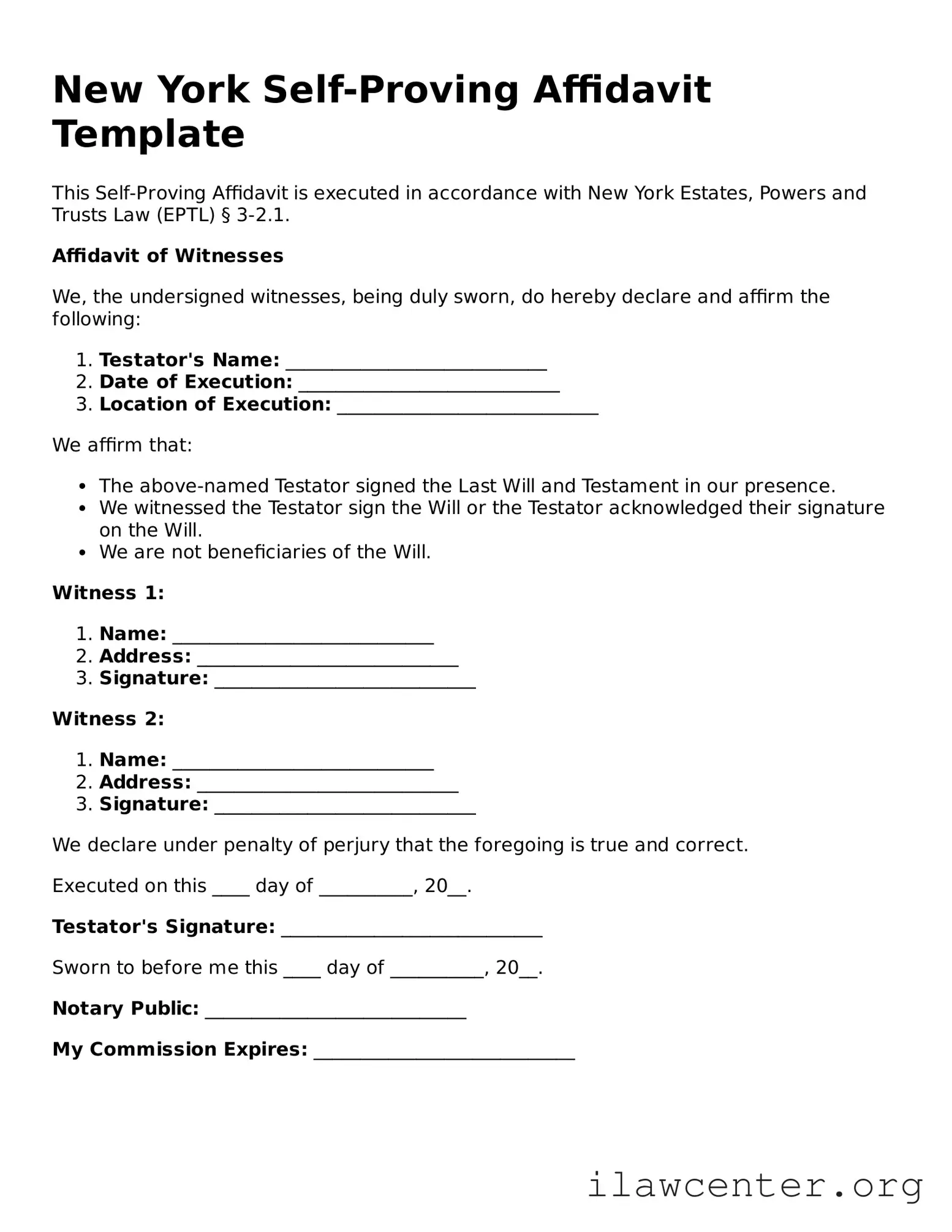
New York Self-Proving Affidavit Preview

New York Self-Proving Affidavit Template

This Self-Proving Affidavit is executed in accordance with New York Estates, Powers and Trusts Law (EPTL) § 3-2.1.

Affidavit of Witnesses

We, the undersigned witnesses, being duly sworn, do hereby declare and affirm the following:

  1. Testator's Name: ____________________________
  2. Date of Execution: ____________________________
  3. Location of Execution: ____________________________

We affirm that:

  • The above-named Testator signed the Last Will and Testament in our presence.
  • We witnessed the Testator sign the Will or the Testator acknowledged their signature on the Will.
  • We are not beneficiaries of the Will.

Witness 1:

  1. Name: ____________________________
  2. Address: ____________________________
  3. Signature: ____________________________

Witness 2:

  1. Name: ____________________________
  2. Address: ____________________________
  3. Signature: ____________________________

We declare under penalty of perjury that the foregoing is true and correct.

Executed on this ____ day of __________, 20__.

Testator's Signature: ____________________________

Sworn to before me this ____ day of __________, 20__.

Notary Public: ____________________________

My Commission Expires: ____________________________

PDF Form Characteristics

Fact Name Details
Definition A New York Self-Proving Affidavit is a legal document that allows a will to be validated without requiring witnesses to testify in court.
Governing Law The use of a Self-Proving Affidavit in New York is governed by New York Estates, Powers and Trusts Law (EPTL) § 3-2.1.
Purpose This affidavit simplifies the probate process by affirming that the will was properly executed.
Execution Requirements The will must be signed by the testator and witnessed by at least two individuals who also sign the affidavit.
Notarization The Self-Proving Affidavit must be notarized to be valid.
Form Availability Forms can be obtained from legal stationery stores, online legal services, or through attorneys.
Benefits Using this affidavit can expedite the probate process and reduce the potential for disputes over the will.
Validity Period A Self-Proving Affidavit remains valid as long as the will is valid and has not been revoked.
Limitations This affidavit does not eliminate the need for probate; it only streamlines the process.

Instructions on Utilizing New York Self-Proving Affidavit

After obtaining the New York Self-Proving Affidavit form, you will need to complete it accurately to ensure its validity. This process involves gathering necessary information and signatures from the appropriate parties.

  1. Begin by writing the date at the top of the form.
  2. Fill in the name of the testator, who is the person making the will.
  3. Provide the address of the testator.
  4. List the names and addresses of the witnesses who will sign the affidavit.
  5. Ensure that the testator signs the form in the presence of the witnesses.
  6. Have the witnesses sign the affidavit, confirming they witnessed the testator's signature.
  7. Include the date of the witnesses' signatures.
  8. Double-check all information for accuracy before finalizing the document.

Once the form is completed, it should be kept with the will to ensure that it can be easily located when needed.

Important Facts about New York Self-Proving Affidavit

What is a New York Self-Proving Affidavit?

A New York Self-Proving Affidavit is a legal document that allows a will to be validated without the need for witnesses to testify in court. When a testator signs the will, the affidavit is signed by the testator and witnesses in the presence of a notary public. This streamlines the probate process, making it easier and faster for the estate to be settled.

Why should I use a Self-Proving Affidavit?

Using a Self-Proving Affidavit can save time and reduce complications during the probate process. It eliminates the need to locate witnesses who can testify about the will's validity. This is particularly beneficial if witnesses have moved away, passed on, or are otherwise unavailable. By including this affidavit, you can help ensure that your wishes are carried out smoothly.

How do I create a Self-Proving Affidavit?

To create a Self-Proving Affidavit, you need to prepare the affidavit itself, which typically includes a statement affirming that the will was signed in the presence of the witnesses. You and the witnesses must sign the affidavit in front of a notary public. It’s advisable to consult with a legal professional to ensure the affidavit meets all necessary legal requirements.

Is a Self-Proving Affidavit required in New York?

No, a Self-Proving Affidavit is not required in New York. However, it is highly recommended. While you can still probate a will without one, having the affidavit simplifies the process and can prevent potential disputes regarding the will’s authenticity.

What happens if my will does not include a Self-Proving Affidavit?

If your will does not include a Self-Proving Affidavit, the probate process may take longer. The court may require witnesses to testify about the will's execution. This can lead to delays, especially if witnesses are hard to find. It could also open the door to challenges regarding the will’s validity.

Can I revoke a Self-Proving Affidavit?

Common mistakes

Filling out the New York Self-Proving Affidavit form can be straightforward, but many individuals make common mistakes that can lead to complications down the road. One frequent error is failing to properly identify the testator. The testator's name must be clearly stated, and any nicknames or abbreviations should be avoided to ensure clarity.

Another mistake involves not including the date of execution. This date is crucial, as it establishes when the affidavit was signed. Omitting this detail can create confusion regarding the validity of the document. Additionally, people often neglect to have the affidavit notarized. A notary public’s signature and seal are essential for the affidavit to be legally recognized.

Signatures are another area where errors frequently occur. The testator and witnesses must sign the affidavit in the appropriate places. Some individuals mistakenly sign in the wrong section or forget to sign altogether, which can invalidate the document. Furthermore, the number of witnesses required is sometimes misunderstood. In New York, at least two witnesses are necessary, and failing to meet this requirement can jeopardize the affidavit's effectiveness.

Many individuals also overlook the importance of ensuring that witnesses are disinterested parties. Witnesses should not be beneficiaries of the will, as this could lead to conflicts of interest. It is vital to select individuals who can attest to the testator's mental capacity and willingness to sign the affidavit without any pressure.

Another common pitfall is not providing complete addresses for all parties involved. Each witness and the testator should have their full address included on the affidavit. This detail helps establish their identity and can be important if the document is ever challenged in court.

Some people forget to read the affidavit thoroughly before submitting it. It is essential to review the entire document for any errors or omissions. A small mistake, such as a misspelled name, can lead to significant issues later on.

Additionally, individuals sometimes fail to keep copies of the signed affidavit. After the document is executed, it is wise to make copies for personal records and for the beneficiaries. This ensures that everyone involved has access to the necessary information if questions arise.

Lastly, people may not be aware of the specific requirements for the Self-Proving Affidavit in New York. Each state has its own rules, and being unfamiliar with these can lead to mistakes. It’s always a good idea to consult with a legal professional to ensure compliance with local laws.

By being mindful of these common mistakes, individuals can fill out the New York Self-Proving Affidavit form more accurately and effectively. Taking the time to ensure all details are correct can save a lot of trouble in the future.
Documents used along the form

The New York Self-Proving Affidavit is an important legal document that serves to validate a will by affirming the signatures of the testator and witnesses. However, it is often used in conjunction with several other forms and documents that help to streamline the probate process. Below is a list of commonly associated documents that individuals may encounter when dealing with wills and estates in New York.

  • Last Will and Testament: This document outlines an individual's wishes regarding the distribution of their assets after death. It appoints an executor to manage the estate and can include provisions for guardianship of minor children.
  • Executor's Oath: This is a formal declaration made by the executor of the estate, affirming their willingness to fulfill their duties as outlined in the will and to act in the best interests of the beneficiaries.
  • Petition for Probate: This document is filed with the court to initiate the probate process. It requests the court to recognize the will as valid and to grant authority to the executor to manage the estate.
  • Notice of Probate: After the petition is filed, this notice informs interested parties that the will has been admitted to probate. It provides details about the court proceedings and the rights of beneficiaries.
  • Inventory of Assets: This document lists all the assets owned by the deceased at the time of death. It is essential for determining the value of the estate and for the distribution of assets to beneficiaries.
  • Accounting of the Estate: This report details all financial transactions conducted by the executor during the probate process. It includes income, expenses, and distributions made to beneficiaries.
  • Affidavit of Service: This document serves as proof that certain legal documents, such as the Notice of Probate, have been properly delivered to all interested parties, ensuring they are informed about the proceedings.
  • Waiver of Citation: This form is used when beneficiaries agree to waive their right to receive a formal notice from the court regarding probate proceedings, thus expediting the process.
  • Renunciation of Letters Testamentary: This document allows a nominated executor to decline the role, which can help in appointing an alternate executor if necessary.
  • Release and Waiver of Claims: Beneficiaries may sign this document to relinquish any claims against the estate, often in exchange for a specific distribution of assets.

Each of these documents plays a critical role in the probate process, ensuring that the wishes of the deceased are honored and that the estate is managed properly. Understanding these forms can help individuals navigate the complexities of estate planning and administration in New York.

Similar forms

The Self-Proving Affidavit is a legal document that serves to validate a will by confirming that the testator signed the will in the presence of witnesses. This document has similarities with several other legal forms. Below are ten documents that share characteristics with the Self-Proving Affidavit:

  • Will: Like the Self-Proving Affidavit, a will outlines how a person's assets should be distributed after their death. Both documents require signatures and may involve witnesses.
  • Power of Attorney: This document allows one person to act on behalf of another. Similar to a Self-Proving Affidavit, it must be signed and often requires witnesses to validate the authority granted.
  • Living Will: A living will expresses a person's wishes regarding medical treatment. It is similar in that it is a formal declaration that may need to be witnessed to be legally binding.
  • Durable Power of Attorney for Health Care: This document allows someone to make health care decisions for another person. Like a Self-Proving Affidavit, it often requires notarization or witness signatures to ensure authenticity.
  • Trust Agreement: A trust agreement establishes a fiduciary relationship for asset management. Similar to the Self-Proving Affidavit, it typically requires signatures and may involve witnesses.
  • Affidavit of Heirship: This document establishes the heirs of a deceased person. It shares the need for sworn statements and witness signatures, much like the Self-Proving Affidavit.
  • Codicil: A codicil is an amendment to an existing will. It must be signed and may also require witnesses, similar to the process for a Self-Proving Affidavit.
  • Marital Settlement Agreement: This document outlines the terms of a divorce. It often requires signatures from both parties and may need to be witnessed, reflecting a similar validation process.
  • Quitclaim Deed: A quitclaim deed transfers property ownership. It requires signatures and can be notarized, akin to the Self-Proving Affidavit's formal requirements.
  • Release of Liability: This document releases one party from liability. It often requires signatures and may need to be witnessed, paralleling the validation process of a Self-Proving Affidavit.

Dos and Don'ts

When filling out the New York Self-Proving Affidavit form, it's essential to ensure accuracy and compliance with legal standards. Here’s a helpful list of things to do and avoid:

  • Do read the instructions carefully before starting.
  • Do provide all required information clearly and legibly.
  • Do have the form signed in front of a notary public.
  • Do keep a copy for your records after completion.
  • Do consult with a legal professional if you have questions.
  • Don't leave any sections blank unless instructed.
  • Don't use unclear handwriting or abbreviations.
  • Don't sign the form before meeting with the notary.
  • Don't ignore state-specific requirements that may apply.
  • Don't rush through the process; take your time to ensure accuracy.

Misconceptions

Understanding the New York Self-Proving Affidavit form is essential for anyone involved in estate planning or probate. However, several misconceptions exist regarding this document. Below is a list of common misunderstandings:

  • The Self-Proving Affidavit is only for wealthy individuals. This form is beneficial for anyone who wants to simplify the probate process, regardless of their financial status.
  • It eliminates the need for a will. The Self-Proving Affidavit does not replace a will; it serves as a tool to validate the will's authenticity during probate.
  • Only attorneys can prepare a Self-Proving Affidavit. While legal assistance can be helpful, individuals can complete the form themselves if they understand the requirements.
  • It must be notarized by a specific type of notary. Any licensed notary public in New York can notarize the Self-Proving Affidavit, provided they follow the proper procedures.
  • The form is only valid in New York. While the Self-Proving Affidavit is specific to New York, other states have similar forms. It's crucial to know the laws of the state where the will is probated.
  • Once signed, the Self-Proving Affidavit cannot be changed. If circumstances change, a new affidavit can be executed, but it must be done following the legal requirements.
  • It guarantees that the will will not be contested. While it helps establish the will's validity, it does not prevent potential challenges in court.

Being informed about these misconceptions can help individuals navigate the complexities of estate planning with greater confidence and clarity.

Key takeaways

Filling out and using the New York Self-Proving Affidavit form can be a straightforward process if you keep a few key points in mind. Here are some essential takeaways:

  • The Self-Proving Affidavit serves to confirm the validity of a will, making it easier to probate without needing witnesses to testify.
  • It must be signed by the testator (the person making the will) and two witnesses in the presence of each other.
  • All parties involved should be of sound mind and at least 18 years old when signing the affidavit.
  • The affidavit should be notarized to ensure its authenticity and to comply with New York law.
  • It is important to include specific language in the affidavit that clearly states the will was executed in accordance with New York state laws.
  • Keep a copy of the completed affidavit with the original will to ensure it is easily accessible during the probate process.