Attorney-Verified  Small Estate Affidavit Document for New York

Attorney-Verified Small Estate Affidavit Document for New York

The New York Small Estate Affidavit is a legal document that allows individuals to settle the estate of a deceased person without going through the lengthy probate process, provided the estate meets certain criteria. This form simplifies the transfer of assets, making it easier for heirs to claim what they are entitled to. If you need assistance in filling out the form, click the button below.

Article Guide

The New York Small Estate Affidavit form serves as a valuable tool for individuals navigating the process of settling a deceased person's estate when the estate's total value falls below a certain threshold. This form allows the heirs or beneficiaries to claim the deceased's assets without the need for a lengthy probate process, thus streamlining what can often be a complex and time-consuming task. To utilize the Small Estate Affidavit, individuals must meet specific criteria, including demonstrating their relationship to the deceased and providing a clear inventory of the assets involved. The form requires essential information such as the decedent's name, date of death, and details about the assets being claimed. Additionally, it includes sections for the affiant, or the person making the affidavit, to affirm the truthfulness of the information provided. By understanding the components and requirements of the Small Estate Affidavit, individuals can effectively facilitate the transfer of assets, ensuring that the wishes of the deceased are honored while minimizing potential disputes among heirs.

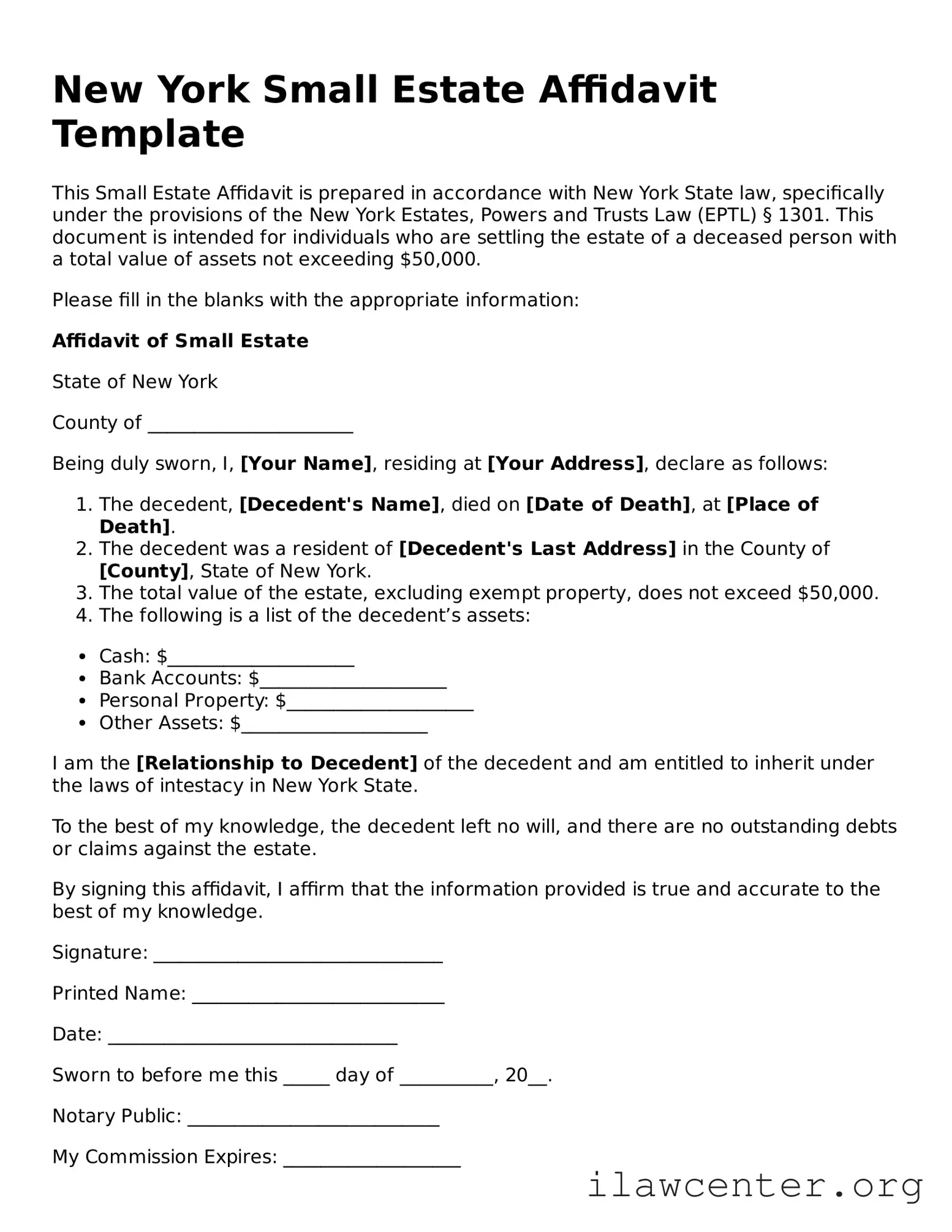
New York Small Estate Affidavit Preview

New York Small Estate Affidavit Template

This Small Estate Affidavit is prepared in accordance with New York State law, specifically under the provisions of the New York Estates, Powers and Trusts Law (EPTL) § 1301. This document is intended for individuals who are settling the estate of a deceased person with a total value of assets not exceeding $50,000.

Please fill in the blanks with the appropriate information:

Affidavit of Small Estate

State of New York

County of ______________________

Being duly sworn, I, [Your Name], residing at [Your Address], declare as follows:

  1. The decedent, [Decedent's Name], died on [Date of Death], at [Place of Death].
  2. The decedent was a resident of [Decedent's Last Address] in the County of [County], State of New York.
  3. The total value of the estate, excluding exempt property, does not exceed $50,000.
  4. The following is a list of the decedent’s assets:
  • Cash: $____________________
  • Bank Accounts: $____________________
  • Personal Property: $____________________
  • Other Assets: $____________________

I am the [Relationship to Decedent] of the decedent and am entitled to inherit under the laws of intestacy in New York State.

To the best of my knowledge, the decedent left no will, and there are no outstanding debts or claims against the estate.

By signing this affidavit, I affirm that the information provided is true and accurate to the best of my knowledge.

Signature: _______________________________

Printed Name: ___________________________

Date: _______________________________

Sworn to before me this _____ day of __________, 20__.

Notary Public: ___________________________

My Commission Expires: ___________________

PDF Form Characteristics

Fact Name Description
Purpose The New York Small Estate Affidavit allows individuals to claim assets of a deceased person without going through formal probate if the estate is below a certain value.
Eligibility To use this affidavit, the total value of the estate must be $50,000 or less for personal property, or $100,000 or less if the deceased owned real property.
Governing Law The Small Estate Affidavit is governed by New York Estates, Powers and Trusts Law (EPTL) § 1301.
Required Signatures The affidavit must be signed by the person claiming the estate and may require signatures from other heirs or beneficiaries, depending on the situation.
Filing Process While the affidavit itself does not need to be filed with the court, it may be presented to financial institutions or other entities holding the deceased's assets.
Limitations This process cannot be used if the deceased left a will or if there are disputes among heirs regarding the estate.

Instructions on Utilizing New York Small Estate Affidavit

After you complete the New York Small Estate Affidavit form, you will submit it to the appropriate court or authority. This process allows you to settle the estate of a deceased person without going through a lengthy probate process. Follow these steps carefully to ensure the form is filled out correctly.

  1. Obtain the New York Small Estate Affidavit form. You can find it online or at your local court.
  2. Begin by entering the name of the deceased person in the designated space.
  3. Provide the date of death. Make sure this information is accurate.
  4. List the names and addresses of all heirs. Include their relationship to the deceased.
  5. Indicate the value of the estate. This should include all assets owned by the deceased.
  6. Sign the affidavit in front of a notary public. This step is crucial for the document's validity.
  7. Make copies of the signed affidavit for your records and for each heir listed.
  8. Submit the affidavit to the appropriate court or authority. Check if there are any filing fees.

Important Facts about New York Small Estate Affidavit

What is the New York Small Estate Affidavit form?

The New York Small Estate Affidavit is a legal document that allows individuals to claim assets of a deceased person without going through the formal probate process. This form is typically used when the total value of the deceased's assets falls below a certain threshold, which is currently set at $50,000 for personal property and $100,000 for real property.

Who is eligible to use the Small Estate Affidavit?

To use the Small Estate Affidavit, you must be an eligible heir or beneficiary of the deceased person. This typically includes spouses, children, parents, or siblings. Additionally, the deceased must have died without a will, or if there is a will, it must not have been probated.

What assets can be claimed using the Small Estate Affidavit?

The affidavit can be used to claim various types of assets, including bank accounts, personal property, and certain types of real estate. However, it cannot be used for assets that are held in a trust or for assets that have designated beneficiaries, such as life insurance policies or retirement accounts.

How do I complete the Small Estate Affidavit?

Completing the Small Estate Affidavit involves filling out the required form accurately. You will need to provide information about the deceased, including their name, date of death, and details about the assets you are claiming. It is important to gather any necessary documentation, such as death certificates and proof of your relationship to the deceased.

Do I need to file the Small Estate Affidavit with the court?

No, the Small Estate Affidavit does not need to be filed with the court. Instead, you will present the completed affidavit directly to the institutions holding the deceased's assets, such as banks or financial institutions, to claim the assets.

Is there a fee associated with filing the Small Estate Affidavit?

There is typically no fee to file the Small Estate Affidavit itself, as it is not submitted to the court. However, some institutions may charge fees for processing the affidavit or for transferring assets, so it is advisable to check with each institution for their specific policies.

What happens if the estate exceeds the small estate limit?

If the total value of the estate exceeds the small estate limit, the Small Estate Affidavit cannot be used. In such cases, the estate may need to go through the formal probate process, which involves filing a will with the court and appointing an executor to manage the estate.

Can I use the Small Estate Affidavit if there is a will?

Yes, you can use the Small Estate Affidavit if there is a will, but only if the will has not been probated. If the will is probated, the formal probate process must be followed, and the Small Estate Affidavit cannot be utilized.
Common mistakes

Filling out the New York Small Estate Affidavit form can be a straightforward process, but mistakes often happen. One common error is failing to provide accurate information about the deceased. This includes the full name, date of death, and last known address. Any discrepancies can lead to delays or even rejection of the affidavit.

Another mistake is not listing all the assets owned by the deceased. The form requires a complete inventory of the estate's assets, including bank accounts, real estate, and personal property. Omitting any significant assets can complicate the process and may result in legal issues later on.

People sometimes forget to include the names and addresses of all heirs. This information is crucial, as it helps verify who is entitled to inherit from the estate. Missing or incorrect details can cause confusion and potentially lead to disputes among heirs.

Signature errors are also common. The affidavit must be signed by the person making the claim, and it should be notarized. Failing to have the document notarized or signing it incorrectly can render the affidavit invalid.

Another frequent mistake is not understanding the eligibility requirements. The Small Estate Affidavit is only applicable if the total value of the estate is below a certain threshold. If the estate exceeds this limit, individuals must pursue a different legal process.

Additionally, people may overlook the importance of providing supporting documentation. This includes death certificates and any relevant financial statements. Without these documents, the affidavit may lack the necessary proof to support the claim.

Some individuals also misinterpret the role of the Small Estate Affidavit. It is not a will or a substitute for probate but a way to simplify the transfer of small estates. Misunderstanding its purpose can lead to inappropriate use of the form.

Lastly, many people fail to keep copies of the completed affidavit and any submitted documents. Having a record is essential for future reference, especially if any questions arise about the estate. Keeping organized records can save time and stress down the line.

Documents used along the form

The New York Small Estate Affidavit is a valuable tool for settling the estates of deceased individuals with limited assets. However, it is often accompanied by other essential forms and documents that facilitate the process. Below is a list of commonly used documents that may accompany the Small Estate Affidavit.

  • Death Certificate: This official document verifies the death of the individual and is required to initiate the estate settlement process.
  • Will: If available, the deceased's will outlines their wishes regarding asset distribution and may affect how the Small Estate Affidavit is processed.
  • Asset Inventory List: This list details all assets owned by the deceased, helping to establish whether the estate qualifies as a small estate under New York law.
  • Affidavit of Heirship: This document may be used to confirm the identity of heirs and their respective shares in the estate, especially when there is no will.
  • Letters of Administration: If no will exists, this court document appoints an administrator to manage the estate, ensuring proper distribution of assets.
  • Tax Returns: Copies of the deceased's last tax returns may be necessary to settle any outstanding tax obligations before distributing the estate.

Using these documents alongside the New York Small Estate Affidavit can streamline the estate settlement process, ensuring that all legal requirements are met efficiently. Proper documentation helps to honor the deceased's wishes while providing clarity and support for the heirs involved.

Similar forms

The Small Estate Affidavit is a useful tool for settling the affairs of a deceased person without going through the lengthy probate process. Several other documents serve similar purposes in estate management. Below are six documents that share similarities with the Small Estate Affidavit:

  • Last Will and Testament: This document outlines how a person's assets should be distributed after their death. Like the Small Estate Affidavit, it can simplify the transfer of assets, but it requires probate to be validated.
  • Letter of Administration: Issued by a court, this document grants authority to an individual to manage the estate of a deceased person. It serves a similar purpose in managing assets but typically involves a more formal process.
  • Trust Declaration: A trust can hold assets for beneficiaries, bypassing probate. Similar to the Small Estate Affidavit, it allows for a smoother transfer of assets upon death.
  • Affidavit of Heirship: This document identifies heirs of a deceased person without a will. Like the Small Estate Affidavit, it helps establish rightful ownership of assets, but it is often used when no formal estate plan exists.
  • Power of Attorney: This document allows someone to make decisions on behalf of another person. While it is not specifically for post-death asset transfer, it can streamline the management of an estate before death, similar to the Small Estate Affidavit.
  • Transfer on Death Deed: This deed allows real property to pass directly to beneficiaries upon death. It simplifies the process and is similar to the Small Estate Affidavit in that it avoids probate for certain assets.

Dos and Don'ts

When filling out the New York Small Estate Affidavit form, it's important to be meticulous. Here’s a list of dos and don’ts to guide you through the process.

  • Do read the instructions carefully before starting.
  • Do ensure that you meet the eligibility requirements for a small estate.
  • Do provide accurate and complete information about the deceased.
  • Do list all assets and their estimated values clearly.
  • Do sign the affidavit in the presence of a notary public.
  • Don't omit any required signatures or information.
  • Don't use outdated forms; always check for the latest version.
  • Don't forget to include the date of death of the deceased.
  • Don't provide false information, as this could lead to legal issues.
  • Don't rush the process; take your time to review your form.

Misconceptions

The New York Small Estate Affidavit is often misunderstood. Here are ten common misconceptions:

  1. Only heirs can use the Small Estate Affidavit. Many believe that only direct heirs can file this form. In reality, any person who is entitled to property can use it, as long as they meet the criteria.
  2. It can be used for any amount of estate value. Some think the Small Estate Affidavit applies regardless of the estate's value. However, it is only applicable for estates valued at $50,000 or less for personal property.
  3. The form is the same as a will. There is a misconception that the Small Estate Affidavit serves the same purpose as a will. In fact, it is a tool to collect assets when there is no will in place.
  4. It eliminates the need for probate. Some people believe using this affidavit means probate is no longer necessary. While it simplifies the process, it does not eliminate the need for probate in all situations.
  5. All debts must be paid before filing. There is a belief that all debts must be settled before filing the affidavit. In truth, debts may still exist, but the affidavit allows for the distribution of remaining assets.
  6. It can be filed at any time. Many think the Small Estate Affidavit can be filed whenever convenient. However, it must be filed after the death of the estate owner and within a reasonable timeframe.
  7. The affidavit is a public document. Some assume that the Small Estate Affidavit is a public record. While it may be filed with the court, it is not as publicly accessible as a will.
  8. All heirs must agree to use the affidavit. There is a misconception that unanimous consent from all heirs is necessary. In fact, only the person filing the affidavit needs to be entitled to the property.
  9. It covers real estate. Many believe the Small Estate Affidavit can be used for real estate assets. This is incorrect; it is only for personal property, not real estate.
  10. Legal assistance is mandatory. Some think that legal help is required to file the affidavit. While it can be beneficial, individuals can complete the process without an attorney if they choose.

Key takeaways

When dealing with the New York Small Estate Affidavit form, it’s important to understand its purpose and how to fill it out correctly. Here are some key takeaways:

  1. Eligibility Criteria: To use the Small Estate Affidavit, the total value of the estate must be less than $50,000 for an individual or $100,000 for a married couple.
  2. Purpose: This affidavit allows heirs to claim property without going through a lengthy probate process.
  3. Who Can File: Only certain individuals, such as the surviving spouse, children, or other close relatives, can file the affidavit.
  4. Required Information: You must provide details about the deceased, including their name, date of death, and last known address.
  5. Asset Listing: Clearly list all assets included in the estate, such as bank accounts, real estate, and personal property.
  6. Witness Signatures: The affidavit must be signed by at least two disinterested witnesses who can confirm the facts stated.
  7. Filing the Affidavit: Submit the completed affidavit to the institution holding the deceased's assets, such as a bank or real estate office.
  8. Potential Complications: Be aware that disputes may arise among heirs, which could complicate the process.
  9. Legal Advice: Consider consulting with a legal professional to ensure the affidavit is filled out correctly and to address any specific concerns.

Understanding these key points can help streamline the process of managing a small estate in New York.