Nfpa Testing PDF Template

Nfpa Testing PDF Template

The Nfpa Testing Form is a crucial document used to ensure that fire alarm systems are functioning properly and in compliance with safety standards. It captures essential information about the inspection and testing process, including details about the equipment, testing results, and notifications made prior to testing. For the safety of your property and its occupants, it is vital to complete this form accurately; please fill it out by clicking the button below.

Article Guide

The NFPA Testing Form is a critical document that ensures fire alarm systems are thoroughly inspected and tested, providing peace of mind to property owners and occupants. This form captures essential details such as the date and time of the inspection, the service organization involved, and the property name. It also includes information about the monitoring entity and approving agency, ensuring all stakeholders are informed. The form outlines various types of transmission services, such as weekly or monthly checks, and specifies the control unit manufacturer, model number, and the last date any service was performed. Detailed sections cover alarm-initiating devices, alarm notification appliances, and supervisory signal-initiating devices, allowing for a comprehensive overview of the system's components. Additionally, it addresses system power supplies, including both primary and secondary sources, and emphasizes the importance of notifying relevant parties before testing begins. With sections dedicated to tests and inspections, the form allows for a systematic evaluation of each component's functionality, ensuring that any issues are promptly identified and addressed. By adhering to NFPA standards, this form plays a vital role in maintaining safety and compliance in fire alarm systems.

Nfpa Testing Preview

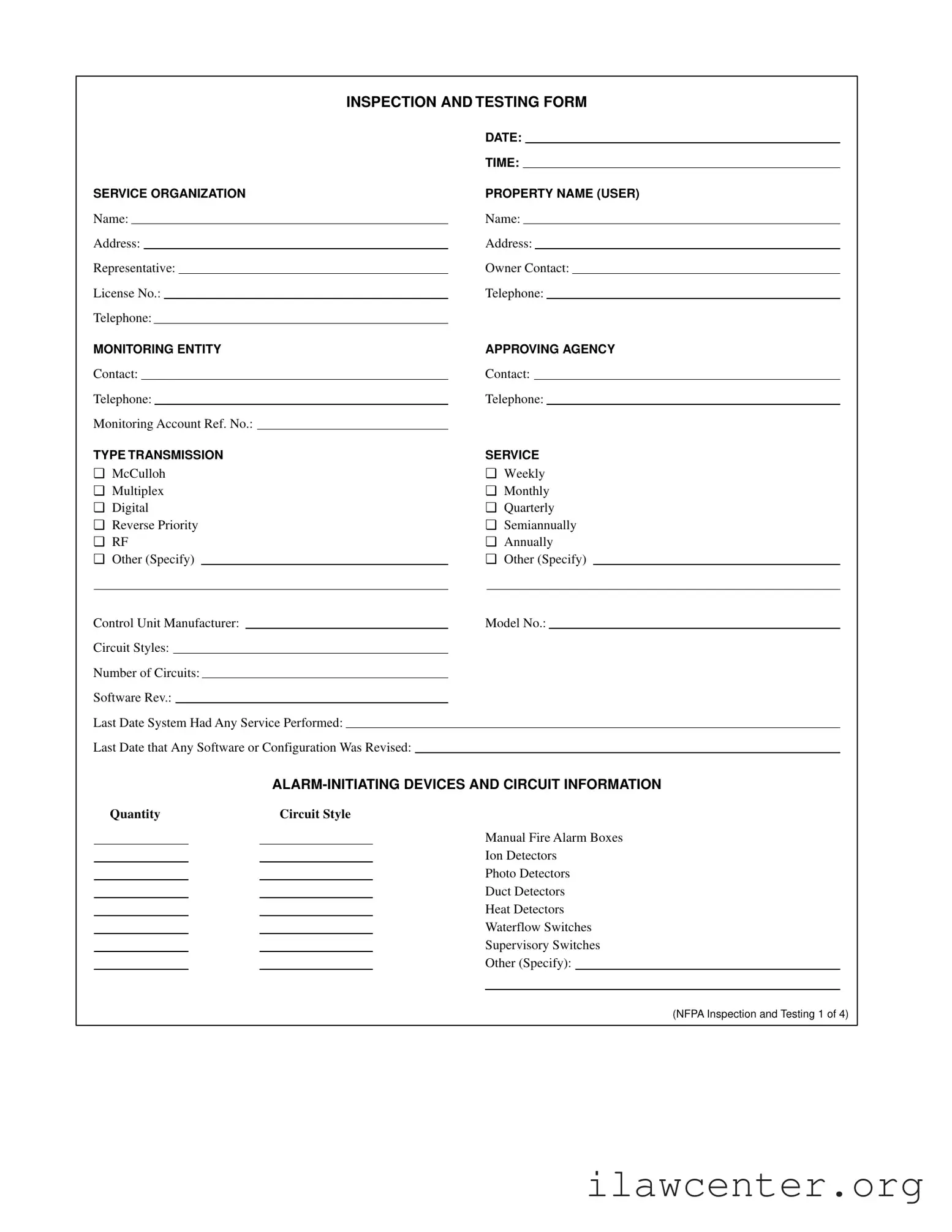
DATE:
TIME:
SERVICE ORGANIZATION PROPERTY NAME (USER)
Name: Name:
Address: Address:
Representative: Owner Contact:
License No.: Telephone:
Telephone:
MONITORING ENTITY APPROVING AGENCY
Contact: Contact:
Telephone: Telephone:
Monitoring Account Ref. No.:
TYPE TRANSMISSION SERVICE
McCulloh Weekly
Multiplex Monthly
Digital Quarterly
Reverse Priority Semiannually
RF Annually
Other (Specify) Other (Specify)
Control Unit Manufacturer: Model No.:
Circuit Styles:
Number of Circuits:
Software Rev.:
Last Date System Had Any Service Performed:
Last Date that Any Software or Configuration Was Revised:
ALARM-INITIATING DEVICES AND CIRCUIT INFORMATION
Quantity Circuit Style
Manual Fire Alarm Boxes
Ion Detectors
Photo Detectors
Duct Detectors
Heat Detectors
Waterflow Switches
Supervisory Switches
Other (Specify):
INSPECTION AND TESTING FORM
(NFPA Inspection and Testing 1 of 4)
ALARM NOTIFICATION APPLIANCES AND CIRCUIT INFORMATION
Quantity Circuit Style
Bells
Horns
Chimes
Strobes
Speakers
Other (Specify):
No. of alarm notification appliance circuits:
Are circuits monitored for integrity? Yes No
SUPERVISORY SIGNAL-INITIATING DEVICES AND CIRCUIT INFORMATION
Quantity Circuit Style
Building Temp.
Site Water Temp.
Site Water Level
Fire Pump Power
Fire Pump Running
Fire Pump Auto Position
Fire Pump or Pump Controller Trouble
Fire Pump Running
Generator In Auto Position
Generator or Controller Trouble
Switch Transfer
Generator Engine Running
Other:
SIGNALING LINE CIRCUITS
Quantity and style (See NFPA 72, Table 3-6) of signaling line circuits connected to system:
Quantity Style(s)
SYSTEM POWER SUPPLIES
a. Primary (Main): Nominal Voltage , Amps
Overcurrent Protection: Type , Amps
Location (of Primary Supply Panelboard):
Disconnecting Means Location:
b. Secondary (Standby):
Storage Battery: Amp-Hr. Rating
Calculated capacity to operate system, in hours: 24 60
Engine-driven generator dedicated to fire alarm system:
Location of fuel storage:
TYPE BATTERY
Dry Cell
Nickel-Cadmium
Sealed Lead-Acid
Lead-Acid
Other (Specify):
c. Emergency or standby system used as a backup to primary power supply, instead of using a secondary power supply:
Emergency system described in NFPA 70, Article 700
Legally required standby described in NFPA 70, Article 701
Optional standby system described in NFPA 70, Article 702, which also meets the performance requirements
of Article 700 or 701.
(NFPA Inspection and Testing 2 of 4)
PRIOR TO ANY TESTING
NOTIFICATIONS ARE MADE Yes No Who Time
Monitoring Entity 
Building Occupants 
Building Management 
Other (Specify) 
AHJ (Notified) of Any Impairments 
SYSTEM TESTS AND INSPECTIONS
TYPE Visible Functional Comments
Control Unit 
Interface Eq. 
Lamps/LEDS 
Fuses 
Primary Power Supply 
Trouble Signals 
Disconnect Switches 
Ground-Fault Monitoring 
SECONDARY POWER
TYPE Visible Functional Comments
Battery Condition
Load Voltage
Discharge Test
Charger Test
Specific Gravity
TRANSIENT SUPPRESSORS
REMOTE ANNUNCIATORS 
NOTIFICATION APPLIANCES
Audible 
Visual 
Speakers 
Voice Clarity
INITIATING AND SUPERVISORY DEVICE TESTS AND INSPECTIONS
Device Visual Functional Factory Meas.
Loc. & S/N Type Check Test Setting Setting Pass Fail
Comments:
(NFPA Inspection and Testing 3 of 4)
EMERGENCY COMMUNICATIONS EQUIPMENT Visual Functional Comments
Phone Set
Phone Jacks
Off-Hook Indicator
Amplifier(s)
Tone Generator(s)
Call-in Signal
System Performance
Device Simulated
Visual Operation Operation
INTERFACE EQUIPMENT
(Specify)
(Specify)
(Specify)
SPECIAL HAZARD SYSTEMS
(Specify)
(Specify)
(Specify)
Special Procedures:
Comments:
SUPERVISING STATION MONITORING Yes No Time Comments
Alarm Signal
Alarm Restoration
Trouble Signal
Supervisory Signal
Supervisory Restoration
NOTIFICATIONS THAT TESTING IS COMPLETE Yes No Who Time
Building Management
Monitoring Agency
Building Occupants
Other (Specify)
The following did not operate correctly:
System restored to normal operation: Date: Time:
THIS TESTING WAS PERFORMED IN ACCORDANCE WITH APPLICABLE NFPA STANDARDS.
Name of Inspector: Date: Time:
Signature:
Name of Owner or Representative:
Date: Time:
Signature:
(NFPA Inspection and Testing 4 of 4)

File Properties

Fact Name Description
Form Purpose This form is used for documenting inspections and testing of fire alarm systems.
Date and Time The date and time of the inspection must be recorded at the top of the form.
Service Organization The name and contact information of the service organization must be included.
Monitoring Entity Information about the monitoring entity and approving agency is required.
Transmission Service Types Options for transmission service types include McCulloh, Digital, RF, and others.
Alarm Devices Details about alarm-initiating devices and their circuit information must be documented.
Power Supplies Information on primary and secondary power supplies, including their specifications, is necessary.
Testing Notifications Notifications to relevant parties before testing are required, including the monitoring entity and building occupants.
System Tests Various system tests and inspections must be recorded, including functional and visible tests.
Compliance This testing must comply with applicable NFPA standards, which vary by state.

Instructions on Utilizing Nfpa Testing

Completing the NFPA Testing form is an essential step in ensuring that fire alarm systems are properly inspected and tested. This process helps maintain safety standards and compliance with regulations. Following the steps outlined below will assist in accurately filling out the form.

  1. Enter the date and time at the top of the form.
  2. Provide the service organization name.
  3. Fill in the property name (user) along with the address.
  4. List the representative's name and the owner contact's name.
  5. Include the license number for the representative.
  6. Provide the telephone number for both the representative and the owner contact.
  7. Complete the monitoring entity and approving agency sections, including their contact names and telephone numbers.
  8. Fill in the monitoring account reference number.
  9. Select the type of transmission service and specify if applicable.
  10. Provide details on the control unit manufacturer, model number, circuit styles, number of circuits, software revision, and the last date any service was performed.
  11. Document the last date that any software or configuration was revised.
  12. Fill out the section for alarm-initiating devices and circuit information by indicating the quantity and circuit style for each type of device.
  13. Complete the alarm notification appliances section, including the quantity and circuit style.
  14. Indicate whether the circuits are monitored for integrity.
  15. Provide information for supervisory signal-initiating devices and circuit information as applicable.
  16. Document the signaling line circuits connected to the system.
  17. Fill in the system power supplies section, detailing both primary and secondary supplies.
  18. Indicate the type of battery used.
  19. Complete the prior to any testing notifications section, indicating who was notified and at what time.
  20. Document the system tests and inspections by marking visible and functional tests.
  21. Fill out the secondary power type section with the appropriate details.
  22. Complete the initiating and supervisory device tests and inspections section, providing details for each device.
  23. Document the emergency communications equipment tests.
  24. Fill in the supervising station monitoring section, indicating whether signals were received and the time of occurrence.
  25. Complete the notifications that testing is complete section, including who was notified and at what time.
  26. Document any issues that did not operate correctly and confirm when the system was restored to normal operation.
  27. Finally, ensure the name of the inspector, date, time, and signature are completed, along with the name of the owner or representative and their signature.

Important Facts about Nfpa Testing

What is the purpose of the NFPA Testing Form?

The NFPA Testing Form serves as a comprehensive record of inspections and tests conducted on fire alarm systems. It ensures that all components are functioning correctly and comply with the National Fire Protection Association (NFPA) standards. This documentation is essential for maintaining safety in buildings and ensuring that fire alarm systems operate effectively in emergencies.

Who should complete the NFPA Testing Form?

The form should be completed by a qualified inspector or technician who is trained in fire alarm system testing. This individual must have the necessary knowledge of NFPA standards and the specific fire alarm system being tested. It is crucial that the inspector documents all findings accurately to ensure compliance and safety.

What information is required on the NFPA Testing Form?

The form requires detailed information, including the date and time of the inspection, service organization details, property name, contact information, and specifics about the fire alarm system. This includes the type of transmission service, control unit manufacturer, circuit styles, alarm-initiating devices, and alarm notification appliances, among other details. Accurate completion of this information is vital for future reference and compliance checks.

How often should the NFPA Testing Form be completed?

The NFPA recommends that fire alarm systems be tested at regular intervals, which can vary based on the type of system and local regulations. Common testing frequencies include weekly, monthly, quarterly, semiannually, and annually. The form should be completed each time a test is conducted to maintain an up-to-date record of the system's condition.

What are the consequences of not completing the NFPA Testing Form?

Failure to complete the NFPA Testing Form can lead to serious consequences, including potential safety hazards in the event of a fire. Additionally, non-compliance with NFPA standards may result in legal liabilities, fines, or increased insurance premiums. It is essential to maintain accurate records to protect the safety of occupants and comply with regulatory requirements.

What should be done if a system component fails during testing?

If a component fails during testing, it is critical to document the issue on the NFPA Testing Form. The inspector should note the specific component that did not operate correctly and the corrective actions taken. The system must be restored to normal operation as soon as possible, and the date and time of restoration should also be recorded on the form.

How can building occupants be notified about testing activities?

Before any testing occurs, notifications should be made to relevant parties, including building occupants, management, and the monitoring entity. The NFPA Testing Form includes sections to document who was notified and at what time. Effective communication helps ensure that occupants are aware of testing activities and can take necessary precautions during the process.

Common mistakes

When filling out the NFPA Testing form, many individuals make common mistakes that can lead to confusion or delays. One frequent error is incomplete information. Failing to provide all required details, such as the property name or contact information, can hinder the process. It’s essential to double-check that every section is filled out accurately before submission.

Another mistake involves incorrect selections in the type of transmission service. Users sometimes select options that don’t apply to their system, which can lead to miscommunication with monitoring entities. Carefully reviewing the choices and ensuring they align with the actual equipment in use is crucial.

Many people also overlook the dates of last service and configuration revisions. Missing or inaccurate dates can create issues during inspections, as they are critical for assessing the system's current state. Keeping a record of these dates and entering them correctly can prevent misunderstandings.

Providing inaccurate quantities for devices is another common mistake. For instance, if the number of detectors or notification appliances is miscounted, it can affect compliance with safety regulations. Taking the time to verify quantities before filling out the form can save time and ensure compliance.

Some users forget to indicate whether circuits are monitored for integrity. This checkbox is vital for understanding the system's reliability. Leaving it unchecked may lead to assumptions that could compromise safety. Always ensure that this detail is accurately marked.

Another frequent oversight is neglecting to notify all necessary parties before testing. This includes building occupants, management, and authorities having jurisdiction (AHJ). Failing to document these notifications can lead to complications during the testing process.

Additionally, people often make errors in the testing results section. Mislabeling pass/fail statuses or comments can create confusion about the system's functionality. Clear and accurate documentation of test results is essential for proper record-keeping and compliance.

Lastly, some individuals forget to sign the form. The signatures of both the inspector and the owner or representative are crucial for validating the testing process. Ensure that all signatures are collected and dated to avoid any issues with the form's acceptance.

Documents used along the form

The NFPA Testing form is an essential document used to ensure that fire alarm systems are functioning correctly and comply with safety standards. However, it is often accompanied by several other forms and documents that provide additional context or information necessary for a comprehensive assessment. Below are four commonly used documents that complement the NFPA Testing form.

  • Inspection Report: This document details the findings from the inspection of the fire alarm system. It includes notes on any deficiencies, recommendations for repairs, and confirmation that all components meet regulatory standards. The inspection report serves as a formal record of the system's condition at the time of the evaluation.
  • Maintenance Log: A maintenance log tracks all service activities performed on the fire alarm system over time. This includes routine checks, repairs, and any upgrades made to the system. Keeping an updated log helps ensure that the system is well-maintained and can be crucial for compliance with safety regulations.
  • Testing Checklist: This checklist outlines specific tests that need to be performed on various components of the fire alarm system. It serves as a guide to ensure that no critical tests are overlooked during the inspection process. The checklist helps maintain consistency and thoroughness in testing procedures.
  • Compliance Certificate: After completing the inspection and testing, a compliance certificate may be issued to confirm that the fire alarm system meets all applicable codes and standards. This document is often required by local authorities and can be essential for property insurance purposes.

In summary, while the NFPA Testing form is vital for documenting the performance of fire alarm systems, these additional documents play significant roles in ensuring comprehensive safety compliance. Together, they create a robust framework for maintaining fire safety standards and protecting lives and property.

Similar forms

  • Fire Alarm System Inspection Report: This document outlines the inspection process for fire alarm systems, detailing the equipment inspected, any deficiencies found, and recommendations for corrective actions.

  • Emergency Lighting Inspection Form: Similar to the NFPA Testing form, this document focuses on the inspection and testing of emergency lighting systems, ensuring they function properly during power outages.

  • Sprinkler System Testing Report: This report documents the testing of fire sprinkler systems, including flow tests, pressure checks, and any maintenance performed, paralleling the NFPA Testing form's emphasis on system functionality.

  • Fire Pump Test Report: This document records the performance testing of fire pumps, including flow rates and pressure readings, similar in purpose to the NFPA Testing form.

  • Building Fire Safety Audit: This audit assesses the overall fire safety measures in a building, including alarms and extinguishing systems, akin to the comprehensive approach of the NFPA Testing form.

  • Emergency Response Plan Review: This document reviews the procedures for responding to emergencies, ensuring that systems like alarms and communication equipment are effectively integrated, much like the NFPA Testing form.

  • Occupant Notification System Test Report: This report documents the testing of systems designed to alert building occupants during emergencies, paralleling the NFPA Testing form's focus on notification appliances.

  • Fire Safety Training Record: This document tracks training provided to personnel regarding fire safety protocols and equipment, similar to how the NFPA Testing form ensures that users are informed about system operations.

  • Hazardous Materials Inventory and Safety Data Sheet (SDS) Review: This review assesses the storage and management of hazardous materials, ensuring compliance with safety standards, similar to the NFPA Testing form's compliance focus.

  • Annual Fire Safety Inspection Checklist: This checklist is used to conduct a thorough inspection of fire safety measures in a facility, aligning with the NFPA Testing form's systematic approach to testing and inspection.

Dos and Don'ts

When filling out the NFPA Testing form, there are important guidelines to follow. Here’s a helpful list of things to do and avoid:

  • Do read the entire form carefully before starting.
  • Do use clear and legible handwriting or type your responses.
  • Do ensure all required fields are completed to avoid delays.
  • Do double-check the contact information for accuracy.
  • Do specify any additional information in the comments section.
  • Don't leave any sections blank unless instructed.
  • Don't use abbreviations that may confuse the reader.
  • Don't forget to sign and date the form at the end.
  • Don't submit the form without a final review.
  • Don't ignore the guidelines for notification prior to testing.

By following these tips, you can ensure that your NFPA Testing form is completed correctly and efficiently. Properly filling out the form is crucial for compliance and safety.

Misconceptions

Understanding the NFPA Testing form can be challenging, and several misconceptions often arise. Here are eight common misunderstandings, along with clarifications to help clear up any confusion.

  • The NFPA Testing form is only for fire alarms. While the form is primarily associated with fire alarm systems, it also covers other safety systems, such as emergency communication equipment and supervisory devices.
  • Only licensed professionals can fill out the NFPA Testing form. While it's essential for qualified personnel to perform the tests, anyone involved in the inspection process can assist in filling out the form, as long as they have the necessary information.
  • All tests must be performed at the same time. Tests can be conducted over a period, as long as all required inspections and tests are completed and documented appropriately.
  • The NFPA Testing form is optional. In many jurisdictions, using this form is a requirement to ensure compliance with safety regulations. It helps maintain safety standards and provides a record of inspections.
  • Once the form is filled out, it doesn’t need to be reviewed. Regular reviews and updates are crucial. The form should be checked for accuracy and completeness to ensure all tests are properly documented.
  • Only the building owner needs to sign the form. Both the inspector and the building owner or representative must sign the form, confirming that the tests were performed and the information is accurate.
  • NFPA Testing forms are only for new systems. These forms are used for both new installations and existing systems. Regular inspections are vital for ongoing safety and compliance.
  • The form is the only requirement for compliance. The NFPA Testing form is part of a broader compliance process. Other documentation and procedures may also be necessary to meet all safety regulations.

By understanding these misconceptions, individuals involved in fire safety can ensure that they are accurately completing the NFPA Testing form and maintaining compliance with safety standards.

Key takeaways

When filling out and using the NFPA Testing form, understanding its components is essential for ensuring compliance and safety. Here are some key takeaways to keep in mind:

  • Accurate Information: Provide precise details about the service organization and property. This includes names, addresses, and contact information.
  • Monitoring Entity: Make sure to include the contact information for the monitoring entity and approving agency. This ensures that all parties are informed.
  • Transmission Service: Clearly indicate the type of transmission service being used, whether it’s weekly, monthly, or another frequency.
  • Device Information: List all alarm-initiating devices and alarm notification appliances, including their quantities and circuit styles. This helps in tracking the system's components.
  • Power Supply Details: Document both primary and secondary power supplies. Include specifications like voltage and amperage to ensure the system operates correctly.
  • Testing Notifications: Confirm that all necessary notifications are made before testing begins. This includes informing building occupants and management.
  • Test Results: Record the results of various tests and inspections. This includes visual checks and functional tests for all devices.
  • Emergency Communications: Test and document the functionality of emergency communication equipment. This is vital for safety during emergencies.
  • Completion Notifications: After testing, notify all relevant parties that the testing is complete. This ensures everyone is aware of the system's status.

By following these takeaways, you can effectively complete the NFPA Testing form and contribute to the safety and compliance of the fire alarm system.