
Non Borrower Credit Authorization PDF Template

Non Borrower Credit Authorization PDF Template

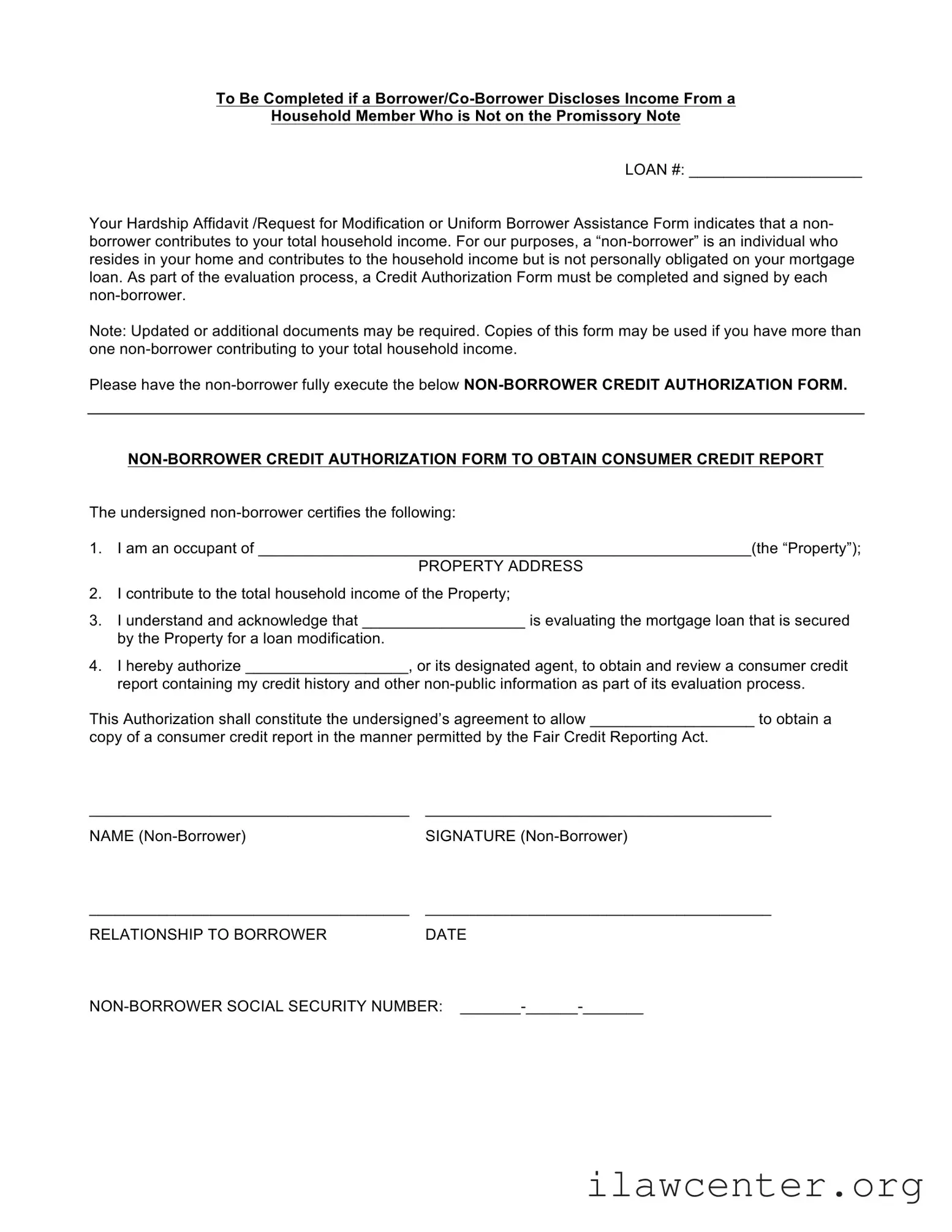
The Non Borrower Credit Authorization form is a document required when a borrower or co-borrower indicates that a household member, not listed on the mortgage, contributes to their total household income. This form allows lenders to obtain a credit report from the non-borrower, which is essential for evaluating loan modifications. If you have a non-borrower in your household, make sure to fill out the form by clicking the button below.

Article Guide

The Non Borrower Credit Authorization form plays a crucial role in the mortgage loan modification process, particularly when a borrower relies on income from household members not listed on the promissory note. This form is essential when a borrower or co-borrower discloses that a non-borrower contributes to the household income, thus impacting the overall financial assessment. A non-borrower is defined as someone who lives in the home and adds to the household finances but is not legally responsible for the mortgage. To proceed with evaluating the mortgage loan for modification, each non-borrower must complete and sign this form. It's important to note that if there are multiple non-borrowers, additional copies of the form may be necessary. The form requires the non-borrower to certify their occupancy of the property, acknowledge their contribution to the household income, and authorize the lender to obtain their consumer credit report. This authorization is critical, as it allows the lender to review the non-borrower's credit history in accordance with the Fair Credit Reporting Act. Understanding the significance of this form can streamline the modification process and ensure that all necessary information is accurately collected.

Non Borrower Credit Authorization Preview

To
Be Completed if a Borrower/Co-Borrower Discloses Income From a
Ho
usehold Member Who is Not on the Promissory Note
LO
AN #: ____________________
Your Hardship Affidavit /Request for Modification or Uniform Borrower Assistance Form indicates that a non-
borrower contributes to your total household income. For our purposes, a “non-borrower” is an individual who
resides in your home and contributes to the household income but is not personally obligated on your mortgage
loan. As part of the evaluation process, a Credit Authorization Form must be completed and signed by each
non-borrower.
Note: Updated or additional documents may be required. Copies of this form may be used if you have more than
one non-borrower contributing to your total household income.
Please have the non-borrower fully execute the below NON-BORROWER CREDIT AUTHORIZATION FORM.
NO
N-BORROWER CREDIT AUTHORIZATION FORM TO OBTAIN CONSUMER CREDIT REPORT
The undersigned non-borrower certifies the following:
1. I am an occupant of _________________________________________________________(the “Property”);
PROPERTY ADDRESS
2. I contribute to the total household income of the Property;
3. I understand and acknowledge that ___________________ is evaluating the mortgage loan that is secured
by the Property for a loan modification.
4. I hereby authorize ___________________, or its designated agent, to obtain and review a consumer credit
report containing my c
redit history and other non-public information as part of its evaluation process.
This Authoriz
ation shall constitute the undersigned’s agreement to allow ___________________ to obtain a
copy of a consumer credit report in the manner permitted by the Fair Credit Reporting Act.
_____________________________________ ________________________________________
NAME (Non-Borrower) SIGNATURE (Non-Borrower)
_____________________________________ ________________________________________
RELATIONSHIP TO BORROWER DATE
NON-BORROWER SOCIAL SECURITY NUMBER: _______-______-_______

File Properties

Fact Name Details
Purpose The Non-Borrower Credit Authorization form is used to obtain credit information from individuals who contribute to household income but are not on the mortgage loan.
Eligibility This form is required for non-borrowers who reside in the home and provide financial support to the household.
Loan Modification The form is part of the evaluation process for mortgage loan modifications.
Multiple Non-Borrowers Copies of the form may be submitted if there are multiple non-borrowers contributing to the household income.
Consumer Credit Report The non-borrower authorizes the lender to obtain a consumer credit report as part of the evaluation process.
Governing Law In the United States, the Fair Credit Reporting Act governs the use of consumer credit reports.
Signature Requirement The non-borrower must sign the form to authorize the release of their credit information.
Personal Information The form requires the non-borrower’s name, relationship to the borrower, and Social Security number.

Instructions on Utilizing Non Borrower Credit Authorization

Filling out the Non Borrower Credit Authorization form is a straightforward process. Once completed, this form will help facilitate the evaluation of your mortgage loan modification. Each non-borrower must provide their information and sign the form to authorize the necessary credit checks.

  1. Start by writing the loan number at the top of the form in the designated space.
  2. Fill in the property address where the non-borrower resides.
  3. Confirm that the non-borrower is an occupant of the property and contributes to the total household income.
  4. Indicate the name of the entity evaluating the mortgage loan in the appropriate blank space.
  5. Have the non-borrower read the authorization statement carefully. They should understand that they are allowing the lender to obtain their consumer credit report.
  6. Ask the non-borrower to print their name clearly in the designated area.
  7. Ensure the non-borrower signs the form in the signature space provided.
  8. Fill in the relationship of the non-borrower to the borrower in the specified area.
  9. Enter the date when the non-borrower is signing the form.
  10. Finally, provide the non-borrower's Social Security number in the format requested.

Important Facts about Non Borrower Credit Authorization

What is the Non Borrower Credit Authorization form?

The Non Borrower Credit Authorization form is a document required when a borrower or co-borrower discloses that a household member, who is not on the mortgage, contributes to the total household income. This form allows the lender to obtain a credit report for the non-borrower, which helps in evaluating the mortgage loan modification request.

Who qualifies as a non-borrower?

A non-borrower is someone who lives in the same household as the borrower but is not legally responsible for the mortgage loan. This individual contributes to the household income and may include family members, roommates, or partners. Their financial information is necessary for the lender to assess the overall financial situation of the household.

Why is the Non Borrower Credit Authorization form necessary?

This form is crucial because it grants the lender permission to access the non-borrower’s credit report. Understanding the credit history of all contributing members helps the lender make informed decisions regarding loan modifications. Without this information, the lender may not have a complete picture of the household's financial health.

How many Non Borrower Credit Authorization forms do I need to submit?

If there are multiple non-borrowers contributing to the household income, each one must complete and sign their own Non Borrower Credit Authorization form. You can make copies of the form to ensure that all non-borrowers provide the necessary authorization for their credit reports to be obtained.

What should I do if I have more questions about the form?

If you have additional questions or need assistance with the Non Borrower Credit Authorization form, consider reaching out to your lender or a qualified housing counselor. They can provide guidance tailored to your specific situation and help ensure that all necessary steps are taken for your loan modification process.

Common mistakes

When filling out the Non Borrower Credit Authorization form, individuals often make several common mistakes that can delay the process. One frequent error is leaving the loan number section blank. This number is essential for identifying the specific loan associated with the credit authorization.

Another mistake involves not providing the correct property address. The address should accurately reflect the location of the property in question. Omitting or miswriting this information can lead to confusion and potential processing delays.

Many individuals forget to sign the form. A signature is a crucial component of the authorization, as it confirms the non-borrower's consent for the lender to obtain their credit report. Without this signature, the form cannot be processed.

Additionally, some people neglect to specify their relationship to the borrower. This information helps establish the connection between the borrower and the non-borrower, which is important for the evaluation process. Failing to include this detail may result in further inquiries.

Providing an incomplete Social Security number is another common issue. The Social Security number must be fully completed to ensure accurate identification and credit reporting. Leaving out digits or providing incorrect information can complicate the verification process.

Some individuals mistakenly assume that only one copy of the form is needed, even when there are multiple non-borrowers contributing to the household income. It is important to complete a separate form for each non-borrower to ensure all contributions are documented properly.

Moreover, individuals may overlook the requirement to read the authorization statement thoroughly. Understanding the implications of granting permission to access credit history is vital. Ignoring this can lead to misunderstandings about what the authorization entails.

Lastly, failing to provide updated or additional documents when requested can hinder the evaluation process. It is essential to respond promptly to any requests for further information to avoid delays in the loan modification process.

Documents used along the form

When applying for a loan modification or similar financial assistance, several forms and documents may be required alongside the Non Borrower Credit Authorization form. These documents help provide a comprehensive view of your financial situation and ensure that all parties involved have the necessary information to make informed decisions. Below is a list of commonly used documents in conjunction with the Non Borrower Credit Authorization form.

  • Hardship Affidavit: This document outlines the financial difficulties the borrower is facing, detailing the reasons for seeking a loan modification. It provides context for the request and helps lenders understand the borrower's situation.
  • Request for Modification: This form formally requests changes to the terms of an existing loan. It typically includes the borrower's proposed new terms and reasons for the modification.
  • Uniform Borrower Assistance Form: A standardized form that collects essential information about the borrower’s financial status, including income, expenses, and assets. This helps streamline the evaluation process for loan modifications.
  • Income Verification Documents: These may include pay stubs, tax returns, or bank statements that confirm the borrower's income. Lenders use these documents to assess the borrower's ability to repay the modified loan.
  • Credit Report: A detailed report of the borrower's credit history. It provides lenders with insights into the borrower’s creditworthiness and financial behavior.
  • Property Appraisal: An assessment of the property’s current market value. This document helps lenders determine the collateral value of the property in relation to the loan amount.
  • Loan Statement: A recent statement from the lender that outlines the current status of the loan, including the balance owed and payment history. This is crucial for understanding the borrower's obligations.
  • Debt-to-Income Ratio Calculation: A calculation that compares the borrower’s total monthly debt payments to their gross monthly income. This helps lenders evaluate the borrower’s financial health.
  • Authorization to Release Information: A form that allows the lender to obtain information from third parties, such as employers or financial institutions, to verify the borrower's financial details.

Gathering these documents may seem daunting, but they play a vital role in the loan modification process. Having them ready can facilitate a smoother evaluation and increase the chances of a successful outcome. Always ensure that all information provided is accurate and up-to-date to avoid delays in processing your request.

Similar forms

The Non Borrower Credit Authorization form is an important document in the mortgage evaluation process, particularly when a household member who is not on the loan contributes to the household income. Several other documents share similarities with this form, often serving to authorize the collection of information or verify a person's role in a financial context. Here are seven such documents:

  • Borrower Credit Authorization Form: This document is similar as it allows the lender to obtain a credit report from the borrower. Both forms require consent for the lender to review financial history.
  • Income Verification Form: This form is used to confirm the income of a borrower or non-borrower. Like the Non Borrower Credit Authorization, it ensures that the lender has accurate information regarding household income.
  • Authorization to Release Information: This document permits third parties to access personal information. It functions similarly by allowing a lender to gather necessary data for evaluating a loan application.
  • Loan Modification Application: This form is submitted when a borrower seeks to change the terms of their loan. It often requires information about all household members, including non-borrowers, just like the Non Borrower Credit Authorization.
  • Affidavit of Support: This document may be used to declare that someone is financially supporting a borrower. It shares the purpose of verifying the financial contributions of individuals who are not on the loan.
  • Consent to Obtain Credit Report: Similar in function, this document specifically allows a lender to pull a credit report. It is often required for both borrowers and non-borrowers to assess creditworthiness.
  • Personal Financial Statement: This form outlines an individual's financial situation. It is similar in that it provides insight into the financial contributions of non-borrowers, aiding in the evaluation of the household's overall financial health.

Dos and Don'ts

When filling out the Non Borrower Credit Authorization form, consider the following important do's and don'ts:

  • Do ensure all required fields are completed accurately.
  • Do provide your full legal name as it appears on your identification.
  • Do include the correct property address where you reside.
  • Do sign and date the form in the designated areas.
  • Do review the form for any errors before submitting.
  • Don't leave any sections blank; fill in all necessary information.
  • Don't use nicknames or abbreviations for your name.
  • Don't forget to specify your relationship to the borrower.
  • Don't submit the form without checking for completeness.
  • Don't share personal information outside of the form's requirements.

Following these guidelines will help ensure a smooth process. Take your time to complete the form carefully.

Misconceptions

Understanding the Non Borrower Credit Authorization form is essential for anyone involved in a mortgage modification process. However, several misconceptions can lead to confusion. Below are seven common misunderstandings about this form:

  • Only Borrowers Need to Sign: Many believe that only those listed on the mortgage need to complete the form. In reality, any non-borrower contributing to household income must sign it.
  • The Form is Optional: Some individuals think that completing the form is optional. However, it is a necessary part of the evaluation process for loan modifications.
  • All Household Members Must Sign: It is a misconception that every person living in the home must complete the form. Only those who contribute to the household income need to sign.
  • Credit Reports Are Only for Borrowers: Many assume that credit reports are only relevant for borrowers. Non-borrowers’ credit histories are also evaluated to assess the household's financial situation.
  • One Form Suffices for Multiple Non-Borrowers: Some think that one completed form can be used for multiple non-borrowers. In fact, each non-borrower must complete their own form.
  • Signing the Form Guarantees Approval: It is a common belief that signing the form guarantees a loan modification approval. The form is merely a step in the evaluation process and does not ensure a favorable outcome.
  • The Information is Not Confidential: Some individuals worry that their personal information will not be protected. The form is governed by the Fair Credit Reporting Act, which ensures that the information remains confidential.

By clarifying these misconceptions, individuals can better navigate the complexities of the Non Borrower Credit Authorization form and the mortgage modification process.

Key takeaways

Filling out and using the Non Borrower Credit Authorization form is an important step in the loan modification process. Here are some key takeaways to keep in mind:

  • Identify the Non-Borrower: Ensure that the individual completing the form is indeed a non-borrower, meaning they reside in the home and contribute to the household income but are not on the mortgage loan.
  • Complete the Form Accurately: Fill in all required fields, including the loan number and property address, to avoid delays in processing.
  • Multiple Non-Borrowers: If there are several non-borrowers contributing to the income, make copies of the form for each individual to complete.
  • Understand the Purpose: The form is necessary for the lender to evaluate the mortgage loan for potential modification based on the total household income.
  • Authorization for Credit Report: By signing the form, the non-borrower agrees to allow the lender to obtain their consumer credit report, which is crucial for the evaluation process.
  • Fair Credit Reporting Act Compliance: The authorization complies with the Fair Credit Reporting Act, ensuring the non-borrower’s credit information is handled appropriately.
  • Signature Requirement: The non-borrower must sign the form to validate their consent. Without a signature, the form will not be accepted.
  • Keep Copies: It’s wise to keep a copy of the completed form for your records, as it may be needed for future reference or follow-up.

By following these guidelines, you can ensure that the Non Borrower Credit Authorization form is filled out correctly and used effectively in your loan modification process.