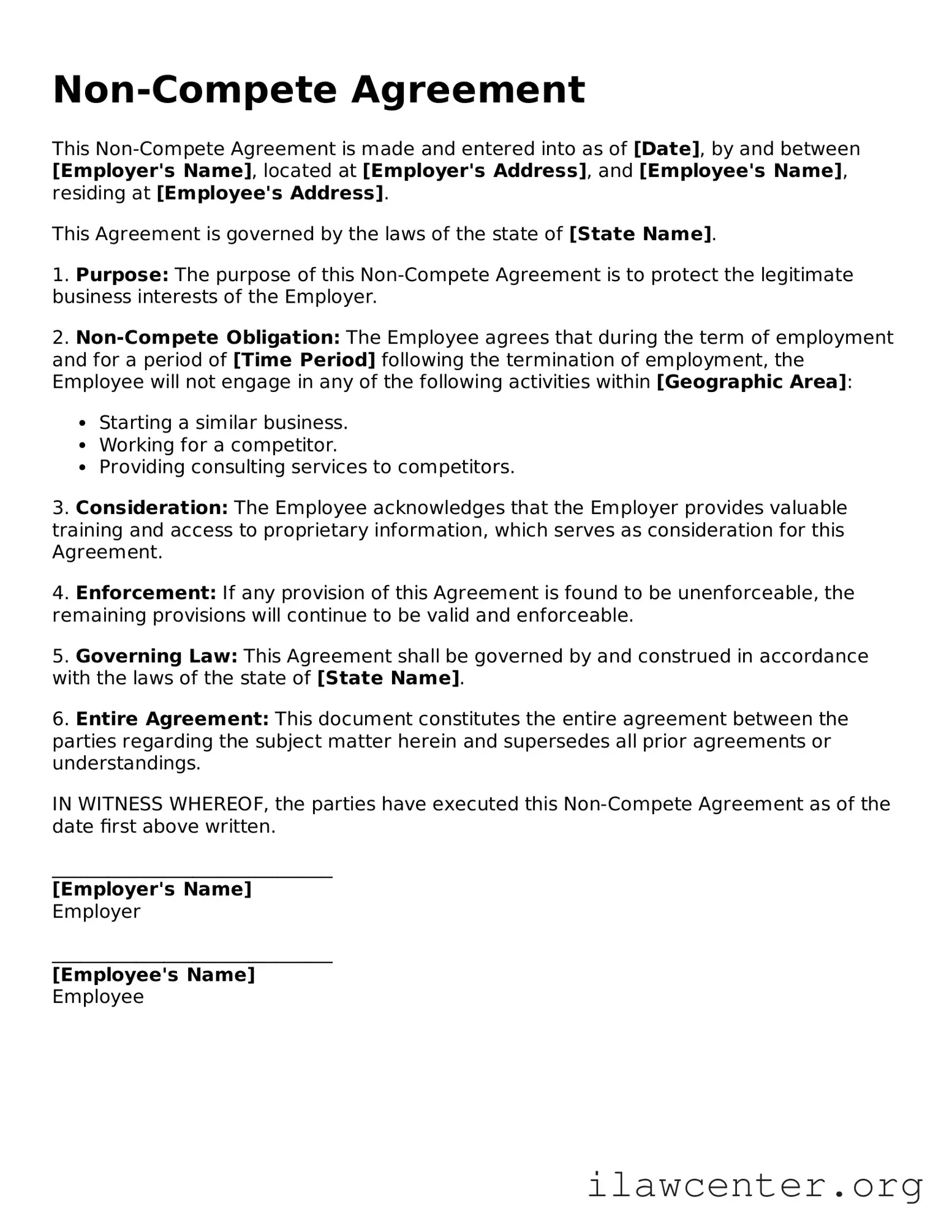
Fillable Non-compete Agreement Document

Fillable Non-compete Agreement Document

A Non-compete Agreement is a legal document that restricts an employee from working for competitors or starting a similar business for a specified period after leaving a company. This form helps protect a business's trade secrets and competitive advantage. If you're considering using this agreement, fill out the form by clicking the button below.

Article Guide

When entering into a new employment relationship, many individuals encounter a Non-compete Agreement form. This document plays a crucial role in defining the boundaries of competition between an employee and their employer after the employment ends. Typically, the form outlines the specific geographic areas where the employee is restricted from working for competitors, as well as the duration of these restrictions. Key elements often include the types of activities that are prohibited, ensuring that sensitive company information is protected. By establishing these parameters, both parties can have a clearer understanding of their rights and obligations. It is essential for employees to carefully review this agreement, as it can significantly impact their future job opportunities. Understanding the implications of signing such a document is vital, and individuals should consider seeking advice to navigate any complexities that may arise.

Non-compete Agreement Preview

Non-Compete Agreement

This Non-Compete Agreement is made and entered into as of [Date], by and between [Employer's Name], located at [Employer's Address], and [Employee's Name], residing at [Employee's Address].

This Agreement is governed by the laws of the state of [State Name].

1. Purpose: The purpose of this Non-Compete Agreement is to protect the legitimate business interests of the Employer.

2. Non-Compete Obligation: The Employee agrees that during the term of employment and for a period of [Time Period] following the termination of employment, the Employee will not engage in any of the following activities within [Geographic Area]:

  • Starting a similar business.
  • Working for a competitor.
  • Providing consulting services to competitors.

3. Consideration: The Employee acknowledges that the Employer provides valuable training and access to proprietary information, which serves as consideration for this Agreement.

4. Enforcement: If any provision of this Agreement is found to be unenforceable, the remaining provisions will continue to be valid and enforceable.

5. Governing Law: This Agreement shall be governed by and construed in accordance with the laws of the state of [State Name].

6. Entire Agreement: This document constitutes the entire agreement between the parties regarding the subject matter herein and supersedes all prior agreements or understandings.

IN WITNESS WHEREOF, the parties have executed this Non-Compete Agreement as of the date first above written.

______________________________
[Employer's Name]
Employer

______________________________
[Employee's Name]
Employee

PDF Form Characteristics

Fact Name Description
Definition A non-compete agreement is a contract that restricts an employee from working for competitors or starting a competing business for a specified period after leaving a company.
Purpose The primary purpose is to protect a company's confidential information and trade secrets, ensuring that employees do not take sensitive knowledge to competitors.
Enforceability Enforceability varies by state; some states uphold non-compete agreements strictly, while others may limit their duration and geographic scope.
Governing Law (California) In California, non-compete agreements are generally unenforceable, reflecting the state's strong public policy favoring employee mobility.
Governing Law (Texas) Texas allows non-compete agreements if they are reasonable in scope and duration, and the employee receives consideration, such as a job offer or promotion.
Governing Law (Florida) Florida enforces non-compete agreements that are reasonable in time, area, and line of business, provided they protect legitimate business interests.

Instructions on Utilizing Non-compete Agreement

Completing a Non-compete Agreement form is an important step in establishing the terms of employment and protecting business interests. Once you have the form ready, follow the steps outlined below to ensure all necessary information is accurately provided.

  1. Read the form carefully. Familiarize yourself with all sections to understand what information is required.
  2. Enter your full name. Write your legal name as it appears on official documents.
  3. Provide your address. Include your current residential address, ensuring it is complete and accurate.
  4. Identify the employer. Write the name of the company or organization you will be working for.
  5. Specify the position. Clearly state the job title you will hold within the company.
  6. Outline the duration. Indicate the length of time the non-compete agreement will be in effect.
  7. Detail the geographic area. Specify the regions or locations where the non-compete will apply.
  8. Review any additional clauses. If there are specific terms or conditions, ensure they are filled out as required.
  9. Sign and date the form. Provide your signature and the date to validate the agreement.
  10. Submit the form. Return the completed form to the appropriate party, whether that is your employer or a designated representative.

Important Facts about Non-compete Agreement

What is a Non-compete Agreement?

A Non-compete Agreement is a legal document that restricts an employee from working for competitors or starting a similar business for a certain period after leaving their current job. Its primary purpose is to protect a company's confidential information and trade secrets. By signing this agreement, employees agree not to engage in activities that could harm their employer's business interests for a specified duration and within a particular geographic area.

Why would an employer require a Non-compete Agreement?

Employers often use Non-compete Agreements to safeguard their proprietary information, client relationships, and overall business strategies. When employees have access to sensitive information, there’s a risk they might take that knowledge to a competing business. By implementing a Non-compete Agreement, employers aim to minimize this risk and ensure that their competitive advantage remains intact even after an employee leaves the company.

Are Non-compete Agreements enforceable?

The enforceability of Non-compete Agreements can vary widely depending on state laws. In some states, these agreements are strictly enforced, while others may impose limitations on their scope, duration, or geographic area. Courts generally look for reasonableness in these agreements, meaning they should not excessively restrict an employee's ability to find work. It’s essential for both employers and employees to understand the specific laws in their state regarding Non-compete Agreements to know what is permissible.

What should I consider before signing a Non-compete Agreement?

Before signing a Non-compete Agreement, it's important to carefully review its terms. Consider the duration and geographic scope of the restrictions. Are they reasonable? Think about how this agreement could impact your future job opportunities. If you have concerns, discussing them with a legal professional can provide clarity. Understanding the implications of the agreement will help you make an informed decision about whether to sign it.

Common mistakes

Filling out a Non-compete Agreement can be a daunting task, and many individuals make mistakes that can have lasting implications. One common error is not fully understanding the terms of the agreement. People often sign documents without reading them thoroughly, which can lead to confusion about what they are agreeing to. This lack of attention can result in unintended restrictions on future employment opportunities.

Another frequent mistake is failing to consider the geographical scope of the non-compete. Many individuals assume that the restrictions apply only to their immediate area, but some agreements may extend to broader regions. This oversight can limit job prospects in ways that are not immediately apparent when signing the document.

Additionally, individuals sometimes overlook the duration of the non-compete clause. It is essential to understand how long the restrictions will last. Some agreements may impose limitations for several years, which could hinder career advancement or transitions to new roles. Not questioning the length of time can lead to frustration down the line.

People also often neglect to negotiate the terms of the agreement. Many assume that the document is set in stone and do not realize they can request modifications. Failing to advocate for oneself can result in overly restrictive conditions that do not reflect their actual job responsibilities or industry standards.

Another mistake is not considering the implications for future employment in related fields. Some individuals may sign a non-compete without realizing it could prevent them from working in similar industries altogether. This lack of foresight can severely limit career options, especially in specialized fields.

Moreover, individuals sometimes forget to seek legal advice before signing. Consulting with a legal expert can provide clarity on the implications of the agreement. Without this guidance, individuals may inadvertently agree to terms that could be detrimental to their career.

Another common error is misunderstanding the concept of “consideration” in the agreement. For a non-compete to be enforceable, there must be something of value exchanged. If someone signs an agreement without receiving adequate compensation or a benefit in return, they may find it difficult to challenge the agreement later.

Finally, individuals may fail to keep a copy of the signed agreement. This oversight can create challenges if disputes arise in the future. Having a personal record of the terms agreed upon is crucial for understanding one’s rights and obligations.

Documents used along the form

When entering into a Non-compete Agreement, several other forms and documents may be necessary to ensure clarity and legal enforceability. These documents help outline the terms of the agreement and protect the interests of all parties involved.

  • Employment Agreement: This document outlines the overall terms of employment, including job responsibilities, compensation, and conditions for termination. It often includes clauses related to confidentiality and non-compete provisions.
  • Confidentiality Agreement: Also known as a Non-disclosure Agreement (NDA), this form protects sensitive information shared between parties. It ensures that proprietary information remains confidential and is not disclosed to unauthorized individuals.
  • Severance Agreement: This document outlines the terms under which an employee will receive severance pay upon termination. It may include non-compete clauses to restrict the employee's activities post-employment.
  • Intellectual Property Assignment Agreement: This agreement transfers ownership of any intellectual property created during the course of employment from the employee to the employer, ensuring that the company retains rights to innovations and creations.
  • Offer Letter: This document formally offers a position to a candidate and may include references to the Non-compete Agreement. It sets the stage for the employment relationship and outlines key terms.
  • Release of Claims: This document is often signed at the end of employment. It releases the employer from any future claims the employee might have, which may include acknowledgment of the Non-compete Agreement.
  • Compliance Policy: This internal document outlines the company's policies regarding compliance with laws and regulations, including those related to non-compete agreements. It helps employees understand their obligations.
  • Employee Handbook: This comprehensive guide provides employees with information about company policies, including those related to non-compete agreements and other employment conditions.

Each of these documents plays a vital role in the employment relationship and can enhance the effectiveness of a Non-compete Agreement. By clearly defining roles, responsibilities, and expectations, these forms help prevent disputes and protect both the employer's and employee's interests.

Similar forms

A Non-compete Agreement is a legal document designed to protect a business's interests by restricting an employee's ability to work for competitors or start a competing business for a specified period after leaving the company. Several other documents share similarities with a Non-compete Agreement, each serving a unique purpose while often addressing similar concerns regarding confidentiality and competition. Below are five such documents:

  • Non-disclosure Agreement (NDA): This document prevents employees from sharing sensitive information about the company with outside parties. Like a Non-compete Agreement, it aims to protect proprietary information but does not limit employment opportunities directly.
  • Employment Contract: An employment contract outlines the terms of employment, including job responsibilities, salary, and duration of employment. While it may contain a Non-compete clause, its primary focus is on the relationship between the employer and employee.
  • Non-solicitation Agreement: This agreement restricts an employee from soliciting clients or employees of the company after leaving. Similar to a Non-compete Agreement, it seeks to safeguard business relationships but focuses specifically on client and employee interactions.
  • Confidentiality Agreement: This document is designed to protect confidential information shared between parties. It is similar to a Non-compete Agreement in that it aims to prevent the misuse of sensitive information, although it does not typically impose restrictions on employment.
  • Severance Agreement: A severance agreement may include clauses that prevent an employee from competing with the company after termination. While primarily focused on the terms of severance pay and benefits, it can also address competitive restrictions similar to those found in a Non-compete Agreement.

Each of these documents plays a vital role in protecting a business's interests while balancing the rights and opportunities of employees. Understanding their similarities can help individuals navigate their legal obligations and rights in the workplace.

Dos and Don'ts

When filling out a Non-compete Agreement form, it’s crucial to approach the process with care. Here’s a list of things to keep in mind:

  • Do read the entire agreement thoroughly before signing.
  • Do understand the terms and conditions, including the duration and geographic scope.
  • Do consult with a legal expert if you have any questions or concerns.
  • Do keep a copy of the signed agreement for your records.
  • Don't rush through the form; take your time to ensure accuracy.
  • Don't ignore any clauses that seem unclear or overly restrictive.
  • Don't sign the agreement without fully understanding your rights and obligations.
  • Don't forget to check if the agreement complies with state laws, as these can vary significantly.

Misconceptions

Understanding non-compete agreements can be challenging. Here are nine common misconceptions about these agreements, along with clarifications to help you navigate this area with confidence.

  1. Non-compete agreements are always enforceable. Not all non-compete agreements hold up in court. Their enforceability depends on state laws and the specific terms of the agreement.
  2. Only employees need to sign non-compete agreements. Independent contractors and even some vendors may also be required to sign non-compete agreements to protect a company's interests.
  3. Non-compete agreements are the same as non-disclosure agreements. While both protect a company's information, non-compete agreements restrict employment opportunities, whereas non-disclosure agreements focus on confidentiality.
  4. Signing a non-compete means you can't work in your field again. Most non-compete agreements are limited in scope, duration, and geography, allowing for some flexibility in future employment.
  5. Non-compete agreements are only for high-level employees. These agreements can apply to any employee who has access to sensitive information or trade secrets, regardless of their position.
  6. Employers can impose non-compete agreements at any time. Many states require that the agreement be signed at the start of employment or as part of a promotion, not after the fact.
  7. All states enforce non-compete agreements equally. Each state has its own rules regarding non-compete agreements, and some states, like California, have very limited enforceability.
  8. Non-compete agreements are a standard part of employment contracts. Not all employers use them. Their inclusion depends on the nature of the business and the role of the employee.
  9. Once signed, a non-compete agreement cannot be challenged. Employees can contest the validity of these agreements in court, especially if they believe the terms are unreasonable.

Awareness of these misconceptions can empower you to make informed decisions regarding non-compete agreements. Always consider consulting a legal professional for personalized advice.

Key takeaways

When filling out and using the Non-compete Agreement form, consider the following key takeaways:

  1. Understand the Purpose: The agreement is designed to protect your business interests by preventing employees from sharing sensitive information or competing directly after leaving the company.
  2. Be Clear and Specific: Clearly define the scope of the non-compete, including the duration and geographical area. Ambiguity can lead to enforceability issues.
  3. Consult Legal Guidance: Before finalizing the agreement, seek advice from a legal professional. This ensures compliance with state laws and regulations.
  4. Communicate with Employees: Discuss the agreement openly with employees. Transparency fosters understanding and compliance, reducing potential conflicts.