Attorney-Verified  Articles of Incorporation Document for North Carolina

Attorney-Verified Articles of Incorporation Document for North Carolina

The North Carolina Articles of Incorporation form is a crucial document that establishes a corporation in the state of North Carolina. This form outlines key information about your business, including its name, purpose, and structure. Taking the first step toward incorporation is vital for your business's legal standing, so don't hesitate—fill out the form by clicking the button below!

Article Guide

Starting a business in North Carolina is an exciting venture, and one of the first steps in this journey is completing the Articles of Incorporation form. This essential document lays the foundation for your corporation, outlining key details such as the corporation's name, its purpose, and the address of its principal office. Additionally, it requires information about the registered agent who will receive legal documents on behalf of the corporation. The form also addresses the number of shares the corporation is authorized to issue and the names and addresses of the initial directors. By carefully filling out the Articles of Incorporation, you not only comply with state requirements but also set the stage for your business's future growth and success. Understanding each section of the form is crucial, as it ensures that you provide all necessary information while also protecting your interests as a business owner.

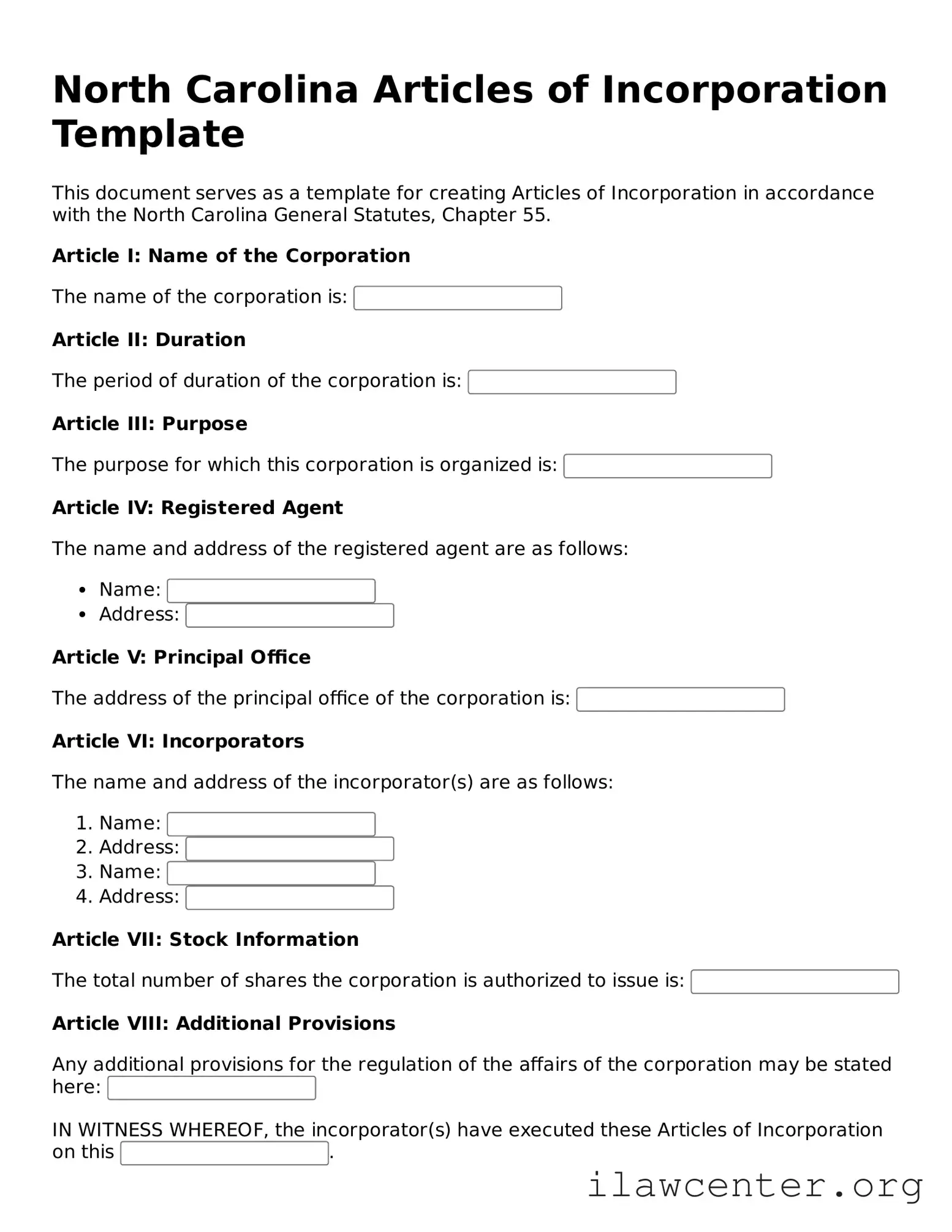
North Carolina Articles of Incorporation Preview

North Carolina Articles of Incorporation Template

This document serves as a template for creating Articles of Incorporation in accordance with the North Carolina General Statutes, Chapter 55.

Article I: Name of the Corporation

The name of the corporation is:

Article II: Duration

The period of duration of the corporation is:

Article III: Purpose

The purpose for which this corporation is organized is:

Article IV: Registered Agent

The name and address of the registered agent are as follows:

  • Name:
  • Address:

Article V: Principal Office

The address of the principal office of the corporation is:

Article VI: Incorporators

The name and address of the incorporator(s) are as follows:

  1. Name:
  2. Address:
  3. Name:
  4. Address:

Article VII: Stock Information

The total number of shares the corporation is authorized to issue is:

Article VIII: Additional Provisions

Any additional provisions for the regulation of the affairs of the corporation may be stated here:

IN WITNESS WHEREOF, the incorporator(s) have executed these Articles of Incorporation on this .

Signature of Incorporator(s):

Name:

Date:

PDF Form Characteristics

Fact Name Description
Purpose The Articles of Incorporation form is essential for legally establishing a corporation in North Carolina.
Governing Law This form is governed by the North Carolina General Statutes, specifically Chapter 55.
Filing Requirement To form a corporation, you must file the Articles of Incorporation with the North Carolina Secretary of State.
Information Needed Key details such as the corporation's name, address, and purpose must be included in the form.
Fees A filing fee is required when submitting the Articles of Incorporation, typically around $125.
Approval Timeline Processing times can vary, but expect approval within a few business days after submission.
Post-Filing Steps After approval, corporations must comply with additional requirements, like obtaining an Employer Identification Number (EIN).

Instructions on Utilizing North Carolina Articles of Incorporation

After you have completed the North Carolina Articles of Incorporation form, you will need to submit it to the North Carolina Secretary of State along with the required filing fee. This step is essential for officially establishing your corporation.

  1. Begin by downloading the North Carolina Articles of Incorporation form from the Secretary of State's website.
  2. Fill in the name of your corporation. Ensure that it complies with North Carolina naming requirements.
  3. Provide the principal office address. This should be a physical address, not a P.O. Box.
  4. List the name and address of the registered agent. This person or business will receive legal documents on behalf of the corporation.
  5. Indicate the purpose of your corporation. Be clear and specific about what your business will do.
  6. State the number of shares your corporation is authorized to issue. If applicable, include the par value of the shares.
  7. Include the names and addresses of the incorporators. These individuals are responsible for filing the Articles of Incorporation.
  8. Sign and date the form. Ensure that the signature is from an incorporator.
  9. Prepare the filing fee. Check the current fee amount on the Secretary of State's website.
  10. Submit the completed form and payment to the North Carolina Secretary of State by mail or online, if applicable.

Important Facts about North Carolina Articles of Incorporation

What are the Articles of Incorporation in North Carolina?

The Articles of Incorporation is a legal document that establishes a corporation in North Carolina. It outlines essential information about the corporation, including its name, purpose, registered agent, and the number of shares authorized. This document must be filed with the North Carolina Secretary of State to create a corporation officially.

Who can file the Articles of Incorporation?

Any individual or group of individuals can file the Articles of Incorporation in North Carolina. Typically, this includes the corporation's founders or directors. There are no specific requirements regarding residency, meaning individuals from outside North Carolina can also file, provided they comply with state regulations.

What information is required on the Articles of Incorporation form?

The form requires several key pieces of information. This includes the corporation's name, which must be unique and not similar to any existing entities in North Carolina. Additionally, the form asks for the corporation's purpose, the name and address of the registered agent, and the number of shares the corporation is authorized to issue. Optional information may include the names and addresses of the incorporators.

How much does it cost to file the Articles of Incorporation?

The filing fee for the Articles of Incorporation in North Carolina is typically $125. This fee is subject to change, so it is advisable to check with the North Carolina Secretary of State's office for the most current fee schedule. Payment can usually be made via check or credit card, depending on the filing method.

How long does it take to process the Articles of Incorporation?

Processing times for the Articles of Incorporation can vary. Generally, it may take anywhere from a few days to several weeks, depending on the volume of filings and the method of submission. Expedited processing options may be available for an additional fee, allowing for quicker turnaround times.

What happens after the Articles of Incorporation are filed?

Once the Articles of Incorporation are filed and approved, the corporation is officially created. The Secretary of State will issue a Certificate of Incorporation, which serves as proof of the corporation's existence. The corporation can then begin conducting business, but it must also comply with other state and federal regulations, such as obtaining necessary licenses and permits.

Can the Articles of Incorporation be amended?

Yes, the Articles of Incorporation can be amended. If changes are necessary, such as altering the corporation's name or changing the number of authorized shares, the corporation must file an amendment with the North Carolina Secretary of State. This process involves submitting the appropriate form and paying any required fees.
Common mistakes

Filling out the North Carolina Articles of Incorporation form is a critical step in establishing a business. However, many individuals make common mistakes that can lead to delays or complications. One frequent error is failing to provide a clear and specific business name. The name of your corporation must be unique and distinguishable from existing entities. If it’s too similar to another business name, the state may reject your application, forcing you to start over.

Another mistake involves neglecting to include the registered agent's information. A registered agent is essential as they serve as the official point of contact for legal documents. Omitting this information can result in your application being incomplete. Ensure you list a valid name and address for the registered agent, as this is a requirement for all corporations in North Carolina.

People often overlook the importance of selecting the correct corporate structure. The Articles of Incorporation require you to specify whether your corporation is a profit or nonprofit entity. Misclassifying your corporation can lead to tax implications and regulatory issues down the line. Understanding the differences between these structures is crucial before submitting your form.

Inaccurate information about the corporation's purpose is another common pitfall. The Articles of Incorporation ask for a brief description of the business activities. Providing vague or overly broad statements can lead to confusion and may not meet the state's requirements. It’s best to be concise yet descriptive, clearly outlining what your corporation intends to do.

Lastly, many individuals fail to sign the Articles of Incorporation correctly. The form must be signed by the incorporator, and if this step is skipped or not done properly, the application will not be processed. Double-check that all signatures are present and that the form is dated appropriately. Taking the time to review these details can save you from unnecessary delays and ensure a smoother incorporation process.

Documents used along the form

When forming a corporation in North Carolina, several additional documents may be required alongside the Articles of Incorporation. These documents serve various purposes, from establishing governance to ensuring compliance with state regulations. Below is a list of commonly used forms and documents.

  • Bylaws: This document outlines the internal rules and regulations for the corporation's operation. It addresses governance, management structure, and procedures for meetings.
  • Initial Report: Some states require a report detailing the corporation's initial directors and officers. This document provides essential information about the corporation's leadership.
  • Registered Agent Appointment: This form designates a registered agent responsible for receiving legal documents on behalf of the corporation. It ensures there is a reliable point of contact.
  • Employer Identification Number (EIN) Application: This application is submitted to the IRS to obtain an EIN, which is necessary for tax purposes and hiring employees.
  • State Business License Application: Depending on the nature of the business, a specific license may be required to operate legally within the state.
  • Operating Agreement: For LLCs, this document outlines the management structure and operating procedures. It helps define the roles and responsibilities of members.
  • Certificate of Authority: If a corporation intends to do business in states other than North Carolina, this certificate allows it to operate legally in those jurisdictions.
  • Annual Report: Corporations are typically required to file an annual report with the state, providing updated information about the business and its financial status.
  • Shareholder Agreements: This document outlines the rights and responsibilities of shareholders, including how shares may be bought, sold, or transferred.

Understanding these documents is crucial for ensuring that your corporation is established and operates in compliance with North Carolina law. Each document plays a significant role in the corporation's formation and ongoing governance.

Similar forms

The Articles of Incorporation form is a crucial document for establishing a corporation. It serves as a foundational legal document, but there are several other documents that share similarities in purpose and function. Here are six documents that are comparable to the Articles of Incorporation:

  • Bylaws: Bylaws outline the internal rules and procedures for managing a corporation. While the Articles of Incorporation are filed with the state, bylaws govern the day-to-day operations and structure of the organization.
  • Certificate of Formation: In some states, this document serves a similar purpose to the Articles of Incorporation. It officially establishes a corporation or limited liability company (LLC) and includes basic information about the business.
  • Operating Agreement: For LLCs, the Operating Agreement is akin to bylaws. It details the management structure, member responsibilities, and operational procedures of the LLC, ensuring clarity among members.
  • Partnership Agreement: This document is essential for partnerships. It outlines the roles, responsibilities, and profit-sharing arrangements among partners, similar to how bylaws function for corporations.
  • Business Plan: While not a legal document, a business plan provides a roadmap for the company's goals and strategies. It complements the Articles of Incorporation by detailing how the corporation intends to operate and grow.
  • Annual Report: Corporations are often required to file annual reports with the state. This document provides updated information about the corporation, similar to how the Articles of Incorporation provide foundational information at the time of formation.

Understanding these documents can help ensure that your business is structured properly and operates smoothly. Each serves a unique role in the legal framework of a corporation or business entity.

Dos and Don'ts

When filling out the North Carolina Articles of Incorporation form, it is essential to follow specific guidelines to ensure a smooth process. Here are six important dos and don'ts to consider:

  • Do provide accurate information for all required fields.
  • Do include the name of your corporation exactly as you want it to appear on the articles.
  • Do designate a registered agent with a physical address in North Carolina.
  • Do ensure that the purpose of your corporation is clearly stated.
  • Don't forget to sign and date the form before submission.
  • Don't use abbreviations or informal names for your corporation in the official documents.

Following these guidelines can help avoid delays and ensure that your incorporation process goes smoothly. Make sure to double-check all entries before submitting the form to the state.

Misconceptions

When it comes to the North Carolina Articles of Incorporation form, there are several misconceptions that can lead to confusion. Here are four common misunderstandings:

  1. It’s only for large businesses. Many people think that only large corporations need to file Articles of Incorporation. In reality, any business entity, regardless of size, can benefit from incorporating. This includes small businesses and startups.
  2. Filing is a one-time event. Some believe that once the Articles of Incorporation are filed, no further action is needed. However, corporations must comply with ongoing requirements, such as annual reports and maintaining good standing with the state.
  3. All information is public. While certain details in the Articles of Incorporation are public, not all information about the corporation is accessible to everyone. Sensitive data, like financial records, remains private.
  4. Incorporation guarantees liability protection. Many assume that simply filing Articles of Incorporation provides complete protection from personal liability. While it does offer some protection, individuals can still be held liable in certain situations, such as personal guarantees or illegal activities.

Understanding these misconceptions can help you make informed decisions about your business structure in North Carolina.

Key takeaways

When filling out and using the North Carolina Articles of Incorporation form, several important points should be considered to ensure compliance and proper formation of a corporation.

  • Understand the purpose of the Articles of Incorporation. This document officially establishes a corporation in North Carolina.
  • Provide a unique name for the corporation. The name must comply with state regulations and not be similar to existing entities.
  • Include the principal office address. This should be a physical location in North Carolina where the corporation will conduct business.
  • Identify the registered agent. This individual or business entity will receive legal documents on behalf of the corporation.
  • State the duration of the corporation. Most corporations are established to exist perpetually, but a specific duration can be indicated if desired.
  • Specify the purpose of the corporation. A brief description of the business activities can help clarify the corporation's intended operations.
  • Detail the number of shares the corporation is authorized to issue. This includes specifying the par value of the shares, if applicable.
  • Ensure that the form is signed by the incorporator. This individual is responsible for submitting the Articles of Incorporation to the state.
  • Pay the required filing fee. This fee must accompany the submission of the Articles of Incorporation to the North Carolina Secretary of State.
  • File the Articles of Incorporation with the North Carolina Secretary of State. This can typically be done online or via mail, depending on preference.

Completing the Articles of Incorporation accurately is crucial for the legal recognition of the corporation. Failure to provide correct information can lead to delays or denial of the application.