Attorney-Verified  Divorce Settlement Agreement Document for North Carolina

Attorney-Verified Divorce Settlement Agreement Document for North Carolina

The North Carolina Divorce Settlement Agreement form is a legal document that outlines the terms agreed upon by both parties during a divorce. This agreement addresses various aspects such as asset division, child custody, and support obligations. Completing this form is an essential step in formalizing the divorce process, and you can begin by filling out the form by clicking the button below.

Article Guide

In North Carolina, navigating the complexities of divorce can be daunting, but a Divorce Settlement Agreement form serves as a crucial tool in simplifying this process. This form outlines the terms agreed upon by both parties regarding the division of assets and debts, child custody arrangements, and spousal support, among other important issues. By clearly detailing these agreements, the form helps to minimize misunderstandings and provides a framework for both parties to follow. It is essential for individuals to understand that this document is not merely a formality; it carries legal weight and can significantly impact one’s financial future and family dynamics. Completing this form accurately is vital, as it reflects the mutual consent of both spouses and can facilitate a smoother transition into post-divorce life. Understanding the major aspects of the Divorce Settlement Agreement form can empower individuals to make informed decisions and promote a more amicable resolution during a challenging time.

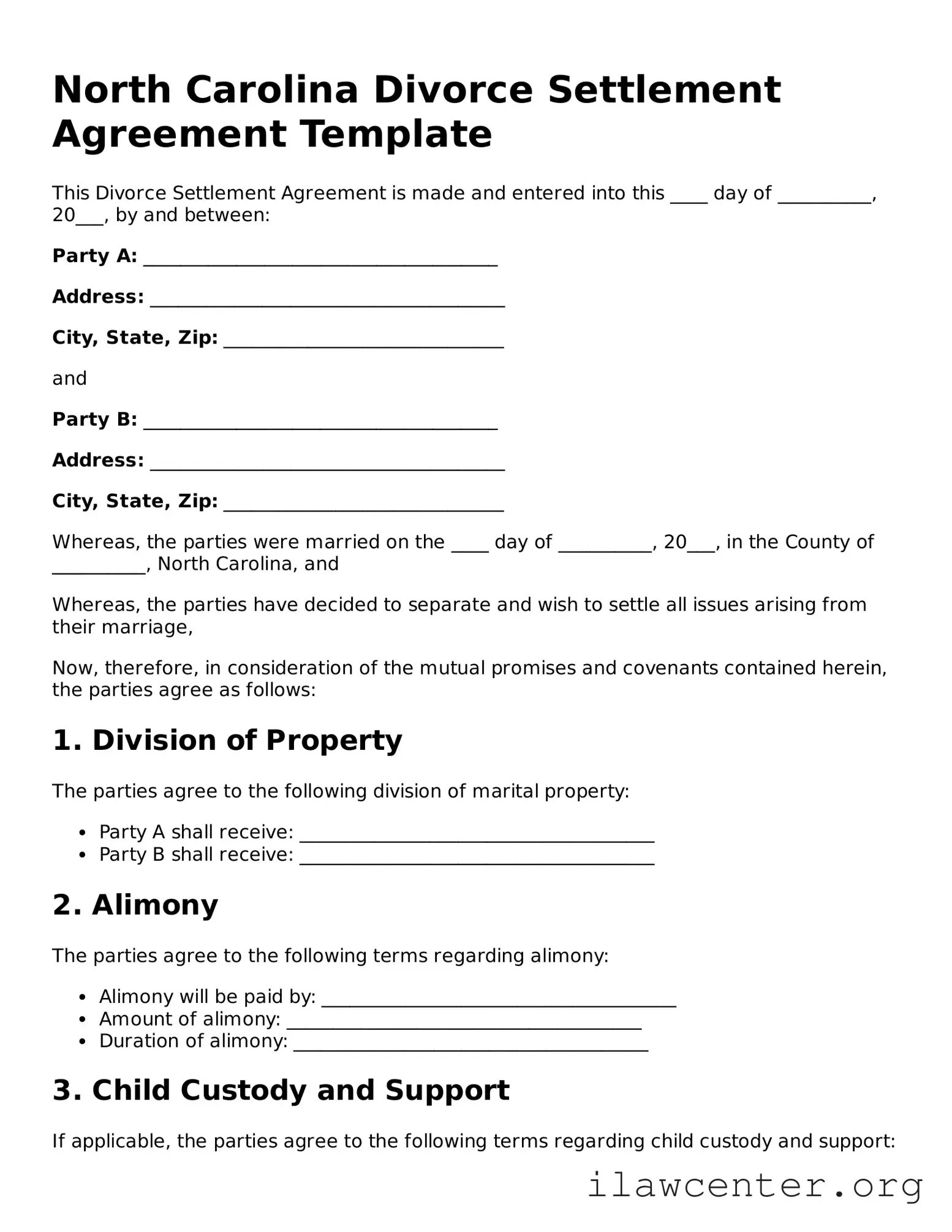
North Carolina Divorce Settlement Agreement Preview

North Carolina Divorce Settlement Agreement Template

This Divorce Settlement Agreement is made and entered into this ____ day of __________, 20___, by and between:

Party A: ______________________________________

Address: ______________________________________

City, State, Zip: ______________________________

and

Party B: ______________________________________

Address: ______________________________________

City, State, Zip: ______________________________

Whereas, the parties were married on the ____ day of __________, 20___, in the County of __________, North Carolina, and

Whereas, the parties have decided to separate and wish to settle all issues arising from their marriage,

Now, therefore, in consideration of the mutual promises and covenants contained herein, the parties agree as follows:

1. Division of Property

The parties agree to the following division of marital property:

  • Party A shall receive: ______________________________________
  • Party B shall receive: ______________________________________

2. Alimony

The parties agree to the following terms regarding alimony:

  • Alimony will be paid by: ______________________________________
  • Amount of alimony: ______________________________________
  • Duration of alimony: ______________________________________

3. Child Custody and Support

If applicable, the parties agree to the following terms regarding child custody and support:

  • Children's names: ______________________________________
  • Custody arrangement: ______________________________________
  • Child support amount: ______________________________________

4. Debt Responsibility

The parties agree to the following division of debts:

  • Party A shall be responsible for: ______________________________________
  • Party B shall be responsible for: ______________________________________

5. Miscellaneous

This Agreement represents the entire understanding between the parties and supersedes all prior discussions or agreements. It may only be modified in writing, signed by both parties.

In witness whereof, the parties have executed this Divorce Settlement Agreement as of the day and year first above written.

Party A Signature: _______________________________

Date: _______________________________

Party B Signature: _______________________________

Date: _______________________________

PDF Form Characteristics

Fact Name Description
Governing Law The North Carolina Divorce Settlement Agreement is governed by North Carolina General Statutes Chapter 50.
Purpose This form is used to outline the terms of a divorce settlement between spouses, including division of property and debts.
Mutual Agreement Both parties must agree to the terms laid out in the settlement for it to be valid and enforceable.
Child Custody If children are involved, the agreement should address custody arrangements and child support obligations.
Property Division The form includes provisions for the equitable distribution of marital property and debts.
Filing Requirements The completed agreement must be filed with the court as part of the divorce proceedings.
Legal Review It is advisable for both parties to seek legal counsel before signing the agreement to ensure fairness and understanding.
Modification Once approved by the court, the agreement can only be modified through a subsequent court order.

Instructions on Utilizing North Carolina Divorce Settlement Agreement

After gathering the necessary information and documents, you are ready to fill out the North Carolina Divorce Settlement Agreement form. This document is crucial for outlining the terms of your divorce. Ensuring accuracy and clarity in your responses will help facilitate the process.

  1. Begin by writing the date at the top of the form.
  2. Fill in the names of both parties involved in the divorce. Ensure that the names are spelled correctly.
  3. Provide the current addresses of both parties. This information is essential for communication purposes.
  4. Indicate the date of marriage and the date of separation. These dates are significant for legal reasons.
  5. Detail any children from the marriage, including their names and birthdates. This section is important for custody and support considerations.
  6. Outline the terms of property division. Specify which assets and debts will be assigned to each party.
  7. Discuss spousal support, if applicable. Clearly state the amount and duration of support payments.
  8. Include any agreements regarding child custody and visitation. Be specific about the arrangements to avoid future disputes.
  9. Address child support obligations. Indicate the amount and frequency of payments.
  10. Review the completed form for accuracy. Double-check all entries to ensure they are correct.
  11. Both parties should sign and date the form at the designated areas. Signatures indicate mutual agreement to the terms outlined.

Once the form is filled out and signed, it will need to be submitted to the appropriate court. Be prepared to provide any additional documentation that may be required for your case.

Important Facts about North Carolina Divorce Settlement Agreement

What is a Divorce Settlement Agreement in North Carolina?

A Divorce Settlement Agreement is a legally binding document that outlines the terms of a divorce between two parties. It includes details regarding the division of property, debts, child custody, visitation rights, and spousal support. This agreement is crucial as it helps both parties understand their rights and responsibilities post-divorce.

How do I create a Divorce Settlement Agreement?

Creating a Divorce Settlement Agreement typically involves negotiation between both parties. It is advisable to discuss each aspect of the divorce, including financial matters and child-related issues. Once both parties reach an agreement, it is essential to put the terms in writing. Legal assistance may be beneficial to ensure that the document is comprehensive and enforceable.

Is a Divorce Settlement Agreement required in North Carolina?

While it is not legally required to have a Divorce Settlement Agreement in North Carolina, it is highly recommended. Having a written agreement can help prevent misunderstandings and disputes in the future. If the parties cannot agree, the court may intervene and make decisions regarding the divorce terms.

What happens if my spouse does not comply with the agreement?

If one party fails to comply with the terms outlined in the Divorce Settlement Agreement, the other party may seek enforcement through the court. The court can order compliance, and in some cases, may impose penalties for non-compliance. It is essential to keep a copy of the agreement and any related correspondence to support your case.

Can a Divorce Settlement Agreement be modified?

Yes, a Divorce Settlement Agreement can be modified, but only under certain circumstances. If there is a significant change in circumstances, such as a job loss or a change in custody needs, either party may request a modification. This request must be filed with the court, and both parties will need to agree to the changes or have the court decide.

Do I need a lawyer to draft a Divorce Settlement Agreement?

While it is not mandatory to have a lawyer draft a Divorce Settlement Agreement, it is highly advisable. Legal professionals can provide guidance on legal rights and ensure that the agreement is fair and compliant with state laws. Their expertise can help avoid potential pitfalls and ensure that the agreement is enforceable.

How long does it take to finalize a Divorce Settlement Agreement?

The time it takes to finalize a Divorce Settlement Agreement can vary significantly based on the complexity of the issues involved and the willingness of both parties to negotiate. Simple agreements may be completed in a matter of weeks, while more complex situations could take several months. Open communication and cooperation between both parties can expedite the process.

Common mistakes

Filling out the North Carolina Divorce Settlement Agreement form can be a daunting task. Many people make mistakes that can complicate the divorce process. One common error is not being thorough with the details. It's essential to include all relevant information about assets, debts, and child custody arrangements. Omitting even a small detail can lead to misunderstandings later.

Another frequent mistake is failing to understand the legal implications of the agreement. Some individuals might think they can simply agree on terms without realizing that these terms need to be clear and enforceable. Vague language can create confusion and may not hold up in court. It's crucial to be specific about what each party is agreeing to.

People often overlook the importance of reviewing the form multiple times. Rushing through the process can lead to typos or incorrect information. Double-checking every section ensures accuracy and helps avoid potential disputes down the line. Taking the time to review can save a lot of hassle later.

Additionally, some individuals forget to consider future changes. Life circumstances can shift dramatically after a divorce, such as changes in income or living situations. It’s wise to include provisions that address how to handle future modifications. This foresight can prevent future conflicts and misunderstandings.

Lastly, a common mistake is neglecting to seek professional advice. While it might seem tempting to fill out the form on your own, consulting with a lawyer can provide valuable insights. A legal expert can help ensure that your agreement meets all legal requirements and protects your interests. Seeking help may seem like an extra step, but it can ultimately save time and stress.

Documents used along the form

When navigating a divorce in North Carolina, the Divorce Settlement Agreement form is a crucial document. However, several other forms and documents may accompany it to ensure a comprehensive and legally sound process. Below is a list of some commonly used documents that can help facilitate a smoother divorce experience.

  • Complaint for Divorce: This document initiates the divorce process. It outlines the reasons for the divorce and sets the stage for legal proceedings.
  • Answer to Complaint: If one spouse files a Complaint for Divorce, the other spouse may respond with an Answer, addressing the claims made and presenting their own position.
  • Financial Affidavit: This form provides a detailed account of each spouse's income, expenses, assets, and debts. It is essential for fair division of property and support considerations.
  • Child Custody Agreement: If children are involved, this document outlines the custody arrangements, including physical and legal custody, visitation schedules, and decision-making responsibilities.
  • Child Support Worksheet: This form calculates the amount of child support one parent may owe to the other, based on income, expenses, and the needs of the child.
  • Marital Settlement Agreement: This document details the division of marital property and debts, addressing how assets will be divided and any spousal support arrangements.
  • Notice of Hearing: If court intervention is needed, this notice informs all parties of the date and time of the hearing regarding the divorce or related matters.
  • Affidavit of Service: This document verifies that one spouse has been formally notified of the divorce proceedings, ensuring that all legal requirements are met.
  • Judgment of Absolute Divorce: This final document officially ends the marriage, confirming that the divorce has been granted by the court.

Each of these documents plays a vital role in the divorce process, helping to clarify rights and responsibilities. Understanding their purpose can make the journey through divorce less daunting and more manageable.

Similar forms

  • Separation Agreement: This document outlines the terms agreed upon by both spouses while living apart. It covers issues like property division, child custody, and support, similar to a Divorce Settlement Agreement.
  • Child Custody Agreement: Focused specifically on the care and custody of children, this agreement details living arrangements and visitation rights, paralleling the child-related provisions in a Divorce Settlement Agreement.
  • Property Settlement Agreement: This document addresses the division of marital assets and debts. Like the Divorce Settlement Agreement, it aims to ensure fair distribution between spouses.
  • Marital Settlement Agreement: Often used interchangeably with the Divorce Settlement Agreement, this document lays out all terms of the divorce, including financial and custody arrangements.
  • Spousal Support Agreement: This focuses on the financial support one spouse may provide to another after separation or divorce, similar to the support provisions in a Divorce Settlement Agreement.
  • Child Support Agreement: This document specifies the financial support for children post-divorce. It aligns with the child support aspects of the Divorce Settlement Agreement.
  • Mutual Release Agreement: In this document, both parties agree to release each other from future claims related to the divorce. This can be a component of a Divorce Settlement Agreement.
  • Non-Disclosure Agreement: Sometimes included in divorce settlements, this document prevents either party from disclosing sensitive information, similar to confidentiality clauses in a Divorce Settlement Agreement.
  • Final Judgment of Divorce: This court document finalizes the divorce and incorporates the terms of the Divorce Settlement Agreement, making it legally binding.

Dos and Don'ts

When filling out the North Carolina Divorce Settlement Agreement form, it is essential to approach the task with care and attention to detail. Below is a list of things to do and avoid to ensure the process goes smoothly.

  • Do read the entire form carefully before beginning to fill it out. Understanding the requirements will help prevent mistakes.
  • Do provide accurate information. Ensure that all names, dates, and financial details are correct.
  • Do consult with a legal professional if you have questions. Their expertise can clarify complex issues.
  • Do keep a copy of the completed form for your records. This can be helpful for future reference.
  • Don't rush through the form. Taking your time can help you avoid errors that may delay the process.
  • Don't leave any sections blank unless instructed. Incomplete forms may be rejected or delayed.
  • Don't forget to sign and date the form. An unsigned document is not valid.

Misconceptions

Here are ten common misconceptions about the North Carolina Divorce Settlement Agreement form, along with explanations to clarify each point.

  1. It is only necessary if children are involved.

    This is not true. A Divorce Settlement Agreement is important for all divorces, regardless of whether children are part of the equation. It outlines how assets and debts will be divided.

  2. It can be completed without legal advice.

    While it is possible to fill out the form independently, seeking legal advice is highly recommended. An attorney can ensure that your rights are protected and that the agreement is fair.

  3. Once signed, it cannot be changed.

    This is misleading. While the agreement is binding, parties can modify it later if both agree and the court approves the changes.

  4. It is the same as a court order.

    A Divorce Settlement Agreement is not a court order by itself. It becomes enforceable as a court order only after a judge reviews and signs it.

  5. It only covers financial matters.

    This misconception overlooks the fact that the agreement can also address custody arrangements, visitation rights, and other important aspects of family life.

  6. All agreements are automatically approved by the court.

    This is incorrect. The court reviews the agreement to ensure it is fair and in the best interest of any children involved before approval.

  7. It must be filed with the court at the time of divorce.

    This is not required. While filing the agreement can be beneficial, it is not mandatory at the time of divorce. It can be submitted later.

  8. Only one party needs to sign it.

    Both parties must sign the agreement for it to be valid. A mutual understanding is crucial for enforceability.

  9. The form is the same for every couple.

    Each Divorce Settlement Agreement should be tailored to the specific circumstances of the couple. Generic forms may not address unique needs.

  10. It is a quick and easy process.

    While it can be straightforward, drafting a comprehensive agreement often takes time and careful consideration. Rushing through can lead to future disputes.

Key takeaways

Filling out the North Carolina Divorce Settlement Agreement form can feel overwhelming, but understanding its key components can simplify the process. Here are some essential takeaways to keep in mind:

  • Complete Accuracy is Crucial: Ensure that all information is filled out accurately. Inaccuracies can lead to delays or complications in the divorce process.
  • Consider Future Needs: Think about how your decisions will impact both parties in the long run. This includes financial arrangements, child custody, and property division.
  • Seek Legal Guidance: While the form is designed for self-filing, consulting with a legal professional can provide clarity and ensure that your rights are protected.
  • Review Thoroughly: Before submitting the agreement, review it multiple times. Make sure everything is clear and that both parties understand the terms.

By keeping these points in mind, you can navigate the Divorce Settlement Agreement form with confidence and ensure a smoother transition to the next chapter of your life.