Attorney-Verified  Marital Separation Agreement Document for North Carolina

Attorney-Verified Marital Separation Agreement Document for North Carolina

A North Carolina Marital Separation Agreement form is a legal document that outlines the terms of separation between spouses. This form helps clarify issues such as property division, child custody, and support obligations. If you're considering separation, it's important to fill out this form accurately—click the button below to get started!

Article Guide

In North Carolina, a Marital Separation Agreement serves as a crucial document for couples who have decided to live apart while addressing various aspects of their relationship. This form outlines the rights and responsibilities of each spouse during the separation period. It typically includes provisions related to the division of property, allocation of debts, and arrangements for child custody and support. Additionally, the agreement may address spousal support, which can be essential for maintaining financial stability during the transition. While the form provides a framework for resolving these issues amicably, it is vital for both parties to understand their rights and obligations. By formalizing these agreements, couples can reduce conflict and promote clarity as they navigate this challenging phase of their lives.

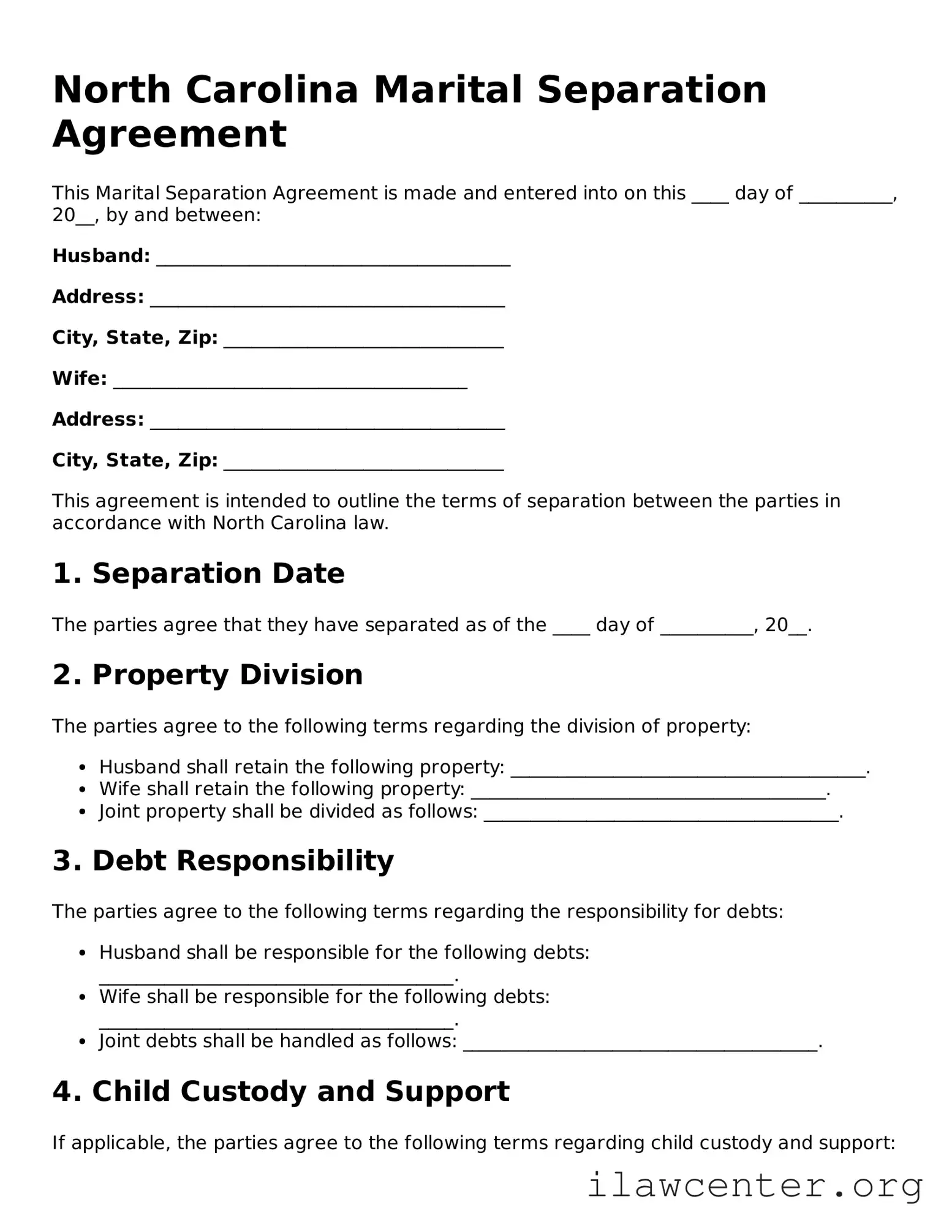
North Carolina Marital Separation Agreement Preview

North Carolina Marital Separation Agreement

This Marital Separation Agreement is made and entered into on this ____ day of __________, 20__, by and between:

Husband: ______________________________________

Address: ______________________________________

City, State, Zip: ______________________________

Wife: ______________________________________

Address: ______________________________________

City, State, Zip: ______________________________

This agreement is intended to outline the terms of separation between the parties in accordance with North Carolina law.

1. Separation Date

The parties agree that they have separated as of the ____ day of __________, 20__.

2. Property Division

The parties agree to the following terms regarding the division of property:

  • Husband shall retain the following property: ______________________________________.
  • Wife shall retain the following property: ______________________________________.
  • Joint property shall be divided as follows: ______________________________________.

3. Debt Responsibility

The parties agree to the following terms regarding the responsibility for debts:

  • Husband shall be responsible for the following debts: ______________________________________.
  • Wife shall be responsible for the following debts: ______________________________________.
  • Joint debts shall be handled as follows: ______________________________________.

4. Child Custody and Support

If applicable, the parties agree to the following terms regarding child custody and support:

  • Custody arrangement for children: ______________________________________.
  • Child support amount: $__________________ per month.
  • Other arrangements: ______________________________________.

5. Spousal Support

The parties agree to the following terms regarding spousal support:

  • Husband shall pay Wife $__________________ per month for spousal support.
  • Duration of support: ______________________________.

6. Miscellaneous Provisions

This agreement shall be governed by the laws of the State of North Carolina. The parties agree to:

  • Consult with legal counsel before signing.
  • Review and modify this agreement as necessary.
  • Maintain confidentiality regarding this agreement.

IN WITNESS WHEREOF, the parties hereto have executed this Marital Separation Agreement as of the date first above written.

Husband Signature: ________________________________ Date: ______________

Wife Signature: ________________________________ Date: ______________

PDF Form Characteristics

Fact Name Description
Purpose The North Carolina Marital Separation Agreement is used by couples to outline the terms of their separation, including asset division, child custody, and support obligations.
Governing Law This agreement is governed by North Carolina General Statutes, particularly Chapter 50, which covers divorce and separation laws.
Voluntary Agreement Both parties must voluntarily agree to the terms laid out in the separation agreement for it to be valid and enforceable.
Legal Counsel While not required, it is advisable for each party to seek legal counsel to ensure that their rights and interests are adequately protected.

Instructions on Utilizing North Carolina Marital Separation Agreement

Completing the North Carolina Marital Separation Agreement form requires careful attention to detail. After filling out the form, both parties should review it thoroughly before signing. Once completed, it is advisable to keep copies for personal records and to provide a signed copy to each party involved.

  1. Obtain a copy of the North Carolina Marital Separation Agreement form from a reliable source, such as the North Carolina court website or a legal office.
  2. Begin by entering the full names of both spouses at the top of the form. Ensure that the names are spelled correctly.
  3. Provide the current addresses of both parties. Include street addresses, city, state, and zip codes.
  4. Indicate the date of marriage and the date of separation in the designated sections.
  5. Detail any children from the marriage, including their names and birthdates, if applicable.
  6. Outline the agreements regarding property division. Specify which assets belong to each party and how debts will be handled.
  7. Address matters concerning alimony or spousal support, if applicable. Clearly state the terms agreed upon by both parties.
  8. Include any provisions for child custody and visitation, if children are involved. Specify the arrangements that both parties have agreed to.
  9. Review the completed form for accuracy. Check that all sections are filled out completely and correctly.
  10. Both parties should sign and date the form in the designated areas. Ensure that the signatures are witnessed if required.

Important Facts about North Carolina Marital Separation Agreement

What is a Marital Separation Agreement in North Carolina?

A Marital Separation Agreement is a legal document that outlines the terms of separation between spouses. It addresses issues such as division of property, child custody, visitation, and support obligations. This agreement helps both parties understand their rights and responsibilities during the separation period.

Is a Marital Separation Agreement legally binding?

Yes, once both parties sign the Marital Separation Agreement, it becomes legally binding. This means that both spouses are obligated to follow the terms outlined in the agreement. However, it is important to ensure that the agreement is fair and reasonable, as courts may review it during divorce proceedings.

Do I need an attorney to create a Marital Separation Agreement?

While it is not legally required to have an attorney, it is highly recommended. An attorney can help you understand your rights, ensure that the agreement complies with North Carolina law, and provide guidance on complex issues like property division and child custody. Having legal representation can protect your interests.

What happens if one spouse violates the Marital Separation Agreement?

If one spouse fails to comply with the terms of the agreement, the other spouse can seek legal recourse. This may involve filing a motion in court to enforce the agreement. Courts take violations seriously, and the non-compliant spouse may face penalties or be required to fulfill their obligations.

Can a Marital Separation Agreement be modified?

Yes, a Marital Separation Agreement can be modified if both parties agree to the changes. It is advisable to document any modifications in writing and have both parties sign the updated agreement. This helps prevent misunderstandings and ensures that the new terms are enforceable.

How long does a Marital Separation Agreement last?

A Marital Separation Agreement remains in effect until the parties divorce or until both spouses agree to terminate it. If the agreement includes specific terms regarding child support or custody, those provisions may continue until the children reach adulthood or until a court modifies them.

What should be included in a Marital Separation Agreement?

A comprehensive Marital Separation Agreement should include details about property division, child custody arrangements, child support, spousal support, and any other relevant issues. Clarity is key. The more detailed the agreement, the less likely there will be disputes in the future.

Can I use a template for a Marital Separation Agreement?

Using a template can be a starting point, but it is crucial to customize it to fit your specific situation. Templates may not address all necessary issues or may not comply with North Carolina laws. Consulting with an attorney can help ensure that your agreement is valid and enforceable.

Common mistakes

Filling out a Marital Separation Agreement in North Carolina can be a complex process. Many individuals make mistakes that can lead to confusion or even legal complications later on. One common error is failing to clearly define the terms of separation. It’s essential to be specific about the date of separation and the reasons for it. Vague language can create misunderstandings and disputes down the line.

Another mistake often seen is neglecting to address the division of assets and debts. This section is crucial, as it outlines how property and financial obligations will be handled post-separation. Without a clear agreement, one party may feel unfairly treated, leading to potential conflicts. Both parties should take the time to list all assets and debts, ensuring that everything is accounted for.

Additionally, people frequently overlook the importance of including child custody and support arrangements. If children are involved, it’s vital to specify custody arrangements, visitation schedules, and financial support. Failing to do so can result in future legal battles and uncertainty for the children. Clarity in these areas not only protects the parents but also prioritizes the well-being of the children.

Another common error is not having the agreement reviewed by a legal professional. While it may seem like an unnecessary step, a lawyer can provide valuable insights and ensure that the agreement complies with North Carolina law. This review can help identify any potential issues before they become problems, saving both parties time and stress in the future.

Lastly, many individuals forget to keep copies of the signed agreement. Once the document is finalized, it’s important for both parties to retain a copy for their records. This ensures that both individuals have access to the terms of their separation and can refer back to them if questions or disputes arise. Keeping organized records can make a significant difference in navigating post-separation life.

Documents used along the form

When navigating the complexities of a marital separation in North Carolina, it is important to have the right documents in place to ensure a smooth process. Alongside the Marital Separation Agreement, several other forms may be necessary to address various aspects of the separation. Here is a list of commonly used documents that can help clarify and formalize your situation.

  • Child Custody Agreement: This document outlines the arrangements for the care and custody of any children involved. It details where the children will live, visitation schedules, and how decisions regarding their upbringing will be made.
  • Child Support Worksheet: This form is used to calculate the financial support one parent will provide to the other for the children. It takes into account income, expenses, and other relevant factors to ensure fair support is established.
  • Property Settlement Agreement: This document specifies how marital property and debts will be divided between the spouses. It is crucial for ensuring that both parties understand their rights and obligations regarding shared assets.
  • Separation Notice: This is a formal notification that one spouse is separating from the other. It can be used to inform relevant parties, such as employers or financial institutions, about the change in marital status.

Having these documents prepared and organized can significantly ease the transition during a marital separation. It is advisable to consult with a qualified professional to ensure that all necessary forms are completed accurately and in accordance with North Carolina law.

Similar forms

A Marital Separation Agreement is a crucial document for couples who decide to live apart but are not ready to divorce. It outlines the terms of the separation, including financial responsibilities and child custody arrangements. There are several other documents that share similarities with this agreement. Here’s a list of ten documents that are comparable:

  • Divorce Decree: This is the final order issued by a court that legally ends a marriage. Like a Marital Separation Agreement, it addresses division of assets, debts, and custody arrangements.
  • Separation Agreement: This is a broader term that may encompass various types of separation arrangements, including those related to legal separation. It serves a similar purpose by detailing how a couple will manage their affairs while living apart.
  • Child Custody Agreement: This document focuses specifically on the care and custody of children. It often accompanies a Marital Separation Agreement to clarify parenting responsibilities and visitation rights.
  • Property Settlement Agreement: This document outlines how a couple’s property and debts will be divided. It is similar to the financial aspects of a Marital Separation Agreement.
  • Postnuptial Agreement: Created after marriage, this agreement details how assets will be handled in case of separation or divorce. It shares the goal of defining financial responsibilities, much like a Marital Separation Agreement.
  • Living Together Agreement: For couples who choose to cohabitate without marriage, this document outlines rights and responsibilities. It mirrors the separation agreement in terms of managing shared assets and responsibilities.
  • Non-Marital Cohabitation Agreement: Similar to a Living Together Agreement, this document is for unmarried couples living together. It addresses financial and property issues, akin to the terms in a Marital Separation Agreement.
  • Affidavit of Support: While primarily used for immigration purposes, this document can also outline financial responsibilities between partners. It has some similarities in terms of financial commitments found in a separation agreement.
  • Consent Order: This is a court order that reflects an agreement between parties, often regarding child custody or support. It shares a similar purpose in formalizing arrangements made in a Marital Separation Agreement.
  • Memorandum of Understanding (MOU): This document outlines the intentions of parties in a non-binding format. It can serve as a precursor to a more formal agreement, similar to the preliminary discussions in a Marital Separation Agreement.

Each of these documents serves a unique purpose but shares common themes of defining responsibilities and protecting the interests of the parties involved. Understanding these similarities can help individuals navigate their options during separation or divorce.

Dos and Don'ts

When filling out the North Carolina Marital Separation Agreement form, it is essential to approach the task with care. Here are seven important do's and don'ts to consider:

  • Do read the entire form carefully before starting to fill it out.
  • Don't leave any sections blank unless instructed to do so.
  • Do provide accurate and truthful information throughout the document.
  • Don't use vague language; be specific in your descriptions and agreements.
  • Do consult with a legal professional if you have any questions or concerns.
  • Don't rush the process; take your time to ensure all details are correct.
  • Do keep a copy of the completed form for your records.

Misconceptions

When it comes to a North Carolina Marital Separation Agreement, there are several misconceptions that can lead to confusion. Understanding these myths is crucial for anyone considering this important legal document. Here are six common misconceptions:

  1. It is the same as a divorce.

    A marital separation agreement is not a divorce. It is a legal document that outlines the terms of separation, including asset division and child custody, but it does not legally end the marriage.

  2. It is not legally binding.

    Many believe that a marital separation agreement holds no legal weight. In fact, once both parties sign the agreement, it becomes a legally enforceable contract, provided it meets certain legal requirements.

  3. It can only be used if both parties agree.

    While mutual consent is ideal, a separation agreement can be drafted even if one party is unwilling to cooperate. However, having both parties on board simplifies the process significantly.

  4. It covers everything related to the marriage.

    Some assume that a marital separation agreement addresses all marital issues. However, it typically focuses on specific aspects like property division, child support, and custody, leaving other matters unresolved.

  5. It is a permanent solution.

    A separation agreement is not permanent. It can be modified or revoked if both parties agree, or it may be replaced by a divorce settlement in the future.

  6. Legal representation is unnecessary.

    Many think they can handle a marital separation agreement without legal help. However, having an attorney can ensure that the agreement is fair, comprehensive, and compliant with North Carolina law.

Understanding these misconceptions can help individuals navigate the complexities of marital separation more effectively. It is always advisable to seek professional guidance when dealing with legal matters to ensure that your rights and interests are protected.

Key takeaways

When filling out and using the North Carolina Marital Separation Agreement form, keep these key takeaways in mind:

  1. Understand the Purpose: This agreement outlines the terms of separation, including property division and child custody arrangements.
  2. Complete All Sections: Ensure every section of the form is filled out accurately to avoid complications later.
  3. Consult Legal Advice: It’s wise to seek legal counsel to ensure your rights are protected and the agreement is enforceable.
  4. Discuss Terms Openly: Have a clear discussion with your spouse about the terms to reach a mutual understanding.
  5. Include Financial Information: Be transparent about assets, debts, and income to create a fair agreement.
  6. Sign in Front of Witnesses: Both parties should sign the document in the presence of a notary or witnesses for validity.
  7. Keep Copies: After signing, make copies for both parties to ensure everyone has access to the agreement.
  8. Review Periodically: Revisit the agreement as circumstances change, especially regarding children or finances.
  9. File with the Court: If necessary, file the agreement with the court to make it part of the official record.

These steps can help ensure that the separation process is smoother and that both parties understand their rights and responsibilities.