Attorney-Verified  Motor Vehicle Power of Attorney Document for North Carolina

Attorney-Verified Motor Vehicle Power of Attorney Document for North Carolina

The North Carolina Motor Vehicle Power of Attorney form allows an individual to designate someone else to handle specific motor vehicle transactions on their behalf. This legal document is essential for anyone needing assistance with tasks like title transfers or vehicle registration. To get started, fill out the form by clicking the button below.

Article Guide

In North Carolina, the Motor Vehicle Power of Attorney form serves as a crucial legal tool that allows individuals to designate someone else to handle specific motor vehicle-related transactions on their behalf. This form is particularly useful when the vehicle owner cannot be present to complete tasks such as transferring title, registering a vehicle, or obtaining license plates. By granting this authority, the vehicle owner ensures that their interests are represented even in their absence. The form requires essential information, including the names and signatures of both the vehicle owner and the appointed agent, as well as details about the vehicle in question. It’s important to note that this power of attorney is limited to motor vehicle matters, providing clarity and focus for both parties involved. Understanding how to properly complete and utilize this form can streamline the process of managing vehicle affairs, making it an invaluable resource for anyone navigating the complexities of motor vehicle ownership in North Carolina.

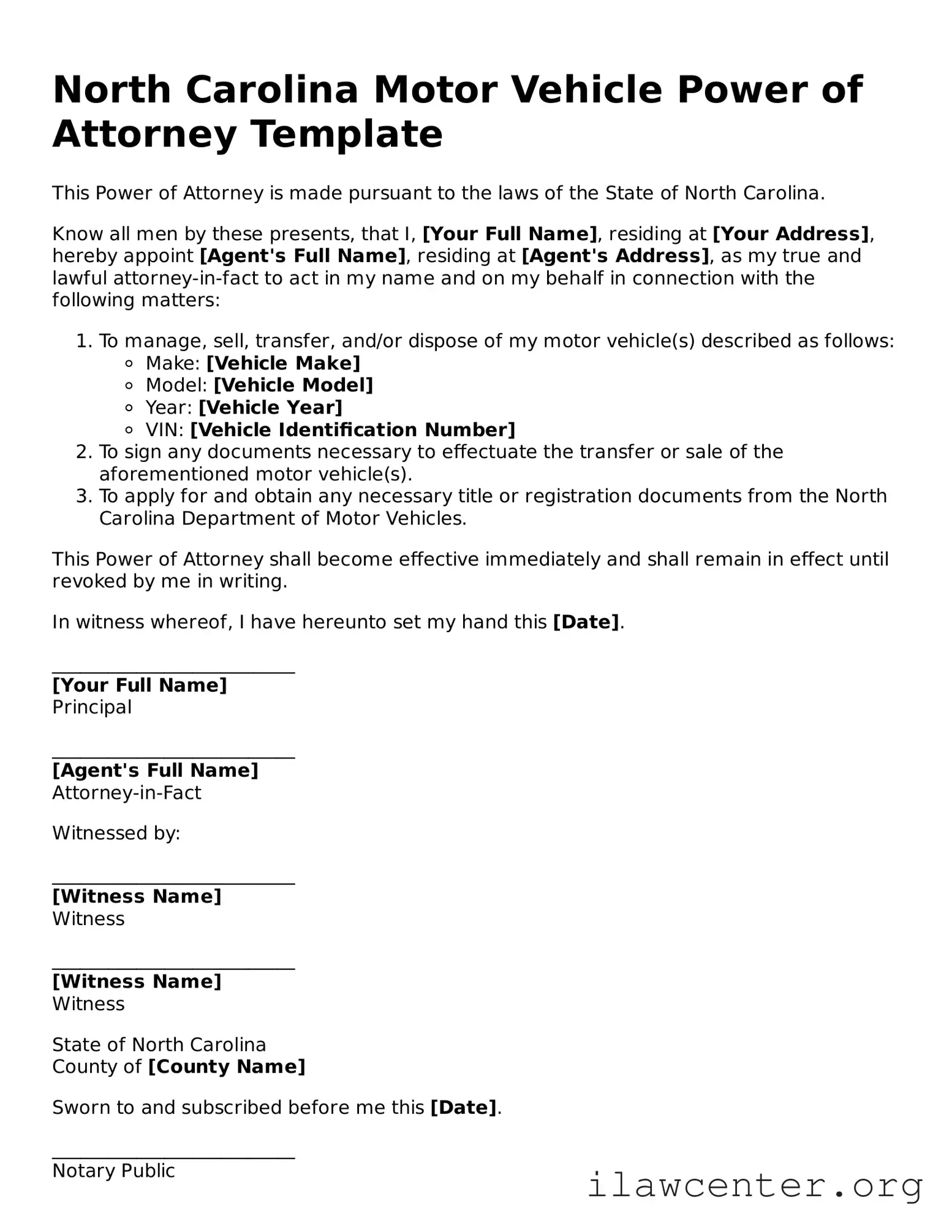
North Carolina Motor Vehicle Power of Attorney Preview

North Carolina Motor Vehicle Power of Attorney Template

This Power of Attorney is made pursuant to the laws of the State of North Carolina.

Know all men by these presents, that I, [Your Full Name], residing at [Your Address], hereby appoint [Agent's Full Name], residing at [Agent's Address], as my true and lawful attorney-in-fact to act in my name and on my behalf in connection with the following matters:

  1. To manage, sell, transfer, and/or dispose of my motor vehicle(s) described as follows:
    • Make: [Vehicle Make]
    • Model: [Vehicle Model]
    • Year: [Vehicle Year]
    • VIN: [Vehicle Identification Number]
  2. To sign any documents necessary to effectuate the transfer or sale of the aforementioned motor vehicle(s).
  3. To apply for and obtain any necessary title or registration documents from the North Carolina Department of Motor Vehicles.

This Power of Attorney shall become effective immediately and shall remain in effect until revoked by me in writing.

In witness whereof, I have hereunto set my hand this [Date].

__________________________
[Your Full Name]
Principal

__________________________
[Agent's Full Name]
Attorney-in-Fact

Witnessed by:

__________________________
[Witness Name]
Witness

__________________________
[Witness Name]
Witness

State of North Carolina
County of [County Name]

Sworn to and subscribed before me this [Date].

__________________________
Notary Public
My Commission Expires: [Date]

PDF Form Characteristics

Fact Name Detail
Purpose The North Carolina Motor Vehicle Power of Attorney form allows an individual to authorize another person to act on their behalf regarding motor vehicle transactions.
Governing Law This form is governed by North Carolina General Statutes, specifically § 20-4.01.
Signatories The form must be signed by the principal, who is the individual granting the authority.
Agent Requirements The agent must be at least 18 years old and capable of fulfilling the responsibilities assigned.
Scope of Authority The authority granted can include tasks such as transferring ownership, registering vehicles, and obtaining titles.
Revocation The principal can revoke the Power of Attorney at any time, as long as they provide proper notice to the agent.
Notarization Notarization is not required for this form to be valid, but it is recommended for added legal protection.
Duration The Power of Attorney remains effective until revoked by the principal or until the specific transaction is completed.
Usage This form is commonly used when the principal cannot be present to complete vehicle-related transactions.
Availability The form can typically be obtained from the North Carolina Division of Motor Vehicles or legal resources online.

Instructions on Utilizing North Carolina Motor Vehicle Power of Attorney

After obtaining the North Carolina Motor Vehicle Power of Attorney form, it is essential to fill it out accurately to ensure that the designated person can act on your behalf regarding motor vehicle matters. Follow these steps carefully to complete the form correctly.

  1. Begin by entering the date at the top of the form.
  2. Provide your full name in the designated area. Ensure that the spelling is correct.
  3. Write your address, including the city, state, and zip code.
  4. Next, enter the name of the person you are granting power of attorney to. This is the individual who will act on your behalf.
  5. Fill in the address of the designated person, ensuring all details are accurate.
  6. Specify the type of motor vehicle matters that the power of attorney will cover. This may include buying, selling, or transferring ownership of a vehicle.
  7. Sign the form in the designated area. Make sure your signature matches the name provided earlier.
  8. Have the form notarized. This step is crucial for the document to be legally binding.

Once you have completed these steps, review the form to ensure all information is accurate and legible. After that, you can submit the form as required or keep it for your records. Proper completion will facilitate the process of allowing your designated representative to manage your motor vehicle transactions seamlessly.

Important Facts about North Carolina Motor Vehicle Power of Attorney

What is a Motor Vehicle Power of Attorney in North Carolina?

A Motor Vehicle Power of Attorney in North Carolina is a legal document that allows an individual, known as the principal, to designate another person, called the agent, to act on their behalf regarding specific motor vehicle transactions. This can include tasks such as signing titles, registering vehicles, or transferring ownership. The document is particularly useful when the principal is unable to handle these matters personally due to reasons like being out of state or having health issues.

How do I complete the Motor Vehicle Power of Attorney form?

To complete the Motor Vehicle Power of Attorney form, you must first obtain the official form from the North Carolina Division of Motor Vehicles (NCDMV) or a legal resource. Fill in the necessary information, including the names and addresses of both the principal and the agent. Specify the powers being granted, such as the ability to sell or transfer a vehicle. After completing the form, both parties must sign it in the presence of a notary public to ensure its validity.

Is it necessary to have the Motor Vehicle Power of Attorney notarized?

Yes, it is necessary for the Motor Vehicle Power of Attorney to be notarized in North Carolina. Notarization adds a layer of authenticity to the document, ensuring that both the principal and the agent have willingly signed it. This step is crucial for the document to be accepted by the NCDMV and other entities involved in motor vehicle transactions. Without notarization, the form may be deemed invalid.

Can I revoke the Motor Vehicle Power of Attorney once it is established?

Yes, you can revoke the Motor Vehicle Power of Attorney at any time as long as you are mentally competent to do so. To revoke the power, you should create a written notice stating your intention to revoke the authority granted to the agent. It is advisable to notify the agent and any institutions or entities that may have relied on the original document. This ensures that the agent no longer has the authority to act on your behalf in motor vehicle matters.

Common mistakes

Filling out the North Carolina Motor Vehicle Power of Attorney form can be straightforward, but many individuals make common mistakes that can lead to delays or complications. One frequent error is failing to provide accurate identification information. It's essential to ensure that both the principal and the agent's names are spelled correctly and match the identification documents. Any discrepancies can cause issues when the document is presented.

Another mistake is neglecting to specify the powers granted. The form allows for specific powers to be designated. If the powers are too vague or not clearly outlined, it may lead to confusion or disputes later. Clearly stating what the agent can and cannot do is crucial for avoiding misunderstandings.

Some individuals forget to sign and date the form. This is a critical step. Without a signature, the document is not valid. Additionally, not having a date can raise questions about the timing of the powers granted, which could complicate matters further.

Inadequate witness signatures are another common issue. North Carolina requires the form to be witnessed. If the necessary witnesses do not sign, the document may be deemed invalid. It's important to ensure that the witnesses are present and understand their role in the process.

Another mistake involves using outdated versions of the form. Laws and requirements can change. Always ensure that the most current version of the Motor Vehicle Power of Attorney form is being used to avoid potential legal issues.

Some people overlook the need for notarization. While not always required, having the document notarized can add an extra layer of validity. It’s advisable to check the specific requirements for your situation.

Additionally, failing to provide a clear description of the vehicle can create problems. The form should include the vehicle's make, model, year, and Vehicle Identification Number (VIN). Omitting this information can lead to confusion about which vehicle the powers pertain to.

Another common oversight is not keeping copies of the completed form. After filling it out, retain copies for personal records. This can be crucial for reference in the future or if any disputes arise.

Finally, many individuals do not review the completed form for errors before submission. Taking the time to double-check all entries can prevent unnecessary complications. A thorough review ensures that all information is accurate and complete.

Documents used along the form

The North Carolina Motor Vehicle Power of Attorney form is a legal document that allows an individual to designate another person to act on their behalf regarding motor vehicle transactions. When completing this process, several other forms and documents may be necessary to ensure compliance with state regulations and to facilitate the transaction. Below is a list of commonly used documents that accompany the Motor Vehicle Power of Attorney form.

  • North Carolina DMV Title Application: This form is required when applying for a new title or transferring an existing title. It provides essential information about the vehicle and the parties involved in the transaction.
  • Bill of Sale: This document serves as proof of the sale of a vehicle. It includes details such as the purchase price, vehicle identification number (VIN), and the names of the buyer and seller.
  • Odometer Disclosure Statement: Required by federal law, this form verifies the mileage on the vehicle at the time of sale. It is essential for preventing fraud and ensuring accurate vehicle history.
  • North Carolina Vehicle Registration Application: This form is necessary for registering a vehicle in North Carolina. It includes information about the vehicle and the owner and is submitted to the DMV.
  • Insurance Information: Proof of insurance is often required when registering a vehicle. This document demonstrates that the vehicle is covered by a valid insurance policy.
  • Identification Documents: A valid form of identification, such as a driver’s license or state ID, is usually needed to verify the identity of the person completing the transaction.

Each of these documents plays a critical role in the process of managing motor vehicle transactions in North Carolina. Ensuring that all necessary forms are completed accurately can help prevent delays and legal issues in the future.

Similar forms

  • General Power of Attorney: This document allows one person to grant another the authority to act on their behalf in a variety of matters, not limited to motor vehicles. It provides broad powers, similar to those found in a Motor Vehicle Power of Attorney.
  • Durable Power of Attorney: This form remains effective even if the principal becomes incapacitated. Like the Motor Vehicle Power of Attorney, it enables someone to manage specific affairs, ensuring continuity of authority.
  • Limited Power of Attorney: This document restricts the agent's authority to specific tasks or time frames. Similar to the Motor Vehicle Power of Attorney, it focuses on defined actions, such as handling vehicle transactions.
  • Medical Power of Attorney: This allows an individual to make healthcare decisions for someone else. While focused on medical issues, it shares the principle of delegating authority, akin to a Motor Vehicle Power of Attorney.
  • Financial Power of Attorney: This form grants authority to manage financial matters. Like the Motor Vehicle Power of Attorney, it empowers someone to act in the principal's best interests in a specific area.
  • Real Estate Power of Attorney: This document allows an agent to handle real estate transactions. It is similar in function to the Motor Vehicle Power of Attorney, which focuses on vehicle-related matters.
  • Trustee Appointment: This document designates an individual to manage a trust. Like a Motor Vehicle Power of Attorney, it involves appointing someone to act on behalf of another, albeit in a different context.
  • Business Power of Attorney: This form enables someone to act on behalf of a business entity. It shares the same concept of authority delegation as the Motor Vehicle Power of Attorney, tailored for business-related decisions.
  • Child Care Power of Attorney: This document allows a parent to designate someone to make decisions for their child. It parallels the Motor Vehicle Power of Attorney in that it grants specific authority to another person.

Dos and Don'ts

When filling out the North Carolina Motor Vehicle Power of Attorney form, it is important to be careful and thorough. Here are some guidelines to help you navigate the process effectively.

  • Do read the entire form carefully before starting to fill it out.
  • Do provide accurate information for both the principal and the agent.
  • Do sign and date the form in the appropriate sections.
  • Do keep a copy of the completed form for your records.
  • Don't leave any blank spaces on the form; fill in all required fields.
  • Don't use white-out or other correction methods on the form.
  • Don't forget to have the form notarized if required.
  • Don't submit the form without double-checking for errors.

Misconceptions

When dealing with the North Carolina Motor Vehicle Power of Attorney form, several misconceptions can arise. Understanding these can help individuals navigate the process more effectively. Here’s a list of common misunderstandings:

  1. It can only be used for buying or selling vehicles. Many believe this form is limited to transactions. In reality, it can also be used for registering vehicles, obtaining titles, and handling other motor vehicle-related matters.
  2. Only a lawyer can complete this form. While legal assistance can be helpful, individuals can fill out the form themselves. It’s designed for straightforward use.
  3. It must be notarized to be valid. Notarization is not always required. The form can be valid without it, depending on the situation, but having it notarized can add an extra layer of security.
  4. It expires after a certain period. There is no set expiration date for the Power of Attorney. It remains in effect until the principal revokes it or the purpose is fulfilled.
  5. Only the vehicle owner can create a Power of Attorney. In some cases, a vehicle owner can designate someone else to act on their behalf, even if they are not the primary owner.
  6. All powers are granted automatically. The form allows for specific powers to be granted. It’s essential to clearly outline what the agent can and cannot do.
  7. It is only valid in North Carolina. While it is tailored for North Carolina, it can also be recognized in other states, depending on their laws.
  8. Once signed, it cannot be changed. The Power of Attorney can be revoked or modified at any time by the principal, as long as they are mentally competent.
  9. It is only for individuals. Businesses can also use this form to designate an agent for their motor vehicle transactions.
  10. Agents cannot be compensated. Agents can be paid for their services if the principal agrees to compensation. This should be specified in the agreement.

Understanding these misconceptions can help individuals make informed decisions when using the North Carolina Motor Vehicle Power of Attorney form.

Key takeaways

Filling out and using the North Carolina Motor Vehicle Power of Attorney form can seem daunting, but understanding the key aspects can simplify the process. Here are some essential takeaways:

  1. Purpose of the Form: This form allows you to authorize another person to act on your behalf regarding your motor vehicle transactions, such as title transfers or registration renewals.
  2. Eligibility: Any adult can be designated as your agent. However, it is crucial to choose someone you trust, as they will have significant authority over your vehicle-related matters.
  3. Completing the Form: Ensure that all sections of the form are filled out completely and accurately. Missing information could lead to delays or complications in processing your requests.
  4. Signature Requirements: Your signature must be notarized to validate the document. This step is essential to prevent any potential disputes about the authority granted.
  5. Duration of Authority: The Power of Attorney remains effective until you revoke it or until the specific task is completed. Be aware that you can revoke it at any time if you change your mind.
  6. Consulting Legal Help: If you have any doubts or questions about filling out the form, seeking advice from a legal professional can provide clarity and ensure that your interests are protected.

Understanding these key points can help you navigate the process more smoothly, ensuring that your vehicle-related transactions are handled effectively and with confidence.