Attorney-Verified  Non-compete Agreement Document for North Carolina

Attorney-Verified Non-compete Agreement Document for North Carolina

A North Carolina Non-compete Agreement form is a legal document that restricts an employee's ability to work for competing businesses after leaving their current employer. This agreement aims to protect the employer's business interests and confidential information. Understanding its implications is crucial for both employers and employees alike.

If you're ready to take the next step, consider filling out the form by clicking the button below.

Article Guide

In North Carolina, the Non-compete Agreement form serves as a crucial tool for employers seeking to protect their business interests while balancing the rights of employees. This legally binding document outlines the terms under which an employee agrees not to engage in competitive activities for a specified period after leaving the company. Key aspects include the duration of the non-compete period, the geographical scope of the restriction, and the specific activities that are considered competitive. It is essential for both parties to understand the implications of the agreement, as it can significantly impact an employee's future job prospects. Furthermore, the enforceability of such agreements hinges on their reasonableness, which is assessed based on factors like the necessity for protection of legitimate business interests and the potential harm to the employee's career. Given the complexities involved, it is vital to approach the drafting and signing of a Non-compete Agreement with careful consideration to ensure compliance with North Carolina law.

North Carolina Non-compete Agreement Preview

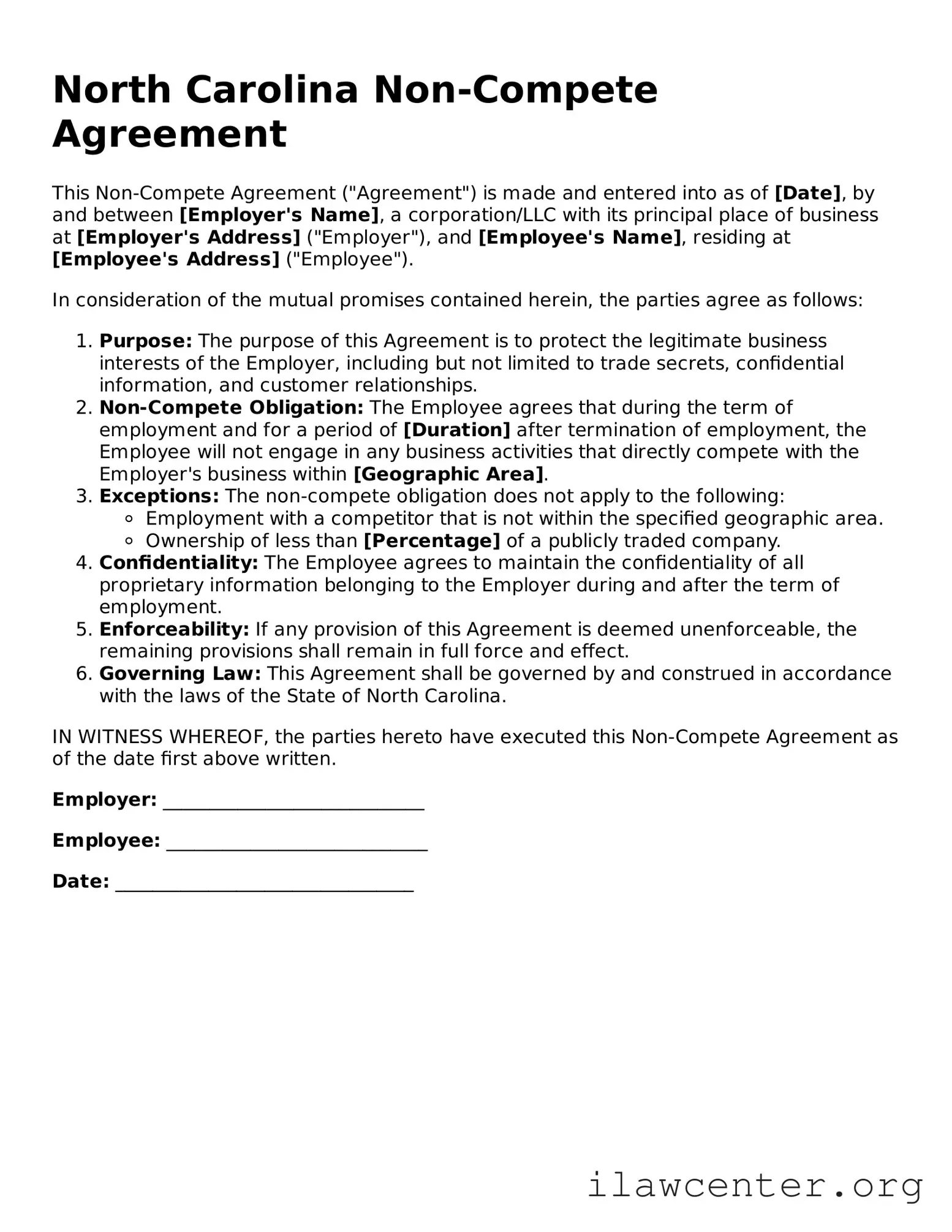
North Carolina Non-Compete Agreement

This Non-Compete Agreement ("Agreement") is made and entered into as of [Date], by and between [Employer's Name], a corporation/LLC with its principal place of business at [Employer's Address] ("Employer"), and [Employee's Name], residing at [Employee's Address] ("Employee").

In consideration of the mutual promises contained herein, the parties agree as follows:

  1. Purpose: The purpose of this Agreement is to protect the legitimate business interests of the Employer, including but not limited to trade secrets, confidential information, and customer relationships.
  2. Non-Compete Obligation: The Employee agrees that during the term of employment and for a period of [Duration] after termination of employment, the Employee will not engage in any business activities that directly compete with the Employer's business within [Geographic Area].
  3. Exceptions: The non-compete obligation does not apply to the following:
    • Employment with a competitor that is not within the specified geographic area.
    • Ownership of less than [Percentage] of a publicly traded company.
  4. Confidentiality: The Employee agrees to maintain the confidentiality of all proprietary information belonging to the Employer during and after the term of employment.
  5. Enforceability: If any provision of this Agreement is deemed unenforceable, the remaining provisions shall remain in full force and effect.
  6. Governing Law: This Agreement shall be governed by and construed in accordance with the laws of the State of North Carolina.

IN WITNESS WHEREOF, the parties hereto have executed this Non-Compete Agreement as of the date first above written.

Employer: ____________________________

Employee: ____________________________

Date: ________________________________

PDF Form Characteristics

Fact Name Description
Governing Law The North Carolina Non-compete Agreement is governed by North Carolina General Statutes, specifically § 75-4.
Enforceability Non-compete agreements in North Carolina are enforceable if they are reasonable in time, geographic area, and scope of activity.
Consideration For a non-compete agreement to be valid, there must be adequate consideration, such as employment or access to confidential information.
Duration The duration of a non-compete agreement should generally not exceed three years, though this may vary based on the circumstances.
Geographic Scope The geographic area covered by the agreement must be reasonable and directly related to the business interests of the employer.
Public Policy North Carolina courts may refuse to enforce a non-compete agreement if it is deemed to be against public policy.
Modification Parties may agree to modify the terms of a non-compete agreement, but any changes must be documented in writing.
Judicial Review North Carolina courts have the authority to modify unreasonable non-compete agreements to make them enforceable.

Instructions on Utilizing North Carolina Non-compete Agreement

Once you have the North Carolina Non-compete Agreement form, it’s time to fill it out carefully. Ensure you have all necessary information on hand, as accuracy is important for the agreement to be valid.

  1. Begin by entering the date at the top of the form.
  2. Provide the name of the employer in the designated space.
  3. Next, fill in the name of the employee who will be bound by the agreement.
  4. Specify the duration of the non-compete period. This is the time frame during which the employee cannot engage in similar work.
  5. Clearly outline the geographic area covered by the non-compete clause. Be specific about the locations where the agreement applies.
  6. Detail the type of work or business activities that are restricted under the agreement.
  7. Both parties should sign and date the form at the bottom to indicate their acceptance of the terms.

After completing the form, review it for any errors or omissions. Once verified, provide copies to all parties involved for their records.

Important Facts about North Carolina Non-compete Agreement

What is a Non-compete Agreement in North Carolina?

A Non-compete Agreement is a legal contract between an employer and employee. It restricts the employee from working for competitors or starting a competing business for a certain period after leaving the company. This agreement is intended to protect the employer's business interests and trade secrets.

Are Non-compete Agreements enforceable in North Carolina?

Yes, Non-compete Agreements can be enforceable in North Carolina, but they must meet certain criteria. The agreement should be reasonable in scope, duration, and geographic area. Courts will evaluate whether the restrictions are necessary to protect legitimate business interests.

What factors do courts consider when evaluating a Non-compete Agreement?

Courts look at several factors, including the duration of the restriction, the geographic area covered, and the nature of the employee's work. They also consider whether the agreement protects legitimate business interests, such as trade secrets or customer relationships.

How long can a Non-compete Agreement last in North Carolina?

There is no specific time limit set by law, but most enforceable agreements range from six months to two years. The duration should be reasonable and justifiable based on the industry and the employee's role.

Can an employee negotiate the terms of a Non-compete Agreement?

Yes, employees can negotiate the terms of a Non-compete Agreement before signing. It is advisable to discuss any concerns with the employer. Modifying terms can lead to a more balanced agreement that protects both parties' interests.

What happens if I violate a Non-compete Agreement?

If you violate a Non-compete Agreement, the employer may take legal action against you. This could include seeking an injunction to prevent you from working with competitors and potentially pursuing monetary damages. It's essential to understand the implications before taking any action that could breach the agreement.

Can a Non-compete Agreement be terminated?

A Non-compete Agreement can be terminated under certain conditions. This might include mutual agreement between the parties or a change in circumstances that makes the agreement unreasonable. It’s important to document any changes in writing.

What should I do if I am asked to sign a Non-compete Agreement?

If you are asked to sign a Non-compete Agreement, read it carefully. Consider seeking legal advice to understand your rights and obligations. Ensure that the terms are fair and reasonable before signing.
Common mistakes

Filling out the North Carolina Non-compete Agreement form can be a straightforward process, but several common mistakes often lead to complications. One major error is failing to clearly define the scope of the agreement. It is crucial to specify the activities that are restricted. Without clear definitions, the agreement may become unenforceable.

Another mistake is neglecting to include a reasonable duration for the non-compete clause. An excessively long time frame can render the agreement invalid. Conversely, a duration that is too short may not adequately protect the interests of the employer. Striking the right balance is essential.

Individuals often overlook the importance of geographic limitations. The agreement should specify the areas where the restrictions apply. A vague geographic scope can lead to confusion and potential legal challenges. Clearly outlining the geographic boundaries helps prevent disputes in the future.

In addition, some people forget to consider the consideration given for signing the agreement. In North Carolina, there must be a valid reason for the employee to agree to the non-compete terms, such as a job offer or a promotion. Without this consideration, the agreement may not hold up in court.

Another frequent error is failing to consult with legal counsel before finalizing the agreement. While it may seem unnecessary, legal advice can help ensure that the terms are fair and compliant with state laws. This step can save time and money in the long run.

Additionally, individuals sometimes make the mistake of signing the agreement without fully understanding its implications. It is vital to read and comprehend every clause before signing. Misunderstanding the terms can lead to unintended consequences.

People also often neglect to update the agreement when circumstances change. If an employee's role or the nature of the business evolves, the non-compete agreement should be revised accordingly. Failing to do so can result in outdated restrictions that no longer serve their intended purpose.

Another common pitfall is not keeping a copy of the signed agreement. Both parties should retain copies for their records. This ensures that everyone is on the same page regarding the terms and can reference the agreement if disputes arise.

Lastly, individuals may ignore the importance of mutuality in the agreement. A one-sided non-compete that only restricts one party may not be enforceable. Ensuring that both parties have obligations under the agreement can enhance its validity.

Documents used along the form

When dealing with a North Carolina Non-compete Agreement, several other forms and documents may be necessary to support the agreement or clarify its terms. Below is a list of commonly used documents that often accompany a Non-compete Agreement.

  • Employment Agreement: This document outlines the terms of employment, including job responsibilities, compensation, and other conditions of employment. It often includes clauses related to confidentiality and non-competition.
  • Confidentiality Agreement: Also known as a Non-disclosure Agreement (NDA), this form protects sensitive information shared between parties during the course of employment or business dealings.
  • Severance Agreement: This agreement details the terms under which an employee will receive severance pay and other benefits upon termination. It may include non-compete clauses as part of the terms.
  • Consulting Agreement: Used when a former employee provides consulting services to a company, this document outlines the scope of work, payment terms, and any non-compete obligations.
  • Intellectual Property Assignment Agreement: This form ensures that any intellectual property created by an employee during their employment is owned by the employer, often tied to non-compete provisions.
  • Release of Claims: This document is signed by an employee to waive any potential claims against the employer, often in exchange for severance or other benefits, and may reference non-compete obligations.
  • Job Offer Letter: This letter formally offers employment to a candidate and may reference the requirement to sign a Non-compete Agreement as part of the hiring process.
  • Termination Letter: This letter notifies an employee of their termination and may reiterate the terms of the Non-compete Agreement, reminding them of their obligations post-employment.

These documents play a crucial role in ensuring that both parties understand their rights and obligations regarding employment, confidentiality, and competition. Having them in place helps to prevent misunderstandings and protects the interests of the employer while clarifying the expectations for the employee.

Similar forms

  • Non-disclosure Agreement (NDA): This document prevents parties from sharing confidential information. Like a non-compete agreement, it protects business interests and sensitive information from being disclosed to competitors.
  • Employment Agreement: This outlines the terms of employment, including duties, compensation, and termination conditions. It may contain clauses that restrict competition, similar to a non-compete agreement.
  • Severance Agreement: This is used when an employee leaves a company. It often includes non-compete clauses to prevent former employees from joining competitors shortly after departure.
  • Confidentiality Agreement: Similar to an NDA, this document ensures that sensitive information remains private. Both agreements aim to protect proprietary information and trade secrets.
  • Partnership Agreement: This document outlines the terms of a business partnership. It may include non-compete clauses to restrict partners from starting competing businesses during and after the partnership.
  • Intellectual Property Assignment Agreement: This agreement transfers ownership of intellectual property. It often includes non-compete provisions to prevent the use of that intellectual property in a competing business.
  • Consulting Agreement: This defines the terms of a consulting relationship. It may include non-compete clauses to protect the client’s business interests from consultants who might work with competitors.
  • Franchise Agreement: This document governs the relationship between a franchisor and franchisee. It typically includes non-compete clauses to maintain brand integrity and market control.
  • Sales Representative Agreement: This outlines the terms under which a sales representative operates. Non-compete clauses may be included to prevent representatives from selling competing products during or after their contract.

Dos and Don'ts

When filling out the North Carolina Non-compete Agreement form, it's essential to follow certain guidelines to ensure clarity and legality. Here’s a straightforward list of dos and don’ts.

  • Do read the entire agreement carefully before signing.
  • Do consult with a legal professional if you have questions.
  • Do ensure that the agreement is reasonable in scope and duration.
  • Do clearly define the geographic area covered by the agreement.
  • Do keep a copy of the signed agreement for your records.
  • Don't sign the agreement without fully understanding its terms.
  • Don't agree to overly broad restrictions that could limit your future employment.
  • Don't ignore any clauses that seem unfair or one-sided.
  • Don't forget to check if the agreement complies with North Carolina law.
  • Don't sign under pressure; take your time to consider your options.

Misconceptions

When it comes to non-compete agreements in North Carolina, there are several common misconceptions that can lead to confusion. Understanding these myths can help both employers and employees navigate the complexities of these contracts more effectively.

  • Non-compete agreements are always enforceable. Many people believe that all non-compete agreements are legally binding. However, in North Carolina, these agreements must meet specific criteria to be enforceable, including reasonableness in time, geographic area, and the scope of activity.
  • All employees must sign a non-compete agreement. It’s a common myth that every employee is required to sign a non-compete. In reality, only certain positions, typically those involving sensitive information or trade secrets, may necessitate such an agreement.
  • Non-compete agreements are the same as non-disclosure agreements. While both types of agreements aim to protect a business's interests, they serve different purposes. Non-disclosure agreements focus on confidentiality, whereas non-compete agreements restrict an employee's ability to work in similar industries after leaving a job.
  • Once signed, a non-compete agreement cannot be changed. This is not true. Parties can negotiate and modify the terms of a non-compete agreement before signing, and sometimes even after, depending on the circumstances and mutual consent.
  • Non-compete agreements are only for executives or high-level employees. Many people think that only top executives need to worry about non-compete agreements. However, they can apply to employees at various levels, especially if they have access to proprietary information.
  • Non-compete agreements are always for a long duration. While some non-compete agreements may have lengthy restrictions, they can also be tailored to shorter time frames. The key is that the duration must be reasonable based on the industry and specific job role.
  • If I sign a non-compete, I can't work in my field again. This misconception can be alarming. In reality, if a non-compete agreement is deemed overly restrictive or unreasonable, it may not be enforceable in court, allowing individuals to continue working in their field.

By clarifying these misconceptions, both employers and employees can better understand their rights and obligations under non-compete agreements in North Carolina. Knowledge is power, and being informed can lead to more favorable outcomes for everyone involved.

Key takeaways

Here are some key takeaways about filling out and using the North Carolina Non-compete Agreement form:

  • The agreement must be in writing to be enforceable.
  • Clearly define the scope of the non-compete, including the geographic area and duration.
  • Ensure that the terms are reasonable and not overly restrictive.
  • Both parties should sign the agreement to indicate their consent.
  • Consider consulting with a legal professional to review the agreement.
  • Keep a copy of the signed agreement for future reference.