Attorney-Verified  Notary Acknowledgement Document for North Carolina

Attorney-Verified Notary Acknowledgement Document for North Carolina

The North Carolina Notary Acknowledgement form is a document that verifies the identity of a signer and confirms that they willingly signed a document. This form plays a crucial role in ensuring that legal documents are valid and recognized. To get started with your Notary Acknowledgement, fill out the form by clicking the button below.

Article Guide

The North Carolina Notary Acknowledgement form plays a crucial role in the legal landscape of the state, serving as a vital tool for ensuring the authenticity of signatures on important documents. This form is typically used when an individual needs to verify their identity before a notary public, who then confirms that the signer willingly executed the document in question. Essential elements of the form include the name and signature of the individual, the date of the acknowledgment, and the notary's official seal, all of which work together to provide a layer of protection against fraud. Additionally, the form must include a statement indicating that the signer appeared before the notary, affirming their identity and willingness to sign. Understanding the nuances of this form is essential for anyone involved in legal transactions, as it not only upholds the integrity of the document but also helps to prevent disputes that may arise over the authenticity of signatures. In North Carolina, the use of this form is governed by specific laws and regulations, making it imperative for individuals and legal professionals alike to be well-versed in its requirements and implications.

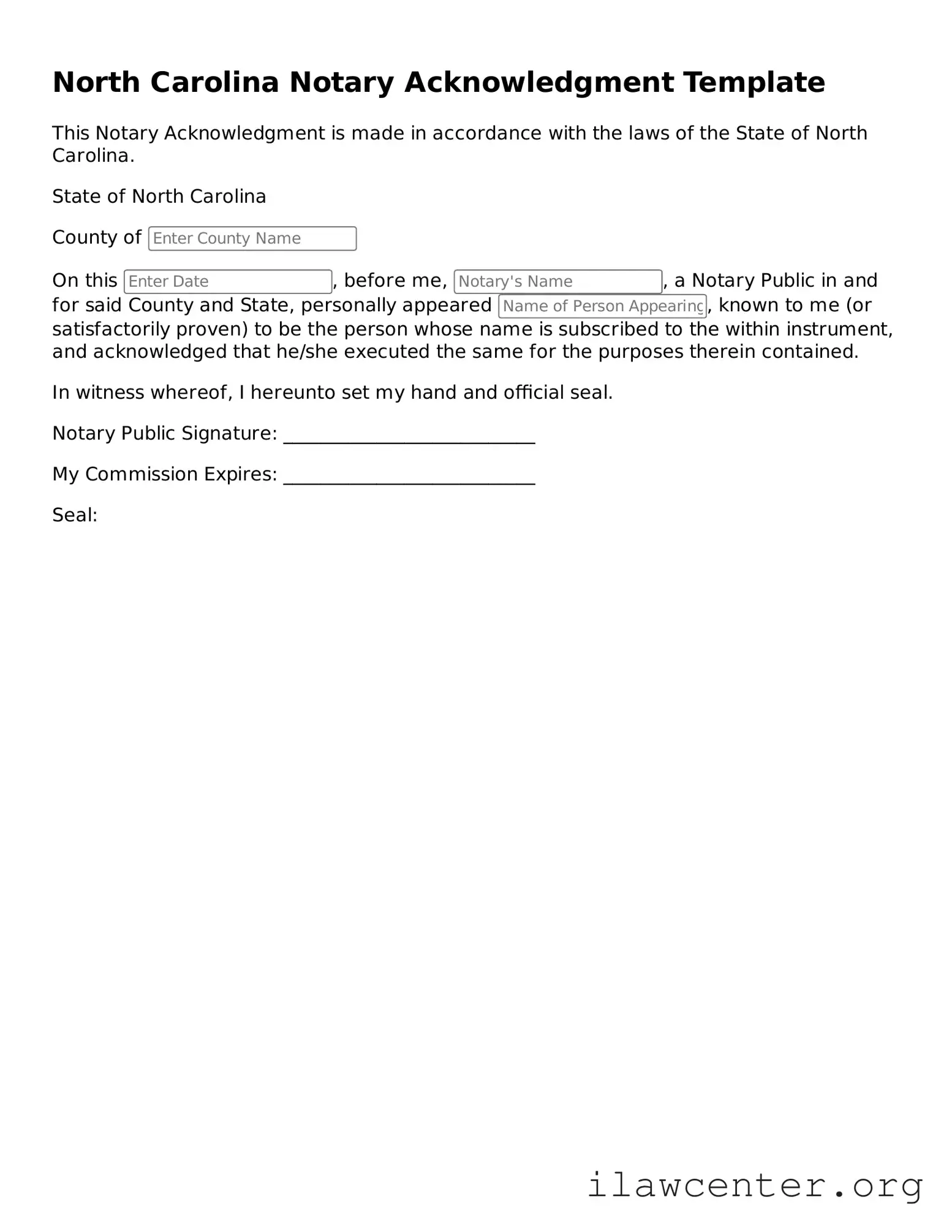
North Carolina Notary Acknowledgement Preview

North Carolina Notary Acknowledgment Template

This Notary Acknowledgment is made in accordance with the laws of the State of North Carolina.

State of North Carolina

County of

On this , before me, , a Notary Public in and for said County and State, personally appeared , known to me (or satisfactorily proven) to be the person whose name is subscribed to the within instrument, and acknowledged that he/she executed the same for the purposes therein contained.

In witness whereof, I hereunto set my hand and official seal.

Notary Public Signature: ___________________________

My Commission Expires: ___________________________

Seal:

PDF Form Characteristics

Fact Name Description
Purpose The North Carolina Notary Acknowledgment form is used to confirm that a person has signed a document in the presence of a notary public.
Governing Law This form is governed by North Carolina General Statutes Chapter 10B, which outlines the laws regarding notaries public.
Signature Requirement The signer must personally appear before the notary and provide a valid form of identification.
Notary Seal A notary public must affix their official seal to the acknowledgment form to validate it.
Document Types This acknowledgment can be used for various documents, including deeds, contracts, and affidavits.
Record Keeping Notaries are required to keep a record of all acknowledgments performed in their official journal.
Expiration The acknowledgment does not expire; however, it is essential that the document it pertains to is executed within a reasonable time frame.

Instructions on Utilizing North Carolina Notary Acknowledgement

Once you have the North Carolina Notary Acknowledgement form ready, you will need to complete it accurately. This form is essential for verifying the identity of the signer and ensuring that the document is executed properly.

  1. Begin by entering the date at the top of the form.
  2. In the first blank, write the name of the person who is signing the document.
  3. Next, fill in the address of the signer. Include the street address, city, state, and zip code.
  4. In the next section, write the name of the person who is taking the acknowledgment, usually the notary public.
  5. Indicate the county where the acknowledgment is taking place.
  6. Leave the space for the notary's signature blank for now. This will be signed in front of the notary.
  7. Finally, fill in the notary's commission expiration date.

After completing the form, ensure that the signer appears before the notary to sign the document in their presence. The notary will then complete the acknowledgment by signing and sealing the form.

Important Facts about North Carolina Notary Acknowledgement

What is a North Carolina Notary Acknowledgement form?

The North Carolina Notary Acknowledgement form is a legal document used to verify the identity of individuals signing a document. It serves as proof that the signer appeared before a notary public, who confirmed their identity and willingness to sign. This form is often required for various legal documents, including deeds, contracts, and powers of attorney, to ensure authenticity and prevent fraud.

How do I complete a Notary Acknowledgement in North Carolina?

To complete a Notary Acknowledgement, the signer must first appear before a notary public. The notary will ask the signer to provide valid identification to confirm their identity. After verifying the identity, the notary will fill out the form, including details such as the date, the signer's name, and the notary's signature and seal. It is crucial that the signer is present during this process, as the notary must witness the signing of the document.

Is a Notary Acknowledgement required for all documents in North Carolina?

No, a Notary Acknowledgement is not required for all documents. However, many legal documents benefit from having one to enhance their credibility. Certain documents, such as real estate deeds or powers of attorney, typically require notarization to be legally enforceable. Always check the specific requirements for the type of document you are dealing with to determine if a Notary Acknowledgement is necessary.

What happens if a Notary Acknowledgement is not properly executed?

If a Notary Acknowledgement is not properly executed, the document may be deemed invalid. This can lead to complications, such as challenges to the authenticity of the signatures or disputes regarding the enforceability of the document. It is essential to ensure that all steps in the notarization process are followed correctly to avoid potential legal issues. If you suspect a problem with a notarized document, consult a legal professional for guidance.

Common mistakes

Filling out the North Carolina Notary Acknowledgement form can seem straightforward, but there are common mistakes that people often make. One frequent error is failing to include the correct date. The date is crucial, as it indicates when the acknowledgment took place. Without it, the document may be deemed incomplete or invalid.

Another mistake involves not providing the signer's name clearly. The form requires the name to be printed legibly. If the name is unclear or written incorrectly, it can lead to issues in verifying the identity of the signer later on. Always double-check this section to ensure accuracy.

People sometimes overlook the requirement for the notary's signature. After the acknowledgment is completed, the notary must sign the form. If this step is skipped, the document will not have the necessary authentication, rendering it ineffective for its intended purpose.

Additionally, the notary's seal is often missing. The seal is a critical part of the acknowledgment process, as it provides an official mark of validation. Without it, the document may face challenges in being accepted by various institutions.

Finally, some individuals forget to check the notarial jurisdiction. The form must specify that the notary is authorized to perform duties in the state of North Carolina. Neglecting this detail can cause complications, especially if the document is used outside the state.

Documents used along the form

In North Carolina, the Notary Acknowledgment form is often used in conjunction with several other legal documents. These forms serve various purposes, such as verifying identity, recording transactions, or formalizing agreements. Below is a list of commonly used forms that you may encounter alongside the Notary Acknowledgment form.

  • Power of Attorney: This document allows one person to grant another the authority to act on their behalf in legal or financial matters.
  • Affidavit: A written statement confirmed by oath or affirmation, used as evidence in court or other legal proceedings.
  • Deed: A legal document that transfers ownership of real property from one party to another, often requiring notarization.
  • Lease Agreement: A contract between a landlord and tenant that outlines the terms of rental, which may require notarization for certain provisions.
  • Quitclaim Deed: A type of deed that transfers any interest the grantor has in the property without guaranteeing that the title is clear.
  • Certificate of Acknowledgment: A form that confirms a notary has verified the identity of the signer and the voluntary nature of the signature.
  • Will: A legal document that outlines how a person’s assets will be distributed upon their death, sometimes requiring notarization for validity.
  • Business Resolution: A document that records decisions made by a corporation or LLC, which may need to be notarized to validate the decision-making process.

These forms are integral to various legal processes in North Carolina. Understanding their functions can help ensure that legal transactions are conducted smoothly and in compliance with state laws.

Similar forms

The Notary Acknowledgment form is an essential document in the realm of notarization, but it shares similarities with several other documents. Here are nine documents that are comparable to the Notary Acknowledgment form, along with explanations of how they relate:

  • Affidavit: Like a Notary Acknowledgment, an affidavit is a written statement confirmed by oath or affirmation. Both require a notary to verify the identity of the signer.
  • Power of Attorney: This document allows one person to act on behalf of another. A notary often acknowledges the signature on a Power of Attorney, ensuring the principal's consent is genuine.
  • Deed: A deed transfers ownership of property. Similar to a Notary Acknowledgment, a deed must be notarized to be legally binding, confirming that the signer acted voluntarily.
  • Will: A will outlines a person's wishes regarding their estate after death. Notarization can add an extra layer of validation, similar to the role of a Notary Acknowledgment.
  • Contract: Contracts are agreements between parties. Notarizing a contract, much like a Notary Acknowledgment, helps verify that all parties signed willingly and are who they claim to be.
  • Loan Document: When securing a loan, various documents require notarization. The process is akin to a Notary Acknowledgment, as it confirms the identity of the borrower and their understanding of the terms.
  • Certificate of Authenticity: This document verifies the legitimacy of an item, often in art or collectibles. Notaries can acknowledge the signatures involved, similar to how they validate a Notary Acknowledgment.
  • Release of Liability: This document protects one party from claims by another. A notary's acknowledgment can ensure that the signer understands the implications, much like with a Notary Acknowledgment.
  • Settlement Agreement: In disputes, a settlement agreement outlines the terms of resolution. Notarization can provide assurance that the agreement was entered into knowingly, paralleling the purpose of a Notary Acknowledgment.

Dos and Don'ts

When filling out the North Carolina Notary Acknowledgement form, it's important to follow certain guidelines to ensure the document is completed correctly. Below is a list of things you should and shouldn't do.

  • Do ensure that all required fields are filled out completely.
  • Do verify the identity of the signer before proceeding with the acknowledgment.
  • Do use clear and legible handwriting or type the information when possible.
  • Do keep a copy of the completed acknowledgment for your records.
  • Do sign and date the form in the designated area.
  • Don't leave any fields blank unless specified as optional.
  • Don't sign the form without the presence of the signer.
  • Don't use correction fluid or tape to alter the form.
  • Don't fill out the form if you are unsure of the signer's identity.
  • Don't forget to include your notary seal where required.

Misconceptions

Understanding the North Carolina Notary Acknowledgement form is crucial for anyone needing notarization. However, several misconceptions can lead to confusion. Here are four common misconceptions:

  • Notaries can notarize any document. This is false. Notaries in North Carolina can only notarize documents that they are authorized to witness. They cannot notarize documents that involve a conflict of interest or that they are personally involved in.
  • All notarizations require the signer to be present. This is not entirely true. While most notarizations require the signer to be physically present, there are provisions for remote notarization under specific circumstances, such as using audio-visual technology.
  • A notary can refuse to notarize a document for any reason. This is misleading. Notaries must adhere to specific guidelines and cannot refuse without a valid reason, such as lack of identification or if the document appears fraudulent.
  • The notary acknowledgment form is the same as a notarial certificate. This is incorrect. The notary acknowledgment form is a specific type of notarial certificate that confirms the identity of the signer and their acknowledgment of the document. Notarial certificates can vary based on the type of notarization performed.

Addressing these misconceptions is essential to ensure a smooth notarization process. Always consult a qualified notary for accurate information and guidance.

Key takeaways

When filling out and using the North Carolina Notary Acknowledgement form, it is important to keep the following key points in mind:

  • The form must be completed in full before it can be signed by the notary.
  • The signer must be present when the notary is acknowledging their signature.
  • Identification is required; the signer should provide a valid government-issued ID.
  • The notary should ensure that the signer understands the contents of the document.
  • The notary's signature and seal must be affixed to the form for it to be valid.
  • The form should be kept in a secure location after it has been completed.
  • Notaries should keep a record of all acknowledgements performed in their journal.
  • Failure to follow these guidelines may result in the form being deemed invalid.