Attorney-Verified  Operating Agreement Document for North Carolina

Attorney-Verified Operating Agreement Document for North Carolina

The North Carolina Operating Agreement form is a vital document for LLCs in the state, outlining the management structure and operational procedures of the business. This agreement serves as a blueprint for how the company will function, detailing the rights and responsibilities of its members. Ready to get started? Fill out the form by clicking the button below!

Article Guide

In North Carolina, an Operating Agreement is a crucial document for anyone forming a Limited Liability Company (LLC). This agreement outlines the internal operations of the LLC, detailing the rights and responsibilities of its members. It serves as a roadmap for how the company will be managed and how decisions will be made. Key aspects include the distribution of profits and losses, management structure, and procedures for adding or removing members. Additionally, the Operating Agreement addresses how disputes will be resolved and outlines the process for amending the agreement itself. While North Carolina does not legally require an Operating Agreement, having one in place is highly recommended to prevent misunderstandings and protect the interests of all members involved. This document not only provides clarity and structure but also helps establish the LLC's credibility with banks and potential investors.

North Carolina Operating Agreement Preview

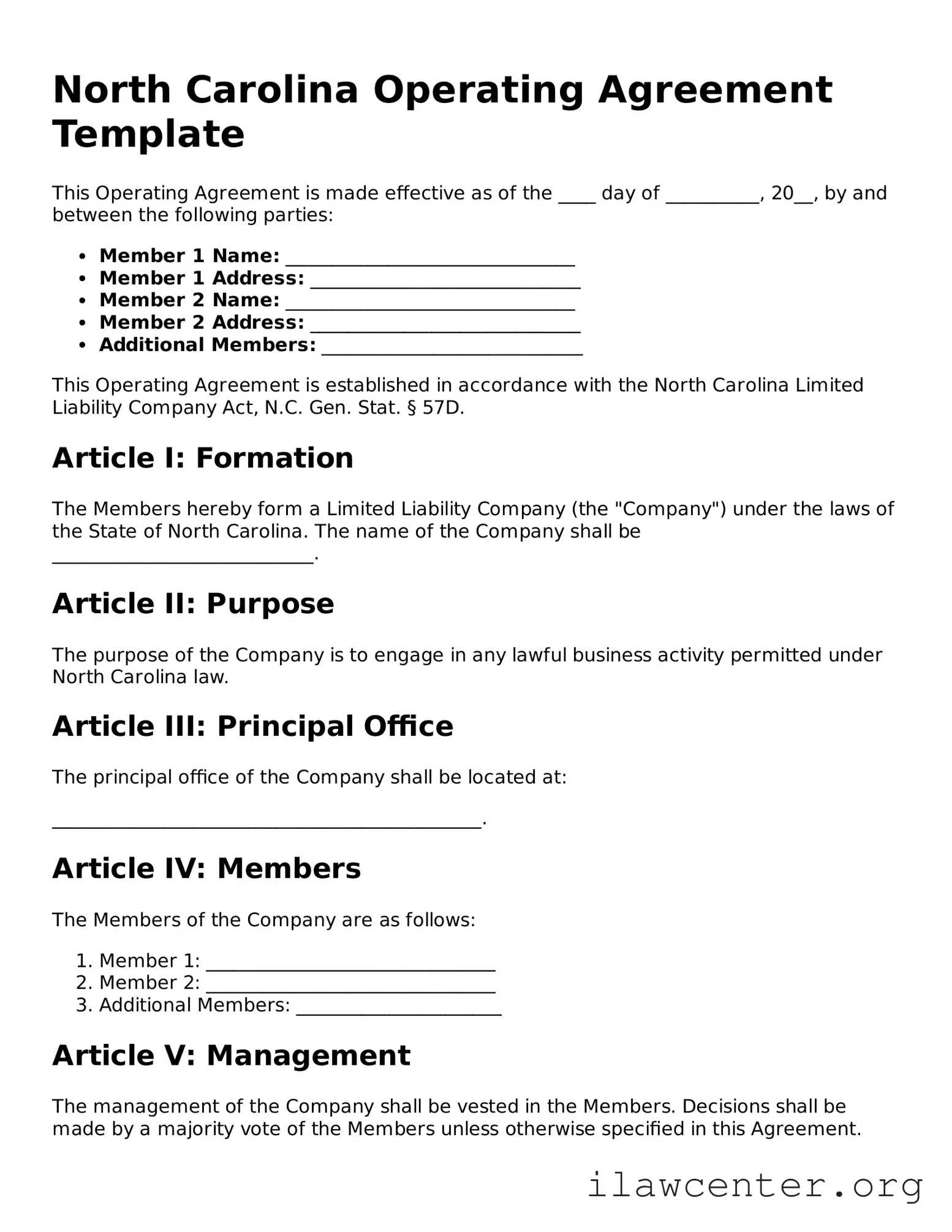
North Carolina Operating Agreement Template

This Operating Agreement is made effective as of the ____ day of __________, 20__, by and between the following parties:

  • Member 1 Name: _______________________________
  • Member 1 Address: _____________________________
  • Member 2 Name: _______________________________
  • Member 2 Address: _____________________________
  • Additional Members: ____________________________

This Operating Agreement is established in accordance with the North Carolina Limited Liability Company Act, N.C. Gen. Stat. § 57D.

Article I: Formation

The Members hereby form a Limited Liability Company (the "Company") under the laws of the State of North Carolina. The name of the Company shall be ____________________________.

Article II: Purpose

The purpose of the Company is to engage in any lawful business activity permitted under North Carolina law.

Article III: Principal Office

The principal office of the Company shall be located at:

______________________________________________.

Article IV: Members

The Members of the Company are as follows:

  1. Member 1: _______________________________
  2. Member 2: _______________________________
  3. Additional Members: ______________________

Article V: Management

The management of the Company shall be vested in the Members. Decisions shall be made by a majority vote of the Members unless otherwise specified in this Agreement.

Article VI: Capital Contributions

The Members agree to contribute capital to the Company as follows:

  • Member 1 Contribution: $____________________
  • Member 2 Contribution: $____________________
  • Additional Members Contributions: $______________

Article VII: Distributions

Distributions of profits and losses shall be allocated to the Members in proportion to their respective capital contributions, unless otherwise agreed upon in writing.

Article VIII: Amendments

This Operating Agreement may be amended only by a written agreement signed by all Members.

Article IX: Governing Law

This Agreement shall be governed by and construed in accordance with the laws of the State of North Carolina.

Signatures

IN WITNESS WHEREOF, the Members have executed this Operating Agreement as of the date first above written.

______________________________
Member 1 Signature

______________________________
Member 2 Signature

______________________________
Additional Member Signature(s)

PDF Form Characteristics

Fact Name Details
Purpose The North Carolina Operating Agreement outlines the management structure and operating procedures of a limited liability company (LLC).
Governing Law The agreement is governed by the North Carolina General Statutes, specifically Chapter 57D.
Member Rights It defines the rights and responsibilities of each member within the LLC.
Management Structure The agreement can specify whether the LLC is member-managed or manager-managed.
Profit Distribution It outlines how profits and losses will be distributed among members.
Amendments The agreement can include procedures for making amendments in the future.
Dispute Resolution It may provide methods for resolving disputes among members.
Initial Capital Contributions The agreement typically details the initial capital contributions made by each member.
Duration The agreement can specify the duration of the LLC, whether it is perpetual or for a set term.
Compliance Having an Operating Agreement is not legally required in North Carolina, but it is highly recommended for clarity and protection.

Instructions on Utilizing North Carolina Operating Agreement

Filling out the North Carolina Operating Agreement form is an important step in establishing the rules and structure of your business. This document will guide you through the process of creating a clear agreement among the members of your business entity. By following the steps outlined below, you will ensure that all necessary information is provided accurately.

  1. Begin by entering the name of your LLC at the top of the form. Make sure to use the exact name as registered with the state.
  2. Next, provide the principal office address of the LLC. This should be a physical address, not a P.O. Box.
  3. List the names and addresses of all members involved in the LLC. Each member should be clearly identified.
  4. Specify the management structure of the LLC. Indicate whether it will be member-managed or manager-managed.
  5. Outline the purpose of the LLC. Describe the nature of the business activities it will engage in.
  6. Detail the contributions of each member. This includes cash, property, or services that members will provide to the LLC.
  7. Explain how profits and losses will be allocated among members. This section should reflect the agreement among members.
  8. Include provisions for meetings. State how often meetings will be held and how decisions will be made.
  9. Address the procedures for adding new members or handling the departure of existing members.
  10. Finally, ensure that all members sign and date the agreement. This step is crucial for validating the document.

Once you have completed the form, review it carefully to ensure all information is accurate and complete. This will help avoid any potential issues in the future. After reviewing, you may proceed to file the agreement as required by state regulations.

Important Facts about North Carolina Operating Agreement

What is an Operating Agreement in North Carolina?

An Operating Agreement is a document that outlines the management structure and operating procedures of a limited liability company (LLC) in North Carolina. It serves as a roadmap for how the LLC will function, detailing the roles of members, decision-making processes, and how profits and losses will be distributed.

Is an Operating Agreement required in North Carolina?

No, North Carolina does not legally require LLCs to have an Operating Agreement. However, having one is highly recommended. It helps prevent misunderstandings among members and provides clarity on how the business should be run.

Who should create the Operating Agreement?

The members of the LLC should collaboratively create the Operating Agreement. Each member should have input to ensure that their interests and responsibilities are clearly defined. It’s a good idea to consult with a legal professional to ensure that the agreement meets all necessary requirements.

What should be included in the Operating Agreement?

An Operating Agreement should include several key elements. These typically cover the ownership structure, member responsibilities, voting rights, how profits and losses will be shared, and procedures for adding or removing members. It may also address what happens if the LLC needs to be dissolved.

Can the Operating Agreement be amended?

Yes, the Operating Agreement can be amended. Members should agree on the amendment process, which can be included in the original document. It’s important to keep the agreement updated to reflect any changes in the business or its members.

How does an Operating Agreement affect liability protection?

An Operating Agreement helps reinforce the limited liability protection that an LLC provides. By clearly outlining the roles and responsibilities of members, it can help protect personal assets from business liabilities. Without a proper agreement, a court might find it easier to disregard the LLC's limited liability status.

Where can I find a template for an Operating Agreement?

Templates for Operating Agreements can be found online through various legal websites or business resources. However, it's wise to customize any template to fit the specific needs of your LLC. Consulting a legal professional can also ensure that the document complies with North Carolina laws.

What happens if we don’t have an Operating Agreement?

If an LLC does not have an Operating Agreement, the state’s default rules will apply. This can lead to confusion and disputes among members, as the default rules may not reflect the members’ intentions. Having an Operating Agreement helps provide a clear framework for operations and decision-making.

Common mistakes

Filling out the North Carolina Operating Agreement form can seem straightforward, but many individuals encounter pitfalls along the way. One common mistake is failing to include all necessary members in the agreement. Each member's role and contribution should be clearly defined to avoid confusion later. Omitting a member can lead to disputes that complicate operations.

Another frequent error is not specifying the management structure of the LLC. Whether the company will be managed by members or appointed managers should be clearly outlined. This decision impacts how the business will be run and who holds authority in decision-making processes.

Inaccurate or incomplete information can also derail an otherwise solid agreement. It’s essential to ensure that names, addresses, and other details are correct. A simple typo can create legal challenges down the line, so double-checking this information is crucial.

Some individuals overlook the importance of outlining the voting rights of members. Not detailing how decisions will be made can lead to confusion and conflict among members. Specify what constitutes a quorum and how votes will be counted to ensure smooth operations.

Ignoring the need for a dispute resolution process is another common mistake. It’s wise to include a method for resolving disagreements, such as mediation or arbitration. This proactive approach can save time and money if conflicts arise.

Additionally, many people forget to address profit and loss distribution. Clearly stating how profits and losses will be shared among members can prevent misunderstandings. This section should reflect the contributions of each member and align with their ownership percentages.

Another oversight is neglecting to update the agreement as the business evolves. Life changes, such as new members joining or existing members leaving, should prompt a review of the agreement. Keeping the document current ensures that it accurately reflects the business's structure.

Some individuals may not seek legal advice when drafting their Operating Agreement. While it might seem unnecessary, consulting with a legal professional can provide valuable insights and help avoid potential pitfalls. Their expertise can ensure that the agreement complies with state laws and protects all parties involved.

Finally, a lack of clarity in language can lead to misinterpretations. Using straightforward, unambiguous terms is vital. Avoiding overly complex language makes the agreement accessible to all members, ensuring everyone understands their rights and responsibilities.

By being aware of these common mistakes, individuals can take proactive steps to create a robust and effective Operating Agreement. This foundational document plays a crucial role in the success of an LLC in North Carolina.

Documents used along the form

An Operating Agreement is an essential document for LLCs in North Carolina, outlining the management structure and operational procedures of the business. However, several other forms and documents often accompany it to ensure compliance and smooth operations. Below is a list of documents that may be relevant for LLCs in North Carolina.

  • Articles of Organization: This document is filed with the state to officially create the LLC. It includes basic information such as the LLC's name, address, and the names of its members.
  • Bylaws: While not required for LLCs, bylaws can provide detailed governance rules, including how meetings are conducted and how decisions are made.
  • Member Resolutions: These are formal documents that record decisions made by the members of the LLC. They can cover a range of issues, from the approval of new members to major financial decisions.
  • Annual Reports: LLCs in North Carolina must file an annual report with the Secretary of State. This report updates the state on the LLC’s status and any changes in membership or management.
  • Tax Forms: Depending on the LLC's structure and revenue, various tax forms may be required for federal and state tax purposes, such as Form 1065 for partnerships.
  • Operating Capital Agreement: This document outlines how much capital each member will contribute to the LLC and the terms for future contributions.
  • Membership Certificates: These certificates serve as proof of ownership in the LLC. They can be issued to members to signify their stake in the company.
  • Non-Disclosure Agreements (NDAs): If the LLC deals with sensitive information, NDAs can protect proprietary information shared among members and employees.
  • Employment Agreements: If the LLC has employees, these agreements outline the terms of employment, including duties, compensation, and termination procedures.
  • Client Contracts: For service-oriented LLCs, client contracts are essential to define the scope of services, payment terms, and other obligations between the LLC and its clients.

Having these documents in order can help ensure that the LLC operates smoothly and remains compliant with state laws. Each document plays a role in clarifying responsibilities and protecting the interests of the members involved.

Similar forms

  • Bylaws: Bylaws outline the internal rules and procedures for managing a corporation. Like an Operating Agreement, they detail how decisions are made and how the organization operates.
  • Partnership Agreement: This document governs the relationship between partners in a business. Similar to an Operating Agreement, it sets forth each partner's rights, responsibilities, and profit-sharing arrangements.
  • Shareholder Agreement: A Shareholder Agreement provides rules for shareholders in a corporation. It is akin to an Operating Agreement in that it addresses voting rights, share transfers, and management roles.
  • Business Plan: A Business Plan outlines the strategy and goals of a business. While it focuses on future growth, it complements an Operating Agreement by providing context for the operational structure.
  • Employment Agreement: This document defines the relationship between an employer and an employee. It is similar to an Operating Agreement as it specifies roles, responsibilities, and expectations within the organization.
  • Non-Disclosure Agreement (NDA): An NDA protects sensitive information shared between parties. Like an Operating Agreement, it establishes terms that govern interactions and confidentiality within the business.
  • Joint Venture Agreement: This agreement outlines the terms of a partnership between two or more parties for a specific project. It is similar to an Operating Agreement in that it specifies the management structure and profit distribution for the joint venture.

Dos and Don'ts

When filling out the North Carolina Operating Agreement form, it's important to follow certain guidelines to ensure accuracy and compliance. Here’s a list of things you should and shouldn't do:

  • Do read the entire form carefully before starting.
  • Do provide accurate information about the members and management structure.
  • Do consult with a legal professional if you have questions.
  • Do keep a copy of the completed agreement for your records.
  • Don't leave any required fields blank.
  • Don't use vague language; be specific in your descriptions.
  • Don't rush through the form; take your time to ensure everything is correct.
  • Don't forget to sign and date the agreement once completed.

Misconceptions

When it comes to the North Carolina Operating Agreement form, there are several misconceptions that can lead to confusion. Understanding these can help you navigate the process more effectively. Here are four common misconceptions:

  1. It is only necessary for large businesses.

    Many people believe that only larger companies need an Operating Agreement. In reality, any business entity, including small LLCs, benefits from having this document. It helps clarify roles and responsibilities, regardless of the size of the business.

  2. It is a legally required document.

    While having an Operating Agreement is highly recommended, it is not legally required in North Carolina. However, without it, members may face challenges in managing the business and resolving disputes.

  3. It cannot be changed once created.

    Some believe that an Operating Agreement is set in stone. In fact, it can be amended as the business evolves. Regularly reviewing and updating the agreement ensures it remains relevant to the current operations and goals.

  4. It only addresses ownership percentages.

    While ownership percentages are important, the Operating Agreement covers much more. It can outline management structure, decision-making processes, and procedures for adding or removing members, among other critical elements.

Understanding these misconceptions can help you make informed decisions about your business structure and operations. Having a clear and comprehensive Operating Agreement can be a valuable tool for any business owner.

Key takeaways

When filling out and using the North Carolina Operating Agreement form, keep these key takeaways in mind:

  • Understand the Purpose: An Operating Agreement outlines the management structure and operating procedures of your business. It serves as a guide for decision-making.
  • Identify Members: Clearly list all members of the LLC. Include their roles and responsibilities to avoid confusion later.
  • Specify Ownership Interests: Clearly define how ownership is divided among members. This includes capital contributions and profit-sharing ratios.
  • Outline Management Structure: Decide if your LLC will be member-managed or manager-managed. This choice affects how decisions are made.
  • Include Voting Procedures: Establish how votes will be taken and what constitutes a quorum. This ensures all members have a say in important decisions.
  • Address Changes: Plan for potential changes in membership or management. This can include procedures for adding or removing members.
  • Review Regularly: Revisit the Operating Agreement periodically. As your business evolves, so too should your agreement to reflect any changes.