Attorney-Verified  Power of Attorney for a Child Document for North Carolina

Attorney-Verified Power of Attorney for a Child Document for North Carolina

The North Carolina Power of Attorney for a Child form allows a parent or legal guardian to grant temporary authority to another adult to make decisions on behalf of their child. This document is particularly useful in situations where the parent is unable to care for their child due to travel, illness, or other circumstances. To ensure the well-being of your child, consider filling out this important form by clicking the button below.

Article Guide

When it comes to ensuring the well-being of a child in North Carolina, the Power of Attorney for a Child form serves as a vital tool for parents and guardians. This legal document allows a parent or legal guardian to grant another trusted adult the authority to make decisions on behalf of their child for a specified period. Whether it’s for a temporary situation like a family emergency, a long-term absence, or simply to facilitate care during a busy season, this form can cover a wide range of responsibilities. The designated adult, often referred to as the agent, can be empowered to handle medical care, educational decisions, and even day-to-day activities. Importantly, the form must be signed and notarized to be legally binding, ensuring that the child's best interests are prioritized. Understanding how to properly fill out and utilize this form can provide peace of mind for parents, knowing that their child's needs will be met by someone they trust.

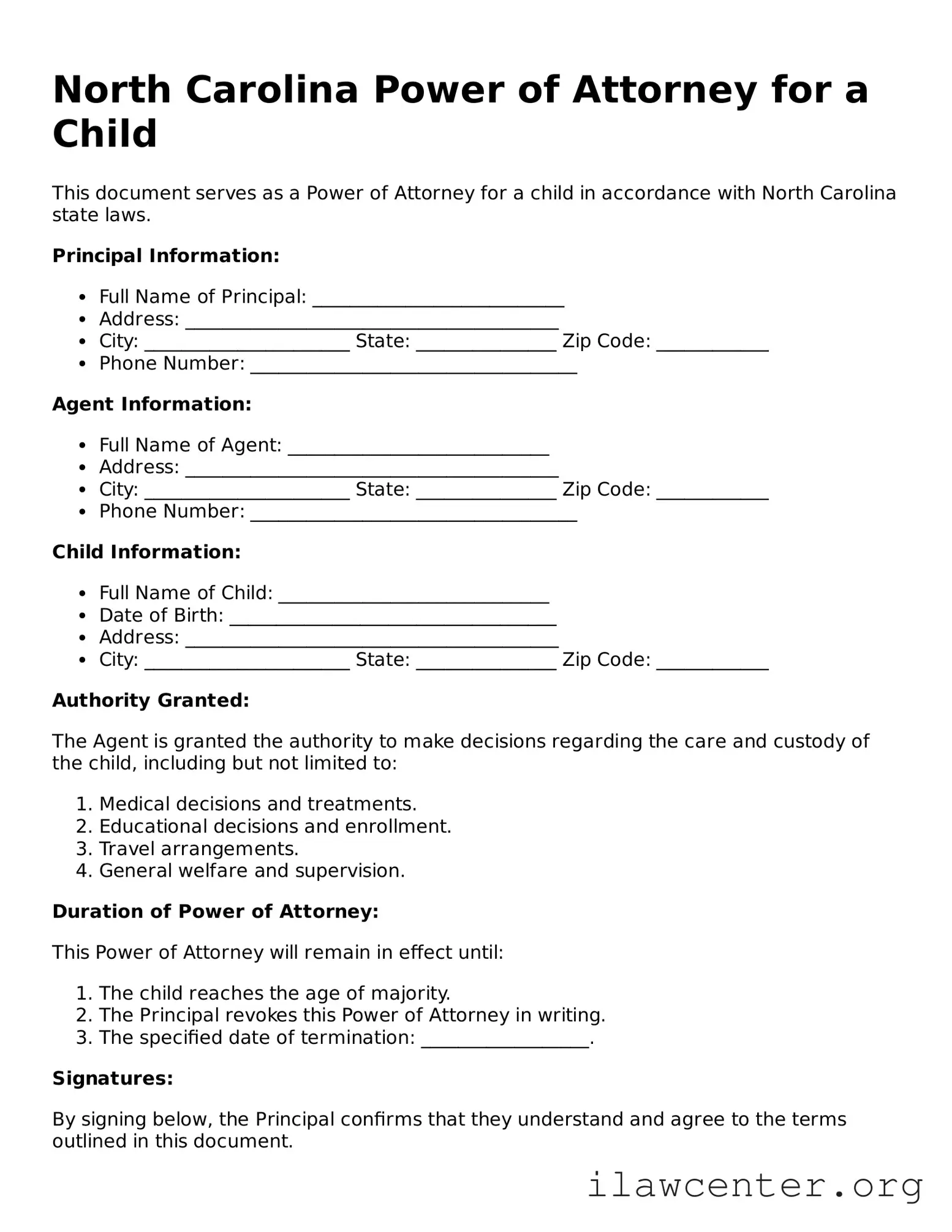
North Carolina Power of Attorney for a Child Preview

North Carolina Power of Attorney for a Child

This document serves as a Power of Attorney for a child in accordance with North Carolina state laws.

Principal Information:

  • Full Name of Principal: ___________________________
  • Address: ________________________________________
  • City: ______________________ State: _______________ Zip Code: ____________
  • Phone Number: ___________________________________

Agent Information:

  • Full Name of Agent: ____________________________
  • Address: ________________________________________
  • City: ______________________ State: _______________ Zip Code: ____________
  • Phone Number: ___________________________________

Child Information:

  • Full Name of Child: _____________________________
  • Date of Birth: ___________________________________
  • Address: ________________________________________
  • City: ______________________ State: _______________ Zip Code: ____________

Authority Granted:

The Agent is granted the authority to make decisions regarding the care and custody of the child, including but not limited to:

  1. Medical decisions and treatments.
  2. Educational decisions and enrollment.
  3. Travel arrangements.
  4. General welfare and supervision.

Duration of Power of Attorney:

This Power of Attorney will remain in effect until:

  1. The child reaches the age of majority.
  2. The Principal revokes this Power of Attorney in writing.
  3. The specified date of termination: __________________.

Signatures:

By signing below, the Principal confirms that they understand and agree to the terms outlined in this document.

______________________________
Signature of Principal

Date: ________________________

______________________________
Signature of Agent

Date: ________________________

This document must be notarized to be valid.

PDF Form Characteristics

Fact Name Details
Purpose The North Carolina Power of Attorney for a Child form allows a parent or guardian to designate another adult to make decisions for their child.
Governing Law This form is governed by North Carolina General Statutes, specifically N.C. Gen. Stat. § 32A-1.
Duration The authority granted in this form can last for up to one year unless revoked earlier.
Signature Requirements The form must be signed by the parent or guardian in the presence of a notary public.
Limitations This Power of Attorney does not grant the agent the ability to consent to medical treatment.
Revocation The parent or guardian can revoke the Power of Attorney at any time by providing written notice.

Instructions on Utilizing North Carolina Power of Attorney for a Child

Filling out the North Carolina Power of Attorney for a Child form can seem daunting, but with a clear understanding of the steps involved, it becomes much more manageable. This form allows a parent or guardian to designate another adult to make decisions on behalf of their child. Once completed, you will be ready to submit it as needed.

  1. Begin by gathering necessary information. You will need the full names, addresses, and contact information of both the parent or guardian and the designated agent.
  2. In the designated spaces, clearly write the full name of the child for whom the power of attorney is being established.
  3. Specify the duration of the power of attorney. Indicate whether it is for a specific time frame or until revoked.
  4. Outline the specific powers you wish to grant to the designated agent. Be clear about the authority they will have in making decisions for the child.
  5. Both the parent or guardian and the designated agent must sign and date the form. Ensure that signatures are clear and legible.
  6. Consider having the signatures notarized. This step can add an extra layer of validation to the document.
  7. Make copies of the completed form for your records and for the designated agent. Keeping these copies can be helpful in the future.

Once you have filled out the form, double-check for accuracy and completeness. This will help prevent any potential issues down the line. With the form finalized, you can move forward with confidence, knowing that the necessary arrangements are in place for your child's care.

Important Facts about North Carolina Power of Attorney for a Child

What is a Power of Attorney for a Child in North Carolina?

A Power of Attorney for a Child in North Carolina is a legal document that allows a parent or guardian to appoint another adult to make decisions on behalf of their child. This can include decisions related to education, healthcare, and other important matters. It is particularly useful when the parent or guardian is unavailable due to travel, work commitments, or other circumstances.

Who can serve as an agent under this Power of Attorney?

Any adult can be appointed as an agent under the Power of Attorney for a Child. This can include relatives, family friends, or trusted neighbors. It is important to choose someone who is responsible and trustworthy, as they will have significant authority over the child's welfare.

How long is the Power of Attorney for a Child valid?

The Power of Attorney for a Child remains valid until the specified time period expires, or until it is revoked by the parent or guardian. Additionally, it automatically terminates when the child turns 18 years old. Parents should review the document periodically to ensure it meets their current needs.

Do I need to have the Power of Attorney notarized?

Yes, in North Carolina, the Power of Attorney for a Child must be signed in the presence of a notary public. This helps to verify the identities of the individuals involved and ensures that the document is legally binding. It is advisable to keep a copy of the notarized document in a safe place.

Can the Power of Attorney for a Child be revoked?

Yes, the parent or guardian can revoke the Power of Attorney at any time, as long as they provide written notice to the agent and any relevant parties. It is recommended to formally document the revocation and keep copies for personal records. This ensures that all parties are aware that the authority has been terminated.

What decisions can the agent make on behalf of the child?

The agent can make a variety of decisions, including those related to the child's education, medical care, and general welfare. However, the specific powers granted can be tailored in the document. Parents should clearly outline what decisions the agent can and cannot make to avoid any confusion.

Is a Power of Attorney for a Child the same as guardianship?

No, a Power of Attorney for a Child is not the same as guardianship. Guardianship is a legal process that grants someone permanent legal authority over a child, often requiring court approval. In contrast, a Power of Attorney is a temporary arrangement that allows an agent to act on behalf of a child without the need for court intervention.

What happens if the agent cannot fulfill their duties?

If the appointed agent is unable to fulfill their responsibilities, the parent or guardian should designate an alternate agent in the Power of Attorney document. If no alternate is specified, the parent will need to appoint a new agent to ensure that the child's needs continue to be met.

Can multiple agents be appointed under the Power of Attorney?

Yes, parents can appoint multiple agents to act together or separately. However, it is crucial to clearly outline how decisions will be made among the agents to prevent conflicts. Clear communication and understanding among all parties can help facilitate a smooth process.

Where can I obtain a Power of Attorney for a Child form?

Power of Attorney for a Child forms can often be found online through legal websites, state government resources, or local legal aid organizations. It is important to ensure that the form complies with North Carolina laws. Consulting with a legal professional can provide additional guidance and ensure that all necessary details are included.
Common mistakes

Filling out the North Carolina Power of Attorney for a Child form can be straightforward, but several common mistakes can lead to complications. One frequent error occurs when parents or guardians fail to specify the duration of the power of attorney. Without clear timelines, the authority granted may lead to misunderstandings or disputes about when it begins and ends. It is crucial to define the start and end dates to ensure all parties are on the same page.

Another mistake involves not including all necessary information about the child. Omitting details such as the child's full name, date of birth, or address can create confusion. This information is essential for identifying the child and ensuring that the power of attorney is valid and applicable. Always double-check that all required fields are filled out completely and accurately.

People often overlook the importance of signatures. Both the parent or guardian granting the power and the agent receiving it must sign the document. Failure to secure these signatures can render the form ineffective. Additionally, having a witness or notary public present during the signing can provide extra validation, which is often required for legal documents in North Carolina.

Lastly, many individuals neglect to review the specific legal requirements set forth by North Carolina law. Each state has its own regulations regarding powers of attorney, and not adhering to these can invalidate the document. It is advisable to familiarize oneself with the legal stipulations or consult with a professional to ensure compliance. Taking these precautions can help prevent misunderstandings and ensure that the power of attorney serves its intended purpose effectively.

Documents used along the form

When you are considering a Power of Attorney for a Child in North Carolina, it's helpful to know about other related documents that may be necessary or beneficial. These forms can provide additional legal support and clarity regarding the care and responsibilities of a child. Here’s a list of documents often used alongside the Power of Attorney for a Child form:

  • Child Custody Agreement: This document outlines the custody arrangements between parents or guardians. It specifies who has legal and physical custody of the child and can help prevent disputes.
  • Medical Authorization Form: This form grants permission for a designated person to make medical decisions on behalf of the child. It ensures that the child receives timely medical care when needed.
  • School Authorization Form: This document allows a designated adult to enroll the child in school, attend parent-teacher conferences, and make decisions related to the child’s education.
  • Emergency Contact Form: This simple form lists emergency contacts for the child, including phone numbers and relationships. It helps caregivers know who to reach in case of an emergency.
  • Travel Consent Form: If the child will be traveling with someone other than their parents, this form provides permission for travel. It can be particularly useful for trips across state lines or internationally.
  • Health Insurance Authorization: This document allows a designated caregiver to access the child’s health insurance information and make necessary claims or decisions regarding coverage.
  • Child Care Agreement: This agreement outlines the terms of care between parents and caregivers, including payment, hours, and responsibilities. It helps set clear expectations for everyone involved.
  • Affidavit of Guardianship: This legal document establishes the guardian's authority over the child, confirming that they have the right to make decisions in the child's best interest.

Understanding these additional forms can help ensure that you have all the necessary documentation in place for the care and protection of your child. Each document serves a unique purpose, providing clarity and security in various situations.

Similar forms

The Power of Attorney for a Child form shares similarities with several other legal documents that grant authority or manage responsibilities on behalf of another person. Below are six documents that bear resemblance to the Power of Attorney for a Child form, along with explanations of their similarities.

  • General Power of Attorney: Like the Power of Attorney for a Child, this document allows one person to act on behalf of another in a broad range of legal and financial matters. Both forms enable the designated individual to make decisions and manage affairs when the principal is unable to do so.
  • Health Care Proxy: This document specifically grants someone the authority to make medical decisions for another person. Similar to the Power of Attorney for a Child, it ensures that the designated individual can act in the best interest of the child regarding health-related matters.
  • Guardianship Agreement: A guardianship agreement establishes a legal relationship where one person is appointed to care for another, typically a minor. Both documents serve to protect the interests of a child when the biological parents are unable to fulfill their responsibilities.
  • Living Will: While a living will primarily addresses end-of-life decisions, it shares the intent of the Power of Attorney for a Child by ensuring that the wishes of the individual are respected. Both documents empower designated individuals to make critical decisions when the original decision-maker is incapacitated.
  • Minor's Travel Consent Form: This form allows a child to travel with someone other than their parents or guardians. Like the Power of Attorney for a Child, it provides legal recognition of the authority given to another adult to care for the child during travel.
  • Educational Power of Attorney: This document specifically grants authority over educational decisions for a child. It is similar to the Power of Attorney for a Child in that it allows a designated person to make choices regarding the child's schooling and educational needs.

Dos and Don'ts

When filling out the North Carolina Power of Attorney for a Child form, it's important to approach the process with care. This legal document allows a parent or guardian to designate another adult to make decisions on behalf of their child. Here are some key do's and don'ts to keep in mind:

  • Do ensure you understand the responsibilities you are granting to the agent.
  • Do fill out the form completely and accurately to avoid any potential issues.
  • Do sign the form in the presence of a notary public to validate it.
  • Do provide a copy of the completed form to the agent and keep one for your records.
  • Don't leave any blank spaces on the form; incomplete forms may not be accepted.
  • Don't use the form for anything other than its intended purpose; misuse can lead to legal complications.
  • Don't assume that verbal agreements are sufficient; always document the arrangement in writing.
  • Don't forget to revoke the power of attorney if your circumstances change or if you no longer need it.

By following these guidelines, you can help ensure that the Power of Attorney for a Child form serves its purpose effectively and protects the best interests of your child.

Misconceptions

Understanding the North Carolina Power of Attorney for a Child form is essential for parents and guardians. However, several misconceptions can lead to confusion. Here are seven common misconceptions:

  1. The form is only for emergencies.

    Many believe this form is only necessary in urgent situations. In reality, it can be useful for planned events, such as vacations or extended trips.

  2. Only biological parents can use this form.

    While biological parents often use it, legal guardians and others with custody rights can also complete the form.

  3. It gives up parental rights.

    This form does not terminate parental rights. It allows another person to make decisions on behalf of the child temporarily.

  4. Any adult can be designated as an agent.

    The chosen agent must be a responsible adult, but there are no specific legal qualifications required.

  5. The form is permanent.

    The Power of Attorney for a Child is not permanent. It can be revoked or is automatically void when the child reaches adulthood.

  6. It requires a notary.

    While having the form notarized is recommended, it is not a strict requirement for the document to be valid.

  7. One form covers multiple children.

    A separate form is needed for each child. This ensures that the specific needs and circumstances of each child are addressed.

Clarifying these misconceptions can help ensure that parents and guardians make informed decisions regarding the care and legal authority for their children.

Key takeaways

When filling out and using the North Carolina Power of Attorney for a Child form, consider these key takeaways:

  • Understand the Purpose: This form allows a parent or legal guardian to grant temporary authority to another adult to make decisions for their child. It can be useful in various situations, such as when parents are traveling or unable to care for their child.
  • Choose the Right Person: Select a trusted adult to act as the agent. This person should be responsible and willing to take on the duties outlined in the form.
  • Specify the Authority: Clearly outline what decisions the agent can make on behalf of the child. This may include medical decisions, educational choices, and other important matters.
  • Keep Copies Accessible: After completing the form, provide copies to the agent and keep one for your records. It’s important that the agent has the document readily available in case of emergencies.