
Notarized Odometer Statement PDF Template

Notarized Odometer Statement PDF Template

The Notarized Odometer Statement form is a legal document used to disclose the mileage of a vehicle at the time of sale. This statement, verified by a notary public, ensures that the mileage is accurately recorded, protecting both the buyer and seller from potential disputes. For those looking to complete this important transaction, fill out the form by clicking the button below.

Article Guide

The Notarized Odometer Statement form serves a crucial role in vehicle transactions, ensuring transparency and accuracy regarding a vehicle's mileage. This form is typically completed by a notary public who verifies the mileage recorded on the odometer at the time of sale or transfer. It includes essential details such as the vehicle's year, make, model, and Vehicle Identification Number (VIN), along with the owner's information. The notary confirms the owner's identity through satisfactory evidence, adding an extra layer of authenticity to the document. This statement is particularly important in preventing odometer fraud, as it provides a legal record of the mileage at a specific point in time. By requiring notarization, the form helps protect both buyers and sellers, fostering trust in the transaction process. Additionally, the notary's commission expiration date is noted, which indicates the timeframe during which the notary's authority is valid. Overall, the Notarized Odometer Statement is a vital tool in the realm of vehicle ownership transfer, promoting accountability and integrity.

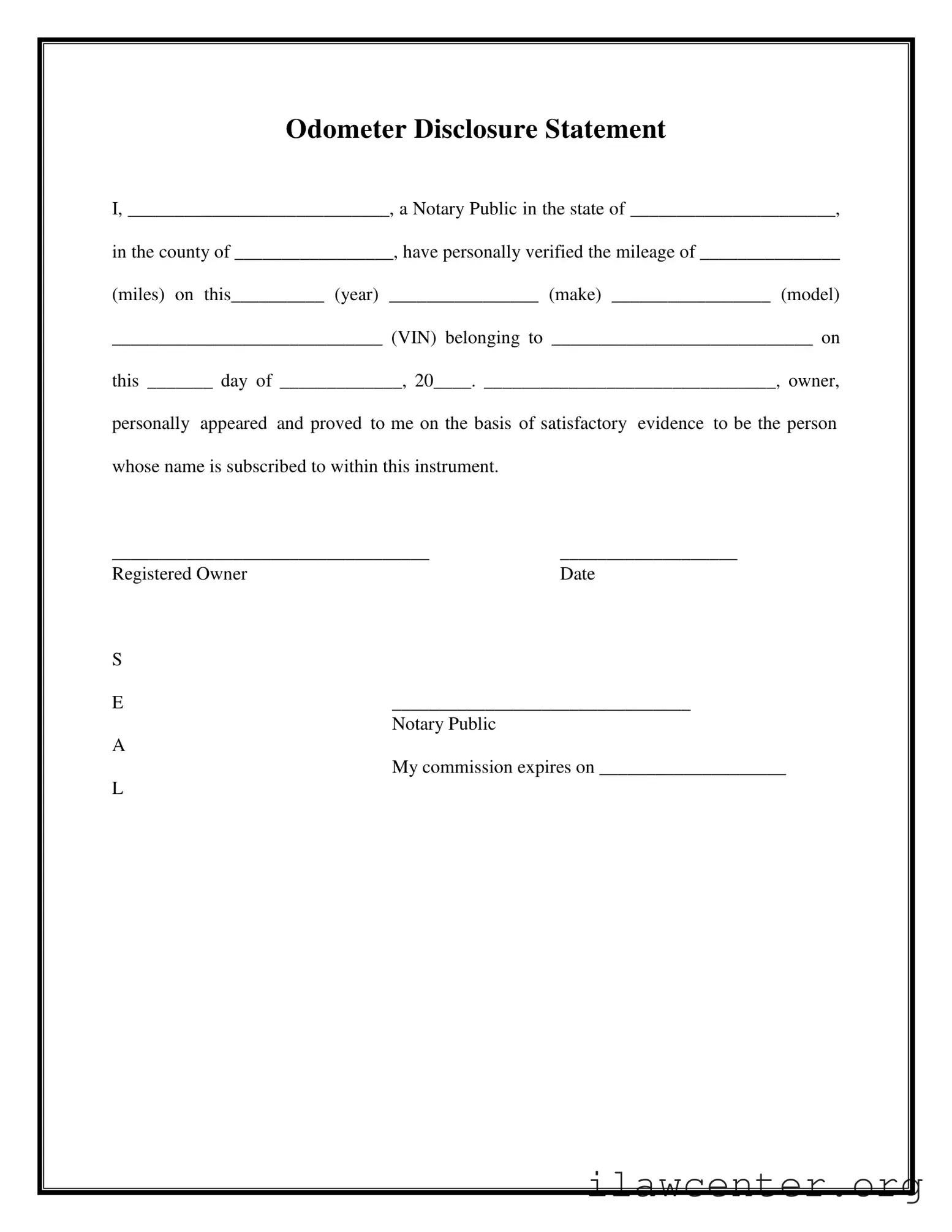
Notarized Odometer Statement Preview

Odometer Disclosure Statement
I, ____________________________, a Notary Public in the state of ______________________,
in the county of _________________, have personally verified the mileage of _______________
(miles) on this__________ (year) ________________ (make) _________________ (model)
_____________________________ (VIN) belonging to ____________________________ on
this _______ day of _____________, 20____. _______________________________, owner,
personally appeared and proved to me on the basis of satisfactory evidence to be the person
whose name is subscribed to within this instrument.
__________________________________ ___________________
Registered Owner Date
S
E ________________________________
Notary Public
A
My commission expires on ____________________
L

File Properties

Fact Name Description
Purpose The Notarized Odometer Statement form is used to document the mileage of a vehicle at the time of sale, ensuring transparency in vehicle transactions.
Notary Requirement This form must be signed in the presence of a Notary Public, who verifies the identity of the seller and the accuracy of the mileage statement.
State-Specific Forms Each state may have its own version of the Notarized Odometer Statement, governed by local laws regarding vehicle sales and disclosures.
Legal Implications Providing false information on this form can lead to legal consequences, including fines or penalties for fraud.
Retention of Records It is advisable for both buyers and sellers to retain a copy of the notarized statement for their records, as it serves as proof of the vehicle's mileage at the time of transfer.

Instructions on Utilizing Notarized Odometer Statement

Once you have the Notarized Odometer Statement form, it’s time to fill it out carefully. Make sure to have all necessary information ready, such as the vehicle's details and the owner's information. After completing the form, it will need to be notarized to ensure its validity.

  1. Start by writing the name of the Notary Public in the first blank line.
  2. Fill in the state where the notarization is taking place.
  3. Enter the county where the notarization occurs.
  4. Write the verified mileage in the space provided.
  5. Indicate the year of the vehicle.
  6. Fill in the make of the vehicle.
  7. Enter the model of the vehicle.
  8. Provide the Vehicle Identification Number (VIN).
  9. Write the name of the vehicle owner in the next blank line.
  10. Fill in the date on which the statement is being completed.
  11. Have the registered owner sign their name in the designated area.
  12. As the Notary Public, sign and date the form in the appropriate sections.
  13. Finally, indicate when your commission expires in the last blank line.

Important Facts about Notarized Odometer Statement

What is a Notarized Odometer Statement?

A Notarized Odometer Statement is a legal document that verifies the mileage on a vehicle at the time of sale. It is completed by a notary public, who confirms the identity of the vehicle owner and the accuracy of the mileage reported. This statement helps prevent fraud related to odometer tampering and ensures that the buyer receives accurate information about the vehicle's history.

Why do I need a Notarized Odometer Statement when selling my vehicle?

When selling a vehicle, providing a Notarized Odometer Statement protects both the buyer and the seller. It serves as proof of the vehicle's mileage at the time of sale, which is important for determining its value. Additionally, it helps to establish trust between parties by ensuring that the information provided is verified and legally binding.

How do I complete a Notarized Odometer Statement?

To complete a Notarized Odometer Statement, you will need to fill in specific details about the vehicle, including the mileage, year, make, model, and VIN. After filling out the form, you must take it to a notary public. The notary will verify your identity and witness your signature. Make sure to bring a valid form of identification. Once notarized, the statement becomes an official document that can be presented during the sale.

Is there a fee for notarizing the Odometer Statement?

Yes, there is typically a fee for notarizing documents, including the Notarized Odometer Statement. Fees can vary depending on the notary public and the state where the notarization takes place. It's a good idea to check in advance and budget for this cost when preparing to sell your vehicle.

Common mistakes

Filling out the Notarized Odometer Statement form can seem straightforward, but many people make common mistakes that can lead to complications down the line. One frequent error is neglecting to fill in all required fields. Each section of the form serves a purpose, from the vehicle's make and model to the owner's name and signature. Omitting any of this information can render the document invalid, causing delays in the transaction.

Another mistake involves inaccuracies in the mileage entry. It's crucial to double-check the odometer reading before writing it down. If the recorded mileage does not match the actual mileage, it could raise suspicions and lead to potential legal issues. Always ensure that the numbers are correct and clearly legible to avoid misunderstandings.

Additionally, many individuals forget to have their signatures notarized properly. The notary's role is to verify identities and witness the signing of the document. If the notary fails to sign or date the form, it may not hold up in legal situations. It's essential to confirm that the notary has completed their part before submitting the form.

Lastly, overlooking the expiration date of the notary's commission is a common pitfall. Each notary public has a specific term during which they are authorized to perform notarizations. If the notary's commission has expired, the document may be considered invalid. Always check that the notary's commission is current to ensure the document is legally binding.

Documents used along the form

The Notarized Odometer Statement is an essential document in the process of buying or selling a vehicle. However, several other forms and documents often accompany it to ensure a smooth transaction. Below is a list of these important documents.

  • Bill of Sale: This document serves as proof of the transaction between the buyer and seller. It includes details such as the vehicle's make, model, VIN, and the sale price, along with signatures from both parties.
  • Title Transfer Document: This form is necessary to officially transfer ownership of the vehicle from the seller to the buyer. It includes information about both parties and may require notarization in some states.
  • Vehicle History Report: This report provides a detailed history of the vehicle, including previous ownership, accidents, and service records. It helps buyers make informed decisions about the purchase.
  • Application for Title: This form is often required by the state to register the vehicle in the new owner's name. It typically includes personal information about the buyer and details about the vehicle.
  • Emissions Certificate: In many states, this document verifies that the vehicle meets environmental regulations. It may be necessary for registration and can impact the sale process.
  • Power of Attorney: If the seller cannot be present for the transaction, this document allows another person to act on their behalf. It must be signed and may need to be notarized to be valid.

Understanding these documents can help streamline the vehicle transfer process and protect both the buyer and seller. Being prepared with the necessary paperwork ensures a smoother transaction and reduces the risk of future disputes.

Similar forms

The Notarized Odometer Statement form is similar to several other documents that serve to verify information or provide official statements. Here are eight documents that share similarities:

  • Vehicle Title: This document proves ownership of a vehicle and includes details like the VIN and mileage, similar to the Odometer Statement.
  • Bill of Sale: A bill of sale records the transfer of ownership of a vehicle and often includes mileage at the time of sale, aligning with the purpose of the Odometer Statement.
  • Affidavit of Vehicle Ownership: This sworn statement confirms ownership and may include details about the vehicle's mileage, mirroring the verification process of the Odometer Statement.
  • Power of Attorney: This document allows someone to act on behalf of another, often including vehicle-related transactions and mileage disclosures, similar in intent to the Odometer Statement.
  • Vehicle Registration Application: This form requires information about the vehicle, including mileage, to register it officially, akin to the Odometer Statement.
  • Inspection Certificate: This document certifies that a vehicle has passed inspection, often noting the current mileage, which relates to the verification aspect of the Odometer Statement.
  • Transfer of Title Document: Used when a vehicle changes ownership, this document includes mileage verification, paralleling the purpose of the Odometer Statement.
  • Insurance Declaration Page: This page outlines coverage for a vehicle and may reference the mileage for underwriting purposes, similar to the Odometer Statement's focus on mileage accuracy.

Dos and Don'ts

When filling out the Notarized Odometer Statement form, there are important guidelines to follow to ensure accuracy and compliance. Below are five things you should and shouldn't do:

  • Do provide accurate information regarding the vehicle's mileage.
  • Do ensure that all fields are completed, including the year, make, model, and VIN.
  • Do sign the document in front of a notary public.
  • Don't leave any sections blank, as incomplete forms may be rejected.
  • Don't use incorrect or misleading information about the vehicle.

Misconceptions

Understanding the Notarized Odometer Statement form is essential for anyone involved in vehicle transactions. However, several misconceptions can lead to confusion. Here is a list of common misunderstandings:

  • Notarization is optional. Many people believe that notarization is not necessary for an odometer statement. In fact, certain states require a notarized statement to ensure the accuracy of the mileage reported.
  • All notaries can verify odometer readings. Notaries are not vehicle experts. Their role is to verify the identity of the person signing the document, not to confirm the accuracy of the odometer reading itself.
  • The form is the same in every state. Each state may have different requirements and formats for the odometer disclosure statement. It's important to use the correct form for your state.
  • Only the seller needs to sign. Both the seller and the buyer may need to sign the odometer statement, depending on state laws and the specifics of the transaction.
  • Odometer statements are only for used cars. While commonly used in the sale of used vehicles, these statements can also apply to new cars in certain situations, particularly if the odometer has been reset.
  • Notarization guarantees the accuracy of the mileage. Notarization does not guarantee that the mileage is accurate. It only confirms that the person signing the document is who they claim to be.
  • Odometer statements are not legally binding. When properly completed and notarized, these statements can be legally binding documents that provide protection against future disputes.
  • Once signed, the statement cannot be changed. If there is an error, it is possible to create a new statement to correct it. However, both parties should agree to the change.
  • Odometer statements are only needed for private sales. Dealerships also use these statements when selling vehicles to ensure compliance with state laws.
  • All vehicles require an odometer statement. Certain vehicles, such as those over a specific age or weight, may be exempt from this requirement in some states.

Being aware of these misconceptions can help individuals navigate the process of vehicle transactions more effectively. Understanding the requirements and implications of the Notarized Odometer Statement form is crucial for both buyers and sellers.

Key takeaways

When filling out and using the Notarized Odometer Statement form, consider the following key takeaways:

  • Accurate Information is Crucial: Ensure that all details, including the mileage, vehicle year, make, model, and VIN, are filled out accurately to avoid potential legal issues.
  • Notary Public Verification: A Notary Public must verify the information. This means the registered owner must appear in person and provide satisfactory evidence of their identity.
  • Timeliness Matters: Complete the form and have it notarized on the same day as the vehicle transaction to ensure that the mileage disclosure is current and valid.
  • Retention of Records: Keep a copy of the notarized statement for your records. This documentation may be essential for future reference or disputes.