Fillable Notary Acknowledgement Document

Fillable Notary Acknowledgement Document

A Notary Acknowledgement form is a legal document that verifies a person's identity and their willingness to sign a particular document. This form is essential for ensuring that signatures are authentic and that the signers understand the contents of the documents they are signing. If you're ready to fill out the Notary Acknowledgement form, click the button below!

Article Guide

The Notary Acknowledgment form serves a crucial role in various legal transactions by confirming the identity of the signer and ensuring that the signing process is conducted voluntarily and without coercion. This form is typically used in situations involving important documents, such as property deeds, contracts, or powers of attorney. When a notary public completes the acknowledgment, they provide a signature and seal, which adds a layer of authenticity and trust to the document. The form generally includes details such as the name of the signer, the date of the acknowledgment, and the notary’s information. Additionally, it may require the notary to verify the signer's identity through government-issued identification. Understanding the importance and components of the Notary Acknowledgment form can help individuals navigate their legal obligations more effectively, ensuring that their documents are recognized and upheld in court when necessary.

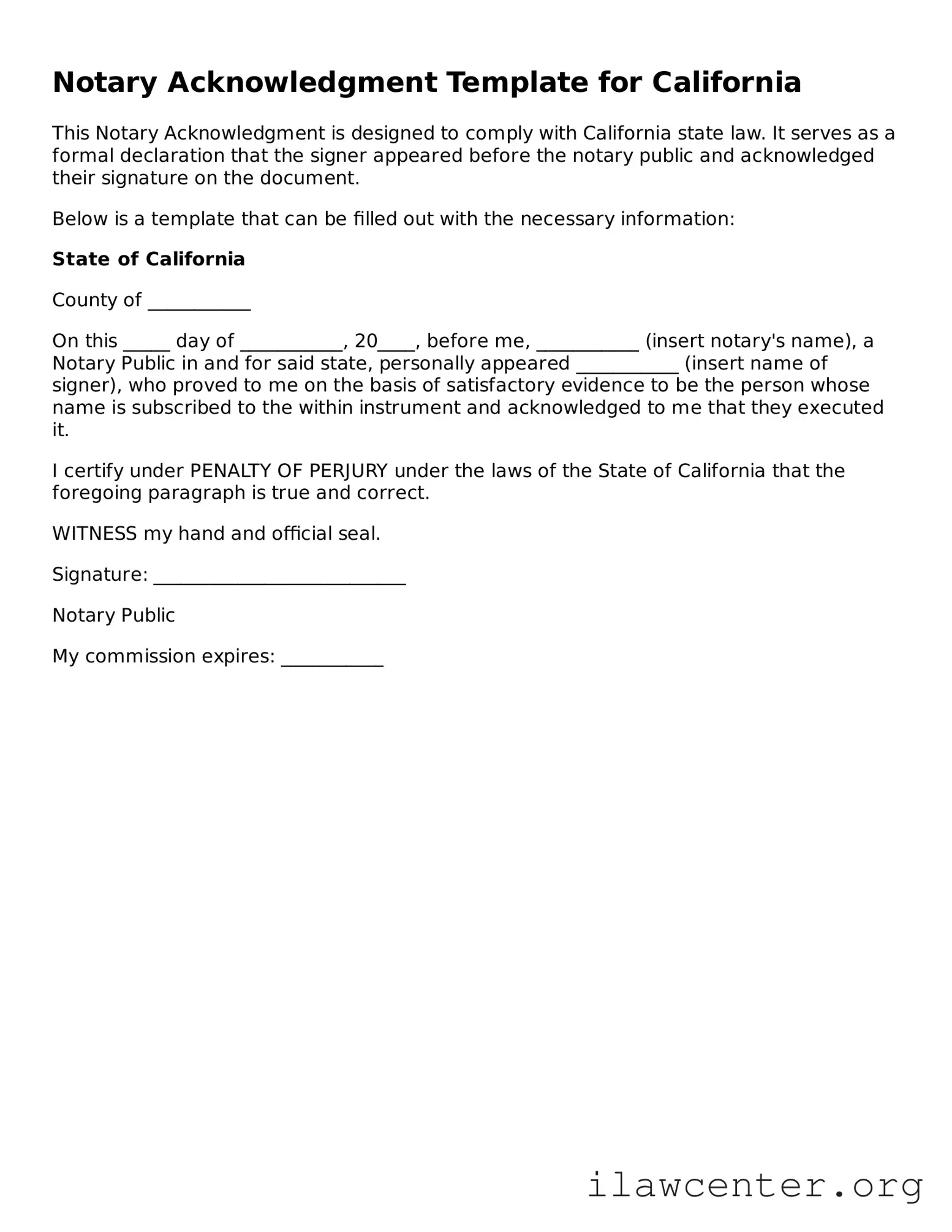
Notary Acknowledgement Preview

Notary Acknowledgment Template for California

This Notary Acknowledgment is designed to comply with California state law. It serves as a formal declaration that the signer appeared before the notary public and acknowledged their signature on the document.

Below is a template that can be filled out with the necessary information:

State of California

County of ___________

On this _____ day of ___________, 20____, before me, ___________ (insert notary's name), a Notary Public in and for said state, personally appeared ___________ (insert name of signer), who proved to me on the basis of satisfactory evidence to be the person whose name is subscribed to the within instrument and acknowledged to me that they executed it.

I certify under PENALTY OF PERJURY under the laws of the State of California that the foregoing paragraph is true and correct.

WITNESS my hand and official seal.

Signature: ___________________________

Notary Public

My commission expires: ___________

PDF Form Characteristics

Fact Name Description
Purpose A Notary Acknowledgement form verifies that a signer has willingly signed a document in the presence of a notary public.
State-Specific Forms Each state has its own Notary Acknowledgement form. It’s important to use the correct form for the state where the document will be executed.
Governing Laws The laws governing Notary Acknowledgements vary by state. For example, in California, it is governed by the California Civil Code Section 1185.
Signature Requirements The signer must appear before the notary and provide valid identification to ensure proper identification and prevent fraud.
Notary's Role The notary public acts as an impartial witness, ensuring that the signer understands the document they are signing.
Record Keeping Notaries are often required to keep a journal of their acknowledgments, which serves as a record of their notarial acts.
Legal Implications A properly executed Notary Acknowledgement can enhance the legal standing of a document, making it more likely to be upheld in court.

Instructions on Utilizing Notary Acknowledgement

After obtaining the Notary Acknowledgement form, you will need to fill it out carefully. This form will require specific information to ensure it is valid. Follow the steps below to complete the form accurately.

  1. Begin by locating the section for the notary public information.
  2. Write the name of the notary public in the designated space.
  3. Fill in the state where the notary is commissioned.
  4. Enter the county where the notary is located.
  5. Provide the date the acknowledgment is being made.
  6. Next, write the name of the signer who is being acknowledged.
  7. Include the type of document being notarized in the appropriate field.
  8. Finally, the notary should sign and stamp the form where indicated.

Important Facts about Notary Acknowledgement

What is a Notary Acknowledgement form?

A Notary Acknowledgement form is a document that confirms a person has signed a specific document in front of a notary public. The notary verifies the identity of the signer and witnesses the signing. This process helps ensure that the signature is legitimate and that the signer understands what they are signing.

Why do I need a Notary Acknowledgement?

You may need a Notary Acknowledgement for various legal documents, such as deeds, contracts, or affidavits. This form adds a layer of security by proving that the signature is valid. It can also help prevent fraud and ensure that the document is accepted by courts or other institutions.

How does the Notary Acknowledgement process work?

The process is straightforward. First, you must sign the document in front of the notary. The notary will then fill out the Notary Acknowledgement form, which includes details like your name, the date, and the document you signed. Finally, the notary will sign and stamp the form, completing the process.

Who can be a notary public?

Notaries public are individuals authorized by the state to perform notarial acts. They must meet specific requirements, which can vary by state. Generally, you need to be at least 18 years old, a resident of the state, and pass a background check. Many states also require training and an exam.

Is a Notary Acknowledgement the same as notarization?

Notary Acknowledgement is a type of notarization. Notarization refers to the overall process of a notary witnessing a signature and verifying the identity of the signer. Acknowledgement specifically refers to the part where the signer confirms they signed the document willingly and understand its contents.

Can I get a Notary Acknowledgement online?

Some states allow remote notarization, which means you can get a Notary Acknowledgement through a video call. However, this is not available everywhere. It’s important to check your state’s laws to see if online notarization is permitted and to find a notary who offers this service.

How much does a Notary Acknowledgement cost?

The cost of a Notary Acknowledgement can vary. Many notaries charge a flat fee per signature, which can range from $5 to $15, depending on the state and the notary's experience. Some may charge additional fees for travel or extra services, so it's best to ask beforehand.

What should I bring to the notary?

When visiting a notary, bring a valid form of identification, such as a driver’s license or passport. You should also have the document you need to sign. Make sure to read the document beforehand, as the notary will not provide legal advice or explain its contents.
Common mistakes

Filling out a Notary Acknowledgment form is a crucial step in many legal processes. However, individuals often make mistakes that can lead to complications. One common error occurs when people fail to include the correct date of the acknowledgment. This date is essential as it indicates when the notary witnessed the signing. Without an accurate date, the validity of the document may be questioned.

Another frequent mistake is neglecting to provide the signer's full name. The form should reflect the name as it appears on the identification presented to the notary. If the name is misspelled or incomplete, it could create confusion or invalidate the document. Ensuring that the name matches official identification helps maintain clarity and legal integrity.

Many individuals also overlook the importance of the notary's signature and seal. The notary must sign the acknowledgment and apply their official seal for the document to be legally binding. If either of these elements is missing, the acknowledgment may not be recognized, leading to potential disputes or delays in legal matters.

In addition, people sometimes forget to indicate the capacity in which the signer is acting. For example, if the individual is signing on behalf of a corporation or as a trustee, this should be clearly stated. Omitting this information can lead to questions about the authority of the signer, complicating the legal standing of the document.

Lastly, many fail to review the entire form for completeness before submission. A thorough review can help catch any overlooked errors or omissions. Submitting an incomplete or incorrect form can result in delays or the need for additional notarization, which can be both time-consuming and frustrating.

Documents used along the form

When you are engaging in legal transactions, especially those that require notarization, there are several key documents that often accompany the Notary Acknowledgment form. Understanding these documents can help ensure that your transaction proceeds smoothly and legally. Here’s a list of some commonly used forms and documents that you might encounter.

  • Power of Attorney: This document allows one person to grant another the authority to act on their behalf in legal matters. It can be broad or limited in scope, depending on the needs of the parties involved.
  • Affidavit: An affidavit is a written statement confirmed by oath or affirmation, used as evidence in court. It serves to provide a sworn account of facts relevant to a legal matter.
  • Deed: A deed is a legal document that conveys ownership of real property from one party to another. It often requires notarization to be valid and enforceable.
  • Contract: This is a legally binding agreement between two or more parties. Notarization may be required for certain contracts to ensure their authenticity and enforceability.
  • Will: A will outlines how a person's assets should be distributed after their death. Notarization can help validate the will and prevent disputes among heirs.
  • Trust Agreement: This document establishes a trust, detailing how assets are managed and distributed. Notarization adds an extra layer of legitimacy to the agreement.
  • Loan Agreement: This is a contract between a borrower and a lender that outlines the terms of a loan. Notarization may be required to ensure both parties are bound by the terms.
  • Release of Liability: This document releases one party from liability for certain actions or events. It is often used in situations where risk is involved, such as waivers for events or activities.
  • Certificate of Authority: This document is often used by businesses to authorize individuals to act on behalf of the company. Notarization helps confirm the authority granted.

Having a grasp of these documents can significantly enhance your understanding of the legal processes you might encounter. Always ensure that you have the necessary forms prepared and properly executed to protect your interests and avoid complications.

Similar forms

  • Affidavit: An affidavit is a written statement confirmed by oath or affirmation. Like a notary acknowledgment, it requires a notary to verify the identity of the signer, ensuring the document's authenticity.
  • Power of Attorney: This document allows one person to act on behalf of another. A notary acknowledgment is often included to confirm that the person granting the power is doing so willingly and understands the implications.
  • Deed: A deed transfers ownership of property. Notarization is crucial here, as it provides evidence that the signatures on the deed are genuine and that the parties were competent when signing.
  • Mortgage: Similar to a deed, a mortgage document requires notarization to validate the agreement between the lender and borrower, ensuring that both parties are aware of their obligations.
  • Contract: Many contracts require notarization to add an extra layer of verification. A notary acknowledgment confirms that the individuals signing the contract are who they claim to be and are entering into the agreement willingly.
  • Will: A will often needs to be notarized to ensure its validity. Notary acknowledgment helps prevent disputes over the authenticity of the will after the person's death.
  • Trust Agreement: Similar to a will, a trust agreement can benefit from notarization. This process helps verify the identities of the parties involved and confirms their intentions regarding asset distribution.
  • Release of Liability: This document releases one party from legal claims. Notarization helps ensure that the person signing the release understands the consequences and is doing so voluntarily.
  • Certificate of Acknowledgment: This is a specific type of notarized document that serves as proof that a signer has acknowledged their signature. It is often used in conjunction with other documents to confirm their legitimacy.
  • Subordination Agreement: This document alters the priority of debts. Notarization is essential to confirm that all parties understand and agree to the terms, preventing future disputes regarding the order of claims.

Dos and Don'ts

When filling out a Notary Acknowledgment form, there are some important practices to follow. Here’s a list of things you should and shouldn't do:

  • Do provide accurate information about the signer.
  • Do ensure the signer is present during the acknowledgment.
  • Do check that the signer has valid identification.
  • Do complete all required fields on the form.
  • Do sign and stamp the form in the appropriate places.
  • Don't fill out the form without the signer present.
  • Don't accept expired identification.
  • Don't alter the form after it has been signed.
  • Don't forget to keep a record of the acknowledgment.
  • Don't notarize a document that you have a personal interest in.

Misconceptions

Notary acknowledgments are often misunderstood. Here are nine common misconceptions about the Notary Acknowledgment form:

  1. Notaries can draft legal documents.

    Notaries are not authorized to create or modify legal documents. Their role is to verify the identity of the signers and ensure that they are signing willingly.

  2. Notarization guarantees the legality of a document.

    A notarization only confirms that the signer is who they claim to be and that they signed the document. It does not validate the content or legality of the document itself.

  3. All documents require notarization.

    Not all documents need to be notarized. The requirement for notarization depends on the type of document and the laws of the state where it is executed.

  4. Notaries can perform their duties anywhere.

    Notaries must operate within the jurisdiction where they are commissioned. Performing notarizations outside this area can lead to legal complications.

  5. Once notarized, a document cannot be contested.

    A notarized document can still be challenged in court. The notarization does not prevent disputes regarding the document’s validity or content.

  6. Notaries can provide legal advice.

    Notaries are prohibited from giving legal advice. They can only facilitate the signing process and ensure the proper execution of documents.

  7. All states have the same notary laws.

    Notary laws vary significantly from state to state. It is important to understand the specific regulations applicable in each jurisdiction.

  8. A notary public is the same as a commissioner of deeds.

    While both roles involve witnessing signatures, they serve different functions and are governed by different regulations. Notaries typically handle more diverse types of documents.

  9. Notarization is a one-time process.

    Some documents may require multiple notarizations, especially if they are being used in different jurisdictions or for different purposes.

Key takeaways

Filling out and using a Notary Acknowledgement form is an important process that ensures the authenticity of signatures on various documents. Here are some key takeaways to keep in mind:

  • Understand the Purpose: A Notary Acknowledgement serves to confirm that a signer willingly signed a document in the presence of a notary public.
  • Complete Information: Ensure that all required fields on the form are filled out accurately, including the name of the signer, the date, and the notary's information.
  • Presence is Key: The signer must be physically present before the notary at the time of signing. Remote notarization may not be accepted in all jurisdictions.
  • Identification Matters: The notary will typically require valid identification from the signer to verify their identity before completing the acknowledgment.
  • Know the Jurisdiction: Notary laws can vary by state. Familiarize yourself with your state’s specific requirements for notarization.
  • Keep Records: Notaries often maintain a journal of their notarizations. This record can be crucial for legal purposes in the future.
  • Check for Additional Requirements: Some documents may have specific rules regarding notarization. Always verify if any additional steps are necessary.

By following these guidelines, you can ensure that the Notary Acknowledgement form is completed correctly and serves its intended purpose effectively.