Fillable Notice of Lease Non-Renewal Document

Fillable Notice of Lease Non-Renewal Document

The Notice of Lease Non-Renewal form is a document used by landlords to inform tenants that their lease will not be extended beyond its current term. This notice serves as a formal communication, allowing both parties to prepare for the end of the rental agreement. For those needing to fill out this form, click the button below.

Article Guide

The Notice of Lease Non-Renewal form serves as a crucial document in the landlord-tenant relationship, signaling the intent not to continue a lease agreement once its term expires. This form must be completed and delivered to the tenant within a specific timeframe, which varies by state, to ensure that both parties are aware of the lease's impending end. Key components of the form include the names of the landlord and tenant, the property address, and the date the lease will terminate. Additionally, it may outline any relevant details regarding the condition of the property and expectations for moving out. By providing clear communication through this notice, landlords can help facilitate a smooth transition, while tenants are given the opportunity to make necessary arrangements for their housing needs. Understanding the importance of this document is essential for both parties to avoid misunderstandings and ensure compliance with local rental laws.

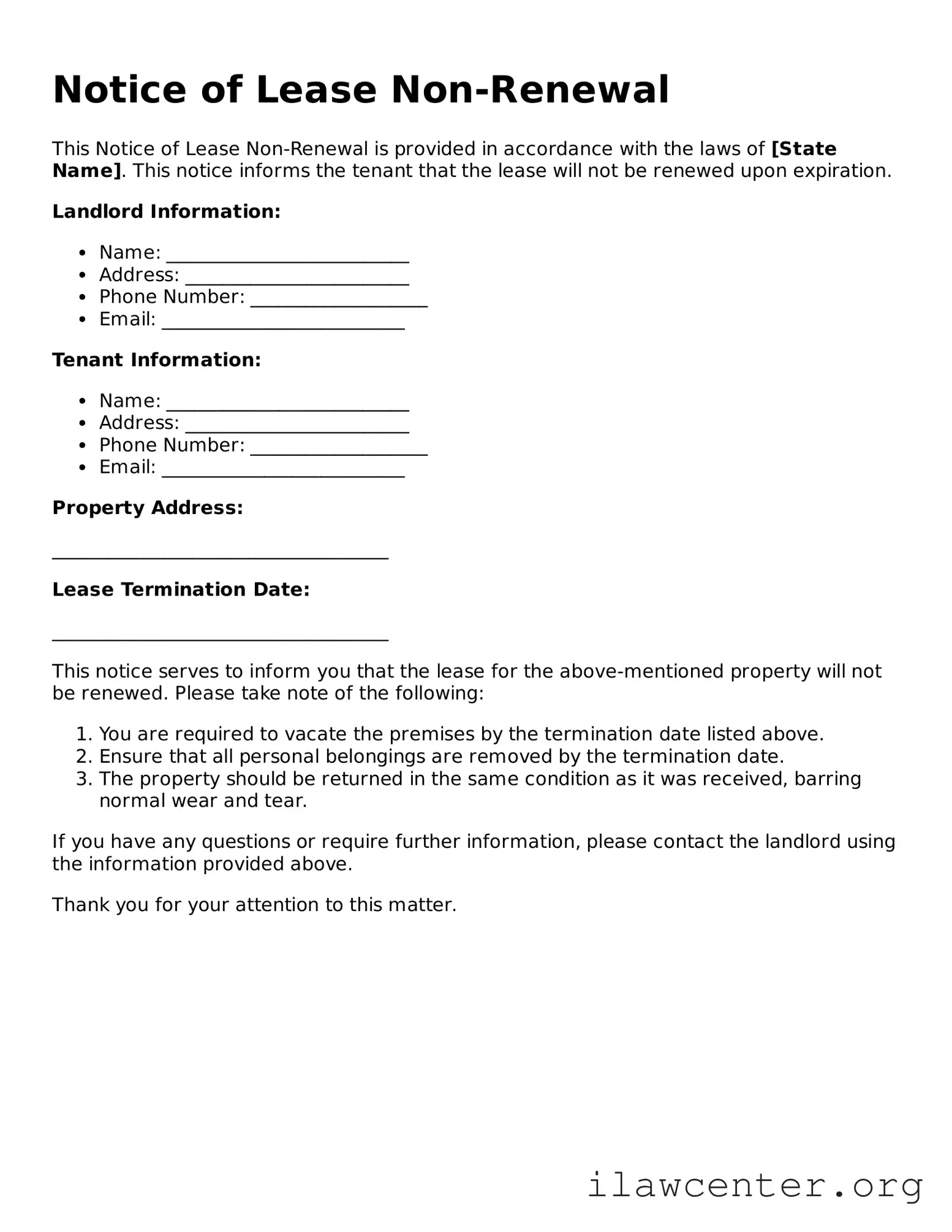
Notice of Lease Non-Renewal Preview

Notice of Lease Non-Renewal

This Notice of Lease Non-Renewal is provided in accordance with the laws of [State Name]. This notice informs the tenant that the lease will not be renewed upon expiration.

Landlord Information:

  • Name: __________________________
  • Address: ________________________
  • Phone Number: ___________________
  • Email: __________________________

Tenant Information:

  • Name: __________________________
  • Address: ________________________
  • Phone Number: ___________________
  • Email: __________________________

Property Address:

____________________________________

Lease Termination Date:

____________________________________

This notice serves to inform you that the lease for the above-mentioned property will not be renewed. Please take note of the following:

  1. You are required to vacate the premises by the termination date listed above.
  2. Ensure that all personal belongings are removed by the termination date.
  3. The property should be returned in the same condition as it was received, barring normal wear and tear.

If you have any questions or require further information, please contact the landlord using the information provided above.

Thank you for your attention to this matter.

PDF Form Characteristics

Fact Name Description
Purpose The Notice of Lease Non-Renewal informs tenants that their lease will not be renewed at the end of the term.
Timing This notice must typically be given a certain number of days before the lease ends, often 30 or 60 days, depending on state law.
Written Requirement Most states require the notice to be in writing to ensure clarity and provide a record.
State Variations The requirements for the notice can vary significantly from state to state, so it’s important to check local laws.
Delivery Methods Landlords can usually deliver the notice by mail, personal delivery, or sometimes via electronic means, depending on state regulations.
Governing Law In California, for example, the governing law is the California Civil Code Section 1946.
Tenant Rights Tenants have the right to challenge the notice if they believe it was issued improperly or without cause.
Potential Consequences If the notice is not given correctly, landlords may face legal challenges or delays in regaining possession of the property.

Instructions on Utilizing Notice of Lease Non-Renewal

Once you have the Notice of Lease Non-Renewal form ready, it’s important to fill it out accurately to ensure clear communication regarding the lease termination. After completing the form, you will need to deliver it to the appropriate party, typically the landlord or property management. Make sure to keep a copy for your records.

  1. Begin by entering the date at the top of the form. This should be the date you are completing the notice.
  2. Next, write your name and address in the designated section. Ensure that the information is current and correct.
  3. Fill in the name and address of the landlord or property management company. Double-check for accuracy.
  4. Specify the address of the rental property. This is crucial for identifying the lease in question.
  5. Indicate the date the lease will end. This should align with the terms of your current lease agreement.
  6. Provide a brief reason for non-renewal if required. Some forms may have a space for this, but it’s not always necessary.
  7. Sign and date the form at the bottom. Your signature indicates that you are formally submitting this notice.
  8. Make a copy of the completed form for your records before submitting it.

Important Facts about Notice of Lease Non-Renewal

What is a Notice of Lease Non-Renewal form?

A Notice of Lease Non-Renewal form is a document used by landlords to formally inform tenants that their lease will not be renewed at the end of the current term. This notice serves as a legal communication, outlining the landlord's intention to terminate the lease agreement upon its expiration.

Who should use this form?

This form is typically used by landlords or property managers who wish to notify tenants that they will not be extending their lease. It is important for landlords to follow the proper procedures to ensure compliance with local laws and regulations.

When should I send the Notice of Lease Non-Renewal?

The timing of the notice is crucial. Most jurisdictions require that the notice be sent a specific number of days before the lease ends. This period can vary, so it is essential to check local laws to determine the appropriate timeframe for sending the notice.

What information should be included in the notice?

The notice should include key details such as the tenant's name, the property address, the lease expiration date, and a clear statement indicating that the lease will not be renewed. Additionally, it may be helpful to include contact information for any questions or further communication.

Is there a specific format for the Notice of Lease Non-Renewal?

Can a tenant challenge a Notice of Lease Non-Renewal?

Yes, tenants may challenge a Notice of Lease Non-Renewal, particularly if they believe it violates their rights or local laws. Tenants should consult legal counsel or a local housing authority for guidance on their specific situation and potential recourse.

What happens after I send the notice?

Once the notice is sent, the tenant is expected to vacate the property by the lease expiration date. If the tenant does not leave, the landlord may need to initiate eviction proceedings, following the legal process outlined in their jurisdiction.

Can I still collect rent after sending the notice?

Yes, landlords can still collect rent for the duration of the lease term, even after sending a Notice of Lease Non-Renewal. The lease remains in effect until the expiration date, and tenants are obligated to pay rent as usual until that time.

What if I change my mind after sending the notice?

If a landlord decides to renew the lease after sending the Notice of Lease Non-Renewal, they should communicate this to the tenant as soon as possible. A new lease agreement should be drafted and signed to formalize the renewal, ensuring that both parties are in agreement.
Common mistakes

Completing the Notice of Lease Non-Renewal form can be straightforward, but several common mistakes often occur. One frequent error is failing to provide accurate tenant information. It is essential to include the full names of all tenants listed on the lease. Omitting a name or misspelling it can lead to confusion and potential disputes.

Another mistake involves incorrect dates. The form requires specific dates for the notice period, which varies depending on local laws. If the notice is not given within the required timeframe, it may invalidate the non-renewal process. Double-checking these dates is crucial to ensure compliance with legal requirements.

Some individuals neglect to sign the form. A signature is necessary to validate the notice. Without it, the document may not be considered official, leading to complications later on. Additionally, the method of delivery can also be problematic. Failing to deliver the notice according to the lease agreement or local regulations can render the notice ineffective.

Another common oversight is not providing a clear reason for non-renewal when required. While not always necessary, some jurisdictions may ask for a justification. Providing a vague or insufficient reason can lead to misunderstandings and potential legal challenges.

Lastly, many people forget to keep a copy of the completed form. Retaining a record is important for future reference, especially if disputes arise. A copy serves as proof of notice and can be essential in discussions with tenants or legal representatives.

Documents used along the form

When a lease is approaching its end and a landlord or tenant decides not to renew it, several other documents may be necessary to ensure a smooth transition. These documents help clarify responsibilities and rights, making the process easier for both parties involved.

  • Lease Agreement: This is the original contract that outlines the terms of the rental arrangement, including duration, payment, and responsibilities of both parties.
  • Move-Out Checklist: A list that details the tasks a tenant must complete before vacating the property. This may include cleaning, repairs, and the return of keys.
  • Security Deposit Return Form: A document used to outline any deductions from the security deposit and to confirm the return of the remaining balance to the tenant.
  • Final Inspection Report: A form that records the condition of the property at the end of the lease. It is typically filled out during the final walkthrough.
  • Notice to Vacate: A formal notification from the tenant to the landlord indicating their intention to leave the property by a specified date.
  • Utility Transfer Request: A document that facilitates the transfer of utility services from the tenant to the landlord or a new tenant after the lease ends.
  • Lease Extension Agreement: If both parties agree to extend the lease, this document outlines the new terms and duration of the lease extension.
  • Written Acknowledgment of Non-Renewal: A document confirming that both parties understand and agree to the non-renewal of the lease.
  • Tenant’s Forwarding Address Form: A form where the tenant provides their new address for future correspondence, especially regarding the security deposit.

Utilizing these documents can help ensure that both landlords and tenants are clear about their obligations and rights during the lease termination process. Proper documentation can prevent misunderstandings and foster a positive conclusion to the rental relationship.

Similar forms

  • Lease Termination Notice: This document notifies a tenant that their lease will end on a specified date. Like the Notice of Lease Non-Renewal, it serves to inform the tenant of the conclusion of their rental agreement.
  • Eviction Notice: Issued when a landlord seeks to remove a tenant from the property, this notice outlines the reasons for eviction and the timeframe for the tenant to vacate. Both documents communicate an end to the tenant's occupancy.
  • Notice to Quit: This document demands that a tenant vacate the premises by a certain date. Similar to the Notice of Lease Non-Renewal, it indicates that the landlord does not wish to continue the rental relationship.
  • Lease Renewal Offer: While this document proposes the continuation of a lease under new terms, it contrasts with the Notice of Lease Non-Renewal by seeking to extend the rental agreement instead of terminating it.
  • Rental Increase Notice: This notice informs tenants of an increase in rent, which may lead to non-renewal if the tenant chooses not to accept the new terms. Both documents can impact the tenant's decision to stay or leave.
  • Sublease Agreement: This document allows a tenant to rent out their space to another party. It differs from the Notice of Lease Non-Renewal but shares the theme of altering occupancy arrangements.
  • Security Deposit Return Notice: This document outlines the return of a security deposit after lease termination. It relates to the end of the lease, similar to the Notice of Lease Non-Renewal, by addressing the conclusion of the rental relationship.
  • Notice of Intent to Vacate: This document is provided by tenants to inform landlords of their decision to leave. It parallels the Notice of Lease Non-Renewal as both signify an end to the tenancy.
  • Property Inspection Notice: This document informs tenants of an upcoming property inspection, often occurring at the lease's end. While not directly terminating the lease, it indicates that the landlord is preparing for the conclusion of the tenancy.

Dos and Don'ts

When filling out the Notice of Lease Non-Renewal form, it's important to approach the process carefully. Here are some key things to keep in mind.

  • Do: Read the entire form thoroughly before starting to fill it out. Understanding the requirements will help you avoid mistakes.
  • Do: Provide accurate information. Double-check names, addresses, and dates to ensure everything is correct.
  • Do: Sign and date the form. An unsigned form may not be considered valid.
  • Do: Keep a copy of the completed form for your records. This will be useful for future reference.
  • Don't: Use vague language. Be clear and specific about your intentions to not renew the lease.
  • Don't: Forget to check local laws. Some areas have specific requirements regarding notice periods.
  • Don't: Submit the form late. Ensure you provide the required notice within the time frame specified in your lease agreement.
  • Don't: Ignore any additional instructions. If the form has specific guidelines, make sure to follow them closely.

By keeping these dos and don'ts in mind, you can fill out the Notice of Lease Non-Renewal form more effectively, ensuring a smoother transition as your lease term comes to an end.

Misconceptions

When it comes to the Notice of Lease Non-Renewal form, several misconceptions can cloud understanding. Here are four common misunderstandings that many people have:

  • Misconception 1: The form must be filed in person.
  • Many tenants and landlords believe that the Notice of Lease Non-Renewal must be delivered in person to be valid. In reality, most jurisdictions allow for the notice to be sent via mail or electronic communication, provided it complies with local laws.

  • Misconception 2: The notice can be given at any time.
  • Some people think they can issue a non-renewal notice whenever they please. However, there are often specific time frames that must be adhered to, which can vary by state or local law. Missing these deadlines can lead to complications.

  • Misconception 3: A verbal notice is sufficient.
  • It's a common belief that a simple verbal communication suffices for non-renewal. In most cases, a written notice is required to provide clear documentation and to protect both parties' rights.

  • Misconception 4: The form is the same everywhere.
  • Many assume that the Notice of Lease Non-Renewal is a standardized document across the country. In fact, the requirements and format can differ significantly depending on local laws and regulations. It's essential to use the correct version for your area.

Key takeaways

When preparing to fill out the Notice of Lease Non-Renewal form, there are several important points to keep in mind. Understanding these key takeaways can help ensure that the process goes smoothly and that all necessary steps are followed.

  • Understand the Timeline: Be aware of the notice period required by your lease agreement. This period can vary based on local laws and the specific terms of your lease.
  • Provide Accurate Information: Fill out the form with precise details, including your name, the property address, and the lease expiration date. Inaccuracies can lead to confusion or disputes.
  • Delivery Method Matters: Deliver the notice according to the guidelines set forth in your lease. Whether by mail, email, or personal delivery, ensure you follow the specified method to avoid complications.
  • Keep a Copy: Always retain a copy of the completed Notice of Lease Non-Renewal for your records. This serves as proof of your intent not to renew the lease.
  • Consider Timing: Submit the notice as early as possible within the required timeframe. This not only fulfills your obligation but also allows the landlord ample time to prepare for the transition.
  • Review Local Laws: Familiarize yourself with any local regulations regarding lease non-renewal. Different jurisdictions may have unique requirements or protections for tenants.

By keeping these points in mind, individuals can navigate the process of non-renewing a lease with greater ease and confidence.