Notice Owner Florida PDF Template

Notice Owner Florida PDF Template

The Notice to Owner Florida form is an important document in the construction industry. It serves as a notification to property owners and other involved parties that a contractor, subcontractor, or material supplier has provided services or materials for a property. Understanding this form is essential to protect your rights and avoid potential liens against your property.

To ensure your interests are safeguarded, consider filling out the form by clicking the button below.

Article Guide

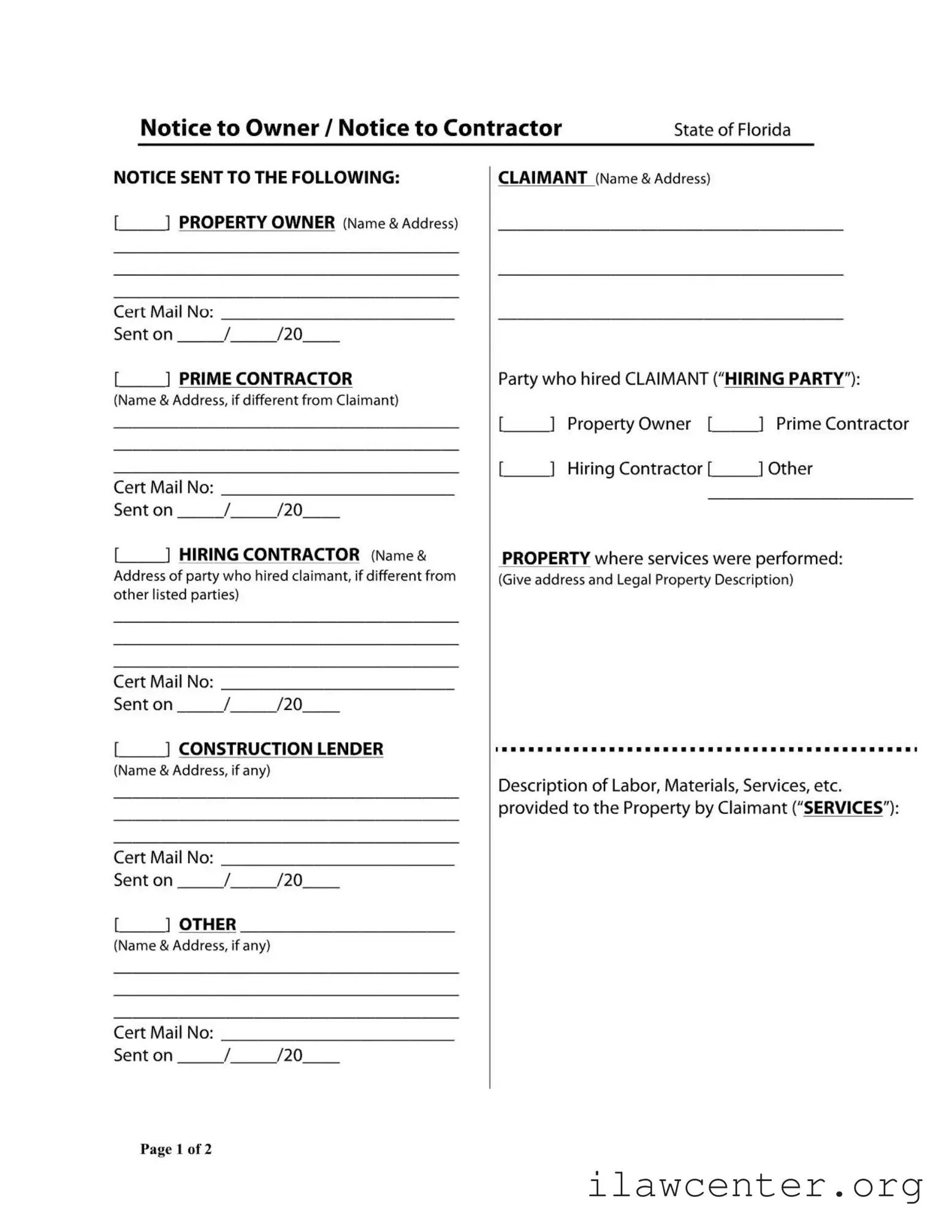
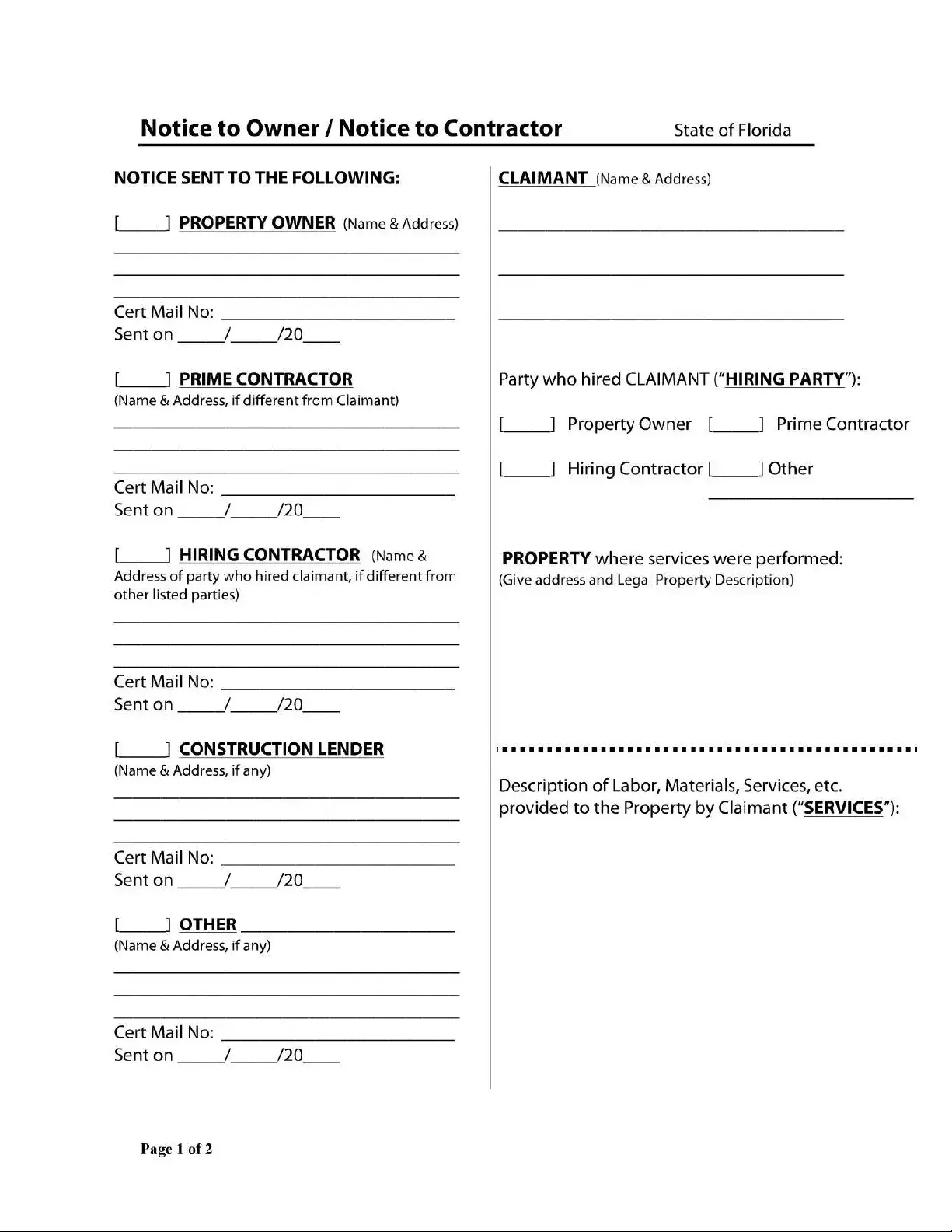
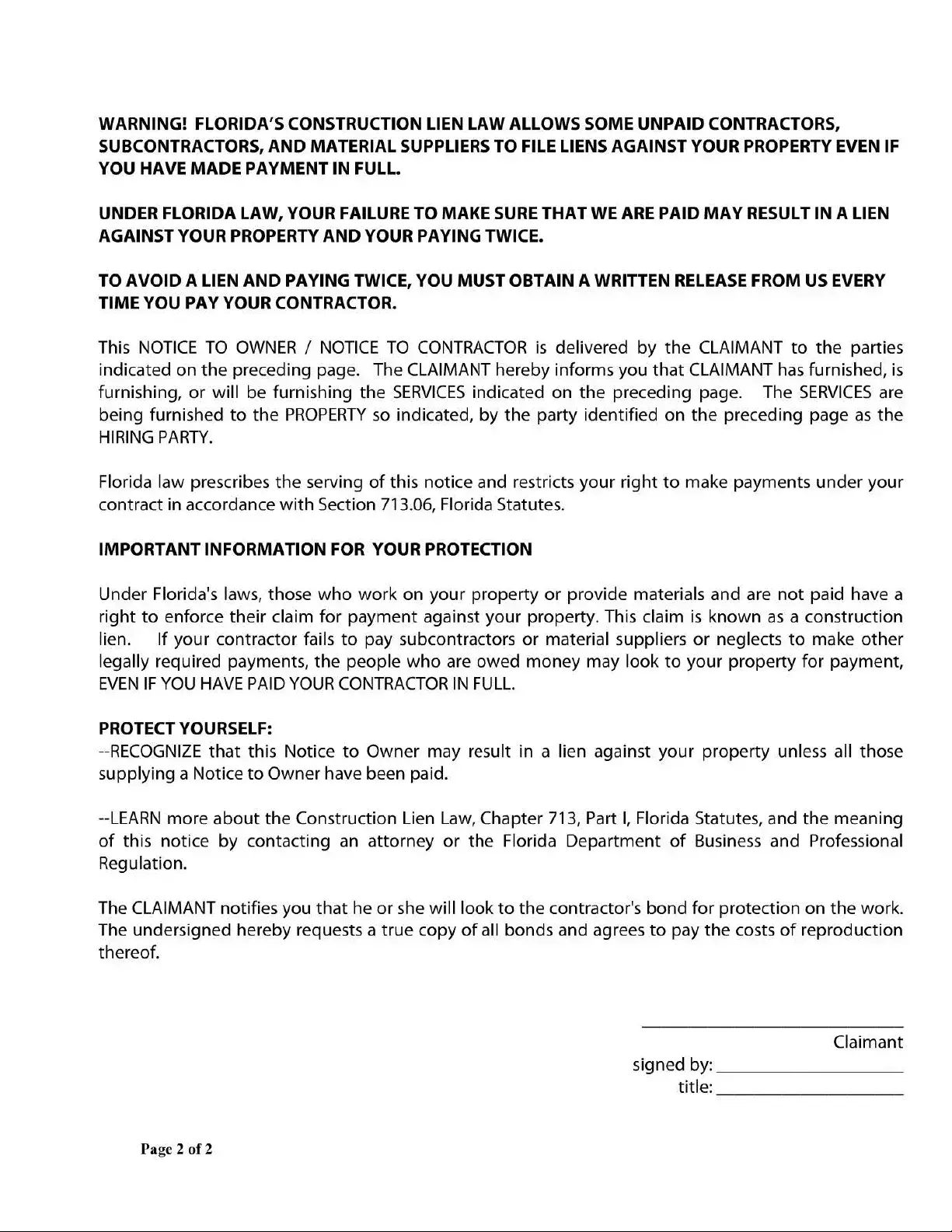
The Notice Owner Florida form serves as a crucial document in the construction industry, particularly for property owners, contractors, and subcontractors. This form is designed to protect the rights of those who provide labor and materials for a construction project. By sending this notice, the claimant informs all relevant parties—including the property owner, prime contractor, hiring contractor, and any construction lender—about the services they have provided or will provide. This is essential because, under Florida law, unpaid contractors and suppliers can file a lien against the property, even if the property owner has already paid the contractor in full. The form outlines important details such as the names and addresses of all involved parties, a description of the services rendered, and the property where the work was performed. Additionally, it includes a warning about the implications of not ensuring that all parties are paid, emphasizing the need for a written release after each payment to avoid the risk of double payment. Understanding this form is vital for anyone involved in a construction project in Florida, as it helps safeguard against potential financial pitfalls and legal issues.

Notice Owner Florida Preview

Notice
to
Owner/
Notice
to
Contractor State
of
Florida
NOTICE
SENT
TO
THE
FOLLOWING:
~
_
_,)
PROPERTY
OWNER
(Name & Address)
Cert Mail No:
__________
_
Sent
on
__
!
__
!20
..__..
) PRIME CONTRACTOR
(Name & Address,
if
different
from
Claimant)
Cert Mail No:
__________
_
Senton
__
/
__
/20
__
..__..)
HIRING
CONTRACTOR
(Name &
Address
of
party
who
hired claimant,
if
different
from
other
listed parties)
Ce
rt
Mail No:
-----------
Senton
__
/
__
/20
__
..__..)
CONSTRUCTION
LENDER
(Name & Address,
if
any)
Cert Mail No:
-----------
Sent
on
__
/
__
/20
__
~
_
_,]
OTHER
_________
_
(Name & Address,
if
any)
Cert Mail No:
-----------
Sent
on
__
/
__
/20
__
Page 1
of2
CLAIMANT (Name & Address)
Party
who
hir
ed CLAIMANT ("HIRING PARTY
"):
Property
Owner
.__[
_
__,)
Prime Contractor
Hiring Contractor.__[ _
__,)
Other
PROPERTY
whe
re
se
rvic
es
were per
fo
rmed:
(Give address and Legal Property Description)
..........•.•....•..........•......•......•.....
Description
of
Labor, Materials, Servi
ces,
et
c.
provided
to
the Property
by
Claimant
("
SERVICES
"):
WARNING! FLORIDA'S CONSTRUCTION
LIEN
LAW
ALLOWS
SOME UNPAID
CONTRACTORS,
SUBCONTRACTORS,
AND MATERIAL
SUPPLIERS
TO
FILE
LIENS
AGAINST YOUR
PROPERTY
EVEN
IF
YOU HAVE MADE PAYMENT IN
FULL.
UNDER FLORIDA LAW, YOUR
FAILURE
TO
MAKE
SURE
THAT
WE
ARE
PAID MAY
RESULT
IN A
LIEN
AGAINST YOUR
PROPERTY
AND YOUR PAYING TWICE.
TO AVOID A
LIEN
AND PAYING TWICE, YOU MUST OBTAIN A WRITTEN
RELEASE
FROM
US
EVERY
TIME YOU PAY YOUR CONTRACTOR.
This
NOTICE
TO
OWNER
/
NOTICE
TO
CONTRACTOR
is
delivered by
the
CLAIMANT
to
the
parties
indicated on
the
preceding page. The CLAIMANT hereby informs you
that
CLAIMANT
has
furnished,
is
furnishing,
or
will be furnishing
the
SERVICES
indicated on
the
preceding page. The
SERVICES
are
being furnished
to
the
PROPERTY
so indicated, by
the
party identified on
the
preceding page
as
the
HIRING
PARTY.
Florida law prescribes
the
serving
of
this notice and restricts
your
right
to
make payments under
your
contract in accordance
with
Section
713
.06, Florida Statutes.
IMPORTANT INFORMATION
FOR
YOUR
PROTECTION
Under Florida's laws, those
who
work
on
your property
or
provide materials and are
not
paid have a
right
to
enforce their claim
for
payment against
your
property. This claim
is
known
as
a construction
lien.
If
your
contractor fails
to
pay subcontractors
or
material suppliers
or
neglects
to
make other
legally required payments,
the
people
who
are owed money may look
to
your
property
for
payment,
EVEN
IF
YOU
HAVE
PAID
YOUR
CONTRACTOR
IN
FULL.
PROTECT
YOURSELF:
--RECOGNIZE
that
this Notice
to
Owner may result
in
a lien against your property unless all those
supplying a Notice
to
Owner have been paid.
--
LEARN
more
about
the
Construction Lien Law, Chapter
713
, Part
I,
Florida Statutes, and
the
meaning
of
this notice
by
contacting
an
attorney
or
the
Florida Department
of
Business and Professional
Regulation.
The CLAIMANT notifi
es
you
that
he
or
she will look
to
the
contractor's bond
for
protection
on
the
work.
The undersigned hereby requests a
true
copy
of
all bonds and agrees
to
pay
the
costs
of
reproduction
thereof.
Claimant
signed by:
_______
_
title:
--------
Page 2
of2

File Properties

Fact Name Fact Description
Purpose The Notice to Owner form informs property owners and contractors about unpaid services related to construction projects.
Governing Law This form is governed by Florida's Construction Lien Law, specifically Section 713.06 of the Florida Statutes.
Parties Involved The form requires information from the property owner, prime contractor, hiring contractor, construction lender, and the claimant.
Certification Each party listed must receive the notice via certified mail, ensuring proof of delivery.
Claimant's Rights The claimant can file a lien against the property if payment is not received for services rendered.
Property Description The form must include a detailed description of the property where services were performed.
Warning The form warns property owners that they could face double payment if they do not ensure all contractors are paid.
Release Requirement To avoid a lien, property owners should obtain a written release from the claimant each time they make a payment.
Legal Assistance Property owners are advised to consult an attorney or the Florida Department of Business and Professional Regulation for guidance.

Instructions on Utilizing Notice Owner Florida

Filling out the Notice Owner Florida form is a crucial step in ensuring that all parties involved in a construction project are aware of their rights and obligations. This form serves as a notification to property owners, contractors, and others about the services provided and helps prevent potential liens against the property. Following the steps below will help you accurately complete the form.

  1. Begin by entering the name and address of the Property Owner in the designated area.
  2. Fill in the Certified Mail Number next to the Property Owner's information.
  3. Indicate the date the notice was sent to the Property Owner.
  4. Next, provide the name and address of the Prime Contractor, if it differs from the Claimant's information.
  5. Again, fill in the Certified Mail Number for the Prime Contractor.
  6. Enter the date the notice was sent to the Prime Contractor.
  7. Proceed to fill in the name and address of the Hiring Contractor, if applicable.
  8. Complete the Certified Mail Number section for the Hiring Contractor.
  9. Indicate the date the notice was sent to the Hiring Contractor.
  10. If there is a Construction Lender, provide their name and address in the next section.
  11. Fill in the Certified Mail Number for the Construction Lender.
  12. Enter the date the notice was sent to the Construction Lender.
  13. If there are any other parties involved, provide their name and address in the Other section.
  14. Complete the Certified Mail Number for the Other party.
  15. Indicate the date the notice was sent to the Other party.
  16. Next, provide the name and address of the Claimant.
  17. Identify the Hiring Party by marking the appropriate option (Property Owner, Prime Contractor, Hiring Contractor, or Other).
  18. Fill in the address and legal description of the property where services were performed.
  19. Describe the Labor, Materials, Services, etc. provided to the property by the Claimant.
  20. Complete the Certified Mail Number for this section.
  21. Finally, ensure that the Claimant signs the form and includes their title.

Important Facts about Notice Owner Florida

What is the purpose of the Notice Owner Florida form?

The Notice Owner Florida form serves as a formal notification to property owners, contractors, and other parties involved in a construction project. It informs them that a claimant has provided or will provide services, labor, or materials to a property. This notice is crucial because it helps protect the rights of contractors and subcontractors by ensuring they can enforce their claims for payment through a construction lien if necessary.

Who should receive the Notice Owner Florida form?

The form must be sent to several key parties involved in the construction project. This includes the property owner, the prime contractor, the hiring contractor, and any construction lenders. Additionally, any other relevant parties may also be included. Sending this notice to all necessary parties is essential to ensure that everyone is informed about the services being provided and the potential for a lien if payments are not made.

What are the consequences of not responding to the Notice Owner Florida form?

If the parties receiving the notice do not respond or take action, they may risk having a lien placed against their property. Florida's construction lien law allows unpaid contractors, subcontractors, and material suppliers to file liens even if the property owner has paid their contractor in full. Failure to address the notice can lead to financial complications, including the possibility of paying twice for the same services.

How can property owners protect themselves when receiving a Notice Owner Florida form?

Property owners can take several steps to protect themselves. First, they should recognize that receiving this notice may indicate potential lien claims. It is advisable to ensure that all parties supplying a Notice to Owner have been paid. Obtaining written releases from contractors upon payment can help prevent liens. Additionally, property owners should educate themselves about the Florida Construction Lien Law by consulting with an attorney or contacting the Florida Department of Business and Professional Regulation.

What should a claimant do after sending the Notice Owner Florida form?

After sending the Notice Owner Florida form, the claimant should keep a record of the sent notices and any responses received. It is also important for the claimant to monitor payments from the hiring party. If payments are not made, the claimant may need to consider enforcing their lien rights to secure payment for the services provided. Keeping thorough documentation will be beneficial if legal action becomes necessary.

Common mistakes

Filling out the Notice to Owner form in Florida can be a straightforward process, but mistakes can lead to complications. Here are ten common errors people make when completing this important document.

First, many individuals forget to include the correct property owner's name and address. This information is crucial, as it identifies the party responsible for the property. Omitting or miswriting this detail can delay the notification process and may even invalidate the notice.

Another frequent mistake is neglecting to provide the correct address and legal description of the property. This description should be accurate and detailed. A vague or incorrect description can create confusion and may hinder the enforcement of any claims.

Some people fail to include the certified mail numbers for each party listed on the form. These numbers serve as proof that the notices were sent. Without them, there may be disputes about whether the notices were properly delivered.

Additionally, it is common for individuals to overlook the date of sending the notices. Each party should have a corresponding date to ensure that all parties are aware of when the notice was issued. This is important for tracking timelines related to any claims.

Another mistake involves inaccurately identifying the claimant and their relationship to the hiring party. It’s essential to clearly state who the claimant is and who hired them. Misidentifying these parties can lead to legal complications.

Some forms are filled out without a clear description of the services provided. This section should be detailed and specific. If the description is vague, it can lead to misunderstandings about what work was done and may weaken any claims for payment.

People often forget to sign the form. A missing signature can render the notice incomplete. It’s important to ensure that the claimant's signature is included, along with their title, if applicable.

Another common oversight is not obtaining a written release from the contractor after making payments. This is a critical step in protecting oneself from potential liens. Failing to do so can result in unexpected financial liabilities.

Some individuals do not take the time to understand Florida's Construction Lien Law. Familiarizing oneself with the law can help property owners recognize their rights and responsibilities. Ignorance of the law can lead to costly mistakes.

Finally, a lack of communication with all parties involved can lead to misunderstandings. It’s important to keep open lines of communication with contractors and subcontractors. This can help ensure that everyone is on the same page and that payments are made appropriately.

By avoiding these common mistakes, individuals can ensure that their Notice to Owner forms are completed correctly, thereby protecting their interests in any construction-related transactions.

Documents used along the form

The Notice to Owner form is a crucial document in Florida's construction industry, ensuring that property owners are informed about potential liens on their property. Alongside this form, there are several other important documents that help facilitate communication and protect the rights of all parties involved in a construction project. Here is a list of some of these key forms and documents.

  • Construction Lien Waiver: This document is used by contractors or subcontractors to waive their right to file a lien against a property after receiving payment. It provides peace of mind to property owners that they will not face a lien for the work completed.
  • Notice of Commencement: This form is filed with the county clerk before starting construction. It provides notice to all parties involved about the beginning of a construction project and includes information about the property, the owner, and the contractor.
  • Affidavit of Payment: This document is often provided by contractors to confirm that all subcontractors and suppliers have been paid for their work and materials. It helps protect property owners from potential liens by ensuring that all parties have been compensated.
  • Subcontractor Agreement: This contract outlines the terms and conditions between a contractor and a subcontractor. It specifies the scope of work, payment terms, and other important details related to the project.
  • Change Order: A change order is a document that modifies the original construction contract. It details changes in the scope of work, cost adjustments, and any necessary extensions of time for project completion.
  • Final Release of Lien: This document is provided at the end of a project to confirm that all parties have been paid and that they waive their right to file a lien against the property. It is essential for closing out a construction project without any lingering financial obligations.
  • Certificate of Substantial Completion: This certificate indicates that the construction project is sufficiently complete, allowing the owner to occupy or use the property. It also marks the start of the warranty period for the work performed.
  • Contractor's License Verification: This document confirms that the contractor holds a valid license to perform work in Florida. It is important for property owners to verify this to ensure compliance with state regulations.
  • Insurance Certificate: This certificate provides proof that the contractor has the necessary insurance coverage, including liability and workers' compensation. It protects property owners from potential claims related to accidents or damages during construction.

Understanding these documents and their purposes can significantly enhance the protection of property owners and contractors alike. By utilizing the appropriate forms and ensuring clear communication, all parties can navigate the complexities of construction projects more effectively.

Similar forms

The Notice to Owner form in Florida serves a critical purpose in construction projects. It notifies property owners and other parties about potential liens. There are several other documents that share similarities with the Notice to Owner form. Here’s a look at five of them:

  • Notice of Intent to Lien: This document informs property owners of a contractor's intention to file a lien if payment is not received. Like the Notice to Owner, it serves as a warning about potential legal actions regarding unpaid services.
  • Claim of Lien: Once a contractor has not been paid, they can file this document to officially claim a lien against the property. Similar to the Notice to Owner, it protects the rights of contractors and subcontractors by asserting their claim to payment.
  • Release of Lien: This document is used to formally release a lien once payment has been made. It parallels the Notice to Owner by ensuring that all parties are aware of the status of payments and claims on the property.
  • Subcontractor's Notice: This notice informs property owners that a subcontractor is involved in the project. It is similar to the Notice to Owner as it keeps the property owner informed about who is working on their property and who may have a claim for payment.
  • Notice of Non-Payment: This document is sent to inform the property owner that a contractor has not been paid. Like the Notice to Owner, it emphasizes the importance of ensuring all parties are compensated to avoid potential liens.

Dos and Don'ts

When filling out the Notice Owner Florida form, attention to detail is crucial. Here are five important do's and don'ts to keep in mind:

  • Do ensure that all names and addresses are accurate. This includes the property owner, prime contractor, hiring contractor, and any construction lender involved.
  • Do provide a clear and complete legal description of the property where services were performed. This helps avoid any confusion regarding the location.
  • Do specify the services provided in detail. Clearly describing the labor, materials, or services ensures that all parties understand what has been rendered.
  • Don't forget to send the notice via certified mail. This step is essential for establishing proof that the notice was delivered.
  • Don't neglect to obtain a written release from the contractor each time a payment is made. This protects against potential liens against the property.

By adhering to these guidelines, individuals can better navigate the complexities of the Notice Owner Florida form and safeguard their interests in construction-related matters.

Misconceptions

  • Misconception 1: The Notice to Owner is only necessary for large construction projects.

    This is not true. The Notice to Owner is required for any construction project where a contractor, subcontractor, or supplier is involved. Regardless of the project's size, if services or materials are provided, this notice helps protect the rights of those who contribute to the project.

  • Misconception 2: Sending the Notice to Owner guarantees payment to the contractor.

    While the Notice to Owner serves as a formal communication regarding the services provided, it does not ensure payment. It is a protective measure that informs property owners of potential liens if payments are not made to contractors or suppliers.

  • Misconception 3: If I pay my contractor in full, I am protected from liens.

    This is a common misunderstanding. Even if you have paid your contractor completely, subcontractors and suppliers can still file a lien against your property if they have not been compensated. The Notice to Owner helps to alert you to this risk.

  • Misconception 4: The Notice to Owner is a legal threat to property owners.

    While the notice does inform property owners of their obligations, it is not intended to intimidate. Instead, it serves as a reminder of the legal framework surrounding construction projects in Florida, helping to ensure all parties are paid appropriately.

Key takeaways

When filling out and using the Notice Owner Florida form, it is essential to understand its implications and requirements. Here are four key takeaways:

  • Purpose of the Notice: The Notice to Owner serves as a formal notification to property owners and other relevant parties that services or materials have been provided. This notice is crucial in protecting the rights of contractors, subcontractors, and suppliers.
  • Potential Liens: Under Florida law, unpaid contractors and suppliers can file a lien against the property, even if the property owner has paid the contractor in full. This underscores the importance of ensuring that all parties are compensated properly.
  • Written Releases: To avoid potential liens and the risk of paying twice, property owners should obtain a written release from contractors each time a payment is made. This step is vital in safeguarding against future claims.
  • Understanding the Law: Familiarity with Florida's Construction Lien Law, specifically Chapter 713, Part I, is essential. Property owners are encouraged to seek legal advice or contact the Florida Department of Business and Professional Regulation for further clarification on their rights and responsibilities.