
Npma33 PDF Template

Npma33 PDF Template

The NPMA-33 form is a Wood Destroying Insect Inspection Report that documents the findings of a visual inspection for wood-destroying insects in a property. This report helps buyers and sellers understand the condition of a structure concerning potential infestations and any visible damage. For a thorough assessment, consider filling out the form by clicking the button below.

Article Guide

The NPMA-33 form serves as a critical tool in assessing the condition of properties concerning wood-destroying insects. It provides a comprehensive inspection report that outlines the findings of a visual examination conducted by a licensed pest control company. The form includes essential details such as the date of inspection, the inspector's credentials, and the property address. In its findings section, the report distinguishes between visible evidence of wood-destroying insects and the absence thereof, while also noting any signs of previous treatments. Importantly, it clarifies that the inspection is not a guarantee against future infestations or structural damage. Recommendations for treatment, if necessary, are included, along with a section addressing any obstructions that may have limited access during the inspection. The NPMA-33 form also emphasizes the importance of consumer awareness regarding the limitations of the inspection, advising homeowners on maintenance practices to prevent infestations. Overall, this form plays a vital role in informing buyers and property owners about potential risks associated with wood-destroying insects and the condition of their structures.

Npma33 Preview

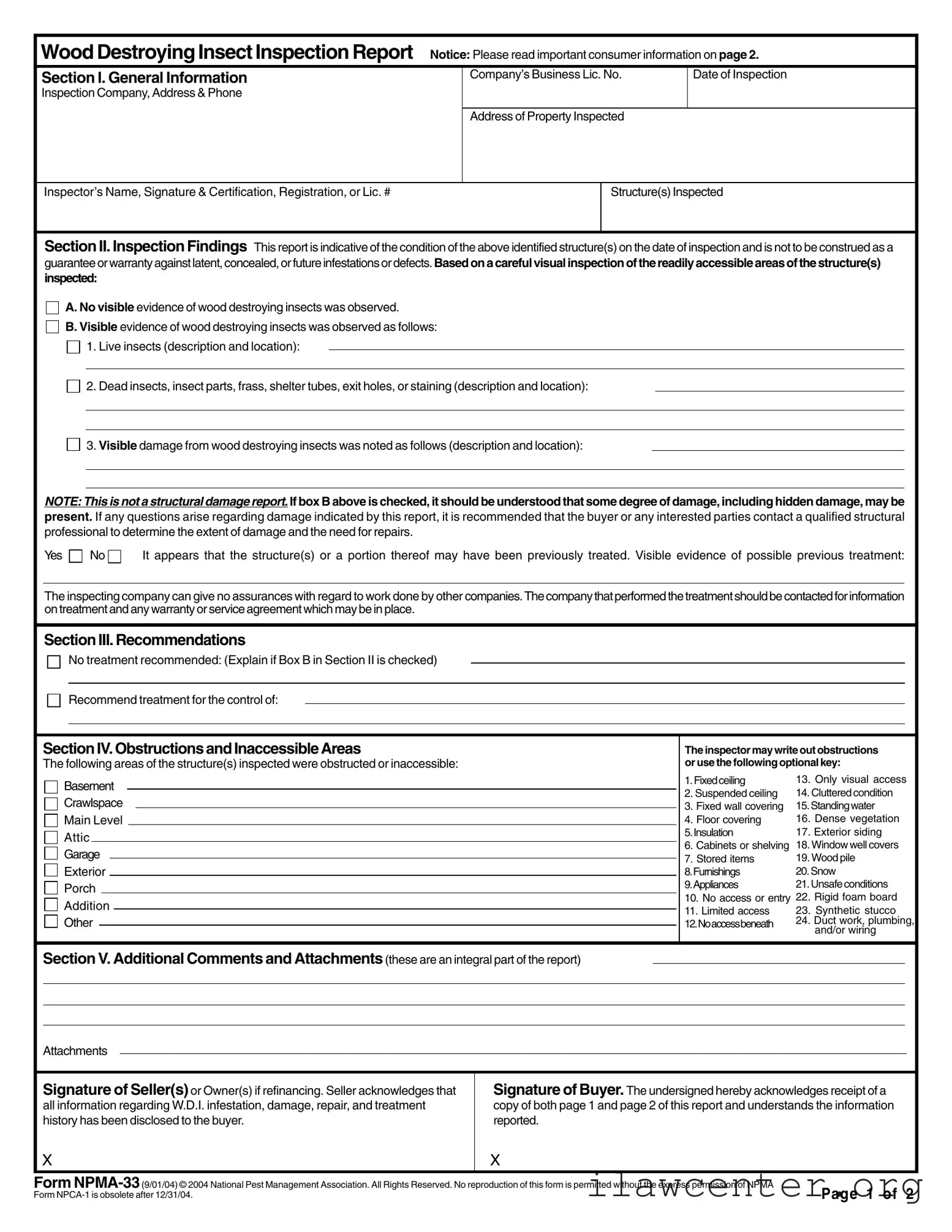
Section II. Inspection Findings This report is indicative of the condition of the above identified structure(s) on the date of inspection and is not to be construed as a
guarantee or warranty against latent, concealed, or future infestations or defects. Based on a careful visual inspection of the readily accessible areas of the structure(s)
inspected:
A. No visible evidence of wood destroying insects was observed.
B. Visible evidence of wood destroying insects was observed as follows:
1. Live insects (description and location):
2. Dead insects, insect parts, frass, shelter tubes, exit holes, or staining (description and location):
3. Visible damage from wood destroying insects was noted as follows (description and location):
NOTE: This is not a structural damage report.
If box B above is checked, it should be understood that some degree of damage, including hidden damage, may be
present. If any questions arise regarding damage indicated by this report, it is recommended that the buyer or any interested parties contact a qualified structural
professional to determine the extent of damage and the need for repairs.
Yes No It appears that the structure(s) or a portion thereof may have been previously treated. Visible evidence of possible previous treatment:
The inspecting company can give no assurances with regard to work done by other companies. The company that performed the treatment should be contacted for information
on treatment and any warranty or service agreement which may be in place.
Signature of Seller(s) or Owner(s) if refinancing. Seller acknowledges that
all information regarding W.D.I. infestation, damage, repair, and treatment
history has been disclosed to the buyer.
Form NPMA-33 (9/01/04) © 2004 National Pest Management Association. All Rights Reserved. No reproduction of this form is permitted without the express permission of NPMA
Form NPCA-1 is obsolete after 12/31/04.
Page 1 of 2
Signature of Buyer. The undersigned hereby acknowledges receipt of a
copy of both page 1 and page 2 of this report and understands the information
reported.
Wood Destroying Insect Inspection Report Notice: Please read important consumer information on page 2.
Section I. General Information
Inspection Company, Address & Phone
Company’s Business Lic. No.
Date of Inspection
Inspector’s Name, Signature & Certification, Registration, or Lic. # Structure(s) Inspected
Address of Property Inspected
Section III. Recommendations
No treatment recommended: (Explain if Box B in Section II is checked)
Recommend treatment for the control of:
Section IV. Obstructions and Inaccessible Areas
The following areas of the structure(s) inspected were obstructed or inaccessible:
Basement
Crawlspace
Main Level
Attic
Garage
Exterior
Porch
Addition
Other
Section V. Additional Comments and Attachments (these are an integral part of the report)
Attachments
1. Fixed ceiling
2. Suspended ceiling
3. Fixed wall covering
4. Floor covering
5. Insulation
6. Cabinets or shelving
7. Stored items
8. Furnishings
9. Appliances
10. No access or entry
11. Limited access
12. No access beneath
13. Only visual access
14. Cluttered condition
15. Standing water
16. Dense vegetation
17. Exterior siding
18. Window well covers
19. Wood pile
20. Snow
21. Unsafe conditions
22. Rigid foam board
23. Synthetic stucco
24. Duct work, plumbing,
and/or wiring
XX
The inspector may write out obstructions
or use the following optional key:
1. About the Inspection: A visual inspection was conducted in the readily accessible areas of the structure(s) indicated (see Page
1) including attics and crawlspaces which permitted entry during the inspection. The inspection included probing and/or
sounding of unobstructed and accessible areas to determine the presence or absence of visual evidence of wood destroying
insects. The WDI inspection firm is not responsible to repair any damage or treat any infestation at the structure(s) inspected,
except as may be provided by separate contract. Also, wood destroying insect infestation and/or damage may exist in concealed
or inaccessible areas. The inspection firm cannot guarantee that any wood destroying insect infestation and/or damage disclosed
by this inspection represents all of the wood destroying insect infestation and/or damage which may exist as of the date of the
inspection.
For purposes of this inspection, wood destroying insects include: termites, carpenter ants, carpenter bees, and
reinfesting wood boring beetles. This inspection does not include mold, mildew or noninsect wood destroying organisms.
This report shall be considered invalid for purposes of securing a mortgage and/or settlement of property transfer if not
used within ninety (90) days from the date of inspection.
This shall not be construed as a 90-day warranty. There is no
warranty, express or implied, related to this report unless disclosed as required by state regulations or a written
warranty or service agreement is attached.
2. Treatment Recommendation Guidelines Regarding Subterranean Termites: FHA and VA require treatment when any active
infestation of subterranean termites is found. If signs of subterranean termites — but no activity — are found in a structure that
shows no evidence of having been treated for subterranean termites in the past, then a treatment should be recommended. A
treatment may also be recommended for a previously treated structure showing evidence of subterranean termites — but no
activity — if there is no documentation of a liquid treatment by a licensed pest control company within the previous five years
unless the structure is presently under warranty or covered by a service agreement with a licensed pest control company.
3. Obstructions and Inaccessible Areas: No inspection was made in areas which required the breaking apart or into, dismantling,
removal of any object, including but not limited to: moldings, floor coverings, wall coverings, siding, fixed ceilings, insulation,
furniture, appliances, and/or personal possessions; nor were areas inspected which were obstructed or inaccessible for physical
access on the date of inspection. Your inspector may write out inaccessible areas or use the key in Section IV. Crawl spaces,
attics, and/or other areas may be deemed inaccessible if the opening to the area is not large enough to provide physical access for
the inspector or if a ladder was required for access. Crawl spaces (or portions thereof) may also be deemed inaccessible if there
is less than 24 inches of clearance from the bottom of the floor joists to the surface below. If any area which has been reported as
inaccessible is made accessible, the inspection company may be contacted for another inspection. An additional fee may apply.
4. Consumer Maintenance Advisory Regarding Integrated Pest Management for Prevention of Wood Destroying Insects.
Any structure can be attacked by wood destroying insects. Homeowners should be aware of and try to eliminate conditions
which promote insect infestation in and around their structure(s). Factors which may lead to wood destroying insect infestation
include: earth to wood contact, foam insulation at foundation in contact with soil, faulty grade, improper drainage, firewood
against structure(s), insufficient ventilation, moisture, wood debris in crawlspace, wood mulch or ground cover in contact with
the structure, tree branches touching structure(s), landscape timbers and wood decay. Should these or other conditions exist,
corrective measures should be taken in order to reduce the chances of infestation of wood destroying insects and the need for
treatment.
5. Neither the inspecting company nor the inspector has had, presently has, or contemplates having any interest in the
property inspected.
Important Consumer Information Regarding
the Scope and Limitations of the Inspection
Page 2 of 2
Please read this entire page as it is part of this report. This report is not a guarantee or warranty as to the absence of wood destroying
insects nor is it a structural integrity report. The inspectors training and experience do not qualify the inspector in damage evaluation or
any other building construction technology and/or repair.
Form NPMA-33 (9/01/04) © 2004 National Pest Management Association. All Rights Reserved. No reproduction of this form is permitted without the express permission of NPMA
Form NPCA-1 is obsolete after 12/31/04.

File Properties

Fact Name Description Governing Law(s)
Purpose of the Form The NPMA-33 form is used to document the findings of a wood destroying insect inspection. It provides a visual assessment of the property for any signs of infestation. State-specific pest control regulations
Limitations of the Inspection This report does not guarantee the absence of wood destroying insects nor does it evaluate structural integrity. It solely reflects the condition at the time of inspection. State regulations regarding pest inspections
Consumer Advisory Homeowners are advised to maintain their property to prevent infestations. This includes managing moisture, wood debris, and ensuring proper drainage. State health and safety codes
Validity of the Report The NPMA-33 report is valid for 90 days from the date of inspection for purposes of mortgage and property transfer. It is not a warranty. State real estate laws

Instructions on Utilizing Npma33

Filling out the NPMA-33 form is a straightforward process that requires attention to detail. This form serves as a record of the inspection of wood-destroying insects and provides important information to both buyers and sellers regarding the condition of the property. Follow the steps below to ensure that the form is completed accurately.

  1. Begin by entering the Company’s Business License Number at the top of the form.
  2. Fill in the Date of Inspection.
  3. Provide the Inspection Company Name, Address, and Phone Number.
  4. Enter the Address of the Property Inspected.
  5. Write the Inspector’s Name, along with their Signature and any relevant Certification, Registration, or License Number.
  6. Indicate the Structure(s) Inspected in the designated area.
  7. In Section II, check the appropriate box regarding the findings:
    • If no visible evidence of wood-destroying insects was observed, check the box for "A."
    • If evidence was observed, check the box for "B" and provide descriptions and locations for:
      • Live insects
      • Dead insects, insect parts, frass, shelter tubes, exit holes, or staining
      • Visible damage from wood-destroying insects
  8. Indicate whether any treatment has been previously applied by checking "Yes" or "No" and providing any visible evidence of possible previous treatment.
  9. In Section III, state whether treatment is recommended. If applicable, explain the recommendation.
  10. In Section IV, list any obstructions or inaccessible areas that were noted during the inspection. Use the optional key if needed.
  11. Provide any additional comments or attachments in Section V.
  12. Lastly, obtain the signatures of the Seller(s) or Owner(s) if refinancing, as well as the Buyer, acknowledging receipt of the report.

After completing the form, review all entries for accuracy. Ensure that all necessary signatures are obtained. This completed form will then serve as an essential document in the transaction process, providing clarity and peace of mind for all parties involved.

Important Facts about Npma33

1. What is the NPMA-33 form?

The NPMA-33 form is a Wood Destroying Insect Inspection Report. It documents the findings of an inspection for wood-destroying insects, such as termites and carpenter ants, in a property. This report is essential for buyers, sellers, and lenders to understand the condition of the property regarding potential insect infestations.

2. What does the inspection cover?

The inspection focuses on readily accessible areas of the property, including attics and crawlspaces. Inspectors look for visible signs of wood-destroying insects, such as live insects, dead insects, and damage to wood structures. However, the inspection does not cover areas that are obstructed or inaccessible.

3. Is the NPMA-33 form a warranty against infestations?

No, the NPMA-33 form is not a guarantee or warranty against future infestations or damage. It only reflects the condition of the property at the time of inspection. Hidden damage or infestations may still exist, so it’s important to remain vigilant even after receiving the report.

4. What should I do if the report indicates evidence of wood-destroying insects?

If the report shows evidence of wood-destroying insects, it is recommended to consult a qualified pest control professional. They can assess the extent of the infestation and suggest appropriate treatment options. The inspector does not provide treatment services.

5. How long is the NPMA-33 report valid?

The NPMA-33 report is valid for 90 days from the date of inspection. After this period, it may not be used for securing a mortgage or completing a property transfer. It’s crucial to act within this timeframe if you plan to use the report for any transactions.

6. What are the common obstructions that may affect the inspection?

Common obstructions include fixed ceilings, wall coverings, furniture, appliances, and cluttered conditions. If the inspector cannot access certain areas, they will note these obstructions in the report. Areas with less than 24 inches of clearance may also be deemed inaccessible.

7. How can homeowners prevent wood-destroying insect infestations?

Homeowners can take several steps to prevent infestations. Keeping wood away from soil, ensuring proper drainage, and maintaining good ventilation are crucial. Regularly checking for moisture and removing wood debris near the foundation can also help reduce the risk of infestations.

Common mistakes

Completing the NPMA-33 form accurately is essential for a thorough wood-destroying insect inspection. However, many individuals make common mistakes that can lead to misunderstandings or incomplete information. Here are ten frequent errors to avoid.

First, people often forget to include the company’s business license number. This number is crucial for identifying the inspecting company and ensuring that it is licensed to perform such inspections. Without it, the report may lack credibility.

Another common mistake is not providing the date of inspection. This date is vital for establishing the timeline of the inspection and for any future reference regarding the condition of the property.

Many individuals also neglect to fill out the inspector’s name and signature. This information confirms who conducted the inspection and ensures accountability. An unsigned report can lead to questions about its validity.

In Section II, people sometimes fail to accurately report visible evidence of wood-destroying insects. If there are signs of infestation, such as live insects or damage, it is crucial to provide detailed descriptions and locations. Inaccurate reporting can mislead potential buyers or owners about the state of the property.

Some individuals incorrectly assume that checking "No" for visible evidence means that the property is free of all infestations. This can lead to misunderstandings, as the report does not guarantee the absence of future infestations.

Another frequent error is skipping the recommendations section. If evidence of infestation is found, it is important to recommend appropriate treatments or actions. Leaving this section blank can leave property owners unsure of the next steps.

People also often overlook the obstructions and inaccessible areas section. Failing to note areas that were not inspected due to obstructions can create gaps in the report and may lead to future issues if those areas harbor infestations.

In addition, some individuals forget to include additional comments or attachments. This section can provide valuable context or information that supports the findings of the inspection. Omitting this can limit the report's effectiveness.

Another mistake is not ensuring that the signatures of the seller and buyer are present. These signatures are critical for acknowledging receipt of the report and understanding its contents. Without them, there may be disputes later regarding the information disclosed.

Lastly, individuals often ignore the importance of reading the consumer information section on page two. This section contains essential details about the scope and limitations of the inspection. Failing to read this can lead to unrealistic expectations about the inspection results.

Avoiding these common mistakes can help ensure that the NPMA-33 form is completed accurately and effectively, providing clear insights into the condition of the property.

Documents used along the form

When dealing with the NPMA-33 form, several other documents may be needed to ensure a comprehensive understanding of wood-destroying insect inspections. Below is a list of these documents, each serving a specific purpose.

  • WDI Treatment Proposal: This document outlines the recommended treatment options for any wood-destroying insect infestations found during the inspection. It includes details on the methods to be used, estimated costs, and any warranties associated with the treatment.
  • Structural Pest Control License: This is a certification that verifies the pest control company is licensed to perform inspections and treatments for wood-destroying insects. It ensures that the company meets state regulations and standards for pest management.
  • Homeowner’s Insurance Policy: This document may provide coverage for damages caused by wood-destroying insects. It is essential for homeowners to review their policy to understand what is covered and any necessary steps to file a claim.
  • Inspection Report Addendum: If additional findings arise after the initial inspection, this addendum serves to document those observations. It can include further recommendations or updates on treatment progress, ensuring that all parties are informed.

Having these documents in hand can help clarify the situation and guide necessary actions. It is crucial to address any findings promptly to protect your property from potential damage.

Similar forms

The NPMA-33 form, which is a Wood Destroying Insect Inspection Report, shares similarities with several other documents related to property inspections and pest control. Below are six documents that bear resemblance to the NPMA-33, along with a brief explanation of how they are similar:

  • Home Inspection Report: Like the NPMA-33, a home inspection report provides a visual assessment of a property. It identifies potential issues, including pest infestations, and outlines the condition of various systems and structures within the home.
  • Pest Control Treatment Record: This document details the treatments that have been applied to a property for pest control. Similar to the NPMA-33, it may note past infestations and the effectiveness of treatments, although it focuses more on actions taken rather than current conditions.
  • Termite Inspection Report: Specifically focused on termites, this report assesses the presence of these pests in a property. It shares the NPMA-33's emphasis on visual inspection and findings, but is more specialized in its scope.
  • Real Estate Disclosure Statement: This document is often required during property transactions. It discloses known issues with a property, including pest problems, much like the NPMA-33, which informs potential buyers of any findings related to wood-destroying insects.
  • Structural Damage Report: While the NPMA-33 does not serve as a structural damage report, it does indicate potential damage from wood-destroying insects. Both documents aim to inform property owners about the condition of their structures, although the structural damage report is more comprehensive in scope.
  • Maintenance Log for Pest Control: This log tracks ongoing pest control measures and inspections. Similar to the NPMA-33, it documents findings and actions taken, providing a historical record of pest management efforts over time.

Dos and Don'ts

When filling out the NPMA-33 form, there are important practices to keep in mind. Below is a list of things you should and shouldn't do to ensure accuracy and compliance.

  • Do read the entire form carefully before starting.
  • Do provide complete and accurate information about the property and inspection details.
  • Do ensure that the inspector signs and dates the report.
  • Do note any visible evidence of wood-destroying insects clearly in Section II.
  • Don't ignore the consumer information on page 2; it contains critical details.
  • Don't assume that the inspection guarantees the absence of wood-destroying insects.

Misconceptions

Misconceptions about the NPMA-33 form can lead to misunderstandings regarding wood destroying insect inspections. Below are eight common misconceptions along with clarifications.

  • This form guarantees the absence of wood destroying insects. The NPMA-33 does not provide a guarantee or warranty against future infestations. It is a visual inspection report based on accessible areas only.
  • All areas of the property are inspected. The inspection is limited to readily accessible areas. Obstructions or inaccessible areas may not be evaluated, which can result in undetected infestations.
  • The report includes a structural integrity assessment. The NPMA-33 is not a structural damage report. It does not evaluate the overall structural integrity of the property.
  • Previous treatments are always noted in the report. The report may indicate visible evidence of previous treatments, but it does not provide information about treatments done by other companies.
  • Dead insects indicate a current infestation. The presence of dead insects does not necessarily mean there is an active infestation. It may indicate past activity.
  • The inspector is qualified to evaluate damage. The inspector's training does not include damage evaluation or building construction technology. For damage assessment, a qualified structural professional should be consulted.
  • This report is valid indefinitely. The NPMA-33 is only valid for 90 days from the date of inspection. After that, it cannot be used for mortgage or property transfer purposes.
  • Homeowners do not need to take preventative measures. Homeowners should maintain their properties to prevent infestations. Conditions like moisture and wood-to-soil contact can attract wood destroying insects.

Understanding these misconceptions can help homeowners make informed decisions regarding pest inspections and property maintenance.

Key takeaways

When filling out and using the NPMA-33 form, it is essential to understand its purpose and limitations. Here are key takeaways to consider:

  • Purpose of the Form: The NPMA-33 is a Wood Destroying Insect Inspection Report that provides a visual assessment of a property for wood-destroying insects.
  • Inspection Scope: The report reflects the condition of the property only on the date of inspection. It does not guarantee the absence of future infestations or structural defects.
  • Obstructions: The inspector may not assess areas that are obstructed or inaccessible. If any areas are reported as such, they may require another inspection if made accessible.
  • Recommendations: If evidence of wood-destroying insects is found, the inspector may recommend treatment. If no evidence is found, treatment may not be necessary.
  • Consumer Awareness: Homeowners should maintain their properties to prevent conditions that may lead to infestations, such as moisture issues and wood-to-soil contact.
  • Limitations of the Report: The report is not a structural integrity assessment. It does not include evaluations of mold, mildew, or non-insect wood-destroying organisms.
  • Time Sensitivity: The report is valid for 90 days from the date of inspection. After this period, it cannot be used for mortgage or property transfer purposes.
  • Disclosure Requirements: Sellers must disclose any history of wood-destroying insect infestations, damage, or treatments to potential buyers.

Understanding these points can help ensure proper use of the NPMA-33 form and facilitate informed decisions regarding property inspections and pest management.