Fillable Nursing Letter of Recommendation Document

Fillable Nursing Letter of Recommendation Document

The Nursing Letter of Recommendation form is a crucial document designed to support aspiring nurses in their applications to nursing programs or job positions. This form allows educators, employers, or mentors to provide insights into the candidate's skills, character, and suitability for the nursing profession. If you’re ready to take the next step in your nursing career, fill out the form by clicking the button below.

Article Guide

When pursuing a career in nursing, a Nursing Letter of Recommendation can play a pivotal role in shaping one’s professional journey. This form serves as a crucial document that provides insight into a candidate's skills, character, and experiences from someone who has closely observed their work or academic performance. Typically, the letter is written by a supervisor, mentor, or professor who can attest to the applicant’s qualifications and readiness for the nursing profession. Essential elements often included in the letter are specific examples of the candidate's clinical skills, their ability to work collaboratively in a healthcare setting, and their commitment to patient care. Additionally, the form may require details about the relationship between the writer and the candidate, which helps contextualize the recommendation. Overall, a well-crafted Nursing Letter of Recommendation can significantly enhance an applicant's chances of acceptance into nursing programs or job opportunities, highlighting their strengths and dedication to the field.

Nursing Letter of Recommendation Preview

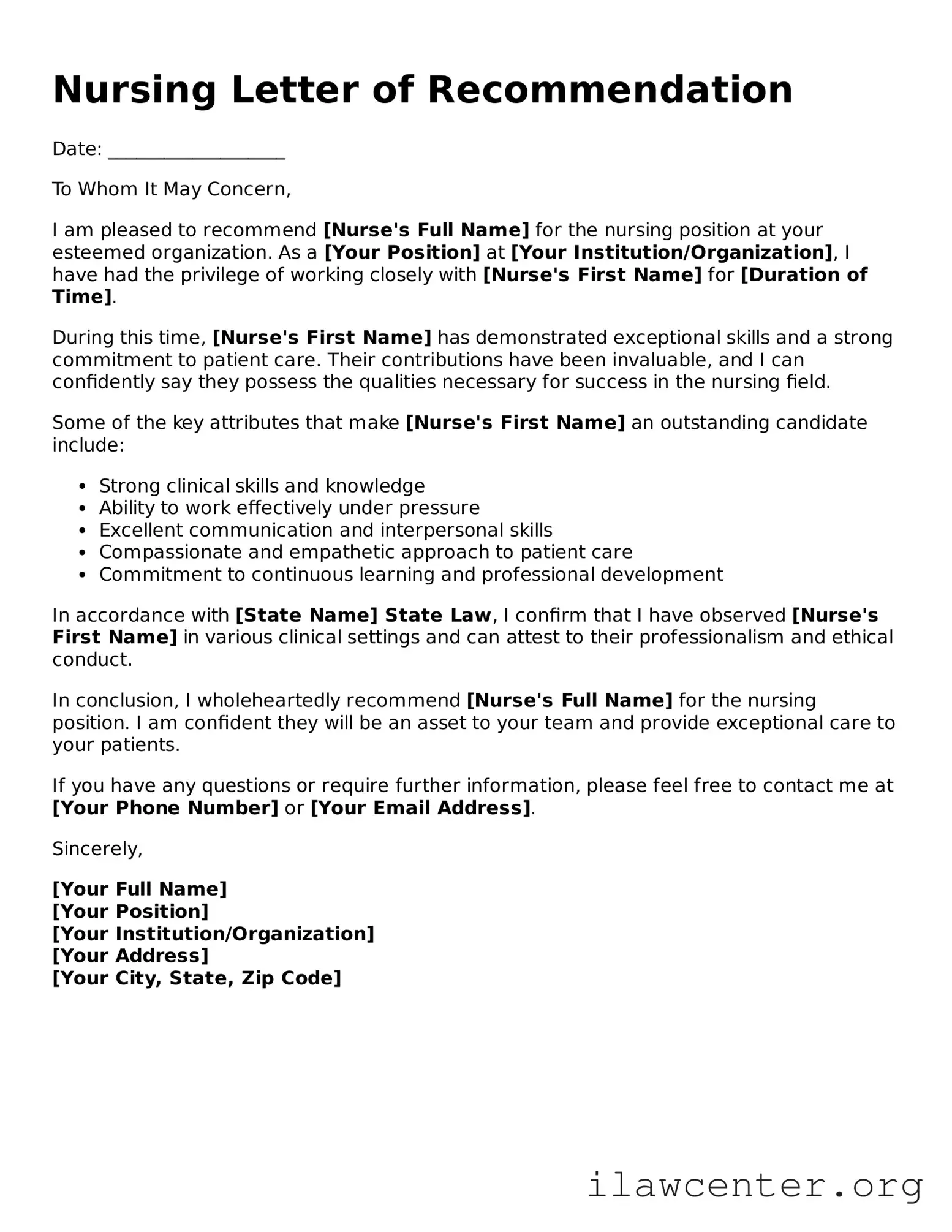
Nursing Letter of Recommendation

Date: ___________________

To Whom It May Concern,

I am pleased to recommend [Nurse's Full Name] for the nursing position at your esteemed organization. As a [Your Position] at [Your Institution/Organization], I have had the privilege of working closely with [Nurse's First Name] for [Duration of Time].

During this time, [Nurse's First Name] has demonstrated exceptional skills and a strong commitment to patient care. Their contributions have been invaluable, and I can confidently say they possess the qualities necessary for success in the nursing field.

Some of the key attributes that make [Nurse's First Name] an outstanding candidate include:

  • Strong clinical skills and knowledge
  • Ability to work effectively under pressure
  • Excellent communication and interpersonal skills
  • Compassionate and empathetic approach to patient care
  • Commitment to continuous learning and professional development

In accordance with [State Name] State Law, I confirm that I have observed [Nurse's First Name] in various clinical settings and can attest to their professionalism and ethical conduct.

In conclusion, I wholeheartedly recommend [Nurse's Full Name] for the nursing position. I am confident they will be an asset to your team and provide exceptional care to your patients.

If you have any questions or require further information, please feel free to contact me at [Your Phone Number] or [Your Email Address].

Sincerely,

[Your Full Name]
[Your Position]
[Your Institution/Organization]
[Your Address]
[Your City, State, Zip Code]

PDF Form Characteristics

Fact Name Description
Purpose The Nursing Letter of Recommendation form is used to provide a formal endorsement for nursing candidates applying for licensure or employment.
Components The form typically includes sections for the recommender's information, the candidate's information, and a narrative assessment of the candidate's skills and character.
Eligibility Recommenders must be licensed professionals who have supervised or worked closely with the candidate in a nursing capacity.
Submission Process The completed form is usually submitted directly to the licensing board or employer by the recommender to ensure authenticity.
State-Specific Requirements Each state may have specific requirements regarding the content and format of the letter, often outlined by the state’s nursing board.
Governing Laws In California, for example, the Nursing Letter of Recommendation is governed by the California Business and Professions Code Section 2736.
Importance of Accuracy Providing accurate and honest information in the recommendation is crucial, as it impacts the candidate's professional reputation and licensure.
Confidentiality Recommenders should maintain confidentiality regarding the candidate's performance and personal information throughout the process.

Instructions on Utilizing Nursing Letter of Recommendation

After receiving the Nursing Letter of Recommendation form, the next steps involve accurately completing it to ensure a strong endorsement. This form requires specific information about the candidate and the recommender to support the application process.

  1. Begin by entering the candidate's full name in the designated field.
  2. Provide the candidate's contact information, including their email address and phone number.
  3. Fill in the candidate's nursing program or institution name.
  4. Indicate the relationship you have with the candidate. This could be as an instructor, supervisor, or colleague.
  5. Describe the candidate's skills and qualifications in the text box provided. Be specific about their strengths and experiences.
  6. Rate the candidate's performance on a scale provided, if applicable.
  7. Include your own name, title, and contact information in the specified sections.
  8. Sign and date the form to validate your recommendation.
  9. Review all entered information for accuracy and completeness before submission.

Important Facts about Nursing Letter of Recommendation

What is a Nursing Letter of Recommendation form?

The Nursing Letter of Recommendation form is a document used to provide a formal endorsement of a nursing candidate’s skills, character, and qualifications. It is often required when applying to nursing programs or job positions within the healthcare field. This letter helps admissions committees or employers assess the candidate’s suitability for the role or program.

Who should write a Nursing Letter of Recommendation?

A qualified individual who knows the candidate well should write the letter. This could be a nursing instructor, a clinical supervisor, or a healthcare professional who has observed the candidate’s work ethic and skills. It’s important that the recommender can provide specific examples of the candidate's abilities and experiences.

What should be included in the Nursing Letter of Recommendation?

The letter should include the recommender’s relationship with the candidate, specific examples of the candidate’s skills and accomplishments, and an overall assessment of their potential as a nurse. Personal anecdotes can make the letter more impactful, providing insight into the candidate's character and dedication to the profession.

How long should the Nursing Letter of Recommendation be?

Typically, the letter should be one page long. This length allows the recommender to provide enough detail to support their claims while remaining concise. A well-structured letter that gets to the point will hold the reader's attention and convey the necessary information effectively.

Is there a specific format for the Nursing Letter of Recommendation?

While there is no strict format, the letter should generally follow a professional structure. It should begin with the recommender's contact information, followed by the date, and then the recipient's information. The body of the letter should clearly outline the recommender's assessment of the candidate, concluding with a strong endorsement and the recommender’s signature.

How can I request a Nursing Letter of Recommendation?

When requesting a letter, approach the potential recommender politely and provide them with ample time to write it. Offer background information about the program or position you're applying for, along with details about your experiences and achievements. This will help them write a more personalized and compelling letter.

What if the recommender doesn’t know me well?

If you feel that a potential recommender may not know you well enough, it’s best to seek someone who can provide a stronger endorsement. A letter from someone who can speak to your skills and character in detail will carry more weight than one from someone who has limited knowledge of your capabilities.

Can I use the same Nursing Letter of Recommendation for multiple applications?

While you can use the same letter for multiple applications, it’s advisable to tailor it to fit each specific program or job. Personalizing the letter to reflect the requirements of each application can enhance its effectiveness and demonstrate your genuine interest in the opportunity.

How important is the Nursing Letter of Recommendation in the application process?

The Nursing Letter of Recommendation can be a crucial component of your application. It provides insight into your qualifications and character that grades and test scores may not fully capture. A strong letter can set you apart from other candidates, making it an essential part of your nursing journey.
Common mistakes

When filling out a Nursing Letter of Recommendation form, many applicants overlook important details. One common mistake is providing insufficient information about their qualifications. A recommendation should highlight specific skills and experiences that set the applicant apart. Without these details, the letter may fail to convey the candidate's true potential.

Another frequent error is neglecting to personalize the letter. Generic recommendations do not resonate with admission committees. Instead, each letter should reflect the unique relationship between the recommender and the applicant. A personal touch, such as anecdotes or specific examples, can make a significant difference in how the recommendation is perceived.

Many also forget to proofread their letters. Typos and grammatical errors can undermine the credibility of the recommendation. A well-written letter demonstrates professionalism and attention to detail. Taking the time to review the content ensures that the letter presents the applicant in the best possible light.

Lastly, some individuals fail to follow the submission guidelines. Each nursing program may have specific requirements regarding format, length, or content. Ignoring these guidelines can lead to disqualification or a negative impression. It is crucial to read the instructions carefully and adhere to them to ensure the recommendation is considered.

Documents used along the form

When applying to nursing programs or seeking employment in the healthcare field, a Nursing Letter of Recommendation is often accompanied by several other important documents. Each of these forms plays a crucial role in presenting a comprehensive view of the applicant's qualifications, experiences, and character. Below is a list of commonly used documents alongside the Nursing Letter of Recommendation form.

  • Resume or Curriculum Vitae (CV): This document outlines the applicant's education, work experience, skills, and relevant certifications. It provides a snapshot of the applicant's professional background.
  • Transcripts: Official academic transcripts are required to verify the applicant's educational achievements. They detail the courses taken, grades earned, and degrees conferred.
  • Personal Statement: This is a written narrative where the applicant discusses their motivations for pursuing a nursing career, personal experiences, and future goals. It offers insight into the applicant's character and aspirations.
  • Application Form: Most nursing programs require a standardized application form that collects essential information about the applicant, including contact details, educational history, and program preferences.
  • Clinical Experience Documentation: This form details the applicant's hands-on clinical experiences, including the types of settings they have worked in and the skills they have developed. It showcases practical knowledge in nursing.
  • Recommendation Forms from Other Professionals: In addition to the Nursing Letter of Recommendation, other recommendation forms from professors or employers can provide a broader perspective on the applicant's abilities and work ethic.
  • Licensure Verification: For applicants who are already licensed nurses, a verification document confirming their licensure status may be required. This ensures compliance with state regulations.
  • Background Check Authorization: Many nursing programs and employers require a background check. This document authorizes the institution to conduct a criminal history check on the applicant.

Collectively, these documents create a robust application package that highlights the applicant's qualifications and readiness for a nursing career. Each piece contributes to a fuller understanding of the individual, ensuring that admissions committees or hiring managers can make informed decisions.

Similar forms

The Nursing Letter of Recommendation form shares similarities with several other documents used in professional and academic settings. Each of these documents serves to provide insight into an individual's qualifications, skills, and character. Below is a list of nine documents that are comparable to the Nursing Letter of Recommendation form:

  • Job Reference Letter: Similar in purpose, this letter is written by a previous employer to attest to a candidate's work ethic and abilities.
  • Academic Reference Letter: Often required for college applications, this letter highlights a student's academic achievements and character traits from a teacher or professor.
  • Character Reference Letter: This document focuses on personal qualities and character, usually written by someone who knows the individual outside of a professional context.
  • Volunteer Reference Letter: Written by a supervisor from a volunteer position, it emphasizes skills and contributions made in a non-paid role.
  • Professional Endorsement: A brief statement or letter from a recognized professional in the field, endorsing an individual's skills and qualifications.
  • Graduate School Recommendation Letter: Similar to the Nursing Letter, this document supports a student's application for advanced studies, focusing on their academic and professional potential.
  • Internship Reference Letter: This letter is provided by an internship supervisor, highlighting the intern's performance and growth during their time in the position.
  • Scholarship Recommendation Letter: Written to support an application for financial aid, it outlines the applicant's qualifications and potential for success in their chosen field.
  • Professional License Recommendation: Required for certain professions, this letter supports an individual's application for licensure, attesting to their qualifications and character.

Dos and Don'ts

When filling out a Nursing Letter of Recommendation form, it is important to follow certain guidelines to ensure the process is smooth and effective. Here are ten things to keep in mind:

  • Do provide accurate and honest information about the candidate.
  • Do highlight specific skills and experiences relevant to nursing.
  • Do use clear and concise language throughout the form.
  • Do follow any provided instructions regarding format and content.
  • Do proofread the letter for spelling and grammatical errors.
  • Don't exaggerate or provide false information about the candidate.
  • Don't use overly technical language that may confuse the reader.
  • Don't include irrelevant personal anecdotes or unrelated experiences.
  • Don't forget to include your contact information for follow-up questions.
  • Don't submit the form without reviewing it thoroughly.

Misconceptions

Here are seven common misconceptions about the Nursing Letter of Recommendation form:

  1. Only professors can write letters of recommendation. Many professionals, including employers and supervisors, can provide valuable insights into a candidate's skills and character.
  2. The form must be filled out by someone in the nursing field. While it helps to have a recommender with nursing experience, letters from other healthcare professionals or related fields are also acceptable.
  3. A letter of recommendation is optional. Most nursing programs require at least one letter. Not submitting one can hurt your application.
  4. Letters should be generic and similar for all applicants. Each letter should be personalized to reflect the applicant's unique qualities and experiences.
  5. Recommenders must use a specific format. While some programs may have guidelines, many allow flexibility in how the letter is structured.
  6. Letters can be submitted at any time. Most programs have strict deadlines. It’s essential to ensure that letters are submitted on time.
  7. Once submitted, letters cannot be changed. If a recommender needs to update or revise their letter, they can submit a new version before the deadline.

Key takeaways

When filling out and using the Nursing Letter of Recommendation form, there are several important points to consider. Here are key takeaways to keep in mind:

  • Understand the Purpose: The letter serves to highlight your skills, experiences, and character, providing a comprehensive view of your qualifications.
  • Choose the Right Recommender: Select someone who knows you well, such as a professor or supervisor, and can speak positively about your abilities.
  • Provide Context: Share your goals and the specific nursing program or job you are applying for, so the recommender can tailor the letter accordingly.
  • Be Clear and Concise: Ensure that the form is filled out neatly and legibly. Clarity helps convey your message effectively.
  • Highlight Key Qualities: Focus on your strengths, such as compassion, teamwork, and clinical skills, which are essential in nursing.
  • Follow Guidelines: Adhere to any specific instructions provided by the nursing program or employer regarding the format and content of the letter.
  • Request in Advance: Give your recommender ample time to write the letter. A rushed letter may not reflect your true potential.
  • Express Gratitude: Always thank your recommender for their time and support, regardless of the outcome of your application.

By keeping these takeaways in mind, you can enhance the effectiveness of your Nursing Letter of Recommendation and improve your chances of success in your nursing career.