Attorney-Verified  ATV Bill of Sale Document for Ohio

Attorney-Verified ATV Bill of Sale Document for Ohio

The Ohio ATV Bill of Sale form is a crucial document that facilitates the transfer of ownership for all-terrain vehicles in the state. This form not only provides a legal record of the transaction but also protects both the buyer and seller by detailing important information about the vehicle and the terms of sale. To ensure a smooth transfer process, consider filling out the form by clicking the button below.

Article Guide

When purchasing or selling an all-terrain vehicle (ATV) in Ohio, one crucial document comes into play: the ATV Bill of Sale form. This form serves as a legal record of the transaction between the buyer and seller, ensuring that both parties have a clear understanding of the details involved. Key components typically included in this document are the names and addresses of both the buyer and seller, the purchase price, and a description of the ATV, including its make, model, and Vehicle Identification Number (VIN). Additionally, the form may outline any warranties or conditions tied to the sale, providing an extra layer of protection for both parties. By documenting the sale, this form not only helps to prevent future disputes but also serves as proof of ownership for the buyer, which is essential for registration purposes. Understanding the importance of this form can make the buying or selling process smoother and more secure for all involved.

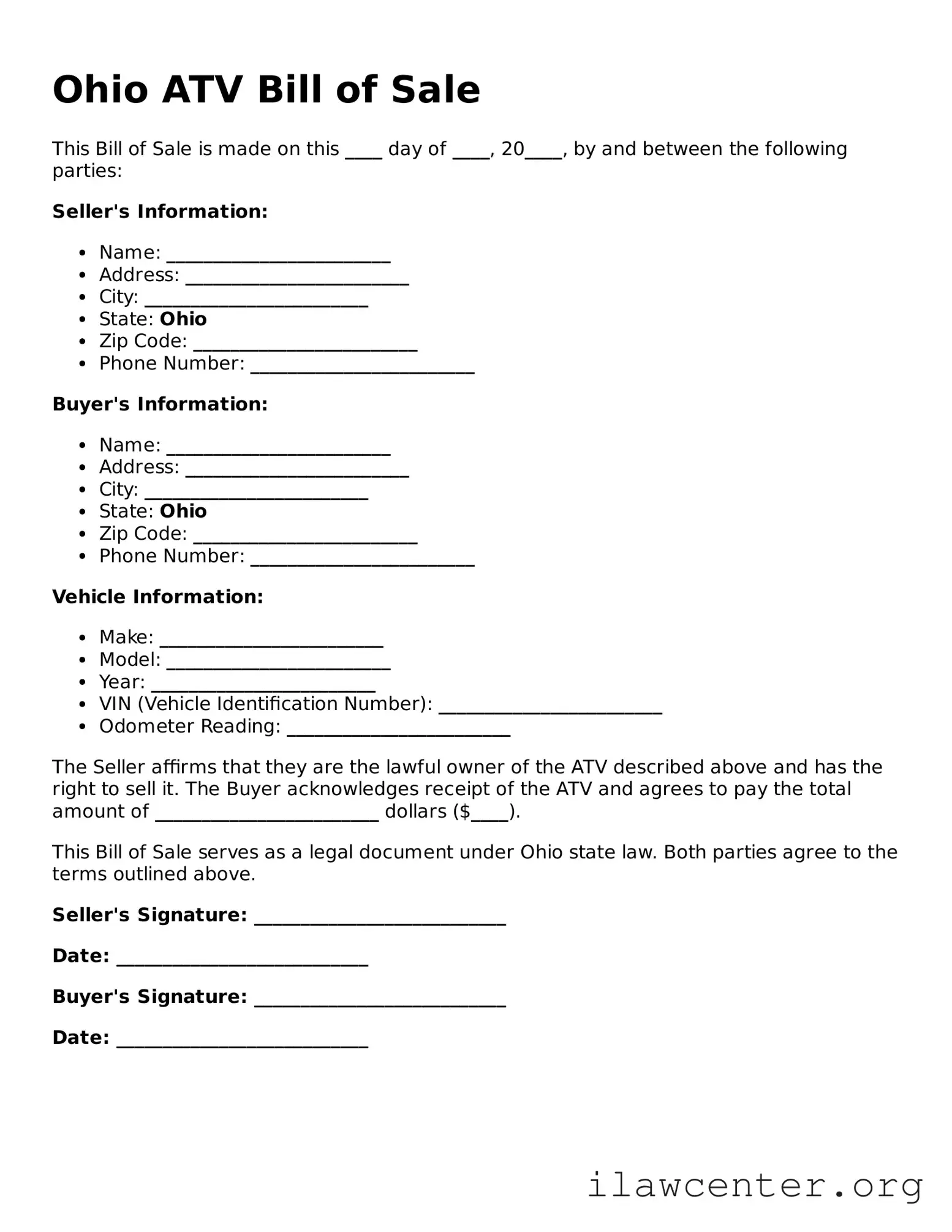
Ohio ATV Bill of Sale Preview

Ohio ATV Bill of Sale

This Bill of Sale is made on this ____ day of ____, 20____, by and between the following parties:

Seller's Information:

  • Name: ________________________
  • Address: ________________________
  • City: ________________________
  • State: Ohio
  • Zip Code: ________________________
  • Phone Number: ________________________

Buyer's Information:

  • Name: ________________________
  • Address: ________________________
  • City: ________________________
  • State: Ohio
  • Zip Code: ________________________
  • Phone Number: ________________________

Vehicle Information:

  • Make: ________________________
  • Model: ________________________
  • Year: ________________________
  • VIN (Vehicle Identification Number): ________________________
  • Odometer Reading: ________________________

The Seller affirms that they are the lawful owner of the ATV described above and has the right to sell it. The Buyer acknowledges receipt of the ATV and agrees to pay the total amount of ________________________ dollars ($____).

This Bill of Sale serves as a legal document under Ohio state law. Both parties agree to the terms outlined above.

Seller's Signature: ___________________________

Date: ___________________________

Buyer's Signature: ___________________________

Date: ___________________________

PDF Form Characteristics

Fact Name Description
Purpose The Ohio ATV Bill of Sale form is used to document the sale or transfer of an all-terrain vehicle (ATV) in Ohio.
Governing Law This form is governed by Ohio Revised Code § 4505.04, which outlines the requirements for vehicle transfers.
Seller Information The form requires the seller's name, address, and contact information to ensure proper identification.
Buyer Information Buyers must provide their name and address, which helps in establishing ownership after the sale.
Vehicle Details Important details about the ATV, such as make, model, year, and VIN, must be included to avoid confusion.
Date of Sale The date when the sale occurs is essential for record-keeping and to establish the timeline of ownership transfer.
Signatures Both the seller and buyer must sign the form, confirming that the transaction is agreed upon and legitimate.

Instructions on Utilizing Ohio ATV Bill of Sale

After obtaining the Ohio ATV Bill of Sale form, you will need to provide specific information to ensure the document is complete. This form is important for transferring ownership of an all-terrain vehicle (ATV) and should be filled out carefully.

  1. Start by entering the date of the sale at the top of the form.
  2. Provide the seller's name and address. Make sure to include the full address, including city and state.
  3. Next, enter the buyer's name and address. Again, include the full address for accuracy.
  4. Fill in the details of the ATV. This includes the make, model, year, and Vehicle Identification Number (VIN).
  5. Indicate the purchase price of the ATV. Be clear about the amount, and ensure it matches any agreed-upon terms.
  6. Both the seller and buyer should sign the form. This confirms that both parties agree to the terms outlined.
  7. Finally, provide any additional information if required, such as any warranties or conditions of the sale.

Once completed, both parties should keep a copy of the signed Bill of Sale for their records. This document serves as proof of the transaction and can be useful for registration or any future disputes.

Important Facts about Ohio ATV Bill of Sale

What is an Ohio ATV Bill of Sale form?

An Ohio ATV Bill of Sale form is a legal document used to record the sale and transfer of ownership of an all-terrain vehicle (ATV) in Ohio. This form serves as proof of the transaction between the buyer and seller. It includes important details such as the names and addresses of both parties, a description of the ATV, the sale price, and the date of the sale. Having this document can help prevent disputes and provides a clear record of ownership for the buyer.

Do I need a Bill of Sale to register my ATV in Ohio?

Yes, you will need a Bill of Sale to register your ATV in Ohio. The Ohio Department of Natural Resources requires proof of ownership for registration purposes. The Bill of Sale acts as this proof, especially if the ATV was purchased from a private seller. Without it, you may encounter difficulties when trying to register your vehicle.

What information should be included in the Bill of Sale?

The Bill of Sale should contain several key pieces of information. This includes the full names and addresses of both the buyer and seller, the make, model, year, and Vehicle Identification Number (VIN) of the ATV, the sale price, and the date of the transaction. Additionally, it’s a good idea to include any warranties or conditions of the sale, as well as signatures from both parties to validate the document.

Is there a specific format for the Ohio ATV Bill of Sale?

While there is no officially mandated format for the Ohio ATV Bill of Sale, it is important that the document is clear and includes all necessary information. Many people choose to use templates available online, which can help ensure that all required details are included. Just make sure that the form is signed by both parties to make it legally binding.

Can I create my own Bill of Sale, or do I need to use a specific form?

You can create your own Bill of Sale as long as it includes all the required information. There is no need to use a specific form, but ensure that it meets the legal requirements for a sale in Ohio. If you prefer, using a template can simplify the process and ensure that you don’t miss any important details.

What should I do with the Bill of Sale after the transaction?

After the transaction, both the buyer and seller should keep a copy of the Bill of Sale for their records. The buyer will need it for registration purposes, while the seller should retain it as proof that the vehicle was sold. It’s a good practice to store these documents in a safe place, as they may be needed for future reference or in case of any disputes.
Common mistakes

When filling out the Ohio ATV Bill of Sale form, one common mistake is failing to include all necessary information. Buyers and sellers must provide details such as the names and addresses of both parties, a description of the ATV, and the sale price. Omitting any of this information can lead to confusion or disputes later on. It’s crucial to ensure that every required field is filled out accurately to avoid complications.

Another frequent error involves inaccuracies in the ATV description. The form requires specific details, including the make, model, year, and Vehicle Identification Number (VIN). If any of this information is incorrect or incomplete, it could create issues with registration or ownership verification. Buyers should double-check the details against the ATV’s title or registration documents to ensure everything matches up.

People often overlook the importance of signatures. Both the seller and the buyer must sign the Bill of Sale for it to be legally binding. If one party forgets to sign, the document may not hold up in a dispute. Additionally, it’s advisable for both parties to keep a copy of the signed document for their records, as this can serve as proof of the transaction.

Lastly, many individuals neglect to check for any applicable state or local requirements. Ohio may have specific regulations regarding the sale of ATVs that need to be followed. For instance, certain taxes or fees may apply, and these should be addressed in the Bill of Sale. Failing to comply with local laws can result in penalties or issues with registration down the line.

Documents used along the form

When purchasing or selling an ATV in Ohio, several documents can accompany the Ohio ATV Bill of Sale form to ensure a smooth transaction. Each of these documents serves a specific purpose and can help protect both the buyer and the seller. Below are some of the commonly used forms and documents.

  • Title Transfer Form: This document is essential for transferring ownership of the ATV from the seller to the buyer. It includes details about the vehicle, such as its make, model, and Vehicle Identification Number (VIN). Proper completion ensures that the new owner can register the ATV in their name.
  • Odometer Disclosure Statement: This form is often required when selling a vehicle, including ATVs. It confirms the mileage on the ATV at the time of sale. This helps prevent fraud and provides transparency regarding the vehicle's usage history.
  • Affidavit of Ownership: If the seller cannot provide the original title, this document can serve as a sworn statement asserting ownership of the ATV. It helps establish the seller's right to sell the vehicle and can be crucial in resolving any disputes that may arise.
  • Release of Liability: This document protects the seller by notifying the state that they are no longer responsible for the ATV once it has been sold. It helps to ensure that any future liabilities or issues related to the vehicle do not fall back on the seller.

Having these documents prepared and properly completed can greatly facilitate the sale or purchase of an ATV in Ohio. They provide important legal protections and help clarify the terms of the transaction for both parties involved.

Similar forms

  • Vehicle Bill of Sale: Similar to the ATV Bill of Sale, this document transfers ownership of a vehicle from one party to another. It includes details such as the vehicle's make, model, year, and VIN.
  • Boat Bill of Sale: This form serves a similar purpose for boats. It documents the sale and transfer of ownership, including the boat's specifications and registration details.
  • Motorcycle Bill of Sale: Just like the ATV Bill of Sale, this document is used for motorcycles. It outlines the sale terms and includes necessary vehicle information to ensure a smooth transfer.
  • Trailer Bill of Sale: This form is used for the sale of trailers. It includes important details about the trailer, ensuring both parties are clear on the transaction.
  • Snowmobile Bill of Sale: Similar to the ATV Bill of Sale, this document facilitates the sale of snowmobiles, detailing ownership transfer and important vehicle specifications.
  • Equipment Bill of Sale: This form is used for various types of equipment, including agricultural or construction machinery. It outlines the sale and includes specifications relevant to the equipment.
  • Personal Property Bill of Sale: This document is broader in scope, covering the sale of personal items beyond vehicles. It ensures a legal transfer of ownership for various goods.
  • Mobile Home Bill of Sale: This form is specifically designed for the sale of mobile homes. It includes details about the home and ensures proper transfer of ownership.
  • Farm Vehicle Bill of Sale: Similar to the ATV Bill of Sale, this document focuses on farm vehicles, detailing the terms of sale and vehicle specifics.
  • Lease Agreement: While different in purpose, a lease agreement can be similar in that it outlines the terms of use and responsibilities regarding a vehicle or equipment, though it does not transfer ownership.

Dos and Don'ts

When filling out the Ohio ATV Bill of Sale form, it's important to ensure accuracy and clarity. Here are ten essential do's and don'ts to guide you through the process:

  • Do double-check all information for accuracy before submitting.
  • Do include the Vehicle Identification Number (VIN) for identification.
  • Do sign and date the form to validate the sale.
  • Do provide the buyer's full name and address for proper record-keeping.
  • Do keep a copy of the completed form for your records.
  • Don't leave any blank spaces; fill in all required fields.
  • Don't use abbreviations that may confuse the reader.
  • Don't forget to specify the sale price clearly.
  • Don't alter the form after it has been signed by both parties.
  • Don't overlook any local regulations regarding ATV sales.

By following these guidelines, you can help ensure a smooth transaction and protect both parties involved in the sale.

Misconceptions

Understanding the Ohio ATV Bill of Sale form is essential for anyone involved in the buying or selling of all-terrain vehicles. However, several misconceptions can lead to confusion. Here are seven common misunderstandings:

  1. The Ohio ATV Bill of Sale is not necessary.

    Many people believe that a bill of sale is optional when transferring ownership of an ATV. In reality, having a bill of sale is crucial for establishing legal ownership and protecting both the buyer and seller.

  2. Any generic bill of sale can be used.

    Some individuals think that any generic bill of sale will suffice for an ATV transaction. However, it is important to use the specific Ohio ATV Bill of Sale form to ensure compliance with state regulations.

  3. The form does not need to be notarized.

    While notarization is not always required, many buyers and sellers prefer to have the bill of sale notarized to add an extra layer of authenticity and security to the transaction.

  4. The seller does not need to provide any information.

    Some sellers assume they can simply hand over the ATV without providing any details. In fact, the seller must complete the bill of sale with accurate information about the vehicle and the transaction.

  5. Buyers do not need a copy of the bill of sale.

    It is a common misconception that only the seller needs to keep a copy of the bill of sale. Buyers should also retain a copy for their records, as it serves as proof of ownership.

  6. The form is only for private sales.

    Many people think that the Ohio ATV Bill of Sale is only necessary for private sales. However, it is also important for transactions involving dealers and other businesses.

  7. Once the form is signed, it cannot be changed.

    Some believe that once the bill of sale is signed, it is set in stone. In reality, if both parties agree, they can amend the document to correct any errors or add additional information.

By addressing these misconceptions, individuals can better navigate the process of buying or selling an ATV in Ohio, ensuring a smoother and more legally sound transaction.

Key takeaways

When filling out and using the Ohio ATV Bill of Sale form, keep the following key takeaways in mind:

  1. Accurate Information: Ensure all details about the ATV, including make, model, year, and VIN, are correct. This prevents future disputes.
  2. Seller and Buyer Details: Include full names and addresses of both the seller and buyer. This establishes clear ownership transfer.
  3. Sale Price: Clearly state the sale price of the ATV. This is important for tax purposes and for both parties' records.
  4. Signatures Required: Both the seller and buyer must sign the document. This signifies agreement and completion of the sale.
  5. Keep a Copy: After filling out the form, both parties should retain a copy for their records. This serves as proof of the transaction.